Organismal Biology · Unit 2: Control and constancy
Tissues, Organs and Homeostasis
How is an animal body built from a few kinds of tissue, and how does it hold its inside steady while the outside changes? This lesson finds all four animal tissue types in one stomach wall, draws the homeostatic loop from regulated variable to effector, separates negative from positive feedback, and compares animals that regulate a variable with animals that let it follow the environment. Afterwards you can label a feedback loop, say whether an animal is a regulator or a conformer for a stated variable and range, and calculate what regulation costs from a measured ratio.
Watch first Name the Variable, Then the Loop · 2:45
In a room heated to about 200 degrees F, close to the boiling point of water, a thermometer under Charles Blagden’s tongue read 98 degrees, about one degree above his usual. A year later, in a room above 260 degrees F, eggs roasted hard and a steak cooked. An egg in hot air heats until it matches the air. A living person did not. This lesson asks what kept him from heating up like the egg, starting with what a body is made of.
It builds on what an organism has to do, size and scaling and animal body plans.
Four tissues build one stomach wall
A tissue is a group of similar cells, with the material around them, that together do one kind of job. Most animals are built from four types.
- Epithelial tissue is a sheet of closely joined cells that covers the body’s surfaces and lines its cavities and tubes. It decides what crosses from one side to the other. How epithelial cells hold together and move material is in epithelia.
- Connective tissue is living cells spread through a nonliving extracellular matrix, a mesh of protein fibres and other material the cells secrete. Bone, tendon, fat and blood are all connective tissues. The matrix itself is covered in adhesion and the extracellular matrix.
- Muscle tissue is made of cells that contract and so produce movement or force.
- Nervous tissue is neurons, cells that receive and send electrical signals, plus glial cells, which support them.
An organ is a structure built from several tissues that work together. A teaching histology section of a stomach wall (the source does not name the species) shows all four. Epithelium lines the inside, where food sits. Beneath it, connective tissue carries blood vessels and holds the layers together. Outside that, layers of smooth muscle churn and squeeze the contents. Networks of nerve cells run between the muscle layers and coordinate the churning.
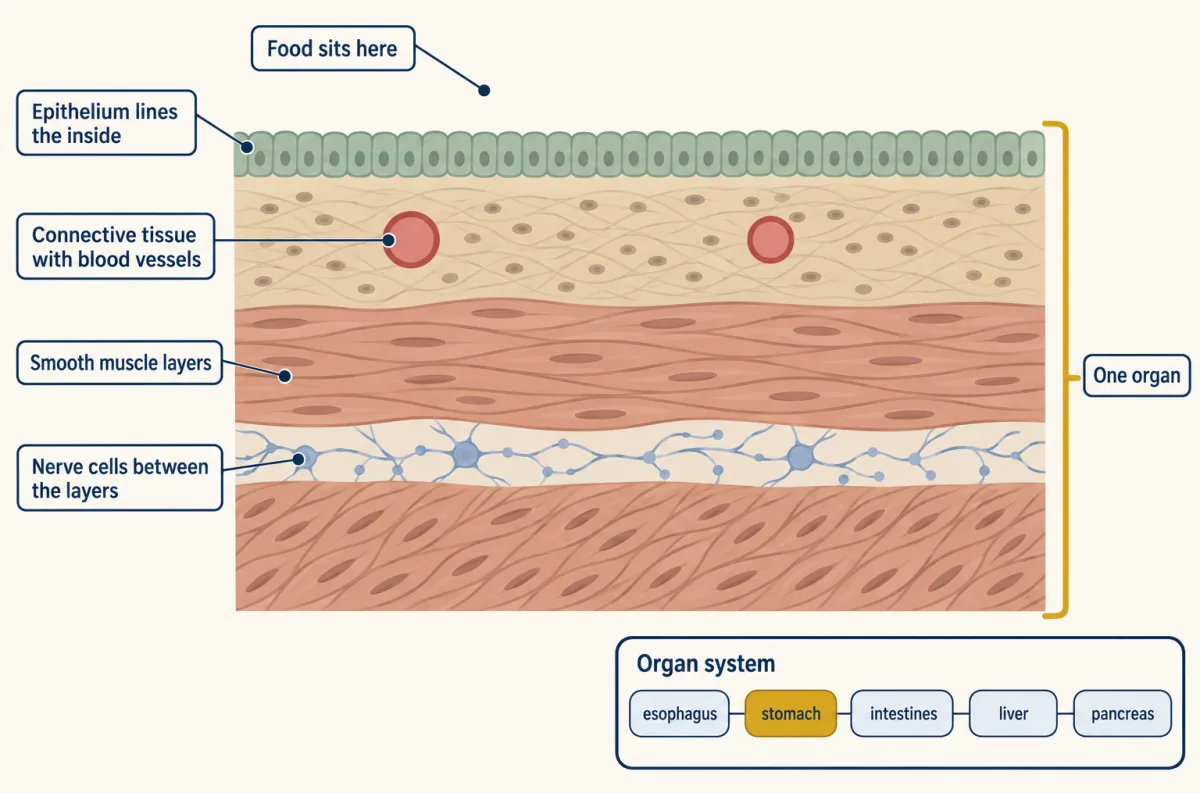
An organ system is a set of organs that share a larger job. The stomach is one organ of the digestive system, along with the esophagus, intestines, liver and pancreas.
Not every animal is built this way. Sponges have specialized cells but no true tissues of this kind, as you saw in animal body plans. Plants solve the same problem with a different kit. A flowering plant’s body is built from dermal, vascular and ground tissues, met in plant body and growth.
The loop: variable, set point, sensor, integrator, effector
Homeostasis is the holding of a body variable within a range compatible with staying alive. The word comes from Walter Cannon, building on Claude Bernard’s idea that the cells of an animal live in an internal environment of blood and tissue fluid that changes much less than the world outside.
Every homeostatic loop has the same parts. Name them in this order.
- The regulated variable: the quantity being held, such as core body temperature or the salt concentration of blood.
- The set point: the reference value around which the normal range fluctuates.
- The sensor: a structure that measures the variable.
- The integrator, or control centre: compares the sensed value with the set point and sends out a command.
- The effector: a muscle, gland or other organ that changes the variable.
A house thermostat is the analogy: room temperature is the variable, the dial the set point, the thermometer the sensor, the circuit the integrator and the furnace the effector.
In an adult human the variable is core temperature. Temperature-sensitive nerve cells in the skin and in the brain are the sensors. A temperature-regulating region of the brain, in the hypothalamus, is the integrator; how it is wired is covered in the hypothalamus and the autonomic system. When temperature rises, the effectors are sweat glands, and evaporation of sweat from the skin removes heat. When it falls, the effectors include skeletal muscles, which shiver and release heat as they use ATP.
Blagden’s report shows the loop at work in people. George Fordyce procured a suite of rooms for heating experiments. On 23 January 1774 Blagden went into a stove-heated chamber with Joseph Banks, Daniel Solander and Captain Phipps. The air stood near 200 degrees F for the party and above 211 when Banks went in. If a body behaved like an egg, its temperature should have climbed toward the air’s. Instead Blagden’s tongue read 98 degrees, about a degree above normal for him, while his pulse rose. In April 1775, with the air a little above 260 degrees, eggs roasted hard in about twenty minutes and a steak cooked in thirty-three, while the men’s body thermometer came back to nearly the same point each time.
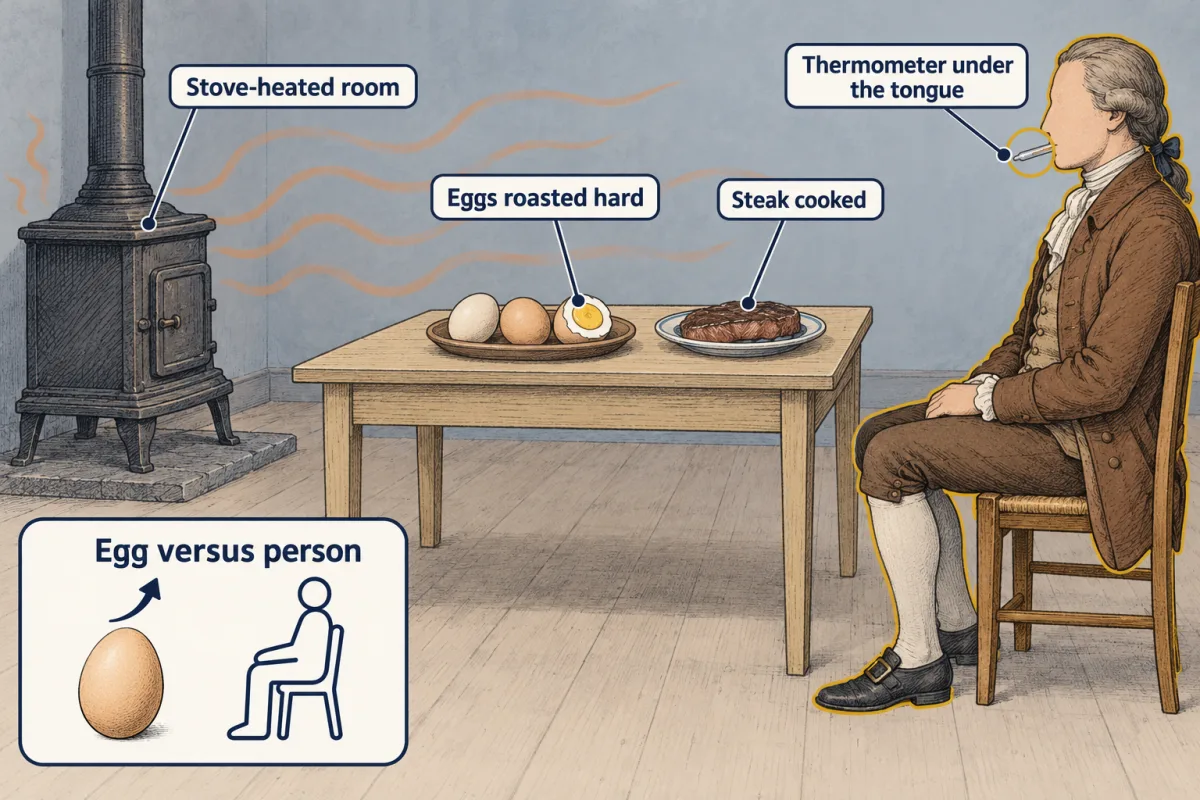
That ruled in an active process holding human temperature against dry heat for minutes, but not its mechanism. Blagden credited evaporation of sweat with part of the cooling but suspected a further power of the living body did most of it. And it says nothing about moist air, which slows evaporation, or about long exposures.
Plants run loops too. As a leaf’s water status falls, its stomata, the pores in its surface, close, which slows water loss.
Negative and positive feedback, and set points that move
In negative feedback, the response opposes the deviation. “Negative” does not mean “makes the variable smaller”. If temperature rises, sweating brings it down; if it falls, shivering brings it up. Both are negative feedback, because each response pushes the variable back toward the set point.
In positive feedback, the response amplifies the change, and the loop runs until something outside it ends it. The textbook model is human childbirth: stretch of the cervix promotes release of the hormone oxytocin, which strengthens contractions of the uterus, which stretches the cervix further, until the baby is born. Treat that as a model of human labour. Mice that lack oxytocin entirely gave birth without obvious problems, though they could not let down milk, so the loop as drawn does not carry over to every mammal. Feedback as circuitry, with gains and delays, is in signaling circuits.
Homeostasis defends a range, not a single number, and the set point itself can move. In a fever the set point for core temperature rises, so a person at normal temperature feels cold and shivers. Body temperature also follows a daily rhythm. So “normal is exactly 37 degrees C” is wrong. The value depends on where and when you measure, and in a 2020 analysis of US adults, Protsiv and colleagues found recent mean oral temperatures below 37 degrees C, falling about 0.03 degrees C per birth decade, an association whose cause is not settled.
Blagden’s heated room, as he reported it: air near 200 degrees F, a thermometer under his tongue read 98 degrees, about a degree above his usual. These are his reported figures, not output of this sketch.
In this sketch: relative units; the controller (acts only past a threshold, then removes a fixed fraction of the deviation), the push of the air, the egg’s warming rate and the labour growth rate are all invented, not from the lesson; one variable, no delays or feedforward.
Rule to keep: negative feedback opposes a deviation in either direction, so sweating and shivering are both negative feedback, while positive feedback amplifies a change until something outside the loop ends it.
Some responses come before the variable changes. In feedforward control, a signal that predicts a disturbance triggers the response early. You will meet one in the design problem at the end.
Regulators and conformers, and the price of constancy
A regulator holds an internal variable fairly steady across a range of outside conditions. A conformer lets that variable follow the environment, within limits it can survive. Both labels describe one variable over one range, never a whole animal.
Temperature. An endotherm warms its body mainly with heat from its own metabolism; mammals and birds are endotherms, with partial endothermy in some fish and insects. An ectotherm gets its body heat mainly from its surroundings. An adult human regulates core temperature by sweating and shivering. A typical teleost fish in a lake is an ectotherm whose body temperature largely follows the water. That is a different solution, not a lesser one.
Blood salt. Osmolality is the concentration of dissolved particles in a fluid. An osmoconformer lets its blood osmolality follow the water’s; an osmoregulator holds it different. The blue mussel, Mytilus edulis, conforms: over the salinities it tolerates, its blood comes close to the water around it. The shore crab, Carcinus maenas, is close to seawater in full-strength seawater, but in water diluted to roughly half strength it holds its blood well above the water. So it conforms at one end of its range and regulates at the other. How either animal does it is in osmoregulation.
Regulation is not free. In a 2022 study, John and colleagues measured energy expenditure by indirect calorimetry in single-housed male C57BL/6J mice and found it about 30% higher at 22 degrees C than at 30 degrees C. A mouse is small and loses heat fast through its large surface for its size, so at 22 degrees C it spends more to stay warm.
Worked problem. The 30% is measured; the baseline here is invented for arithmetic. Assume a mouse of this kind spends 24 kJ per day at 30 degrees C, and treat the ratio as exactly 1.30. Assume steady state and the same mouse in both conditions.
- Expenditure at 22 degrees C. 24 kJ per day x 1.30 = 31.2 kJ per day.
- Extra daily cost. 31.2 - 24 = 7.2 kJ per day. Over 30 days: 7.2 x 30 = 216 kJ.
- The reverse move. Moving the mouse from 22 to 30 degrees C cuts expenditure by 7.2 / 31.2 = 0.231, or 23.1%, not 30%. The base is now the larger value.
- Check. 31.2 x (1 - 0.231) = 31.2 x 0.769 = 24.0 kJ per day.
percentage change = 100 x (new - old) / old
Keep the scope: one strain, one sex, two temperatures. The paper’s chronic experiment lost its 30 degrees C data for normal-weight mice to a calibration error, so the figure here comes from the short-term comparison. And the thermoneutral point for a mouse, the air temperature at which it spends no extra energy to hold its body temperature, is not one number: Skop and colleagues (2020) found thermoneutral points near 29 degrees C in the light phase and 33 degrees C in the dark. Heat balance comes next, in thermoregulation; the signals that run these loops are in nervous control and the endocrine system.
Design problem
A thirsty mouse that drinks stops long before the water is absorbed and dilutes its blood. Zimmerman and colleagues (2019) found that in mice, water infused straight into the stomach silenced thirst-promoting neurons in the subfornical organ, a small brain region, with a mean latency of about 105 seconds in hydrated mice (107 seconds in water-deprived mice), before any detectable change in blood osmolality, and that cutting the vagus nerves below the diaphragm weakened the suppression of drinking. Design an experiment that tests whether drinking stops only after the blood is corrected, or whether a signal from the gut acts first.
One way to do it
Use thirsty mice with a stomach tube, so fluid bypasses the mouth, and record the thirst neurons throughout.
- Separate volume from dilution. Give one group water and another an equal volume of concentrated (hypertonic) salt solution. If stomach stretch alone stopped thirst, both would silence the neurons. If the gut senses dilution, only water should. Zimmerman and colleagues reported that hypertonic saline in the stomach activated these neurons instead.
- Put neurons and blood on one time base. Sample blood osmolality at short intervals while recording, and ask which changes first. Neural activity falling before blood changes means a feedforward signal on top of negative feedback from the blood.
- Test the route. Compare vagotomy with a sham operation, in which the nerves are exposed but not cut. If the effect weakens only after vagotomy, the vagus carries part of the signal. Limits: this is mice only, “no detectable change” depends on how sensitive the blood assay is, and the peripheral sensor itself remains unidentified.
How we measure it
Histological microscopy
Thin sections of an organ are cut, stained and examined under a light microscope. Stains separate cell sheets, fibrous matrix, muscle and nerve, so you can see which tissues an organ is made of and how they are layered.
Thermometry and pulse counting in a controlled environment
Body temperature is read at a stated site (under the tongue, in the hand, in urine) while the surrounding temperature is set and recorded. Comparing the body with an inert object in the same room shows whether temperature is being actively held.
Indirect calorimetry
An animal sits in a sealed chamber while the oxygen it takes up and the carbon dioxide it gives out are measured, and energy expenditure is calculated from them. Repeating the measurement at different housing temperatures shows what holding body temperature costs.
Fiber photometry with intragastric infusion
A fluorescent activity sensor is expressed in identified neurons, and an implanted optical fiber reads their combined signal in an awake animal. Infusing fluid through a stomach tube bypasses the mouth, so the gut's contribution to the signal can be tested on its own.
Finish line
Test yourself
8 questions
Practice and MCAT-style, with explained answers.
Next · Lesson 7
Nervous Control: A First Look
In 1850 Helmholtz timed a signal running along a frog's nerve. It was fast, but no faster than a car on a motorway.
Continue →