Organismal Biology · Unit 2: Control and constancy
Hormones and the Endocrine System
How does a chemical released in one place change cells far away, and how does the body keep that signal in check? This lesson defines a hormone, contrasts peptide and steroid hormones, follows the hypothalamus-pituitary chain with its negative feedback, and works blood glucose and the cortisol stress axis as loops, then compares hormones that drive moulting in an insect and metamorphosis in a frog. Afterwards you can predict what removing or adding a hormone does to the rest of its loop, and calculate how fast a hormone level falls once secretion stops.
Watch first A Hormone Chain, Held in Check · 2:38
In 1848 a Göttingen physician castrated young cockerels and put a testis back into the belly of some of them, cut off from its original nerves. Those birds still grew combs and crowed. How can an organ change the whole body without its own nerves?
It sends chemicals through the blood. This lesson asks what counts as a hormone, why some act in seconds and others over hours, how glands in the head control glands elsewhere, and how insects and frogs use the same logic.
What makes a hormone
A hormone is a chemical released by one group of cells into the blood, which carries it to distant target cells that have receptors for it. A receptor is a protein that binds the hormone and changes what the cell does. Think of a radio broadcast: it reaches every house, and only houses with a set tuned to that station hear it. Glands that release hormones into the blood are endocrine glands, and together they make up the endocrine system.
Berthold’s experiment is the classic test of that idea. Arnold Berthold castrated young cockerels. Birds left without testes grew up like capons, with small combs and wattles, and little crowing or fighting. In other birds he put a testis back into the abdominal cavity, either the bird’s own or one from another bird. If the testis acted through nerves, a transplanted testis with no nerve connections should have done nothing. Instead, those birds grew combs and behaved like roosters, and later accounts of his examination say the graft had gained a new blood supply and was no longer connected to its original nerves. That rules in a blood-borne product of the testis, in this bird. It does not identify the substance, which we now know includes testosterone, and it rests on very few animals.
How a receptor passes its signal into the cell is the subject of nuclear receptors and G-protein-coupled receptors, and the story of secretin, a gut hormone found by Bayliss and Starling in a dog, is in signals and distance. Unlike the fast, point-to-point signals of nervous control, hormones are slower and reach every tissue the blood reaches.
Peptides and steroids: two chemistries, two speeds
Most hormones fall into two chemical groups. Peptide hormones, such as insulin, glucagon and ACTH, are chains of amino acids. They dissolve in plasma, so most circulate free, and because they cannot cross the fatty cell membrane, they mostly bind receptors on the cell surface. Their effects usually start within seconds to minutes. Steroid hormones, such as cortisol, aldosterone, testosterone and estrogens, are made from cholesterol. They dissolve poorly in water, so most of the circulating hormone, about 90 percent or more for cortisol and testosterone in humans, rides on carrier proteins. Because they are fat-soluble, they cross membranes, and their classical receptors sit inside the cell, where the bound receptor changes which genes are transcribed. That takes hours.
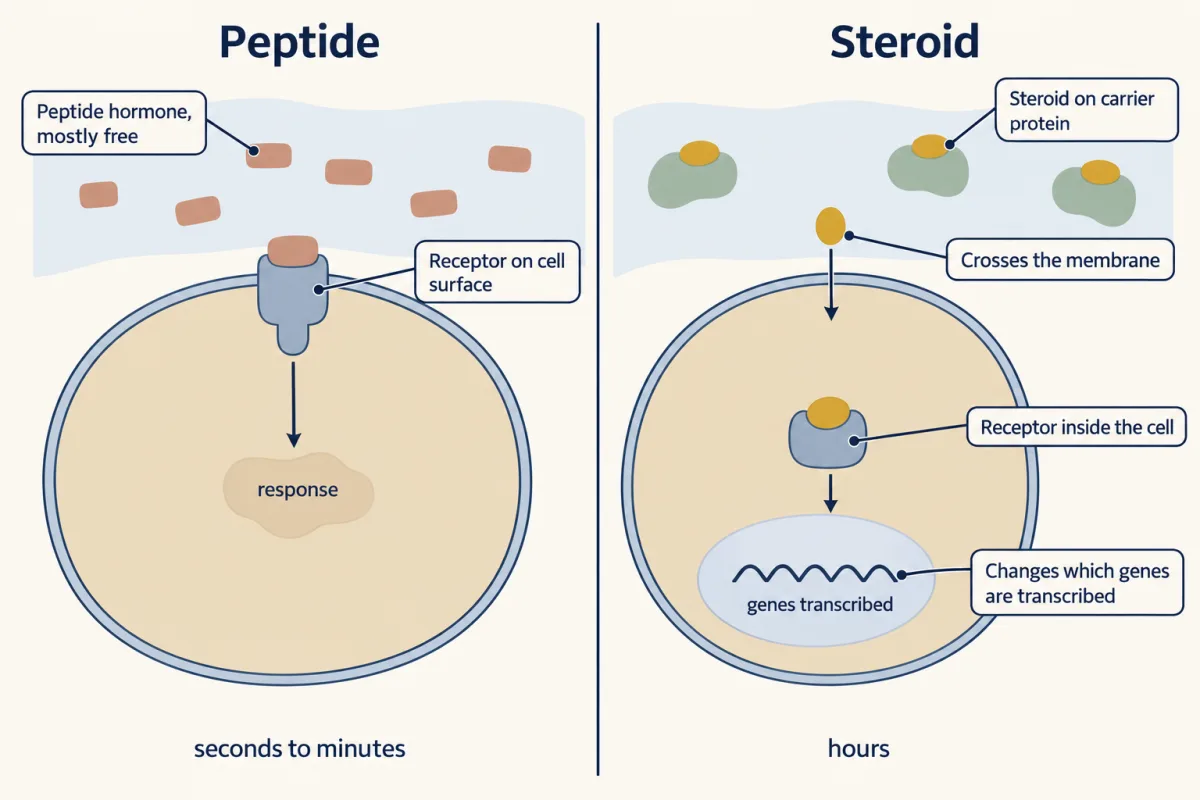
Two warnings keep this from becoming a false rule. Not every peptide works the same way: glucagon’s receptor is a G-protein-coupled receptor, but insulin’s receptor is itself an enzyme, a tyrosine kinase (see receptor tyrosine kinases). And not every steroid action is slow, as the design problem shows. A third group, the amine hormones made from single amino acids, splits between the two: epinephrine acts like a peptide, while thyroid hormone, like a steroid, enters cells and binds an intracellular receptor.
Hypothalamus and pituitary: a chain with feedback
In mammals the hypothalamus, at the base of the brain, controls the pituitary gland beneath it, and the pituitary controls several other glands.
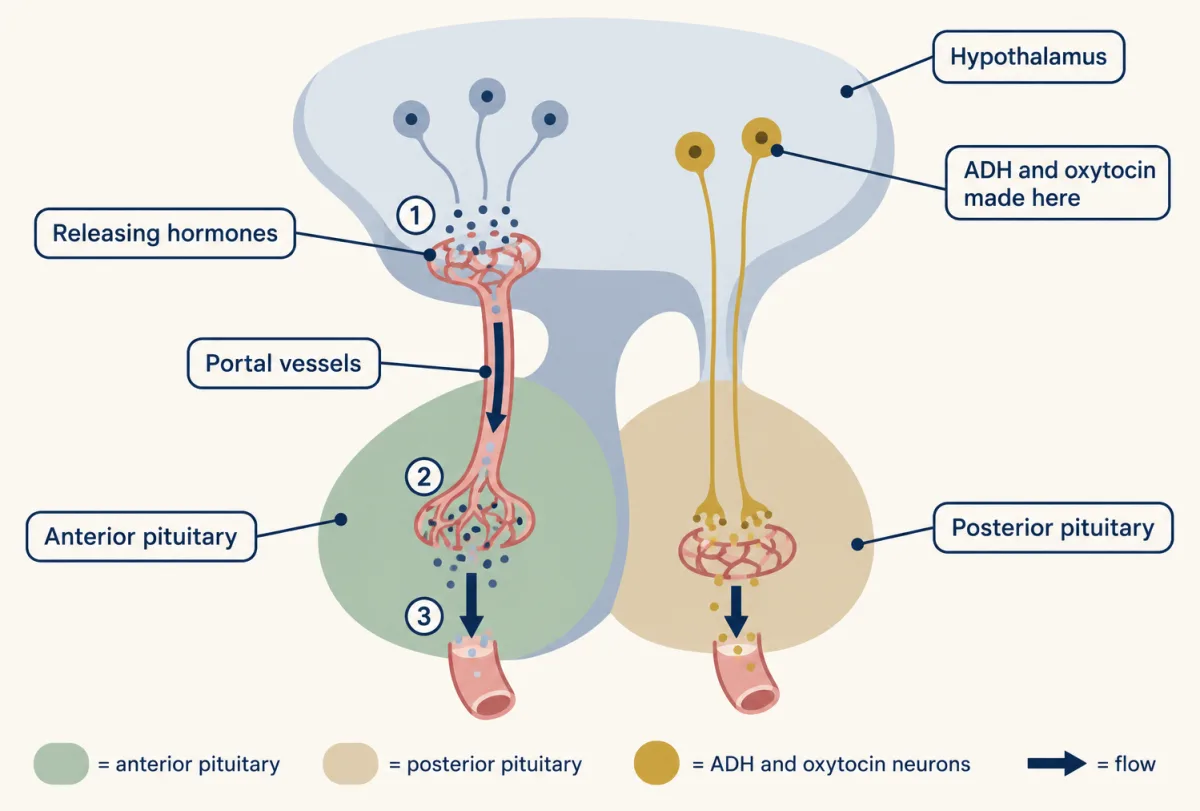
The anterior pituitary is a gland in its own right. Hypothalamic neurons release releasing hormones into capillaries, and portal vessels, veins that run from one capillary bed to a second one, carry that blood directly to the anterior pituitary. The hormones arrive concentrated, without passing through the rest of the body. CRH (corticotropin-releasing hormone) triggers release of ACTH (adrenocorticotropic hormone), TRH triggers TSH (thyroid-stimulating hormone), and GnRH triggers LH and FSH (luteinizing and follicle-stimulating hormones). The anterior pituitary also makes growth hormone and prolactin. How the portal link was demonstrated is told in hypothalamus and autonomic control.
The posterior pituitary makes nothing. ADH (antidiuretic hormone) and oxytocin are made by neurons whose cell bodies sit in the hypothalamus, and those axons end in the posterior pituitary, which stores and releases the hormones into the blood. ADH increases water reabsorption in the kidney; oxytocin contracts the uterus during birth.
The main glands, from human physiology:
| Gland | Hormone | Main effect |
|---|---|---|
| Anterior pituitary | ACTH, TSH, LH and FSH, growth hormone, prolactin | Drive adrenal cortex, thyroid, gonads; growth; milk production |
| Thyroid | T4 and T3 | Raise basal metabolic rate |
| Parathyroid | Parathyroid hormone | Raise blood calcium |
| Adrenal cortex | Cortisol, aldosterone | Glucose production and stress response; sodium retention |
| Adrenal medulla | Epinephrine, norepinephrine | Raise heart rate in a stress response |
| Pancreatic islets | Insulin (beta cells), glucagon (alpha cells) | Lower and raise blood glucose |
| Gonads | Testosterone, estrogens, progesterone | Sex characteristics, reproductive cycles |
| Pineal | Melatonin | Daily rhythms |
Each axis is held in check by negative feedback: a response that opposes the change that caused it. Thyroid hormone, for example, lowers TRH and TSH release, so a rise in thyroid hormone reduces the drive that produced it. Feedback acts at both the hypothalamus and the pituitary.
Glucose and cortisol as loops
Blood glucose. In a healthy adult human after a meal, glucose rises. Beta cells in the pancreatic islets respond by releasing insulin. Insulin increases glucose uptake by skeletal muscle and fat, and it reduces the liver’s glucose output by slowing glycogen breakdown and new glucose synthesis. Glucose falls, and so does the stimulus for insulin. Between meals, alpha cells release glucagon, which makes the liver break down glycogen and release glucose. The liver is a target of both hormones. In mice, deleting the insulin receptor only in liver cells stopped insulin from suppressing the liver’s glucose output normally. The chemistry of the liver’s response belongs to integration of metabolism and gluconeogenesis.
The stress axis. CRH from the hypothalamus releases ACTH from the anterior pituitary, and ACTH makes the adrenal cortex produce cortisol. Cortisol raises glucose production: in normal human volunteers given high doses of hydrocortisone while their insulin, glucagon and growth hormone were held in fasting ranges, glucose production rose through new glucose synthesis. Rising cortisol then lowers CRH and ACTH. The glucose result comes from a high-dose infusion, not an ordinary stressful day. For the brain’s side of stress, see emotion and stress.
Negative feedback does not hold a hormone at one fixed value. In humans, cortisol rises and falls over the day and comes in pulses roughly every 60 to 90 minutes. In a study of 15 healthy men whose own cortisol was blocked and replaced with the same daily dose on different schedules, the schedule changed how their brains responded to emotional stimuli. Timing carries information.
How fast a level can follow its gland depends on the hormone’s half-life, the time for its plasma concentration to fall by half. Worked problem. This is a model, not an intact axis. Take an adult human with plasma cortisol of 400 nmol per L at time zero, and suppose secretion stops completely. Assume constant blood volume, no further secretion, and first-order elimination (a constant fraction lost per minute), with a half-life of 75 minutes, chosen within the textbook range of about 60 to 90 minutes.
C(t) = C0 x 2^(-t / t-half)
- After 150 minutes. t / t-half = 150 / 75 = 2 half-lives, so C = 400 x 1/4 = 100 nmol per L.
- When does it reach 50 nmol per L? 400 to 200 to 100 to 50 is three halvings, so 3 x 75 = 225 minutes. It falls below 50 nmol per L after that.
- Compare a peptide. Suppose, for illustration, a peptide hormone with a half-life of 5 minutes also starts at 400 nmol per L. In 30 minutes, which is 6 half-lives, it falls to 400 x 2^-6 = 400 / 64 = 6.25 nmol per L. Cortisol in the same 30 minutes falls only to 400 x 2^-0.4, about 303 nmol per L.
A short half-life lets the plasma level track secretion within minutes; a long one smooths out pulses. These numbers are invented, and real hormones are not secreted at one steady rate or switched off outright; secretion varies over time and often comes in pulses.
- Half-lives elapsed, t / thalf
- Concentration at the cursor
- Time to fall to 50 nmol per L (3 halvings)
- 5 min peptide at the cursor
In this sketch: adult human plasma cortisol (or an invented peptide), C0 = 400 nmol per L, secretion stopped completely at time zero, constant blood volume, first-order elimination; invented numbers.
Each half-life halves the level: C(t) = C0 × 2−t / t-half. A short half-life lets the plasma level track secretion within minutes; a long one smooths out pulses.
Hormones across animals: moulting insects, metamorphosing frogs
Other animals run the same logic on different molecules, so name the animal each time.
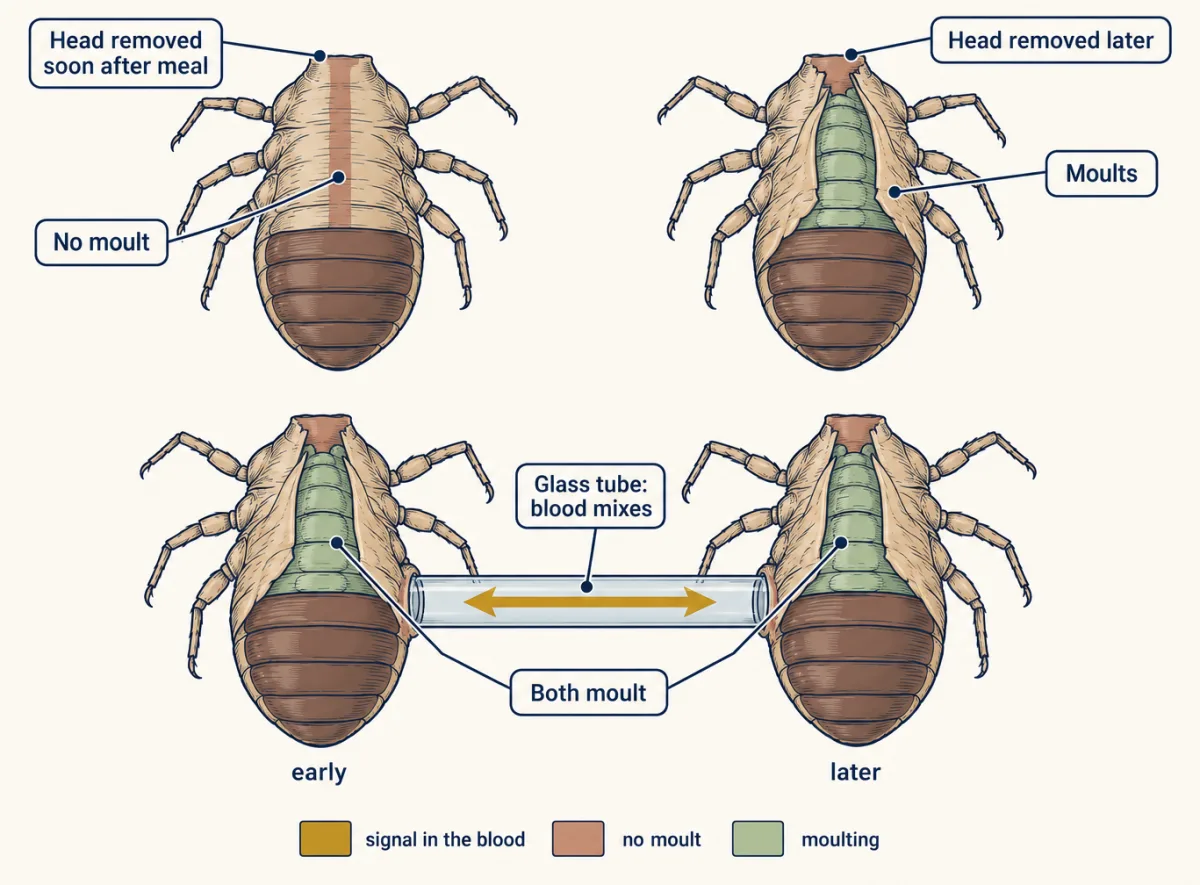
The bug Rhodnius prolixus takes one large blood meal per larval stage and moults some days later. Vincent Wigglesworth cut the heads off larvae at different times after feeding. Larvae decapitated soon after the meal did not moult, while those decapitated later did, so a signal from the head was needed for a limited time. When he joined an early-decapitated larva to a later one with a glass tube so that their blood mixed (parabiosis), both moulted: the signal travelled in the blood. The moult itself is now known to be driven by ecdysteroids, steroid hormones of arthropods. A second hormone, juvenile hormone from a small gland behind the brain called the corpus allatum, keeps each moult a larval one; only when it falls does the bug moult into an adult.
In frogs, tadpoles turn into froglets by metamorphosis, a body remodelling in which limbs grow and the tail is resorbed, and that change is driven by thyroid hormone. In an early report usually credited to J. F. Gudernatsch (1912), tadpoles fed mammalian thyroid tissue metamorphosed early. Mammals use thyroid hormone to set metabolic rate; the response depends on the tissue and the animal.
Plants have hormones too, such as auxin, but no blood; they move signals through tissues and vascular tissue, covered in plant hormones and responses.
Design problem
In slices of hypothalamus from young male rats, the synthetic glucocorticoid dexamethasone reduced excitatory synaptic input to recorded neurons within 3 to 5 minutes (Di, Malcher-Lopes, Halmos and Tasker, 2003). Is this the classical genomic action, in which the steroid enters the cell, binds an intracellular receptor and changes transcription? Design the tests, and say what each result would mean.
One way to do it
Start with timing. Transcription and new protein synthesis take far longer than 3 to 5 minutes, so the onset alone makes a genomic action unlikely.
Next, keep the steroid outside the cell. Dexamethasone bound to albumin, a large protein, cannot cross the membrane. In this study the albumin-bound form still reduced synaptic input. Add albumin alone as a control.
Then put the steroid only inside. Delivered into the recorded neuron through the recording pipette, dexamethasone did not reproduce the effect. Together these point to a site reached from outside the membrane.
A transcription blocker is a further test: if the effect is membrane-initiated, blocking transcription should leave it intact. That is a prediction you would test, not a result from this paper as given here.
Finally, look for what carries the signal. Blockers of the CB1 cannabinoid receptor (AM251 and AM281) abolished the effect, so it depended on endocannabinoid signalling in this preparation.
Conclusion: a rapid, membrane-initiated steroid action in rat hypothalamic slices. The membrane receptor was not identified, and the result does not show how cortisol feedback works in a living human.
How we measure it
Gland removal and replacement
Remove a gland (ablation) and record what changes, then restore it by a graft or by an extract or a purified hormone. If the replacement reverses the change, the gland acts through that material; a graft with no nerve supply tests whether nerves are needed.
Parabiosis and decapitation in insects
Join two animals so that their blood mixes, or cut off the head at chosen times after a trigger such as a meal. Timing shows when a signal from the head is needed, and a shared blood supply shows whether that signal travels in the blood.
Radioimmunoassay
Let the hormone in a sample compete with a radioactively labelled copy for a limited amount of antibody. The bound label falls as the sample's hormone rises, and a standard curve gives the concentration, even at the low levels at which hormones circulate in blood.
Hyperinsulinemic-euglycemic clamp
Infuse insulin at a fixed rate and infuse glucose at whatever rate holds blood glucose steady. The glucose infusion needed measures how strongly the body responds to insulin, and tracers can split that into uptake by tissues and output by the liver.
Finish line
Test yourself
8 questions
Practice and MCAT-style, with explained answers.
Next · Lesson 9
Metabolic Rate and Body Temperature
A desert iguana basking in the sun can be warmer than you are. So what does 'cold-blooded' mean?
Continue →