Life Science · Unit 5: Living together
Living Together: Symbiosis
Do some living things help each other, or hurt each other, by living close together? You test pairs of species in a model, sort Virginia examples such as lichens, ticks and root fungi into three kinds of symbiosis, and read real data on marigolds grown with and without a root fungus. Afterwards you can name each kind of symbiosis and back up a claim with evidence.
Where this lesson sits
- Virginia SOL LS.6 c
- Practices LS.1 b, LS.1 c, LS.1 d, LS.1 f
Essential question: Do some living things help each other, or hurt each other, by living close together?
-
Life Science (grade 7) LS.6 c You are here
This lesson
-
Biology
Preview it at high school level
In Biology you will look at the smallest partners: microbes. Most bacteria do not cause disease. Decomposer bacteria break down dead matter and return nutrients to soil and water. Bacteria in the root nodules of soybeans fix nitrogen from the air, and the plant feeds them in return. Bacteria in your gut break down fiber your body cannot digest. Other bacteria and viruses are pathogens, which cause disease in plants, animals and people. You will learn that whether a microbe helps or harms often depends on where it lives.
-
Biology II Biology II: Ecology, EC.4 a
Preview where it goes next
In Virginia’s Biology II Ecology course, you follow how matter such as nitrogen and phosphorus moves through an ecosystem, and you name each step. Many of those steps run through partners. Nitrogen-fixing bacteria in legume roots bring nitrogen from the air into living things. Fungi on roots help plants take up minerals from the soil. You also ask which nutrient runs short first and limits growth, and how partners change that.
-
College
Watch first Living Together: Help, Harm, or Neither · 2:22
Look closely at a tree trunk or a rock in a Virginia park. Some of the gray-green crusty patches you see are lichens, and each lichen is a partnership of very different living things growing as one body.
One partner is a fungus. The other is a tiny green alga or a cyanobacterium, a kind of bacterium that can make its own food. Why would two different living things share one body? And do living things that live close together always help each other? First, decide what you think now.
What do you think? Decide before you read.
-
Scientists disagree: Scientists sort close partnerships by what each partner gains or loses. In some, both gain. In others, one gains and the other is not affected. In others, one gains and the other is harmed. All three count as symbiosis.
What scientists think
Scientists disagree: Scientists sort close partnerships by what each partner gains or loses. In some, both gain. In others, one gains and the other is not affected. In others, one gains and the other is harmed. All three count as symbiosis.
-
Scientists disagree: A parasite does not have to kill its host quickly. A tick can stay attached to a living deer or person and feed for days. If a host dies, a parasite that lives on it can lose its home and its food.
What scientists think
Scientists disagree: A parasite does not have to kill its host quickly. A tick can stay attached to a living deer or person and feed for days. If a host dies, a parasite that lives on it can lose its home and its food.
-
Scientists disagree: A fungus and an alga do not choose to be kind. Scientists explain partnerships with survival and reproduction. Partners that lived together survived and had offspring, so the relationship carried on over many generations.
What scientists think
Scientists disagree: A fungus and an alga do not choose to be kind. Scientists explain partnerships with survival and reproduction. Partners that lived together survived and had offspring, so the relationship carried on over many generations.
Explore: pair up two species
In this simulation you see two species and a bar for each population over 20 weeks. You choose how living together affects each species: helped, unaffected or harmed. Then you watch the bars change and name the relationship. You can also pick a real pair, such as the fungus and alga in a lichen, a lichen on a tree, or a tick on a deer.
Bar height = population size in relative units (not to scale). One thin bar for each week.
Assumptions made up in this sketch: both populations start at the same size; “helped” pushes a bar up and “harmed” pushes it down by the same fixed amount each week; “unaffected” leaves it level; no other species and no seasons.
Keep this rule: sort a pair by what each partner gains or loses. All benefit is mutualism; one benefits and the other is unaffected is commensalism; one benefits and the other is harmed is parasitism.
Try this.
- Pick the lichen fungus and alga. Predict whether both bars will rise, then run it.
- Set species A to helped and species B to harmed. Predict what happens to each bar, and what to call the pair.
- Set both species to harmed. Predict whether this matches any kind of symbiosis, then check the message.
Explain: what symbiosis means
- symbiosis
- lichen
- mutualism
- commensalism
- parasitism
- host
- parasite
Symbiosis is a close relationship between individuals of different species living together. The partners stay together for a long time. A bird that eats one seed and flies off is not in a symbiosis with the plant.
A lichen is a living thing made of a fungus and an alga or a cyanobacterium living as one body. They stay two different species, but they share one body. Here is what each partner gives:
- The fungus forms the outside of the lichen. It shelters its partner and helps keep it moist.
- The lichen body, made mostly of the fungus, soaks up water from rain and from the air.
- The alga or cyanobacterium makes sugar by photosynthesis. That food feeds both partners.
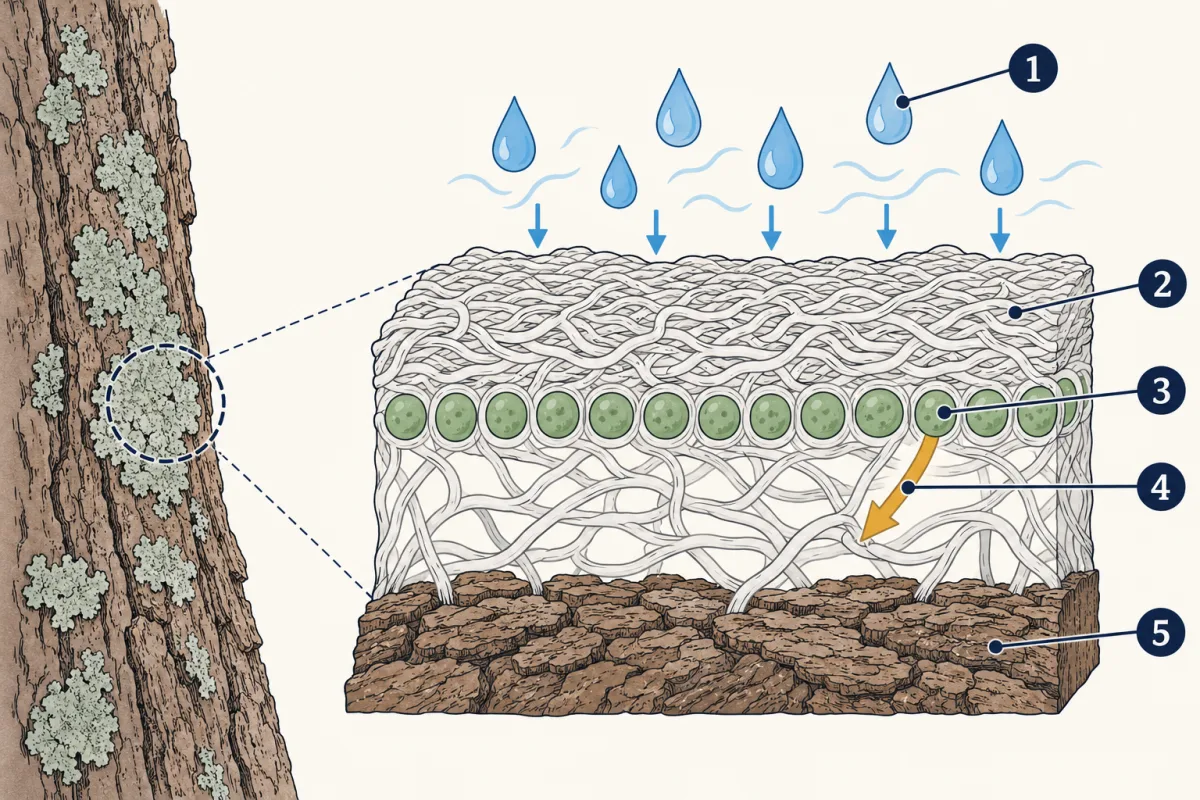
- rain and water from the air
- fungus threads
- green alga cells
- sugar
- tree bark
- blank
- fungus threads
- blank
- blank
- tree bark
Word bank: green alga cells, rain and water from the air, sugar
- blank
- blank
- blank
- blank
- blank
Check your labels
- rain and water from the air
- fungus threads
- green alga cells
- sugar
- tree bark
This two-partner picture is a model. In 2016, scientists found yeast cells, another kind of fungus, living inside some lichens too. What the yeast does there is still being studied.
Explain: three kinds of symbiosis
Scientists sort symbiosis by asking what each partner gains or loses. There are three kinds.
- Mutualism is symbiosis in which all the partners benefit.
- Commensalism is symbiosis in which one partner benefits and the others are unaffected.
- Parasitism is symbiosis in which one partner benefits and the others are harmed.
In parasitism, the host is the living thing that the other partner lives on or in. The parasite is the partner that benefits by feeding on its host.
| Virginia example | Partner A | Partner B | Kind |
|---|---|---|---|
| Fungus and alga in a lichen | fungus gets food | alga gets shelter and water | mutualism |
| Fungi on tree roots | fungus gets food from the tree | tree gets minerals from the soil | mutualism |
| Bacteria in soybean root bumps | bacteria get food from the plant | plant gets nitrogen it can use | mutualism |
| Lichen on tree bark | lichen gets a place to live | tree seems unaffected | commensalism |
| Blacklegged tick on a deer | tick gets blood | deer loses blood | parasitism |
Look at the two lichen rows. The fungus and alga inside the lichen are one relationship. The lichen and the tree are a different one. Experts say ordinary lichens on bark almost always do not harm the tree.
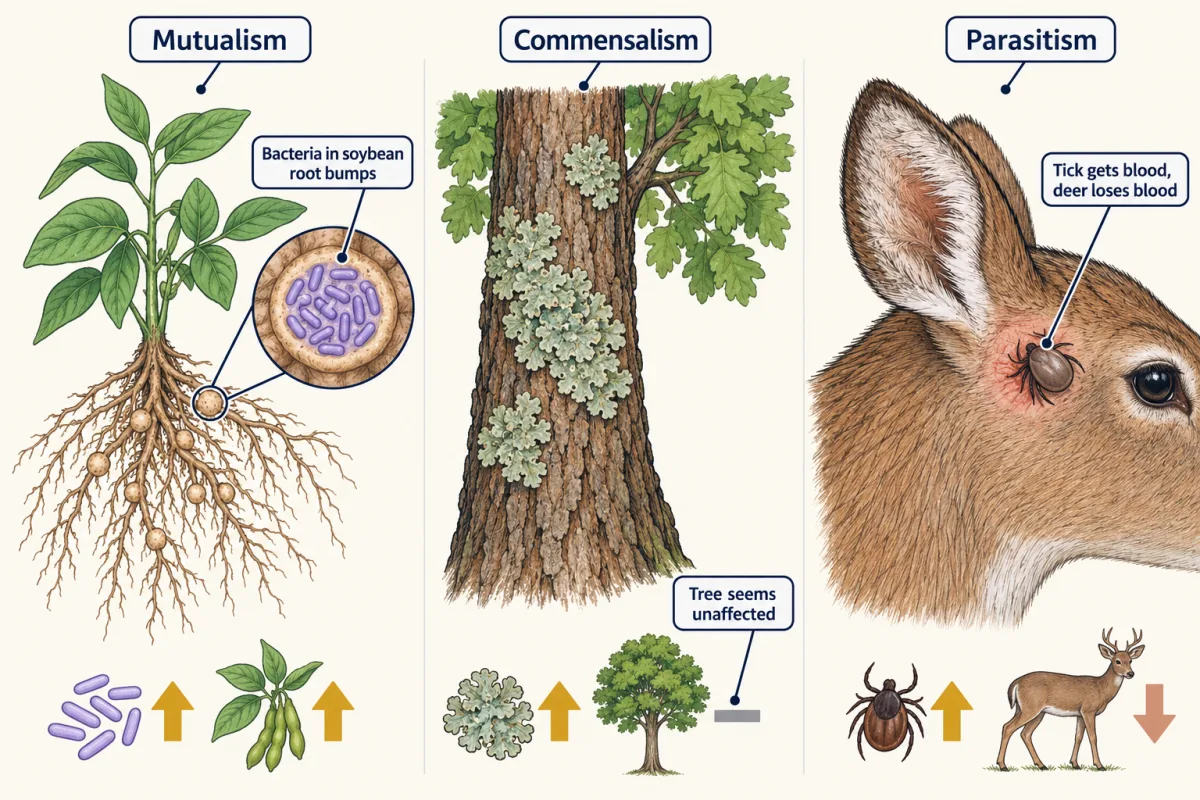
The soybean bacteria turn nitrogen from the air into a form the plant can use. You met them in Nitrogen for Life.
Blacklegged ticks live in Virginia. A tick can hold onto its host and drink blood for several days. Some hosts get irritated skin around a bite.
Explain: why partnerships last
A parasite is not the same as a predator. A predator kills and eats its prey quickly. A parasite usually lives on or in its host and feeds over a long time, often while the host stays alive. You can compare them in Predators and Prey.
Partners do not help each other on purpose. A fungus cannot decide to be kind. Over many generations, partners that lived together survived and reproduced better than ones that did not. Their offspring kept living the same way, so the relationship carried on.
That is how symbiosis supports the survival of different species. A lichen can grow on bare rock, where the alga alone might dry out and the fungus alone could not make its own food.
- In a blank, partner A blank and partner B blank, so it is blank.
- This is not blank, because blank.
Elaborate: does a root fungus help a plant grow?
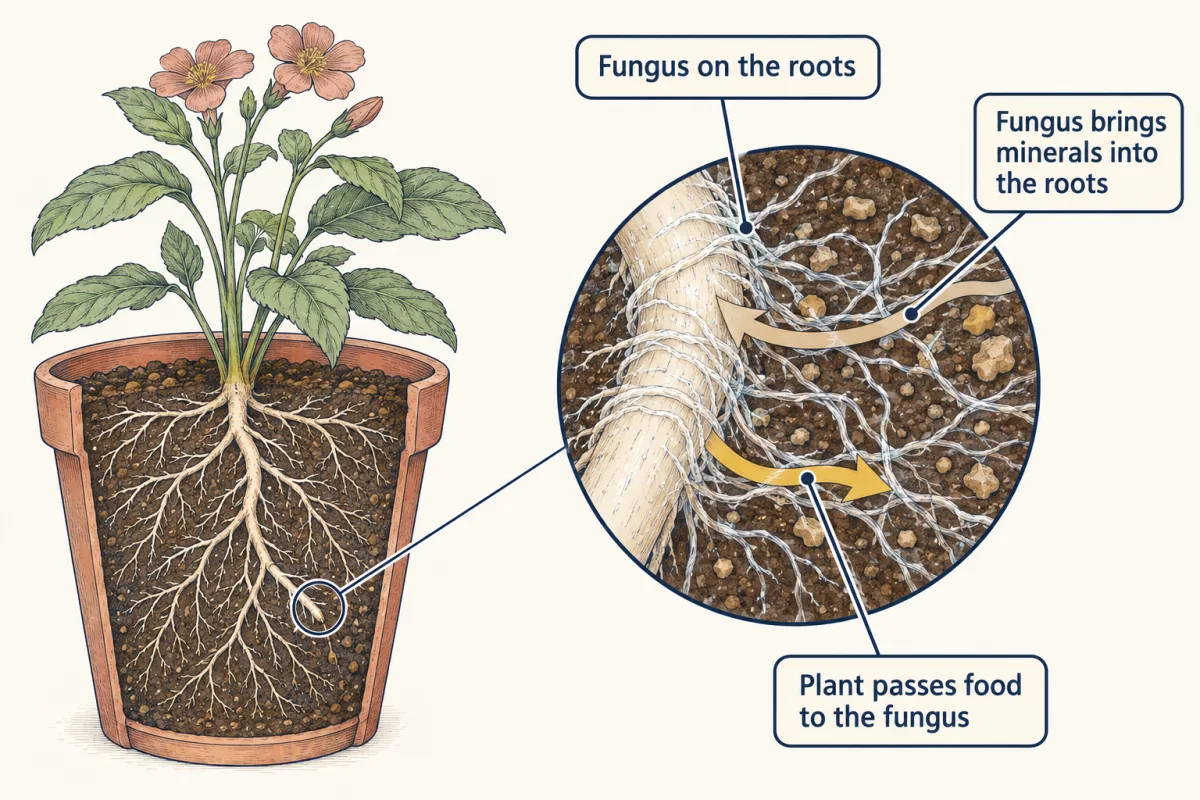
Many plants grow with a fungus on their roots. The fungus brings minerals from the soil into the roots. The plant passes food it made to the fungus. Does the plant really grow more with this partner?
| Water given (% of what the soil can hold) | Root fungus | Mean shoot dry mass (g per plant) |
|---|---|---|
| 100% | present | 5.29 |
| 100% | absent | 4.44 |
| 75% | present | 4.12 |
| 75% | absent | 3.28 |
| 50% | present | 3.06 |
| 50% | absent | 2.89 |
| 25% | present | 2.62 |
| 25% | absent | 2.01 |
These are means from a pot experiment by Asrar and Elhindi, published in 2011. They grew Jubilee marigolds in a greenhouse at King Saud University in Riyadh, Saudi Arabia. Seeds were sown in September 2009. The shoots were weighed as dry mass six weeks after the seedlings were moved into pots. The table shows only plant growth, not how many plants lived.
- At 25% water, how many grams more did plants with the fungus have? What percent is that of the mass without the fungus?
- As the water drops from 100% to 25%, what happens to shoot mass in both groups?
- At which water level is the gap between the two groups smallest?
Claim, evidence, reasoning
Make a claim about which kind of symbiosis the marigold and its root fungus show, using this data.
Start with: The marigold and the root fungus show blank.
Start with: At every water level, plants with the fungus had blank shoot mass, for example blank g compared with blank g at 25% water.
Start with: This fits blank because the plant blank and the fungus blank.
Compare with a model answer
The marigold and its root fungus show mutualism. At every water level, plants with the fungus had more shoot mass than plants without it. At 25% water, they had 2.62 g compared with 2.01 g, which is 0.61 g more. So the plant benefited. Other studies show that root fungi receive food from the plant, so the fungus benefits too. One limit: this is one kind of plant in one greenhouse, and the table does not measure the fungus’s gain or how many plants survived.
Saved in this browser only.
Design problem
Plan an investigation to test whether a root fungus helps bean plants grow. Name your variables, your control, what you keep the same, how many plants you use, what you measure in metric units, and how you keep it safe.
One way to do it
- Question: do bean plants grow more shoot mass with a root fungus than without one?
- Independent variable: root fungus added (a garden-store root fungus powder) or not added.
- Dependent variable: dry shoot mass in grams after six weeks. Cut the shoots, dry them in paper bags for a week, then weigh them on a balance.
- Control: pots with the same potting mix and no fungus powder.
- Constants: the same seeds, pot size, amount of potting mix, water, light and temperature.
- Trials: at least 10 pots per group, mixed together on the shelf so neither group gets better light. Find the mean for each group.
- Safety: wear gloves and avoid breathing the powder, follow the label, wash your hands afterward, and never taste anything.
- What results would mean: a higher mean mass with the fungus supports a benefit to the plant in these conditions. If a teacher has a microscope, check stained roots to see if the fungus grew.
Evaluate: check your thinking
Those gray-green crusty patches can be lichens: a fungus and an alga or cyanobacterium living as one body. Both partners gain, so that is mutualism. Living close together does not always help, though. A lichen on bark seems to leave the tree unaffected, and a tick harms the deer it feeds on.
Science practices you used: predicting and testing with a model, sorting examples into groups, reading a data table and finding a difference and a percent, planning a fair test with a control and many plants, and naming the limits of one study.
How we measure it
Drying and weighing plants (dry mass)
Plant shoots are cut, dried until the water is gone, and weighed on a balance in grams. Comparing the dry mass of plants grown with and without a partner shows whether the partner changed how much the plant grew.
Root staining and the microscope
Thin roots are soaked in a dye that colors fungus cells, then looked at under a microscope. This checks that a fungus partner really grew inside the roots before anyone credits it with a result.
Finish line
Test yourself
8 questions
Practice and MCAT-style, with explained answers.
Next · Lesson 19
Habitat and Niche
How can five kinds of small birds that all eat insects share the same spruce trees?
Continue →