Life Science · Unit 5: Living together
Predators and Prey
If wolves eat moose, why don't the wolves eat every last moose? You run a model island with wolves and moose, then read real winter counts from Isle Royale in Lake Superior. Afterwards you can explain how predators and prey change each other's numbers, and how herds and packs help animals get what they need.
Where this lesson sits
- Virginia SOL LS.6 a
- Practices LS.1 c, LS.1 d, LS.1 e, LS.1 f
Essential question: If wolves eat moose, why don't the wolves eat every last moose?
-
Life Science (grade 7) LS.6 a You are here
This lesson
-
Biology
Preview it at high school level
In Biology you will learn a name for the limit this lesson only describes: carrying capacity, the largest population an environment can support over time. You will read two shapes of growth curves. A J-shaped curve shows a population growing faster and faster with no limits. An S-shaped curve shows growth that slows and levels off near the limit. You will sort limiting factors into biotic ones, such as predators and food, and abiotic ones, such as temperature. You will also see that carrying capacity is not fixed. It moves when conditions change, which you will test with the Chesapeake Bay's winter blue crab survey.
-
Biology II Biology II: Ecology, EC.5 a-e
Preview where it goes next
In Virginia's Biology II Ecology course (EC.5 a-e), you study how populations grow in more detail. You describe how individuals are spread out in space and how crowded they are. You read age structure, which shows how many young and old members a population has. You compare species that have many offspring and give little care with species that have few offspring and give more care. You read survivorship curves, and you sort limits into ones that grow stronger as a population gets crowded and ones that do not.
-
College
Watch first Predators and Prey Change Each Other's Numbers · 2:27
Isle Royale is an island in Lake Superior where wolves hunt moose. In the winter of 2016, scientists counted only 2 wolves on the whole island, and they estimated 1,300 moose.
Wolves eat moose. Moose eat young trees and other plants. Scientists have studied the wolves and moose on this island for decades. So why did the wolves not eat every last moose, and why were there so few wolves? First, decide what you think now.
What do you think? Decide before you read.
-
Scientists disagree: When prey become scarce, the predators usually run short of food first. Fewer predators survive and raise young, and the prey can recover. Scientists see this in long records of predator and prey counts, though not every population recovers.
What scientists think
Scientists disagree: When prey become scarce, the predators usually run short of food first. Fewer predators survive and raise young, and the prey can recover. Scientists see this in long records of predator and prey counts, though not every population recovers.
-
Scientists disagree: Each predator eats many prey animals over its life. In winter 2017, Isle Royale had an estimated 1,600 moose and only 2 wolves. A place can feed far fewer predators than prey.
What scientists think
Scientists disagree: Each predator eats many prey animals over its life. In winter 2017, Isle Royale had an estimated 1,600 moose and only 2 wolves. A place can feed far fewer predators than prey.
-
Scientists disagree: Without predators, prey numbers can grow until the animals eat much of their own food. Then many can starve. On Isle Royale, researchers found that more moose went with more bites taken from young fir trees.
What scientists think
Scientists disagree: Without predators, prey numbers can grow until the animals eat much of their own food. Then many can starve. On Isle Royale, researchers found that more moose went with more bites taken from young fir trees.
Explore: run an island with wolves and moose
In this simulation you watch an island with two populations, moose and wolves. Bars show how many of each there are, and a line graph tracks them over 40 years. You set the starting number of wolves, how fast moose have calves, and whether a harsh winter strikes. A food meter shows how much plant food is left for the moose.
Press Run. Bars show moose, wolves and plant food at the start.
In this sketch: all sizes are relative units, not real counts, and the wolf count can be a fraction. The starting moose, how fast plants grow back, how many moose each wolf catches, how fast wolves gain and lose numbers (which sets how long they lag behind the moose), the calf rates, and a harsh winter taking half the moose in one year are invented. Moose eat the plants. There is no disease and no age groups, and the numbers are smooth averages, not individual animals.
Pattern scientists often see: when prey are plentiful, more predators tend to survive. When prey become few, predators can run short of food and fewer may survive, so the prey can recover.
Try this.
- Set the starting wolves to 20 (a relative number in the model, not a count). Predict which line will reach its high point first, the moose or the wolves. Then run it and watch the two lines.
- Set the wolves to 0. Predict what will happen to the moose and to the food meter over 40 years. Then test it.
- Press the harsh winter button once. Predict how the moose line and then the wolf line will change in the next few years. Then check.
Explain: populations, communities and food webs
- population
- community
- predator
- prey
- food web
- first-order consumer
- second-order consumer
- herd
- pack
A population is all the members of one species living in one place at the same time. All the moose on Isle Royale make up one population. All the wolves make up another.
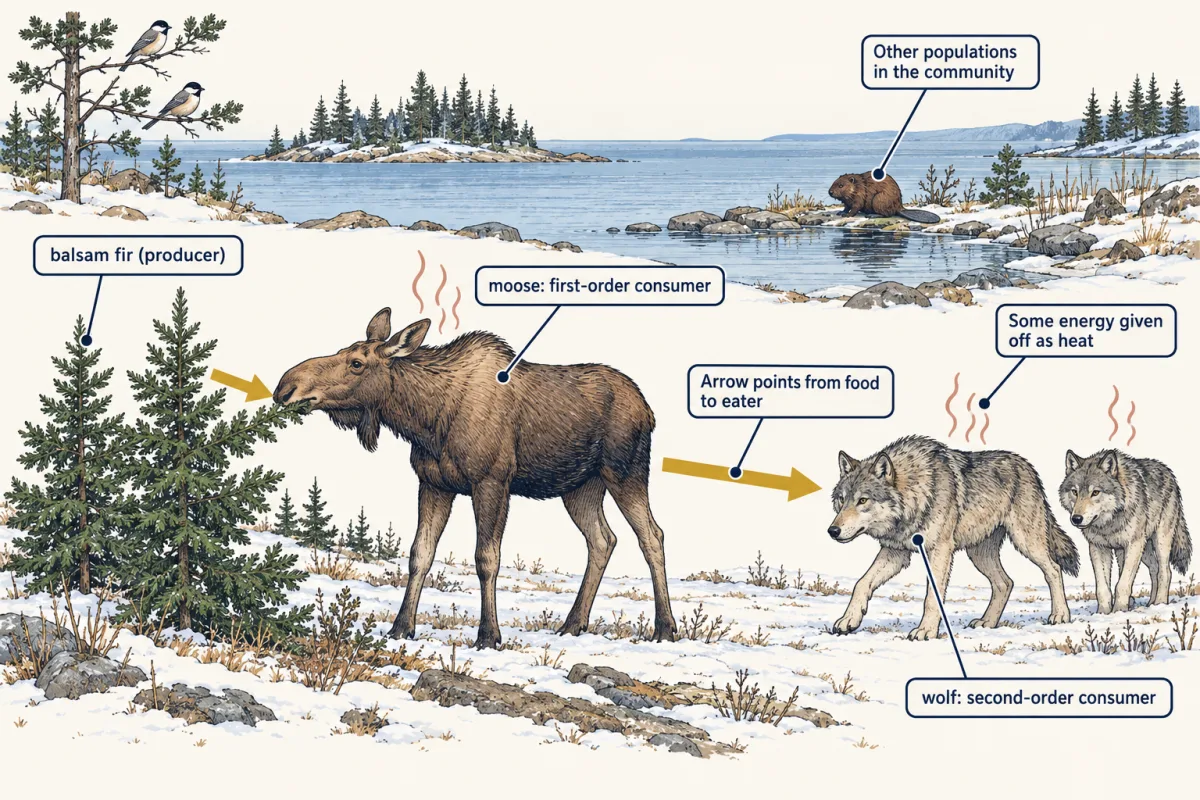
A community is all the populations that live together in one place. On Isle Royale, the community includes the wolves, the moose, the fir trees, beavers, birds and many more. The populations in a community depend on one another.
A predator is an animal that catches and eats other animals. The animal it eats is its prey. Moose are the main prey of the island’s wolves.
You met food chains in Food Webs and Energy. A first-order consumer eats producers, and a second-order consumer eats first-order consumers. A moose that eats fir trees is a first-order consumer. A wolf that eats the moose is a second-order consumer.
balsam fir → moose → wolf
A food web links many food chains to show who eats whom in a community. Each arrow points from the food to the eater. It shows which way energy moves. When a wolf eats a moose, some of the energy stored in the moose passes to the wolf. Every animal gives off some of its energy as heat.
Virginia has predators and prey too. In the Chesapeake Bay, ospreys dive for menhaden, a small fish.
Explain: how predators and prey change each other’s numbers
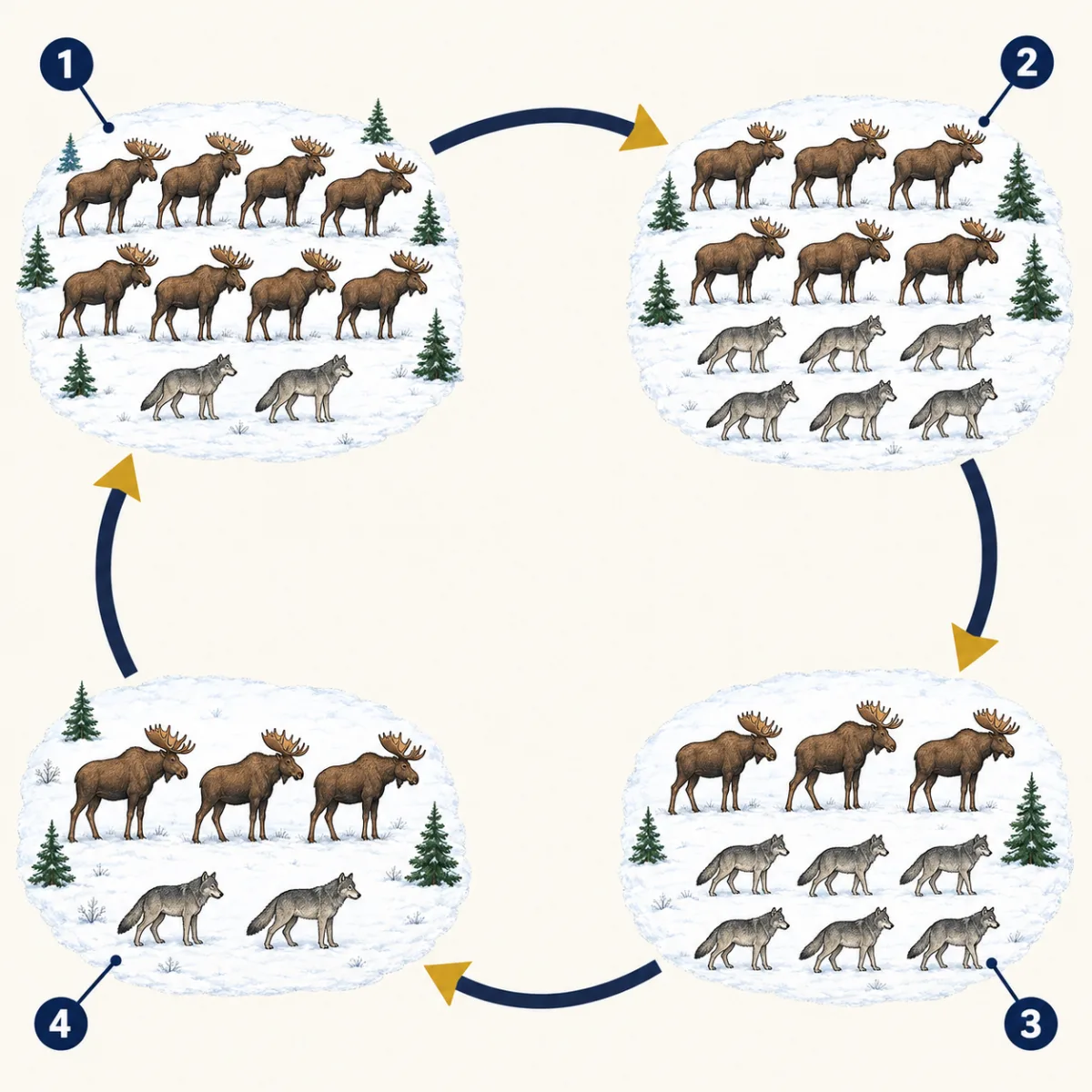
Predators and prey affect each other’s numbers. Here is the pattern scientists often see:
- When prey are plentiful, predators find food easily. More predators survive and raise young, so the predator population grows.
- More predators catch more prey, so the prey population falls.
- With less prey to eat, predators run short of food. Fewer survive, and the predator population falls.
- With fewer predators hunting, more prey survive. The prey population grows again.
So the predator numbers often rise and fall a little after the prey numbers. The predators usually run short of food before the last prey animal is caught.
- many moose
- wolves increase
- fewer moose
- wolves decrease
- many moose
- blank
- fewer moose
- blank
Word bank: wolves decrease, wolves increase
- blank
- blank
- blank
- blank
Check your labels
- many moose
- wolves increase
- fewer moose
- wolves decrease
Real populations are messier than this pattern. On Isle Royale, harsh winters, ticks, disease and the moose’s plant food also change the counts. Scientists report that the island’s wolf and moose numbers do not follow one simple pattern. Predators are one cause of change, not the only one.
Other limits on populations, such as competition for food and space, come in Competition and Cooperation.
Explain: herds and packs
Many animals live in groups. These social behaviors help them get what they need.
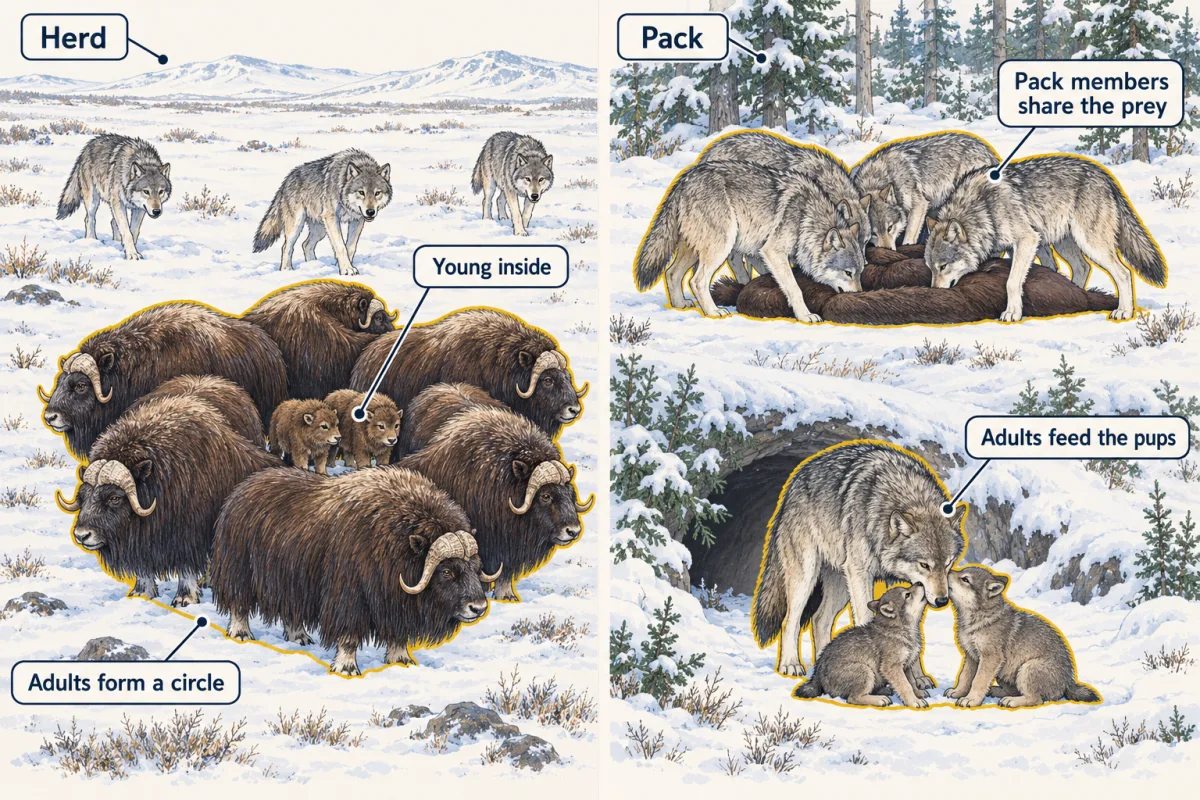
A herd is a group of plant-eating animals that live and move together. More eyes can spot danger, and adults can guard young. Muskoxen, large shaggy plant eaters of the far north, give one example. When several predators come near, adults can form a circle with their young inside. Moose mostly live alone, so they do not do this.
A pack is a group of predators, such as wolves, that live and hunt together. On Isle Royale, wolves often hunt moose as a pack. Pack members share the prey they catch. They also help care for the pups, and, once the pups stop drinking their mother’s milk, they feed them meat that they bring up from their own stomachs.
| Group | Who | How the group helps |
|---|---|---|
| Herd | Muskoxen and other plant eaters | Spot danger and guard the young |
| Pack | Wolves | Hunt large prey, share it, raise pups |
- A herd helps prey because blank.
- A pack helps predators because blank.
- One way the two groups differ is blank.
Elaborate: read the Isle Royale counts
Here are selected winter counts from Isle Royale. Wolves are counted from the air and are close to a full count. Moose are estimates from aerial surveys of sample plots and other methods.
| Winter | Wolves (animals) | Moose (estimated animals) |
|---|---|---|
| 1980 | 50 | 664 |
| 1990 | 15 | 1,216 |
| 1995 | 16 | 2,400 |
| 1997 | 24 | 500 |
| 1998 | 14 | 700 |
| 2010 | 19 | 510 |
| 2016 | 2 | 1,300 |
| 2017 | 2 | 1,600 |
| 2019 | 15 | 2,060 |
| 2024 | 30 | 840 |
| 2026 | 37 | 524 |
Source: National Park Service, Isle Royale National Park, “Wolf and Moose Populations from 1980 through 2026” (downloaded 2026), winter counts for the whole island. In 2018 and 2019, the Park Service brought new wolves to the island, so the later rise in wolves is partly from people. Some years have no count.
- Find the year with the most moose in the table. What happened to the wolves in the next row?
- Compare 2017 and 2026. About how many moose were there for each wolf in each year?
- From 2019 to 2026, describe how each population changed.
Claim, evidence, reasoning
Make a claim that answers the essential question: if wolves eat moose, why don't they eat every last moose? Use the Isle Royale counts.
Start with: Wolves do not eat every last moose because blank.
Start with: When there were blank wolves in 2017, the moose estimate was blank, but when wolves rose to blank in 2026, the moose estimate was blank.
Start with: When moose become scarce, wolves blank, so blank.
Compare with a model answer
Wolves do not eat every last moose because when moose become scarce, wolves can run short of food and fewer may survive. In 1997, about 500 moose were left and there were 24 wolves, but by 1998 there were 14 wolves. In 2017, with only 2 wolves, the moose estimate was 1,600. By 2026, wolves had risen to 37 and moose had fallen to 524, but hundreds of moose remained. One limit: these are counts from one island, and people moved new wolves there in 2018 and 2019. Weather, ticks and food also changed the moose numbers, so wolves were not the only cause.
Saved in this browser only.
Design problem
Does living in a group protect prey? You can test this with a model. Spread 30 paper squares, each 2 centimeters on a side, on a square of floor 1 meter by 1 meter. They are the prey. Drop a 10 centimeter cardboard square from 1 meter high. It is the predator. Any prey it touches is caught. Plan a fair test that compares prey in one tight group with prey spread out.
One way to do it
- Question: Are prey in a tight group caught on fewer drops than prey spread out?
- Independent variable: how the prey are placed, in one tight group or spread out evenly.
- Dependent variables: the number of drops that catch any prey, and the number of prey caught on each drop.
- Constants: 30 prey squares, the same field, the same predator card, the same drop height of 1 meter, the same person dropping with eyes closed.
- Control: the spread-out field, which you compare the group against.
- Trials: 20 drops for each setup. Put caught prey back after each drop. Repeat the whole test three times and find the mean.
- Safety: drop only paper and cardboard, keep the area clear, and pick up all pieces.
A tight group is likely to be caught on fewer drops, but some drops may catch many prey at once. This model has limits. Real predators aim, and real herds watch and move.
Evaluate: check your thinking
The wolves on Isle Royale have not eaten every last moose. When moose become scarce, wolves can run short of food, so fewer may survive and the moose can recover. When moose are plentiful, wolves can increase. Weather, food, disease, and people moving wolves also changed the numbers.
Science practices you used: testing predictions with a model, reading and comparing data in a table, making a claim from evidence, and planning a fair test.
How we measure it
Counting wolves from the air
In winter, researchers fly over Isle Royale again and again and count the wolf packs they see against the snow. Repeated flights let them come close to counting every wolf on the island.
Moose survey on sample plots
Moose are too many to count one by one, so researchers count them on small squares of land, each 1 square kilometer, seen from an airplane. They use those counts to estimate the number of moose on the whole island.
Checking young trees for bites
Researchers mark young balsam fir trees and check whether moose have bitten off the growing tips. More bitten tips mean moose are eating more of their winter food.
Finish line
Test yourself
8 questions
Practice and MCAT-style, with explained answers.
Next · Lesson 17
Competition and Cooperation
Why did one kind of paramecium shrink to a small number when it shared a tube of food with another kind, while honeybees in a hive share their food?
Continue →