Biology · Unit 3: Bacteria and viruses
Microbes in Bodies and Ecosystems
Are bacteria and viruses always harmful, and what would life on Earth look like without them? You switch groups of microbes off in a model ecosystem, follow bacteria that break down dead leaves, feed soybeans with nitrogen from the air, digest fiber in your gut and make yogurt and insulin, and meet microbes that cause disease. Afterwards you can read field data on soybean nitrogen and argue that the same kind of organism can help or harm depending on where it lives.
Where this lesson sits
- Virginia SOL BIO.4d
- Practices BIO.1c, BIO.1d, BIO.1f
Essential question: Are bacteria and viruses always harmful, and what would happen to life on Earth without them?
-
Life Science (grade 7) LS.5 a and c
Review it at grade 7 level
In Life Science you learned that decomposers, such as fungi and bacteria, break down dead plants and animals. That returns nutrients to the soil and water, where plants can take them up again. You also learned that nitrogen cycles through an ecosystem. Air is mostly nitrogen gas, but plants and animals cannot use it in that form, and bacteria change it into forms that plants can use. You did not need the names of each step. Biology adds the other side of the story: some bacteria and viruses cause disease, and both helpers and pathogens shape whole ecosystems.
-
Biology BIO.4d You are here
This lesson
-
Biology II Biology II: Ecology, EC.4 a
Preview where it goes next
In Virginia’s Biology II Ecology course, the nitrogen cycle is followed step by step, and most steps are run by particular microbes. In fixation, bacteria turn nitrogen gas into ammonia using an enzyme called nitrogenase. In nitrification, other soil microbes turn ammonium into nitrite and then nitrate. Assimilation is plants taking those forms into their own molecules. Ammonification is decomposers releasing ammonium from dead matter. In denitrification, bacteria in low-oxygen soil and water turn nitrate back into nitrogen gas. You also connect decomposers to energy flow: as they break down dead matter, they use energy stored in it, and nutrients return to the cycle.
-
College
Watch first Microbes: Partner or Pathogen? · 2:48
Dig up a soybean plant and you can find small round bumps on its roots, and if you cut one open, an active one is often pink inside. Those bumps are packed with bacteria that turn nitrogen from the air into a form the plant can use.
Your own gut also holds trillions of bacteria, and some of them help break down your food. Yet most of us learn the word “bacteria” next to the word “germs.” So which is it: are bacteria and viruses enemies, or are they partners that life depends on?
What do you think? Decide before you read.
-
Scientists disagree: Field studies of soybean roots show bacteria supplying the plant with nitrogen, and yogurt is made by two kinds of bacteria growing in milk. Some bacteria do cause disease, such as one that blocks the water pipes of grapevines. Scientists sort bacteria by what they do, not by one label.
What scientists think
Scientists disagree: Field studies of soybean roots show bacteria supplying the plant with nitrogen, and yogurt is made by two kinds of bacteria growing in milk. Some bacteria do cause disease, such as one that blocks the water pipes of grapevines. Scientists sort bacteria by what they do, not by one label.
-
Scientists disagree: In a lab model ecosystem, a virus burst ocean algae cells, and when bacteria broke down the remains, nitrogen and phosphorus appeared in the water for other living things to use. Bacteria that break down dead leaves in streams return nutrients too. Disease is one of several things microbes do.
What scientists think
Scientists disagree: In a lab model ecosystem, a virus burst ocean algae cells, and when bacteria broke down the remains, nitrogen and phosphorus appeared in the water for other living things to use. Bacteria that break down dead leaves in streams return nutrients too. Disease is one of several things microbes do.
-
Scientists disagree: A 2016 study added up published counts for a reference adult man. It estimated about 38 trillion bacterial cells and about 30 trillion human cells. That is close to one to one. The older ten-to-one figure came from a rough estimate that newer counts replaced.
What scientists think
Scientists disagree: A 2016 study added up published counts for a reference adult man. It estimated about 38 trillion bacterial cells and about 30 trillion human cells. That is close to one to one. The older ten-to-one figure came from a rough estimate that newer counts replaced.
Explore: switch microbes off in an ecosystem
The simulation shows a simple ecosystem: a field with soybeans, a stream with fallen leaves, a deer, a person and some ocean water. You can switch off one group of microbes at a time: decomposers, nitrogen fixers, gut bacteria, pathogens, or viruses that infect bacteria. Bars show how much matter is moving along each path and how large each population is, using numbers meant only for comparison.
In this sketch: every bar starts at 100 (relative units, not a measurement) and one group is off at a time. Steps are not days or years. Only the soybean 47 comes from the lesson; every other direction and size is a display assumption, not to scale.
Rule to keep: microbes keep matter moving and shape populations, and whether a microbe helps or harms depends on which microbe it is and where it lives.
Try this.
- Before you switch off the decomposers, predict what will happen to the pile of dead leaves and to the nutrients in the soil. Then test it.
- Switch off the nitrogen fixers. Predict which population changes first, the soybeans or the deer that eat plants.
- Switch off the pathogens. Predict whether the deer population grows without limit or levels off. Watch what happens to the plants.
- Switch off the viruses in the ocean water. Predict what happens to the number of bacteria and to the nutrients dissolved in the water.
Explain: microbes that keep matter moving
- decomposer
- nitrogen fixation
- nodule
- mutualism
- microbiome
- fermentation
- pathogen
- host
- bacteriophage
- biodiversity
Breaking down the dead
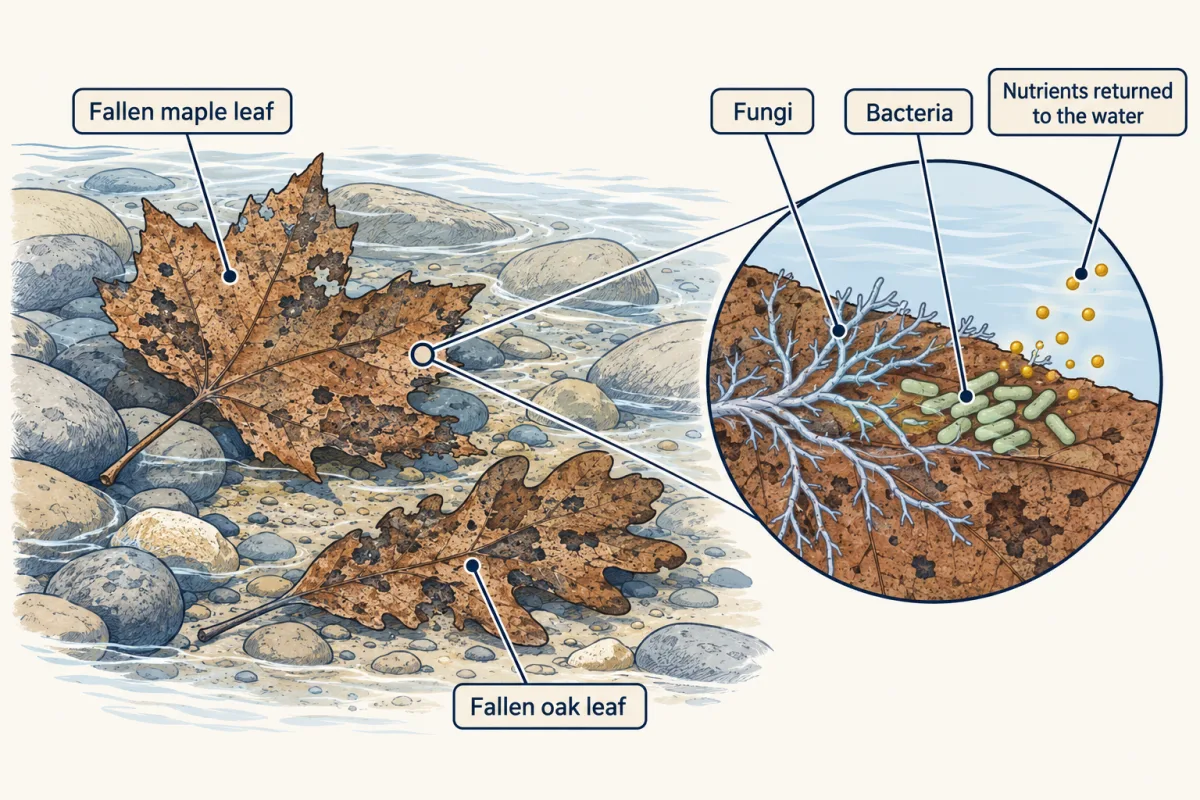
A decomposer is an organism that breaks down dead plants, animals and wastes and returns their nutrients to the soil or water. Bacteria and fungi do most of this work. In an Ohio stream study, both bacteria and fungi grew on fallen maple and oak leaves. These microbes release enzymes that break the large molecules in leaves into smaller ones. Without decomposers, dead matter would pile up and its nutrients would stay locked inside it.
Feeding plants nitrogen
Living things use nitrogen to build proteins and DNA. The air is mostly nitrogen gas, but plants and animals cannot use it in that form. Nitrogen fixation is the change of nitrogen gas from the air into a form living things can use. Only some bacteria and archaea (another group of microbes) can do it.
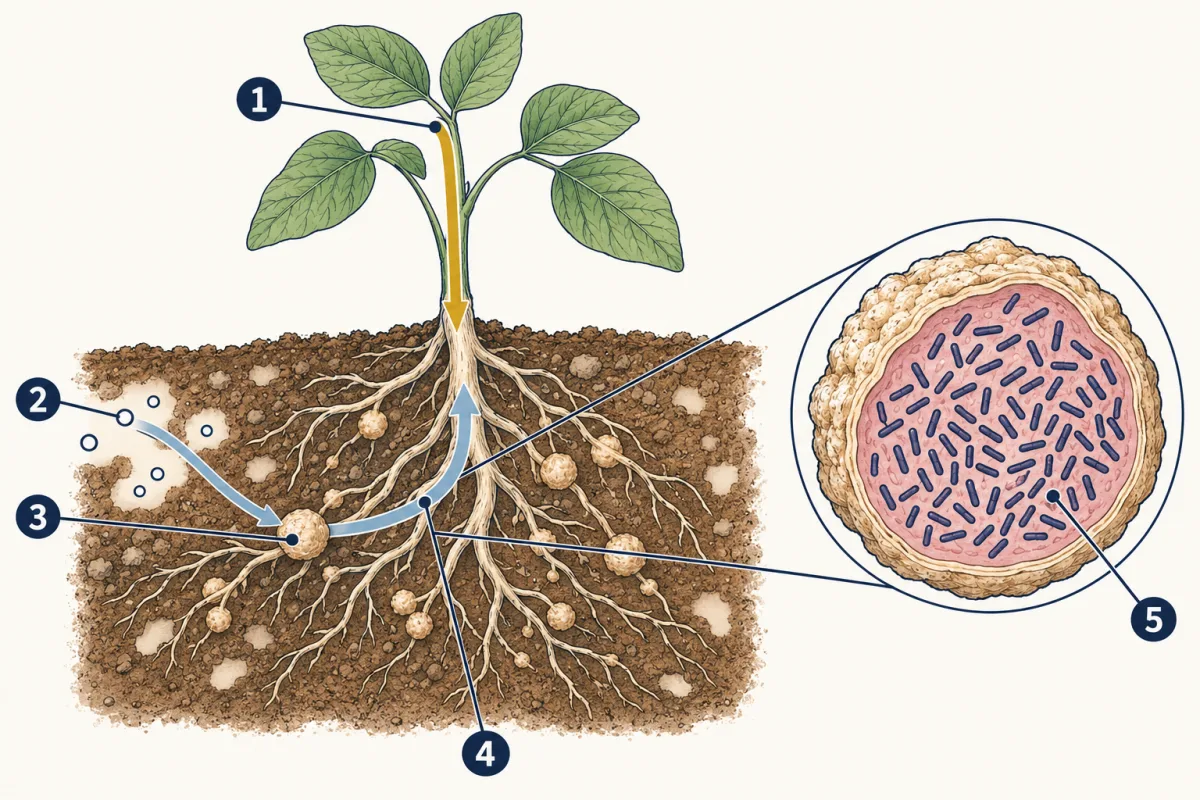
In soybeans, peanuts and other legumes, these bacteria live inside a nodule, a small swelling on a root that holds nitrogen-fixing bacteria. The bacteria turn nitrogen gas into ammonium, which the plant uses. The plant sends the bacteria energy-rich food made by photosynthesis. A partnership in which both species benefit is called mutualism.
nitrogen gas from the air → bacteria in root nodules → ammonium the plant can use → plant proteins and DNA
- energy-rich food
- nitrogen gas
- nodule
- ammonium
- bacteria
- blank
- blank
- nodule
- blank
- blank
Word bank: ammonium, bacteria, energy-rich food, nitrogen gas
- blank
- blank
- blank
- blank
- blank
Check your labels
- energy-rich food
- nitrogen gas
- nodule
- ammonium
- bacteria
When a soybean plant dies, decomposers break down its roots and stems, and some of that fixed nitrogen returns to the soil. You can read more about the whole cycle in Matter Cycles.
Explain: partners in your body, and pathogens
Your gut microbiome
The microbiome is the community of microbes that live in or on a body. In 2016 Ron Sender, Shai Fuchs and Ron Milo estimated that a reference adult man weighing 70 kg carries about 38 trillion bacterial cells and about 30 trillion human cells. Most of those bacteria live in the large intestine.
Your body cannot digest some parts of plant food, called fiber. Gut bacteria break fiber down by fermentation, a process that breaks down food molecules without oxygen. Fermentation of fiber makes small acids that your body can absorb and use as a source of energy. Diet matters to these partners. In a 2016 study, mice carrying a set of human gut bacteria and fed a low-fiber diet had gut bacteria that began feeding on the protective mucus that lines the gut.
Foods and medicines
People have used bacteria for a very long time. Yogurt forms when two kinds of bacteria ferment the sugar in milk and release lactic acid, which thickens the milk and makes it sour. In 1979, researchers reported that E. coli carrying lab-made genes for human insulin made the two parts of insulin, showing that bacteria can be used to make human medicines. More on this comes in Engineering Genes.
Pathogens
A pathogen is a microbe or virus that causes disease in its host, the living thing it lives in or on. Pathogens attack all kinds of hosts:
| Host | Pathogen | What it does |
|---|---|---|
| Grapevine | the bacterium Xylella fastidiosa | causes Pierce’s disease, which blocks the vine’s water-carrying tubes |
| Cattle | the bacterium Mycobacterium bovis | causes bovine tuberculosis |
| Humans | the bacterium Helicobacter pylori | causes inflammation of the stomach lining |
| Birds and humans | West Nile virus, spread by mosquitoes | causes illness, sometimes severe |
How we prevent and treat these diseases is the subject of Germs, Vaccines and Antibiotics.
The same bacterium can be a partner in one place and a problem in another. E. coli usually lives quietly in the large intestine, but some strains cause illness when they get into food or water.
Explain: viruses and diseases reshape ecosystems
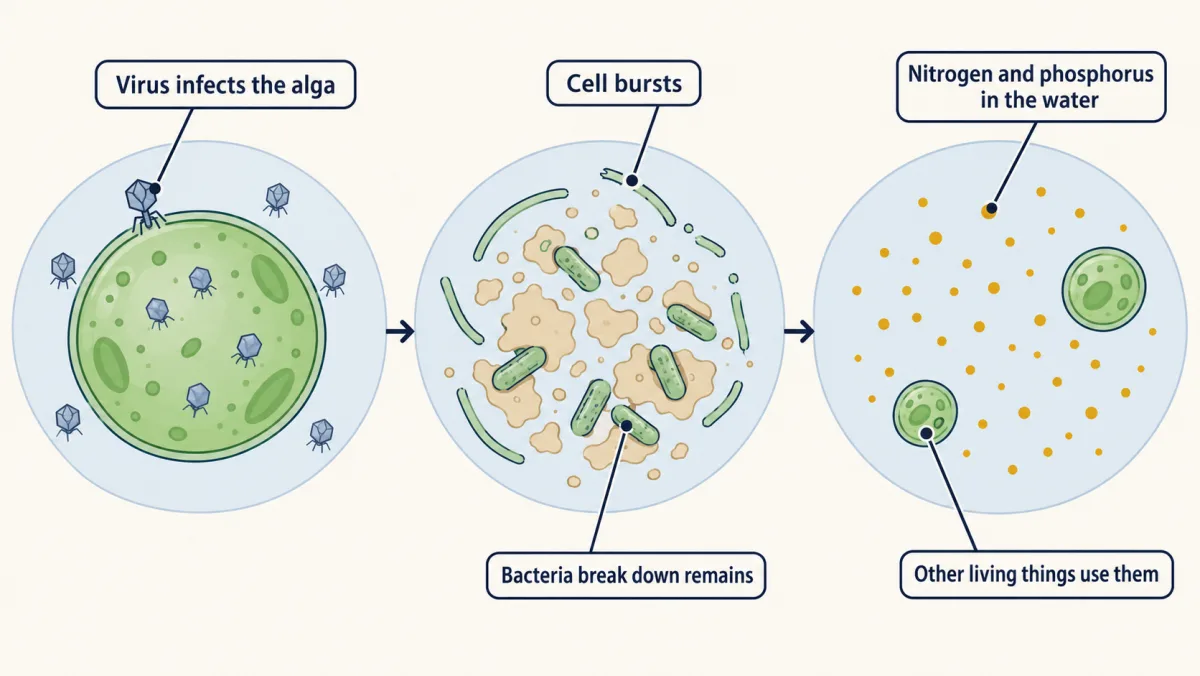
A bacteriophage (phage for short) is a virus that infects bacteria. Ocean water holds enormous numbers of phages and other viruses. When a virus bursts its host cell, the cell’s contents spill into the water. Researchers estimate that in surface waters viruses kill a large share of the ocean’s bacteria and archaea every day, though the estimates are rough and vary from place to place.
What happens to those spilled contents? In a lab model ecosystem, Jakob Haaber and Mathias Middelboe let a virus infect an ocean alga called Phaeocystis. Bacteria then broke down the dead algae. The water gained about 148 micrograms of nitrogen and 7 micrograms of phosphorus per liter that other living things could use.
Viruses can also affect biodiversity, the variety of living things in a place. A virus usually infects only certain kinds of bacteria. When one kind becomes very common, its viruses can spread faster and cut it back, which may leave room for other kinds. A 2019 experiment on coastal water found that when viruses switched from lying hidden inside bacteria to bursting them, the bacterial community became more diverse.
On land, disease can reshape whole landscapes. In the Serengeti in East Africa, the virus disease rinderpest disappeared in the 1960s. Wildebeest numbers then rose, they ate more grass, fewer fires burned, and more trees grew.
Elaborate: how much nitrogen do nodules add?
| Year | Sampling date | Soybean type | Total nitrogen above ground (kg N/ha) | Nitrogen from fixation (kg N/ha) |
|---|---|---|---|---|
| 2006 | 13 Sept | Nodulating | 282 | 195 |
| 2006 | 13 Sept | Non-nodulating | 150 | not applicable |
| 2007 | 12 Sept | Nodulating | 144 | 95.0 |
| 2007 | 12 Sept | Non-nodulating | 67.6 | not applicable |
| 2008 | 23 Sept | Nodulating | 148 | 90.3 |
| 2008 | 23 Sept | Non-nodulating | 61.6 | not applicable |
These are means from a field trial by Snapp, Wilke, Gentry and Zoellner, published in 2017, at the Kellogg Biological Station in Hickory Corners, Michigan. Both soybean types were Williams 82 plants, nearly identical except that one cannot form nodules. Each value is a mean over several farming systems, for one growing season. A hectare is an area of 10,000 square meters, about one and a half soccer fields. “Nitrogen from fixation” was estimated with nitrogen isotopes, so it is not the same as the difference between the two rows.
- In 2006, how much more nitrogen did nodulating plants hold than non-nodulating plants? Write it as a percentage of the non-nodulating value.
- Which year had the most nitrogen from fixation? Was the gap between the two soybean types the same every year?
- Find the mean nitrogen from fixation over the three years.
Claim, evidence, reasoning
Make a claim that answers the essential question for soybean nodule bacteria, using this data.
Start with: The bacteria in soybean nodules were blank to the plants in this trial.
Start with: In every year, nodulating soybeans held blank nitrogen than non-nodulating soybeans, for example blank compared with blank kg N/ha in 2006.
Start with: This shows blank because nitrogen fixation blank. Bacteria can also be pathogens, so whether a microbe helps or harms depends on blank.
Compare with a model answer
The bacteria in soybean nodules helped the plants in this trial. In all three years, nodulating soybeans held about twice as much nitrogen above ground as plants that could not form nodules: 282 compared with 150 kg N/ha in 2006, 144 compared with 67.6 in 2007, and 148 compared with 61.6 in 2008. The nodule bacteria turn nitrogen gas into a form plants use, and plants build proteins and DNA from it. Other bacteria are pathogens, so bacteria are not always harmful; it depends on the microbe and where it lives. One limit: these are three seasons at one Michigan station, so a Virginia field could differ.
Saved in this browser only.
Design problem
Plan an investigation to test whether adding nodule bacteria helps soybeans grow in nitrogen-poor soil. Name your variables, your control, what you keep the same, how many plants you use, and how you keep it safe.
One way to do it
- Question: does adding nodule bacteria increase soybean growth in soil low in nitrogen?
- Independent variable: nodule bacteria added (a garden-store legume inoculant made for soybeans) or not added.
- Dependent variables: dry plant mass after six weeks, the number of nodules per plant, and how many split nodules are pink inside.
- Control: pots of the same sterile, nitrogen-poor potting mix with no inoculant. Sterile mix matters, because ordinary soil may already hold nodule bacteria.
- Constants: the same seed batch, pot size, amount of soil, water, light and temperature. Add no nitrogen fertilizer to either group.
- Sample size and trials: at least 10 pots per group, with pots mixed together on the shelf so neither group gets the better light. Find the mean for each group. Repeat the whole test if you can.
- Safety: wear gloves when handling the inoculant and soil, follow the product label, and wash your hands afterwards.
- What results would mean: if the inoculated plants have more nodules and a higher mean mass, that supports a benefit from the bacteria in these conditions. If both groups match, the bacteria may not have formed nodules, so check the roots.
Evaluate: check your thinking
The pink bumps on a soybean root are nodules where bacteria turn nitrogen from the air into a form the plant uses, in exchange for food from the plant. Bacteria in your gut ferment fiber, and decomposers recycle dead matter. Some bacteria and viruses cause disease, and even they shape ecosystems, so whether a microbe helps or harms depends on which microbe it is and where it lives.
Science practices you used: predicting and testing in a model ecosystem, reading a data table and calculating a difference, a percentage and a mean, planning a fair test with a control and many plants, and naming the limits of one study’s data.
How we measure it
Digging up roots and splitting nodules
A soybean plant is dug up with the soil around its roots, so the nodules stay attached, and a few nodules are cut open. A pink or red inside is a field sign that the bacteria are fixing nitrogen; it tells you yes or no, not how much.
Nitrogen isotope comparison
Nitrogen atoms come in a common light form and a rare heavier form, and the air and the soil hold them in slightly different mixes. By measuring the mix in a soybean and in a plant that cannot fix nitrogen, researchers estimate how much of the soybean’s nitrogen came from the air.
DNA sequencing of microbial communities
Researchers collect water, soil or gut samples and read one gene that all bacteria carry. The different versions of that gene show which kinds of bacteria are present and how many kinds there are, without growing each one in a dish.
Finish line
Test yourself
8 questions
Practice and MCAT-style, with explained answers.
Next · Lesson 15
Germs, Vaccines and Antibiotics
Why did mothers in one maternity clinic of a Vienna hospital die far more often than mothers in the other, and why did the gap shrink once doctors washed their hands in chlorine?
Continue →