Life Science · Unit 5: Living together
Habitat and Niche
How can five kinds of insect-eating birds share the same spruce forest? You use a model of a tree where birds feed everywhere or keep to their own zones, then read real data on where each kind spent its time. Afterwards you can tell a habitat from a niche and explain how different niches help many kinds of living things share one place.
Where this lesson sits
- Virginia SOL LS.6 d
- Practices LS.1 c, LS.1 d, LS.1 e, LS.1 f
Essential question: How can so many kinds of animals share one place without running out of food?
-
Life Science (grade 7) LS.6 d You are here
This lesson
-
Biology
Preview it at high school level
In Biology you will learn a name for the limit this lesson only describes. Carrying capacity is the largest population an environment can support over time. You will read growth curves. A J-shaped curve shows a population growing fast with plenty of food. An S-shaped curve bends and levels off as food and space run short. You will sort the factors that limit a population into living ones, such as predators and disease, and nonliving ones, such as cold and salt. You will see that carrying capacity moves when conditions change, using a winter survey of Chesapeake Bay blue crabs.
-
Biology II Biology II: Ecology, EC.5 a-e
Preview where it goes next
In Virginia’s Biology II: Ecology course (EC.5 a to e), you describe populations with numbers. You measure density, the number of individuals in an area, and how they are spread out. You compare J-shaped and S-shaped growth. You sort limits into those that hit harder in a crowd, such as competition for food, and those that do not, such as a freeze. You also read survivorship curves and age-structure diagrams.
-
College
Watch first Different Niches Let Many Kinds Share · 2:34
Five kinds of small birds called warblers spend the summer in the same spruce forests of Maine and Vermont. All five eat mostly insects that they pick from the trees.
In 1956 and 1957, a scientist named Robert MacArthur watched these birds and timed where they spent their time. If they all hunt insects in the same trees, why doesn’t one kind take all the food? Some of these warblers also pass through Virginia when they migrate. First, decide what you think now.
What do you think? Decide before you read.
-
Scientists disagree: A habitat is the place where an organism lives. A niche is its role there: what it eats, where and when it feeds, and what eats it. Two warblers can live in the same forest, so they share a habitat, but still use it in different ways.
What scientists think
Scientists disagree: A habitat is the place where an organism lives. A niche is its role there: what it eats, where and when it feeds, and what eats it. Two warblers can live in the same forest, so they share a habitat, but still use it in different ways.
-
Scientists disagree: Food is only one part. When scientists timed warblers in spruce trees, the birds differed in where they spent time and how they moved while hunting. Where, when and how an animal feeds, and what eats it, are all part of its niche.
What scientists think
Scientists disagree: Food is only one part. When scientists timed warblers in spruce trees, the birds differed in where they spent time and how they moved while hunting. Where, when and how an animal feeds, and what eats it, are all part of its niche.
-
Scientists disagree: If two species need the same limited food in the same spot, they compete. In a study of warblers, the species used the trees in different but overlapping ways. In a study of barnacles, the larger kind crowded out the smaller kind in many places.
What scientists think
Scientists disagree: If two species need the same limited food in the same spot, they compete. In a study of warblers, the species used the trees in different but overlapping ways. In a study of barnacles, the larger kind crowded out the smaller kind in many places.
Explore: share a tree with five kinds of birds
This simulation shows one spruce tree split into zones: top, middle and lower, and inner and outer branches. Insects are spread through the tree, and a bar shows how many insects each kind of bird eats per day. You set how many kinds of warblers there are, from 1 to 5, and whether they all feed everywhere or each keeps to its own zone. You can also lower the insect supply.
insect left insect eaten today expected catch (average of many sampled days) outer tips: new needles and buds inner base: bare branch base
Made up for this sketch (the lesson gives no numbers for it): every zone holds the same number of insects at the start of each day, because insects come back at a fixed rate. One bird stands for each kind. Each bird has the same number of tries and stops when it has had enough. If two birds go to one zone at the same moment, only one gets the insect. No predators, no migration. In this sketch, these rules and the insect counts are invented. With 4 or 5 kinds, some kinds hold two zones and others one, so they do not have equal shares. In this sketch a kind’s niche is only the zones it uses; the lesson’s niche is more than place.
Overlapping niches lead to competition, and different niches let more species share one habitat. A different niche does not remove all competition, and less food likely means more competition. This is a sketch of the logic, not a measurement.
The model keeps things simple. Insects are spread evenly and come back at a fixed rate. The birds are the same except for where they feed, and there are no predators or migration.
Try this.
- Set five kinds of birds that all feed everywhere. Predict whether every kind gets enough insects. Then test it.
- Now give each kind its own zone. Predict how the bars will change, and check.
- Set the insect supply to much lower in both settings. Predict which setting has more birds falling short. Then test it.
Explain: a place to live and a way to live
- habitat
- niche
- species
- resource
- competition
- biodiversity
A habitat is the place where an organism lives. A spruce forest is a habitat. So is a pond, a marsh or a rotting log.
A niche is an organism’s role in its habitat. It includes the jobs the organism does and the space it uses in the ecosystem. A niche includes:
- what it eats
- where and when it feeds
- the space it uses, such as treetops or soil
- what eats it
- what it does for the ecosystem, such as breaking down dead leaves
Think of the habitat as an address and the niche as a job. The comparison breaks down because a niche is more than one job. It is everything the organism does and uses.
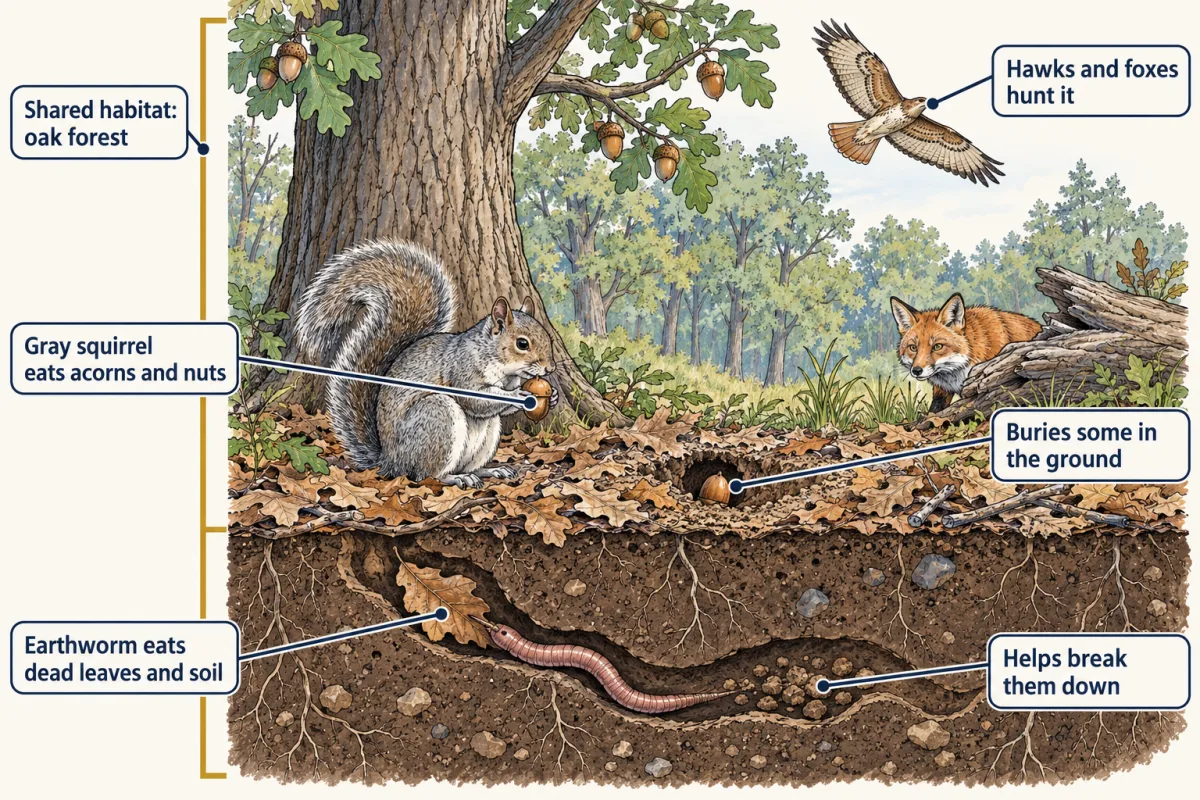
Take a Virginia oak forest. A gray squirrel and an earthworm both live there. They share a habitat. The squirrel eats acorns and nuts and buries some in the ground. Hawks and foxes hunt it. The earthworm eats dead leaves and bits of soil and helps break them down, as you saw in Producers, Consumers and Decomposers. Their niches are very different.
Explain: a niche helps an organism survive
A resource is something a living thing needs and takes from its habitat, such as food, water, shelter or space. An organism’s niche is how it gets those resources. A warbler’s small, thin bill picks insects from among needles. Its niche gives it food, and food keeps it alive.
The amount of a resource can change a niche. When food is plentiful, an animal may feed in just a few favourite spots. When food runs short, it may have to search more places or eat other things. MacArthur saw Cape May warblers feed low in small trees during cold, wet, windy weather. Most of the time they stayed near the treetops.
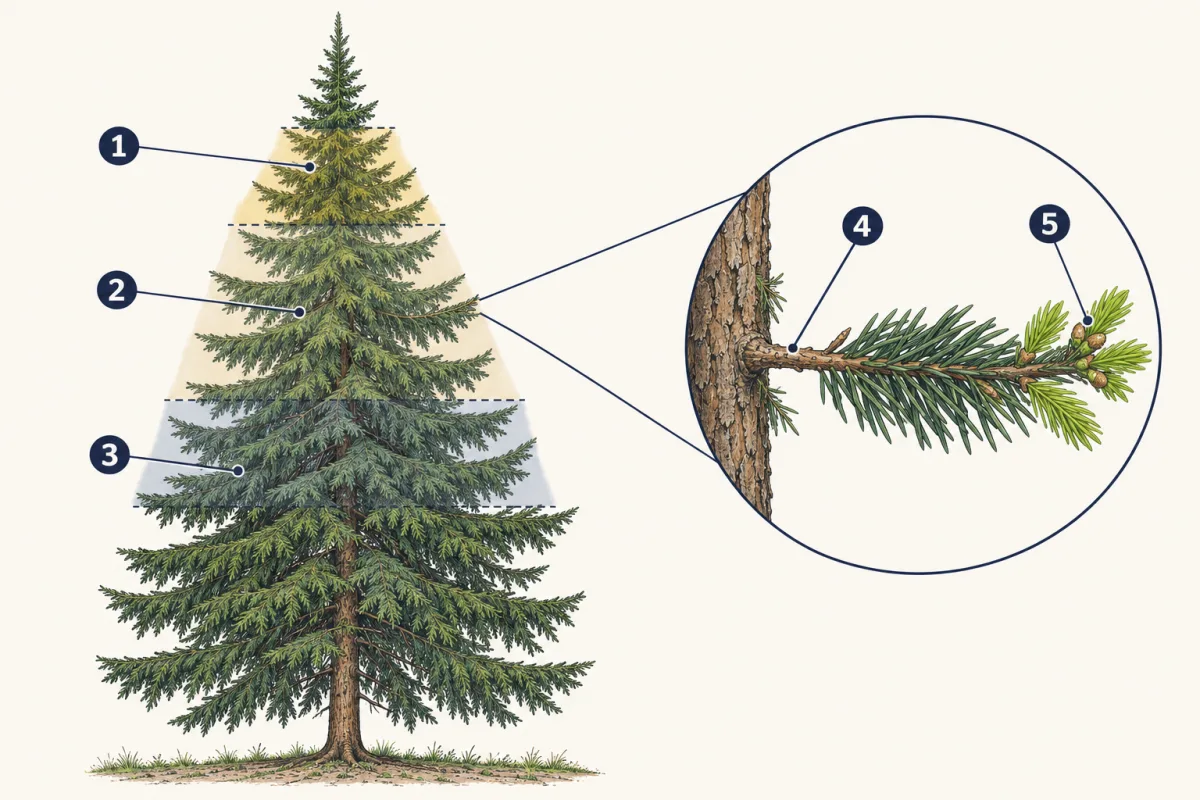
- top band
- middle band
- lower band
- bare inner branch base
- outer branch tips
- top band
- middle band
- blank
- blank
- blank
Word bank: bare inner branch base, lower band, outer branch tips
- blank
- blank
- blank
- blank
- blank
Check your labels
- top band
- middle band
- lower band
- bare inner branch base
- outer branch tips
Explain: sharing a habitat
A species is one kind of living thing whose members can breed with each other and have young that can also breed. When two species need the same limited resource, they compete. Competition is when organisms struggle for the same resources that are in short supply. You will see more in Competition and Cooperation.
If two species have niches that overlap a lot, they compete a lot. One may get most of the food, and the other may do poorly. If their niches are different, they compete less. Many species can then share one habitat.
Biodiversity is the variety of living things in a place. Different niches help a habitat hold more kinds of living things. But using a place differently does not remove all competition. How strongly each species competes, and the weather and food that year, also matter.
- The two species share a habitat because blank.
- Their niches are different because blank.
- This helps them share the forest because blank.
Elaborate: where the warblers spent their time
MacArthur timed each kind of warbler in spruce trees. The table groups his height zones into bands measured down from the treetop. The last column shows the single zone where each kind spent the most time.
| Warbler | Top band, 0 to 6 m (% of time) | Middle band, 6 to 12 m (% of time) | Lower band, 12 to 15 m (% of time) | Lowest zone, below 15 m (% of time) | Most-used single zone (% of time) |
|---|---|---|---|---|---|
| Cape May | 92.0 | 4.5 | 0.0 | 3.5 | outer tips, top 3 m: 49.9 |
| Blackburnian | 74.6 | 25.4 | 0.0 | 0.0 | outer tips, top 3 m: 34.8 |
| Black-throated green | 44.6 | 52.8 | 2.6 | 0.0 | outer tips, 6 to 9 m down: 21.8 |
| Bay-breasted | 27.2 | 70.2 | 2.6 | 0.0 | branch middles, 6 to 9 m down: 19.1 |
| Myrtle (yellow-rumped) | 25.0 | 30.8 | 16.5 | 27.7 | lowest zone, below 15 m: 27.7 |
Source: MacArthur, Ecology, 1958, Figures 2 to 6, from summer observations in 1956 and 1957 in spruce forests of Maine and Vermont. Each value is a percent of that species’ recorded time, not of birds. MacArthur measured in feet; the metres here are converted and rounded. The bands are not equal thirds. Some records were of singing birds, not feeding birds.
- Which two kinds had the same most-used zone? How many percentage points apart were they there?
- Which kind spent the most time in the middle band? Which kind spread its time most evenly?
- Which kinds overlapped in the top band? Use the numbers.
Claim, evidence, reasoning
Make a claim that answers the question: how can five kinds of insect-eating warblers share one forest? Use the table.
Start with: The five warblers can share the forest because blank.
Start with: Cape May warblers spent blank percent of their time in the top band, while bay-breasted warblers spent blank percent in the middle band.
Start with: This supports my claim because blank, which means the birds compete blank for insects. One limit of the data is blank.
Compare with a model answer
The five warblers can share the forest because each kind uses the trees in its own pattern. Cape May warblers spent 92.0 percent of their time in the top band, while bay-breasted warblers spent 70.2 percent in the middle band. Different niches mean the birds compete less for the same insects. The patterns still overlap: Cape May and Blackburnian both used the treetop tips most. The data come from a few forests in two summers. They show where birds spent time, not how much each ate.
Saved in this browser only.
Design problem
Plan an investigation to find out whether two kinds of birds in your schoolyard feed at different heights. You will use two bird feeders and a timer, and you will not touch or catch any birds.
One way to do it
- Question: Do two kinds of birds, such as chickadees and mourning doves, visit a high feeder and a low feeder equally?
- Independent variable: feeder height, 0.5 m or 2.0 m above the ground.
- Dependent variable: the number of visits by each kind of bird in 15 minutes.
- Constants: the same tray feeder that both kinds can use, the same seed mix and amount, the same time of day, and feeders about 3 m apart.
- Control: after 5 of the 10 days, swap which feeder is high and which is low. This checks that the spot is not causing the difference.
- Repeated trials: watch on 10 different days and find the mean visits for each kind at each height.
- Safety: an adult hangs the feeders. Watch quietly from at least 10 m away or from a window. Never touch birds, nests or droppings, and wash your hands after filling feeders.
If one kind visits the low feeder much more and the other visits the high feeder more, they may use different feeding heights here.
Evaluate: check your thinking
The five warblers share one habitat, the spruce forest, but they do not live the same way. Each kind spent its time in its own pattern of zones, and they also hunted in different ways. Because their niches differ, they compete less for the same insects, even though their patterns still overlap.
Science practices you used: using a model to test a prediction, reading a data table and comparing percents, making a claim backed by evidence and reasoning, and planning a fair investigation.
How we measure it
Timed watching
An observer follows one bird and times how long it stays in each part of a tree. Adding up many timed views shows where that kind of bird spends most of its time.
Zone map of a tree
The tree is split into named zones by height and by part of the branch. Each timed view is recorded by zone, so different kinds of birds can be compared on the same map.
Finish line
Test yourself
8 questions
Practice and MCAT-style, with explained answers.
Next · Lesson 20
Land and Water Ecosystems
Why can oysters live in the brackish lower James River but not in its fresh water near Richmond?
Continue →