Life Science · Unit 4: Matter and energy in ecosystems
Nitrogen for Life
The air is mostly nitrogen, so why do farmers still have to give plants nitrogen? You run a model of a soybean field and a cornfield, then read real field data on soybeans that can and cannot grow root bumps. Afterwards you can explain how nitrogen moves from the air to living things and back, and back up a claim about where soybeans get their nitrogen.
Where this lesson sits
- Virginia SOL LS.5 a
- Practices LS.1 a, LS.1 b, LS.1 c, LS.1 d
Essential question: The air is mostly nitrogen, so why do farmers still have to give plants nitrogen?
-
Life Science (grade 7) LS.5 a You are here
This lesson
-
Biology
Preview it at high school level
In Biology you will learn a name for each step of the nitrogen cycle. Nitrogen fixation is the change from nitrogen gas into a usable form. Nitrification, assimilation, ammonification and denitrification are the other steps, and you will learn which living things do each one. You will read Chesapeake Bay data that show how much nitrogen reaches the Bay from farms, cities and the air. You will also look closely at root-nodule bacteria and soybeans as a partnership in which both sides benefit, and learn that most bacteria do not cause disease.
-
Biology II Biology II: Ecology, EC.4 a; Advanced Topics, BIOII.6 c
Preview where it goes next
In Virginia’s Biology II: Ecology course, you follow the nitrogen cycle with every process named and compare it with the carbon, water and phosphorus cycles. You ask which nutrient limits growth in a lake, a forest or a field. Advanced Survey of Biology Topics adds the specialized microbes that carry out each nitrogen process and how people have changed the amount of usable nitrogen on Earth.
-
College
Watch first The Air's Nitrogen Must Be Changed · 2:41
The air around you is about 78 percent nitrogen. Yet corn farmers in Virginia usually add nitrogen to their fields, while soybeans next door, with healthy root bacteria, can often get by with little or none.
Dig up a healthy soybean plant and shake off the soil. You will usually find small round bumps on its roots. What are those bumps? And if nitrogen is all around us, why do plants run short of it?
What do you think? Decide before you read.
-
Scientists disagree: Air is mostly nitrogen gas, but crop plants cannot use it in that form. Scientists found that certain bacteria, some in soil and some in root bumps, change it into forms that roots take up. Plants with no source of usable nitrogen grow poorly, even in open air.
What scientists think
Scientists disagree: Air is mostly nitrogen gas, but crop plants cannot use it in that form. Scientists found that certain bacteria, some in soil and some in root bumps, change it into forms that roots take up. Plants with no source of usable nitrogen grow poorly, even in open air.
-
Scientists disagree: Plants can use only so much. In a 2018 greenhouse test, one soybean grew larger with more nitrogen up to a point, then grew less at the highest amount. Extra nitrogen that plants do not take up can wash away in rain.
What scientists think
Scientists disagree: Plants can use only so much. In a 2018 greenhouse test, one soybean grew larger with more nitrogen up to a point, then grew less at the highest amount. Extra nitrogen that plants do not take up can wash away in rain.
-
Scientists disagree: Rainwater carries usable nitrogen through soil and into streams. Plants also need sugar from photosynthesis, which is part of the carbon cycle, to build proteins with nitrogen. Scientists track these links in fields and in the Chesapeake Bay.
What scientists think
Scientists disagree: Rainwater carries usable nitrogen through soil and into streams. Plants also need sugar from photosynthesis, which is part of the carbon cycle, to build proteins with nitrogen. Scientists track these links in fields and in the Chesapeake Bay.
Explore: grow a soybean field and a cornfield
In this simulation you run one growing season on two fields, soybeans and corn. You can turn root bacteria on or off, choose how much nitrogen fertilizer to add, and set how much it rains. Bars show how much the plants grow, how much usable nitrogen is in the soil, and how much nitrogen washes into a nearby stream.
Set the field, then press Run the season. Each dot is one made-up amount of nitrogen.
In this sketch, everything below is made up (relative amounts, not measured): each dot is one made-up amount of nitrogen. The soil starts with 4 dots, and each step of fertilizer adds 4. Plants can hold at most 12 dots, and a full growth bar means 12. Roots take soil nitrogen first, then root bacteria fill the gap. Rain washes none, 1 in 4, 1 in 2 or 3 in 4 of the nitrogen the plants did not take up. The sketch has no drop in growth at high doses. The picture is a sketch of the logic, not to scale.
Plants can use only so much nitrogen. Nitrogen they do not take up can wash into streams in rain, and some streams flow to the Chesapeake Bay, where extra nitrogen can feed algal blooms.
Try this.
- Turn the root bacteria on and add no fertilizer. Predict which crop will grow better. Then run the season.
- Predict what will happen to the corn if you add a little fertilizer, then a lot. Test both and watch the soil bar.
- Add a lot of fertilizer and turn the rain up. Predict where the extra nitrogen goes. Then check the stream bar.
Explain: why living things need nitrogen, and why air is not enough
- nitrogen cycle
- protein
- bacteria
- root nodule
- decomposer
- fertilizer
- biodiversity
- algal bloom
Every living thing is built partly from nitrogen. A protein is a large molecule that builds cells and does much of their work. Proteins contain nitrogen. DNA, the material that carries a living thing’s instructions, contains nitrogen too. So a plant cannot grow new leaves without it, and you cannot grow muscle without it.
Here is the puzzle. The air is about 78 percent nitrogen, but it is nitrogen gas. Most living things cannot use nitrogen in that form. Corn can stand in nitrogen-rich air all summer and still run short.
Nitrogen gas must first be changed into other forms that plants can use. Three things can change it:
- Bacteria are tiny living things, each made of one cell. Some kinds that live free in the soil change nitrogen gas into a usable form.
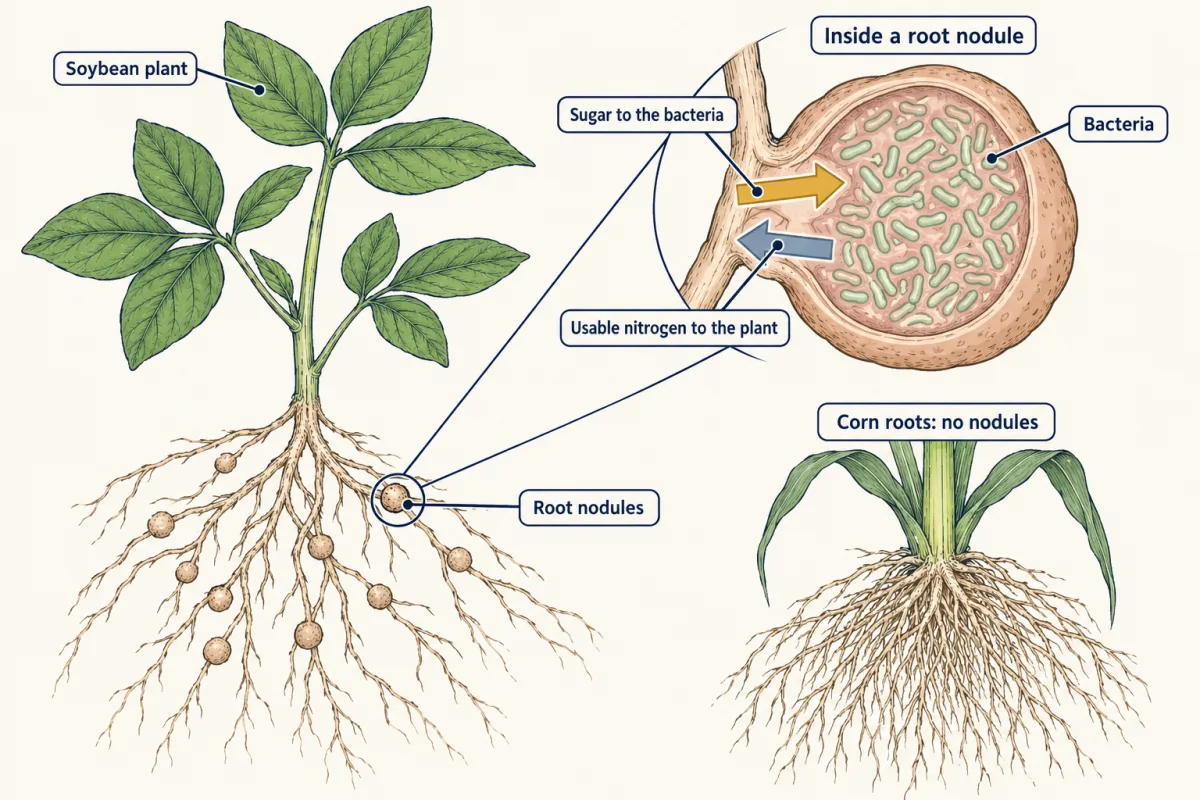
- A root nodule is a small bump on the root of a plant such as a bean, pea, soybean or peanut. Bacteria live inside it and change nitrogen gas into a usable form for the plant.
- Lightning, and factories that make fertilizer, also change nitrogen gas. Fertilizer is material that farmers add to soil to supply nutrients such as nitrogen.
The soybean and its bacteria are partners. The plant gives the bacteria sugar it made by photosynthesis. The bacteria give the plant usable nitrogen. Corn has no root nodules, so it depends on usable nitrogen already in the soil.
Explain: the nitrogen cycle
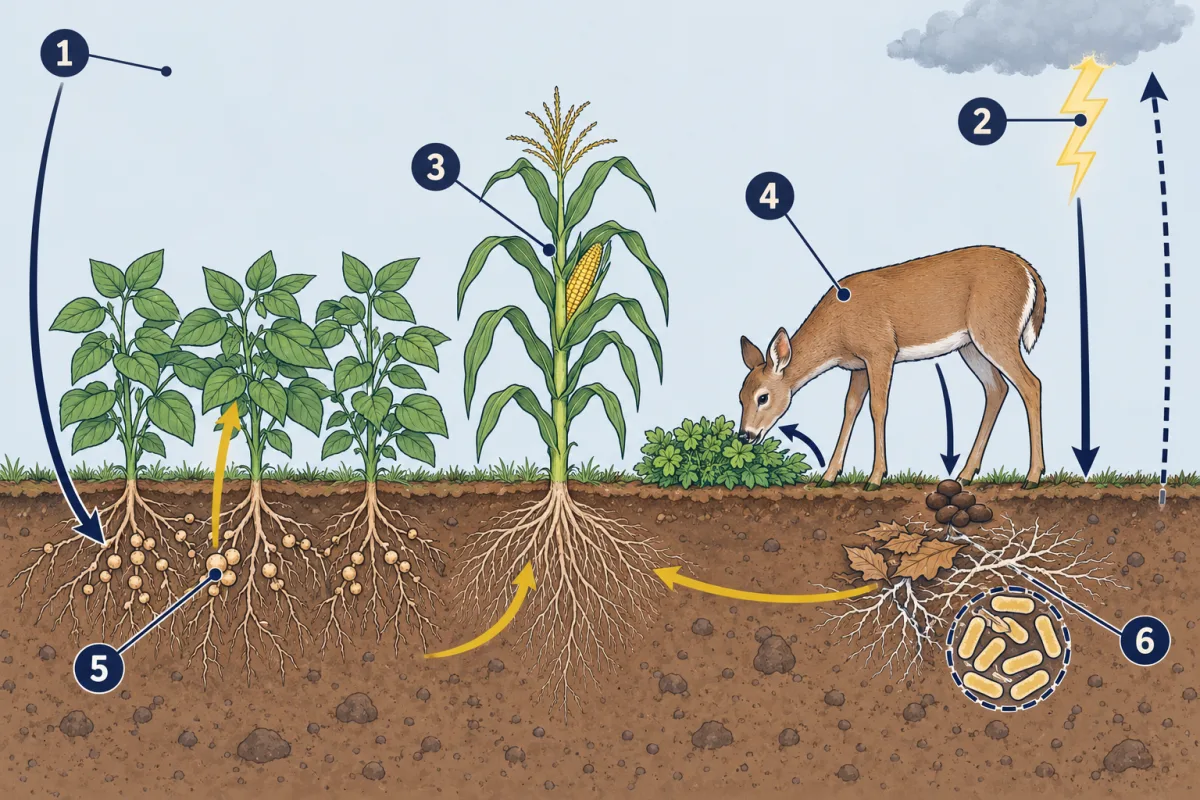
The nitrogen cycle is the movement of nitrogen from the air, through the soil, into living things and back to the air. At each stage, the nitrogen changes form. No new nitrogen is made, and none is used up.
- Bacteria, lightning and factories change nitrogen gas from the air into usable forms.
- Plant roots take up usable nitrogen from the soil.
- Animals get nitrogen by eating plants or other animals.
- A decomposer is a living thing, such as a fungus or a bacterium, that breaks down dead things and wastes. Decomposers return the nitrogen to the soil in a usable form.
- Other bacteria in the soil change some usable nitrogen back into nitrogen gas, which goes back into the air.
- nitrogen gas
- lightning
- corn
- deer
- root nodule
- decomposer
- blank
- blank
- corn
- deer
- blank
- blank
Word bank: decomposer, lightning, nitrogen gas, root nodule
- blank
- blank
- blank
- blank
- blank
- blank
Check your labels
- nitrogen gas
- lightning
- corn
- deer
- root nodule
- decomposer
This cycle is tied to the others. Water moves usable nitrogen through the soil and carries it into streams. Plants use sugar from photosynthesis to build proteins with nitrogen. You met the carbon and water cycles in The Carbon and Water Cycles.
Explain: too little or too much nitrogen
The amount of usable nitrogen changes what can live in a place. In many ecosystems, there is not enough of it, so plants grow less. Less plant growth means less food for animals.
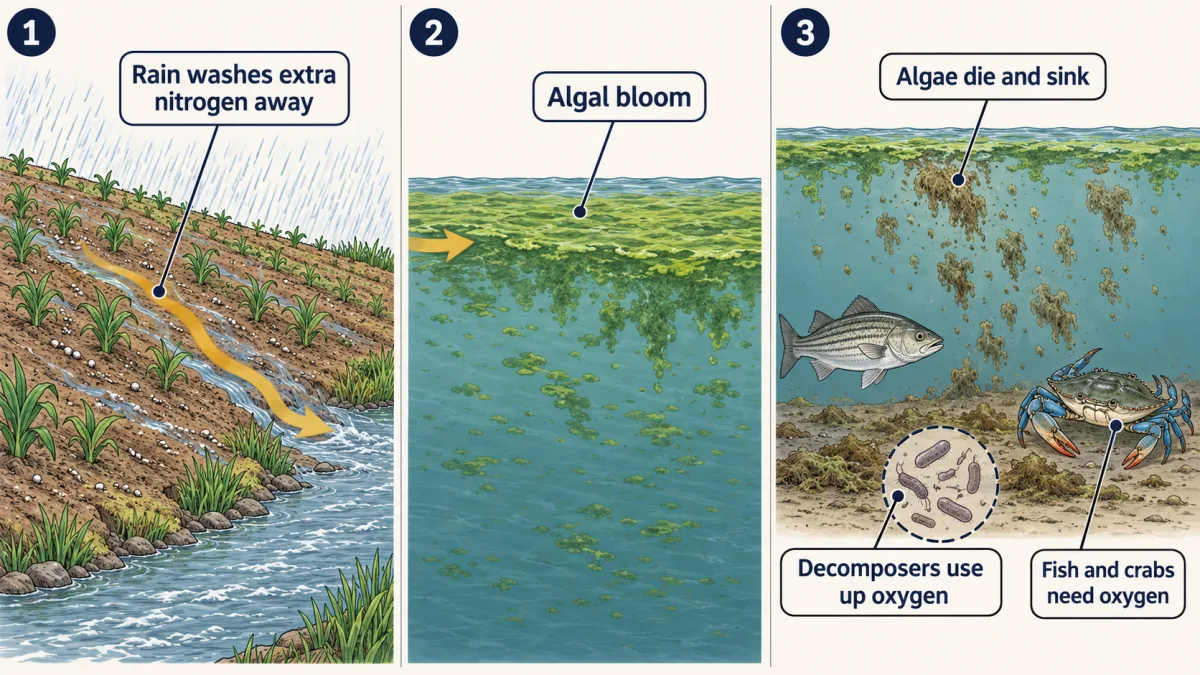
Too much nitrogen causes problems too. Rain can wash extra nitrogen from farms, lawns and other places into streams that flow to the Chesapeake Bay. There it can feed an algal bloom, a fast growth of algae in the water. When the algae die, decomposers break them down and use up oxygen that fish and crabs need. You will see more in Big Changes (a later lesson).
Extra nutrients can also change which plants grow. In an experiment in 40 grasslands on six continents, adding nutrients, including nitrogen, made plants grow more. But fewer kinds of plants grew, mostly because the taller plants shaded the smaller ones. Biodiversity is the variety of living things in an area. So the amount of nitrogen affects biodiversity.
Elaborate: do root bumps add nitrogen?
Scientists in Michigan grew two kinds of soybeans side by side. The plants were nearly the same, except that one kind cannot form root nodules. No fertilizer was added. Late each summer they measured the dried plant parts above the ground.
| Year | Soybean type | Dry plant mass (tonnes per hectare) | Nitrogen in plants above ground (kg per hectare) |
|---|---|---|---|
| 2006 | With nodules | 8.9 | 282 |
| 2006 | No nodules | 6.6 | 150 |
| 2007 | With nodules | 5.2 | 144 |
| 2007 | No nodules | 3.5 | 67.6 |
| 2008 | With nodules | 4.9 | 148 |
| 2008 | No nodules | 2.8 | 61.6 |
Source: Snapp, Wilke, Gentry and Zoellner, Agronomy Journal, 2017, field trial at the Kellogg Biological Station, Hickory Corners, Michigan, 2006 to 2008. Each value is a mean over several research plots with different management histories. A hectare is 10,000 square meters, about the size of one and a half soccer fields.
- In each year, which soybean type held more nitrogen?
- In 2007, how many more kilograms of nitrogen per hectare did the plants with nodules hold?
- Find the mean nitrogen for plants with nodules over the three years. Do the same for plants with no nodules.
- In every year, soybeans with nodules held blank nitrogen than soybeans with no nodules.
- The plants with no nodules still held some nitrogen, which came from blank.
- One reason to be careful with this claim is blank.
Claim, evidence, reasoning
Make a claim that answers the essential question: where did the soybeans with nodules get their extra nitrogen? Use the Michigan data.
Start with: The soybeans with nodules got extra nitrogen from blank.
Start with: In blank, plants with nodules held blank kg of nitrogen per hectare, but plants with no nodules held only blank.
Start with: Plants cannot use nitrogen gas, but bacteria in blank change it into blank, so blank.
Compare with a model answer
The soybeans with nodules got extra nitrogen from the bacteria in their root nodules. In 2007 they held 144 kg of nitrogen per hectare, while plants with no nodules held only 67.6 kg, and no fertilizer was added. Plants cannot use nitrogen gas, but nodule bacteria change it into a usable form. One limit: this is one Michigan station over three years, and the difference is not an exact measure of what the bacteria supplied.
Saved in this browser only.
Design problem
Do root bacteria help pea plants grow in soil with little usable nitrogen? Plan an investigation.
One way to do it
- Question: Do pea plants grow more mass when their seeds are coated with root-nodule bacteria?
- Independent variable: seeds coated with a garden inoculant (a powder of root-nodule bacteria sold for peas and beans) or not coated.
- Dependent variable: dry mass of each plant above the soil, in grams, after five weeks. Also count the nodules on each plant’s roots.
- Constants: same pea variety, same pot size, same new, low-nitrogen mix such as sand or vermiculite, with no added fertilizer, same water, light and temperature.
- Control: pots of uncoated seeds.
- Repeated trials: six pots of each kind. Find the mean mass.
- Safety: wear gloves when handling the powder and soil, wash your hands after, and do not eat any seeds or plants.
If coated plants have nodules and more mass, the data support the idea that the bacteria supplied nitrogen.
Evaluate: check your thinking
Corn cannot use the nitrogen gas in the air, so it needs usable nitrogen in the soil, and farmers often add it. The bumps on soybean roots are nodules. Bacteria inside them change nitrogen gas into a usable form, so soybeans often need little or no added nitrogen.
Science practices you used: asking a testable question, planning a fair test with a control and repeated trials, reading a data table and finding a mean, and making a claim with evidence and reasoning.
How we measure it
Matched soybean lines in one field
Scientists grow two soybean lines that are nearly the same, except that one cannot form root nodules, side by side in the same field. Any big difference between them points to the nodules and their bacteria.
Drying and weighing plants
Workers cut the plants above the ground in a measured area, dry them and weigh them on a balance. The dry mass shows how much plant matter grew in that area.
Measuring nitrogen in plant tissue
A machine burns a small sample of dried, ground plant and measures the nitrogen that comes off. Multiplying the share of nitrogen in the sample by the total dry mass gives the total nitrogen the plants held in that area.
Finish line
Test yourself
8 questions
Practice and MCAT-style, with explained answers.
Next · Lesson 16
DNA: The Code of Life
If strawberries, mushrooms, bacteria and people all have DNA, why are they so different?
Continue →