Life Science · Unit 5: Living together
Competition and Cooperation
Why do two kinds of tiny paramecium struggle in a shared tube while thousands of honeybees share food in a hive? You run a model tube with one or two kinds of paramecium, then read real counts from Gause’s 1934 book. Afterwards you can explain competition, cooperation and limiting factors, and make a claim from data about how sharing the same food changed each population.
Where this lesson sits
- Virginia SOL LS.6 b
- Practices LS.1 b, LS.1 c, LS.1 d, LS.1 e
Essential question: Why do some living things fight over food while others share it?
-
Life Science (grade 7) LS.6 b You are here
This lesson
-
Biology
Preview it at high school level
In Biology you will learn a name for the limit you saw here: carrying capacity. It is the largest population an environment can support over time. You will read two kinds of growth curves. A J-shaped curve shows a population growing faster and faster when food is plentiful. An S-shaped curve shows growth slowing and leveling off as limits set in. You will sort limiting factors into biotic and abiotic ones. You will also see that carrying capacity is not fixed. It moves when conditions change, which you test with real winter survey counts of blue crabs in the Chesapeake Bay.
-
Biology II Biology II: Ecology, EC.5 a-e
Preview where it goes next
In Virginia's Biology II: Ecology course you measure populations in more detail. You find density, the number of individuals in an area, and dispersion, whether they are clumped, evenly spaced or random. You compare J-shaped and S-shaped growth, and you sort limits into density-dependent ones, such as competition and disease, which hit harder in a crowd, and density-independent ones, such as a freeze. You also read age-structure diagrams and survivorship curves.
-
College
Watch first Who Gets the Food? Who Shares It? · 2:46
In 1934 a scientist named G. F. Gause published his counts of two kinds of paramecium, tiny one-celled living things that swim in water. Each kind grew well alone in a tube with bacteria to eat, but when the two kinds shared a tube, one kind stayed common while the other shrank to a small number. Meanwhile, in a beehive, tens of thousands of honeybees share food and work. So why do some living things struggle over food while others share it? And what decides how many of one kind can live in a place?
What do you think? Decide before you read.
-
Scientists disagree: Gause’s paramecia never fought. They ate the same bacteria, and bacteria eaten by one were gone for the other. Gause saw the food get used up as the counts stopped rising. Competing often means getting a limited thing first or using it better.
What scientists think
Scientists disagree: Gause’s paramecia never fought. They ate the same bacteria, and bacteria eaten by one were gone for the other. Gause saw the food get used up as the counts stopped rising. Competing often means getting a limited thing first or using it better.
-
Scientists disagree: Plants need light, water and minerals from soil, and a crowded patch has only so much of each. In a 2017 greenhouse study, plants grew more upright when green filters copied the shade of short, crowded neighbors.
What scientists think
Scientists disagree: Plants need light, water and minerals from soil, and a crowded patch has only so much of each. In a 2017 greenhouse study, plants grew more upright when green filters copied the shade of short, crowded neighbors.
-
Scientists disagree: Members of one species need many of the same things: the same food, the same shelter and mates of their own kind. So they often compete with each other. Ecologists see this in plants and animals.
What scientists think
Scientists disagree: Members of one species need many of the same things: the same food, the same shelter and mates of their own kind. So they often compete with each other. Ecologists see this in plants and animals.
Explore: share a tube of food
The simulation shows a model tube with two kinds of paramecium as colored dots. A bar graph tracks how many of each kind there are for 20 days. You choose how much food goes in each day, whether the second kind is added, and how much their foods overlap, meaning how much of the same food both kinds eat.
In this sketch, Kind 1 is alone in the tube. Press Run.
Made up for this sketch, in relative units, not measurements: each food level sets how high the bars can get; both kinds start with the same few; Kind 1 uses food faster (about 2 to 1); “partly the same” food is a guess, and different food means no overlap in this sketch. Growth slows as both kinds together fill the top set by the food; the competition strengths are invented. No predators and no random scatter. Dots are not to scale.
Rule to keep: when two kinds eat the same limited food, food eaten by one is gone for the other, and the kind that gets more of it can leave the other with a small number.
Try this.
- Grow one kind alone with a medium amount of food. Predict whether it will grow, and whether it will grow forever. Then run it.
- Turn on the second kind, with the same food. Predict which bars will change, and how. Then run it.
- Change the food overlap to “different food.” Predict whether both kinds can stay in the tube. Then test it.
The model keeps things simple. The food supply is steady, there are no predators, and the kind that wins is set to use food faster.
Explain: competing for what you need
- population
- community
- competition
- cooperation
- limiting factor
- biotic factor
- abiotic factor
- interdependent
Every living thing needs matter and energy. Animals get both from food. Plants capture energy from sunlight and take in water, carbon dioxide and minerals, as you saw in that lesson. Most of these things are limited.
A population is all the members of one species living in one area at the same time. A community is all the populations in an area that interact with each other.
Competition happens when living things need the same resource and there is not enough for all of them. Animals compete for:
- food and water, which give them matter and energy
- shelter and territory, the area an animal uses and keeps others out of
- mates
Members of one population often compete hard, because they need many of the same things. Two male deer may push with their antlers in the breeding season. Robins on one lawn hunt the same worms. Different species compete too, like the two kinds of paramecium.
Competition is often quiet. Nobody has to fight. A bird that finds the seeds first eats them, and they are gone for the next bird. Over many generations, individuals with inherited traits that help them get food may leave more young. In this way, competition can shape these helpful traits, called adaptations, as you will see in that lesson. Kinds that use different foods or places compete less, which you will meet in that lesson.
Plants compete too. They need light, water and minerals from the soil. A tall plant can shade a short one. Some plants grow taller, spread longer roots, or turn their leaves toward the light. How a plant responds depends on the plant and on its neighbors.
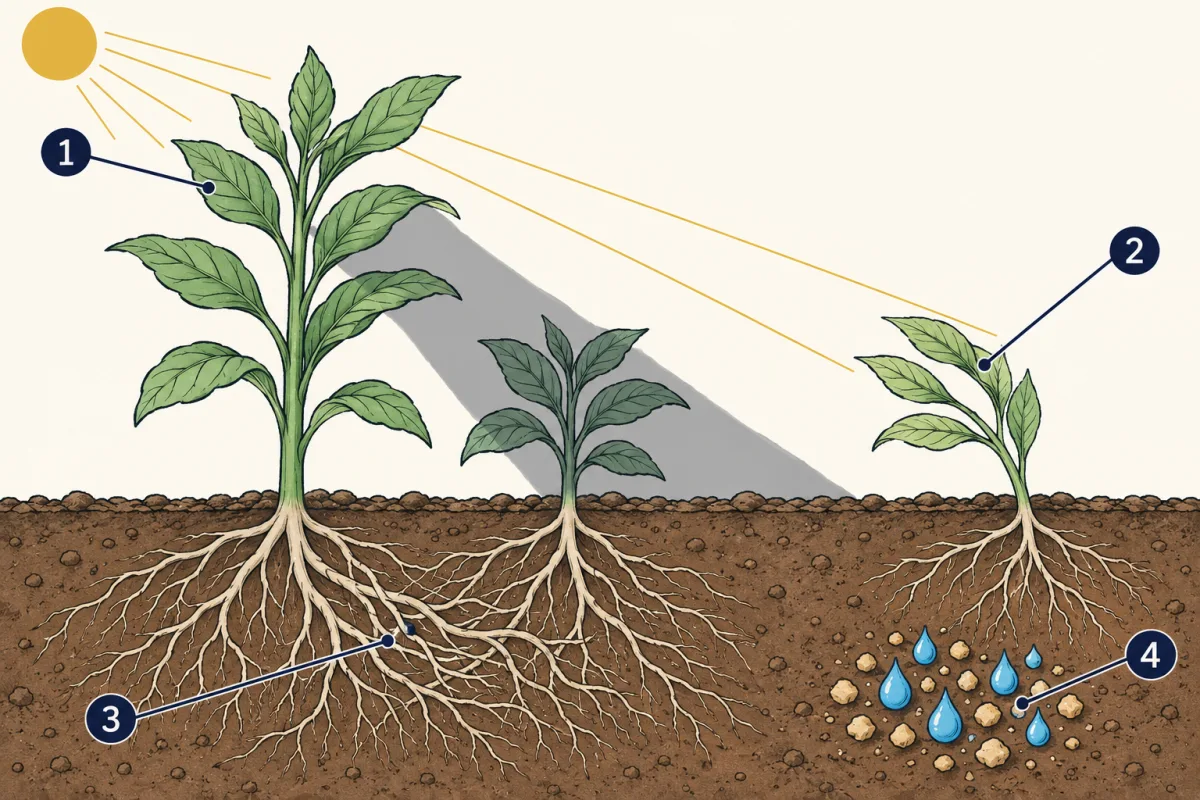
- a tall plant shading a shorter one
- leaves turned toward the light
- roots of neighbors spreading into the same soil
- water and minerals in the soil
- a tall plant shading a shorter one
- leaves turned toward the light
- blank
- blank
Word bank: roots of neighbors spreading into the same soil, water and minerals in the soil
- blank
- blank
- blank
- blank
Check your labels
- a tall plant shading a shorter one
- leaves turned toward the light
- roots of neighbors spreading into the same soil
- water and minerals in the soil
Explain: working together
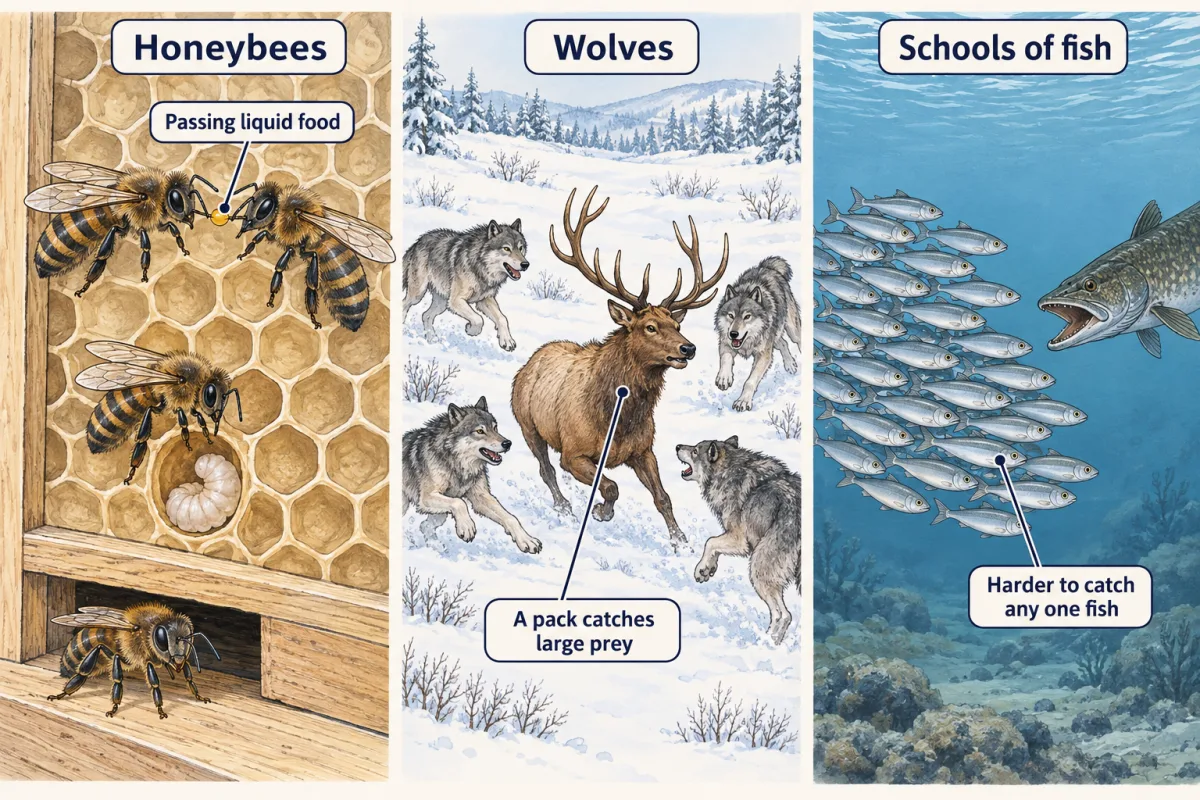
Cooperation happens when members of a population work together to meet their needs. Here are three examples.
- Honeybees. A colony can hold tens of thousands of bees. Worker bees do different jobs, such as caring for young, guarding the hive and collecting food. They also pass liquid food from one bee to another. The shares are not always equal.
- Wolves. A pack hunts as a group and can catch large prey, such as elk. You can read more in that lesson.
- Schools of fish. Many small fish swim close together. A tight school can make it harder for a predator to catch any one fish.
Explain: limiting factors and linked lives
A limiting factor is anything in the environment that limits which species, or how many of a species, can live in an ecosystem. A biotic factor is a living part of the environment. An abiotic factor is a nonliving part, such as water or temperature.
| Limiting factor | Biotic or abiotic | How it can limit a population |
|---|---|---|
| Food | Biotic | Less food means fewer young survive. |
| Water | Abiotic | In a dry summer, some animals and plants die. |
| Shelter | Either | Too few dens or nest holes leave some animals exposed. |
| Disease | Biotic | Sickness can spread faster in a crowded group. |
| Predation | Biotic | Predators eat some members of the population. |
| Cold weather | Abiotic | A hard freeze can kill many animals at once. |
Shelter can be living, like a hollow tree, or nonliving, like a gap in rocks.
Populations in a community depend on each other, so we call the community interdependent. A change in one population affects the others. Think about Gause’s tubes. The bacteria were a population too. Gause added fresh bacteria every day. As the paramecia grew, they ate the day’s bacteria until the liquid cleared, so with little food left, the paramecia stopped growing. If a disease killed many rabbits in a forest, the foxes that eat rabbits would find less food.
Elaborate: read Gause’s counts
| Day | P. aurelia alone (per 0.5 mL) | P. caudatum alone (per 0.5 mL) | P. aurelia, sharing (per 0.5 mL) | P. caudatum, sharing (per 0.5 mL) |
|---|---|---|---|---|
| 0 | 2 | 2 | 2 | 2 |
| 2 | 14 | 10 | 10 | 10 |
| 4 | 56 | 11 | 58 | 29 |
| 6 | 189 | 56 | 202 | 88 |
| 8 | 330 | 137 | 221 | 124 |
| 12 | 610 | 199 | 302 | 83 |
| 16 | 560 | 179 | 363 | 55 |
| 25 | 510 | 180 | 350 | 20 |
These are Gause’s mean counts of paramecia in a 0.5 mL sample from 5 mL lab tubes, read from Table 3 of his 1934 book The Struggle for Existence (pages 144 to 145). Only eight of his days are shown. From day 20 he took samples from similar tubes together.
- Grown alone, which kind reached higher counts? About how many times higher was it on day 12?
- On which day was caudatum highest when sharing? What happened to it after that day?
- On day 25, compare each kind alone and sharing. Did sharing affect only caudatum?
Claim, evidence, reasoning
Make a claim that answers the question: how did sharing the same food change each population? Use the table.
Start with: When the two kinds shared a tube, blank.
Start with: On day 25, caudatum had blank per sample alone and blank sharing, while aurelia had blank alone and blank sharing.
Start with: This happened because both kinds ate blank, so blank. The table cannot tell us blank.
Compare with a model answer
Sharing a tube held both kinds back, but caudatum much more. On day 25, caudatum had 180 per sample alone but only 20 when sharing. Aurelia had 510 alone and 350 sharing. Both kinds ate the same bacteria, so food eaten by one was gone for the other, and aurelia kept more of it. The data have limits: these are lab tubes, not a pond, and the counts come from small samples. The table alone cannot prove food was the only cause.
Saved in this browser only.
Design problem
Plan a test of whether crowding makes plants compete. You can use radish seeds, pots, potting soil, water and a balance.
One way to do it
- Question: How does the number of plants in a pot affect how much each plant grows?
- Independent variable: plants per pot, such as 1, 4, 8 and 16.
- Dependent variable: mean mass of each plant in grams after three weeks. Pull the plants, rinse off the soil, blot them dry and weigh them, then divide each pot’s total plant mass by the number of plants in it.
- Control: pots with one plant, which has no neighbors to compete with.
- Constants: pot size, the same soil, the same water in mL each day, the same light and the same temperature.
- Repeated trials: at least three pots for each crowding level.
- What results would mean: if mean mass per plant falls as crowding rises, the plants were probably competing for light, water or minerals.
- Safety: wear gloves or wash your hands after handling soil. Do not eat the plants or seeds.
Evaluate: check your thinking
The two kinds of paramecium ate the same bacteria in a small tube. Food eaten by one was gone for the other, so both were held back, and caudatum shrank the most. Honeybees in one hive cooperate, sharing food and jobs.
Science practices you used: making predictions with a model and naming its limits, reading a data table and comparing numbers, making a claim backed by evidence and reasoning, and planning a fair test with a control and repeated trials.
How we measure it
Counting a measured sample
A scientist takes the same small volume of liquid each time, such as 0.5 mL, and counts the living things in it under a microscope. Comparing counts from equal samples shows whether a population is growing or shrinking.
Alone versus together comparison
Each kind is grown alone as a control, and both kinds are grown together in the same conditions. Differences between the alone and together counts show what sharing did to each population.
Food tracer
Bees are fed sugar water with a tiny radioactive tag that an instrument can detect. Measuring the tag in each bee later shows where the food went and how evenly it was shared.
Finish line
Test yourself
8 questions
Practice and MCAT-style, with explained answers.
Next · Lesson 18
Living Together: Symbiosis
The gray-green crusty patches on a tree trunk look like one living thing, so why do scientists say many of them are more than one living thing at once?
Continue →