Organismal Biology · Unit 3: Supply and exchange
Digestive Systems and Nutrition
How does an animal turn a meal into molecules its cells can use, and who does the work when the food is grass? This lesson follows food through the human tract organ by organ, separates the four jobs of a gut, compares cows, horses, rabbits, a leaf-eating bird and a cat, reads Pavlov's sham-fed dogs as the test of nervous control, and balances the gut's daily water budget. Afterwards you can name the job of each organ and gland, say which nerve or hormone switches it on, and judge what a comparison of gut lengths across species can and cannot show.
Watch first What Told the Stomach to Start · 2:41
A dog eats a meal that falls out of an opening in its neck before it reaches the stomach, and its stomach still pours out acid juice. This lesson follows a meal through a gut, asks who does the work when the food is grass, and shows how nerves and hormones switch each part on.
One tube, four jobs
A gut does four things. Mechanical breakdown tears and grinds food into smaller pieces. Enzymatic hydrolysis splits large molecules (starch, proteins, fats) into small subunits by adding water across their bonds; the enzyme chemistry belongs to the Biochemistry lesson on digestion. Absorption moves those subunits across the gut lining into the body, using the transporters described in membrane transport and an epithelium, a sheet of tightly joined cells. Elimination gets rid of what is left. Many animals add a fifth step: fermentation, the breakdown of food by microbes living in the gut, without oxygen.
The simplest arrangement is an incomplete gut, a sac with one opening. In Hydra, a small freshwater cnidarian, and in a planarian flatworm, food enters a gastrovascular cavity, is digested there, and the leftovers go out the way they came in. A complete gut is a tube with a mouth at one end and an anus at the other, as in earthworms, insects and vertebrates. Food moves one way, so different regions can do different jobs in sequence. The body plans behind this split are in animal body plans.
Mouth to anus in a human
In an adult human, food passes from the mouth to the pharynx, the esophagus, the stomach, the small intestine (duodenum, then jejunum, then ileum), the large intestine (cecum, then the ascending, transverse, descending and sigmoid colon), the rectum and the anal canal, which opens at the anus. One main job per stop:
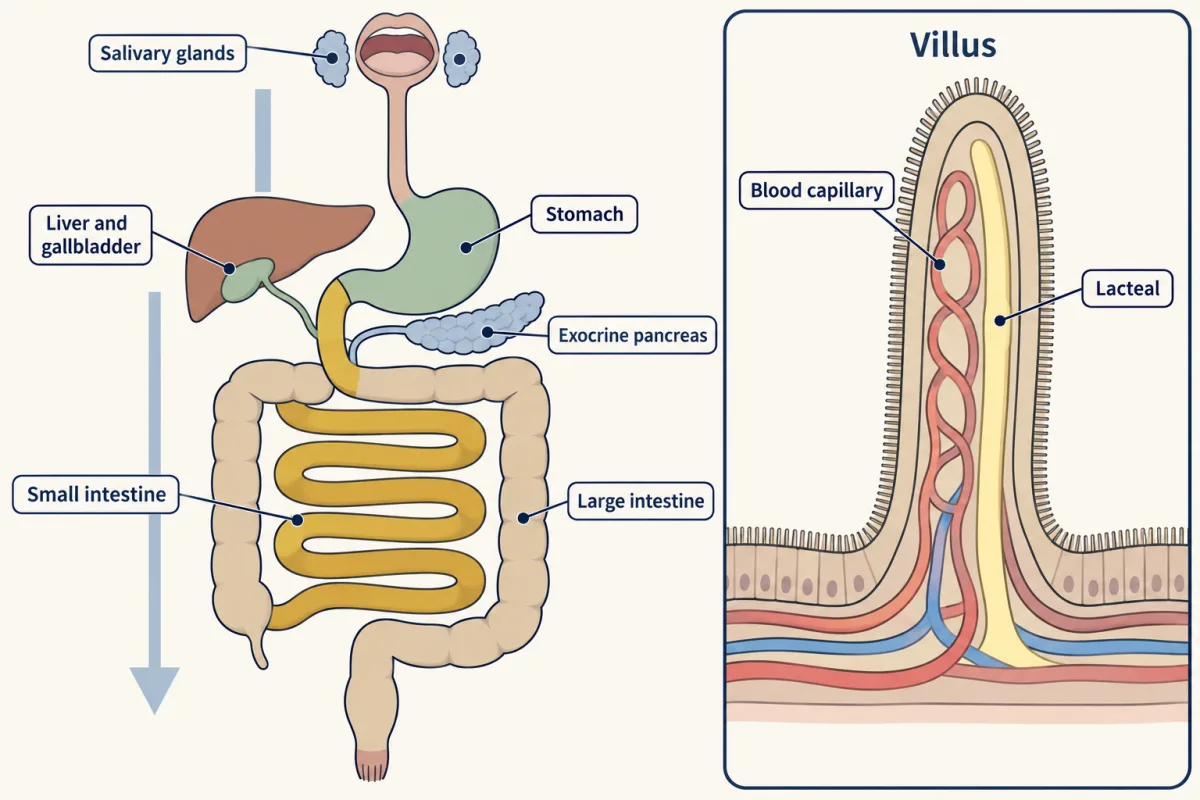
- Mouth and salivary glands. Teeth reduce particle size. Three pairs of major salivary glands (parotid, submandibular, sublingual) add saliva, whose amylase starts digesting starch.
- Esophagus. Waves of muscle contraction, called peristalsis, push the swallowed lump (the bolus) to the stomach.
- Stomach. It mixes food with acid and enzymes into a soup called chyme. Parietal cells secrete hydrochloric acid and chief cells secrete pepsinogen, the inactive form of pepsin. The layers of its wall are in tissues and homeostasis.
- Small intestine. The main site of digestion and of nutrient absorption. Circular folds, finger-like villi and the microvilli on each cell multiply its surface.
- Liver and gallbladder. The liver makes bile; the gallbladder stores and concentrates it. Bile salts emulsify fat, breaking large drops into small droplets that lipase can reach. Bile is not an enzyme.
- Exocrine pancreas. It sends digestive enzymes and bicarbonate, which neutralizes the stomach’s acid, into the duodenum.
- Large intestine. It absorbs water and salts, and its microbes ferment what escaped digestion.
Most absorbed sugars and amino acids enter blood capillaries in the villi. Absorbed fat is mostly packaged into particles called chylomicrons, which leave through lacteals, the lymph vessels of the villi.
Worked problem: the gut’s water budget. Take an adult human at steady state, with no change in the water held in the gut. Textbook figures, used here as illustrative values: about 9.0 L per day of water enters the small intestine (food, drink, and secretions such as saliva, gastric juice, bile and pancreatic juice), and about 90% of it is absorbed there.
- Small intestine. Absorbed = 9.0 L per day x 0.90 = 8.1 L per day. Passed on to the colon = 9.0 - 8.1 = 0.9 L per day.
- Colon. Suppose, as an illustrative value, the colon absorbs 0.8 L per day. Fecal water = 0.9 - 0.8 = 0.1 L per day. Total absorbed = 8.1 + 0.8 = 8.9 L per day, so overall absorption = 8.9 / 9.0 = 98.9%.
- Halve colonic absorption to 0.4 L per day. Fecal water = 0.9 - 0.4 = 0.5 L per day, five times as much. Overall absorption = 8.5 / 9.0 = 94.4%, a drop of only 4.4 percentage points.
Check: in each case absorbed plus fecal water equals 9.0 L per day (8.9 + 0.1, then 8.5 + 0.5). Fecal water is a small difference between two large flows, so it is very sensitive to colonic absorption.
- Small intestine
- Colon
- Overall absorption
- Check: absorbed + fecal water = input
In this sketch: adult human at steady state, no change in the water held in the gut; textbook figures used as illustrative values; bar and arrow widths proportional to flow. Slider ranges are chosen for the sketch; only 9.0 L, 90%, 0.8 and 0.4 L per day come from the lesson.
Rule to keep: absorbed water plus fecal water equals the water that entered. Fecal water is what is left of what reaches the colon after the colon absorbs; in the lesson’s numbers, a small difference between two large flows.
Who digests cellulose: cow, horse, rabbit, hoatzin
Cellulose is the main fiber of plant cell walls, though pectins and hemicelluloses make up much of the rest. Humans make no cellulase, the enzyme that breaks it, and no vertebrate is known to make enough of its own. Herbivores depend on microbes that ferment cellulose and release short-chain fatty acids such as acetate, propionate and butyrate, which the host absorbs. The microbe-host partnership is a mutualism, treated in mutualism, parasitism and coevolution. Where in the tube the fermentation happens differs between groups.
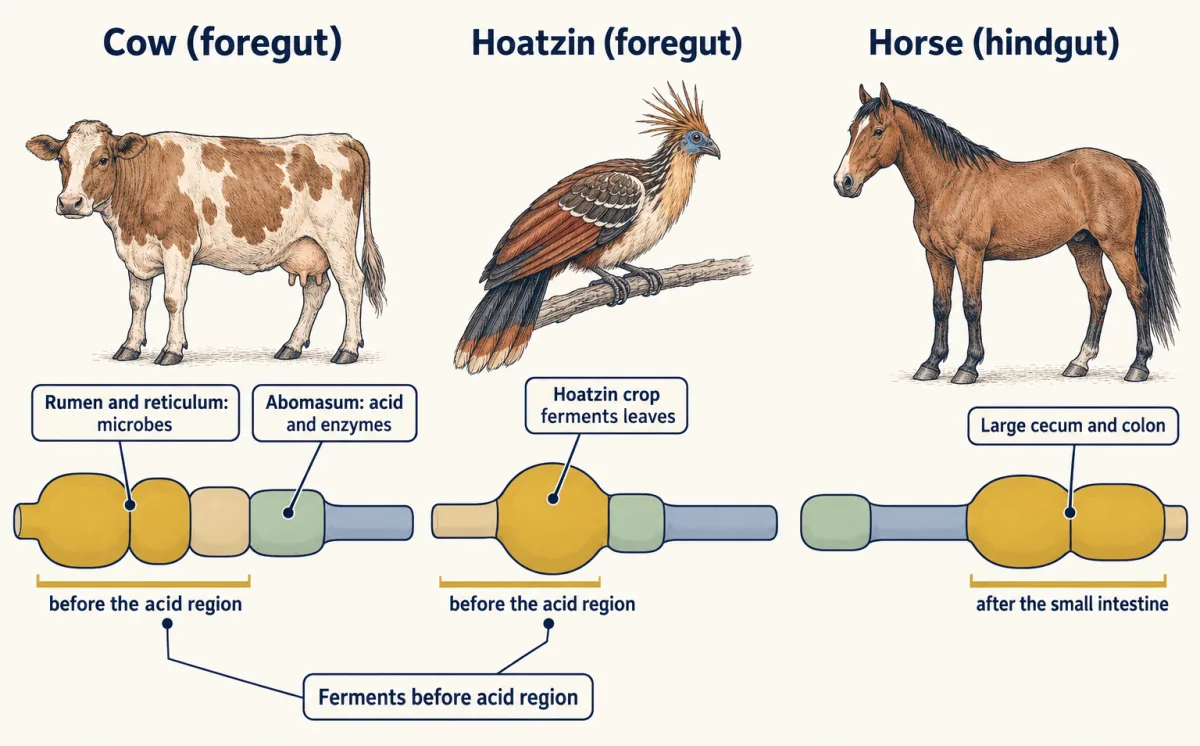
Foregut fermenters ferment before the acid-secreting region. A cow has one stomach with four compartments: the rumen and reticulum hold microbes that break down fiber, the omasum follows, and the abomasum is the glandular compartment that secretes acid and enzymes, equivalent to a single stomach. Microbes washed into the abomasum are digested in turn. Kangaroos ferment in an enlarged forestomach too, a separate origin in marsupials. The hoatzin, Opisthocomus hoazin, a leaf-eating bird of South America, ferments leaves in its enlarged crop. The chicken, by contrast, stores food in its crop and grinds it in a muscular gizzard.
Hindgut fermenters ferment after the small intestine. Horses ferment in a large cecum and colon. Rabbits ferment in the cecum and then produce soft cecal pellets, which they eat directly from the anus and pass through the gut a second time. Fermentation here comes after the main site of absorption, so a rabbit absorbs the fermentation acids directly through the hindgut wall; its reingestion of cecal pellets gives the microbial protein a second pass through the small intestine.
Carnivores and omnivores. The domestic cat is an obligate carnivore: it depends on animal tissue and needs taurine, a small sulfur-containing compound related to amino acids, in its diet; adult humans and many other mammals make taurine for themselves. Humans are omnivores, eating plant and animal foods, with a modest cecum and colon where microbes ferment fiber.
Is the herbivore gut always longer? Not simply. Larger animals have longer intestines whatever they eat, and related species resemble each other by descent. In a 2021 study of 519 mammal species, with body mass and phylogeny modeled, herbivores tended to have longer large-intestine components, but diet did not improve the model of small-intestine length. Gut length tracks diet only loosely, and by region.
Nerves and hormones run the line
Each part of the gut starts and stops in sequence, and two systems control it. The enteric nervous system is a network of nerve cells within the gut wall that runs local reflexes, such as peristalsis, on its own. The vagus nerves connect the brainstem to the gut and carry the parasympathetic signals that increase secretion; the nervous system map and the hypothalamus and autonomic system cover them.
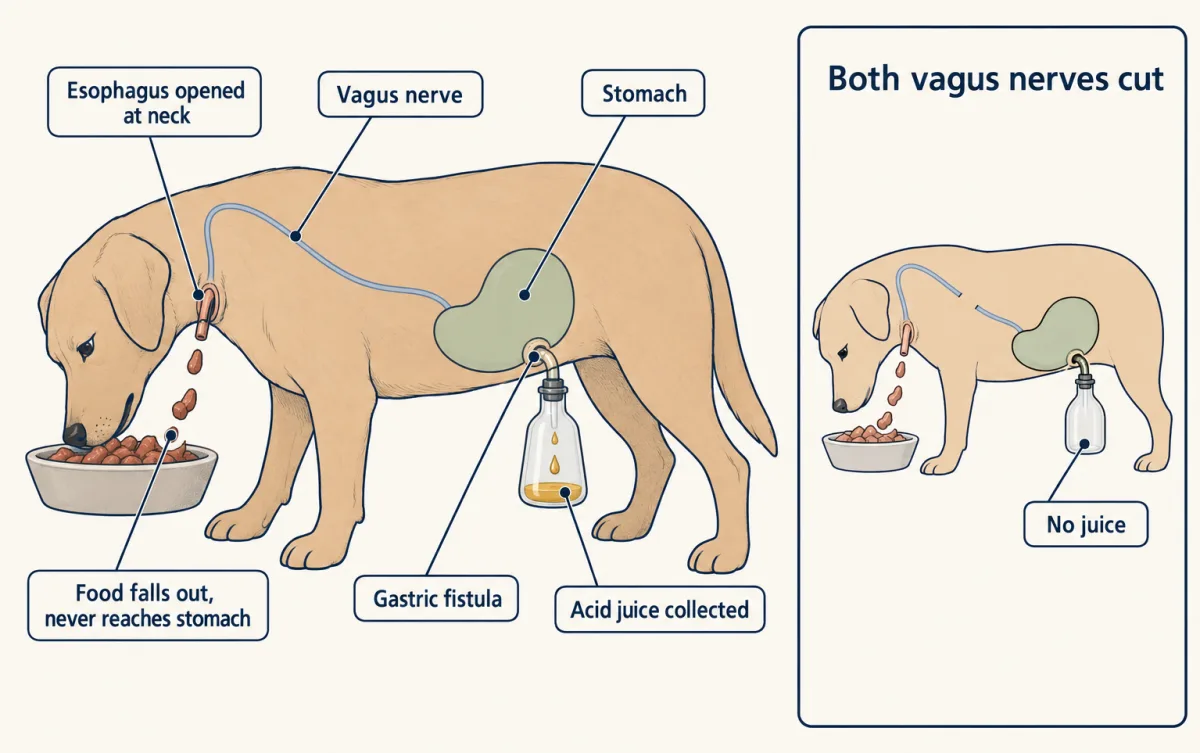
The classic experiment: Pavlov’s sham-fed dogs. In St Petersburg from about 1889, Ivan Pavlov’s laboratory prepared dogs with an esophagotomy (the esophagus opened at the neck, so swallowed food fell out) and a gastric fistula, an opening through which juice could be drained from the stomach. If gastric juice flowed only when food touched the stomach, sham feeding should produce none. Instead, after a delay of some minutes, abundant acid juice flowed while the dog ate food that never arrived. Cutting both vagus nerves abolished this response. That rules in a nerve-driven cephalic phase (the phase triggered by the sight, smell, taste and chewing of food) in the dog, carried by the vagus. It does not rule out later phases that run once food is in the stomach or intestine.
Later phases are partly chemical. A hormone is a substance released into the blood that acts on distant target cells (the endocrine system). Three gut hormones, by source, trigger and target:
| Hormone | Source | Trigger | Main targets and effect |
|---|---|---|---|
| Gastrin | G cells of the stomach lining | Food (especially protein) in the stomach; vagal input | Stomach: more acid |
| Secretin | Lining of the duodenum | Acid chyme entering the duodenum | Pancreatic duct cells: bicarbonate-rich fluid |
| CCK (cholecystokinin) | Lining of the duodenum | Fats and proteins in the duodenum | Pancreas: enzymes; gallbladder: contracts, releases bile |
J. S. Edkins proposed gastrin in 1905, but it was purified only in 1964. Secretin was the first gut hormone found, by Bayliss and Starling, a story told in signals and distance. Gastrin and CCK act on receptors of the type described in GPCRs and G proteins.
Nerves and hormones overlap. In healthy human volunteers given CCK-8 at one dose, atropine, a drug that blocks the acetylcholine receptors nerves use on many glands, cut the pancreatic trypsin response by 84%. So in that test much of the hormone’s effect ran through nerves. In mice, Kaelberer and colleagues reported in 2018 that hormone-releasing cells of the intestine form synapses on vagal neurons and signal with glutamate, a fast nerve-like route alongside slower hormones.
Essential depends on who is eating
An essential nutrient is one an animal must get from food because its body cannot make it, or cannot make enough. What is essential depends on the species. For humans, nine amino acids are essential: histidine, isoleucine, leucine, lysine, methionine, phenylalanine, threonine, tryptophan and valine (amino acids). Two fatty acids are essential for humans, linoleic acid and alpha-linolenic acid. Vitamins are organic molecules needed in small amounts; minerals are inorganic elements, such as calcium and iron.
Most mammals make their own vitamin C, but humans, some other primates and guinea pigs cannot and need it in the diet. Cats need dietary taurine, which adult humans make. “Essential” is a statement about an animal and its partners, not about a molecule.
Design problem
Across many mammal species, herbivores have longer large intestines than carnivores. A classmate concludes that eating plants makes the large intestine grow longer. What would you need to check before accepting a link between diet and gut length, and what kind of evidence would test cause?
One way to do it
First, scale by body mass. Large animals have long guts, and many herbivores are large, so compare length at a given body mass, for example with a regression that predicts log gut length from log body mass, with diet added as a second predictor.
Second, account for phylogeny. Related species share anatomy by descent (see reading phylogenetic trees), so fifty closely related herbivores are not fifty independent tests. A phylogenetic regression asks whether diet explains length beyond what shared ancestry explains. Duque-Correa and colleagues (2021) did this for 519 species and found strong phylogenetic signal.
Third, test each region separately. In that study diet was associated with large-intestine length, but adding diet did not improve the small-intestine model, so “herbivores have longer guts” is too broad.
Fourth, remember that a correlation across species does not show cause, and it cannot say whether diet changes the gut during a lifetime or whether lineages with long large intestines took up plant diets. Evidence for cause would come from feeding experiments that change diet within one species. A change within one animal’s life is not enough by itself: in many frogs, plant-eating tadpoles have a long coiled gut that shortens at metamorphosis when the animal turns to eating animals, but thyroid hormone drives that whole transformation, so diet and gut change are tangled together.
How we measure it
Chronic fistula and sham feeding
A surgically made opening to the outside lets juice be collected from a gland or organ of an animal that has recovered from surgery, awake and eating. Combined with an opening of the esophagus at the neck, it separates what eating does from what food in the stomach does.
Pharmacological blockade
Give a drug that blocks one signaling route, such as atropine for the acetylcholine receptors that nerves use on many gut glands, and measure how much of a response remains. The fraction that disappears estimates how much of the response ran through that route under those conditions.
In vitro fermentation cultures
Gut or fecal microbes from donor animals are grown without oxygen at body temperature with a chosen food added, and pH and organic acids (measured by high-performance liquid chromatography) are followed over hours. It shows what a community can do with a substrate, not what happens in the intact animal.
Comparative method with phylogenetic regression
Measure a trait such as intestine length across many species, scale it by body mass, and fit a model that accounts for how the species are related. It asks whether a pattern holds beyond what shared ancestry and body size already explain.
Finish line
Test yourself
8 questions
Practice and MCAT-style, with explained answers.
Next · Lesson 15
Osmoregulation and Nitrogenous Waste
A seabird that takes in seawater or a salt load faces a problem: bird kidneys cannot make urine as salty as the sea. Where does the extra salt go?
Continue →