Organismal Biology · Unit 6: How plants work
Moving Water and Sugar in Plants
A tree has no heart, yet water reaches leaves more than 100 m up and sugar reaches roots and shoot tips. This lesson uses water potential to predict which way water moves, explains how evaporation pulls water up the xylem under tension, how guard cells trade water loss for carbon dioxide, and how pressure flow drives phloem sap from source to sink. Afterwards you can calculate a solute potential and a total water potential, say why root pressure cannot lift water to the top of a tall tree, and read the morning glory test of the pressure-flow idea.
Watch first Water Pulled Up, Not Pushed · 3:03
The tallest measured coast redwoods (Sequoia sempervirens) stand more than 100 m high, and every leaf at the top is supplied with water from roots in the soil. A tree has no heart and no pump. What lifts the water?
The answer is the dry air around the leaves. You met the two tissues in plant body and growth: xylem, the tissue whose water-carrying cells are dead and hollow, that carries water and minerals up from the roots, and phloem, the tissue of living cells that carries sugar from where it is made to where it is used. Both rely on bulk flow, movement of a whole fluid driven by a pressure difference, far faster than diffusion over long distances (size and scaling).
Water potential: which way water goes
Plant biologists predict water movement with water potential (Psi), the potential energy of water relative to pure water at atmospheric pressure and the same temperature and height. It is measured in megapascals (MPa; 1 MPa is about ten atmospheres), and pure water at atmospheric pressure is defined as 0. Water always moves toward lower total water potential.
Three parts add up:
Psi = Psi_s + Psi_p + Psi_g
Solute potential (Psi_s) is zero for pure water and negative for any solution, because solutes lower water’s free energy. For a dilute solution it is roughly Psi_s = -iCRT, where i is the particles per dissolved molecule, C the molar concentration, R the gas constant and T the absolute temperature. Pressure potential (Psi_p) can be either sign. In a living walled cell it is usually positive: turgor, the contents pushing out against the wall. In the xylem of a transpiring plant it is usually negative: tension, a pull. Gravitational potential (Psi_g) rises by about 0.01 MPa per metre of height (not 0.1, a known textbook error), so lifting water costs energy. A fourth term, matric potential, matters in dry soil and cell walls; this lesson sets it aside. How water crosses membranes, through channels called aquaporins, is in membrane transport.
Worked problem. Assume equal heights (so ignore Psi_g), a membrane that passes water but not solutes, and 20 degrees C (293 K), with R = 0.008314 L MPa per mol per K.
- A solute potential. For 0.30 M sucrose (i = 1, since sucrose does not split into ions), Psi_s = -(1)(0.30)(0.008314)(293) = -0.73 MPa.
- A cell in a bath. In this made-up example a walled cell has Psi_s = -0.80 MPa and turgor Psi_p = +0.50 MPa, and sits in a large bath at -0.40 MPa. The cell’s total is -0.80 + 0.50 = -0.30 MPa. That is higher than -0.40 MPa, so water moves out of the cell, even though the cell holds more solute than the bath.
- Equilibrium. If the cell’s solute potential stayed at -0.80 MPa, water would stop moving when turgor fell to Psi_p = -0.40 - (-0.80) = +0.40 MPa. Check: -0.80 + 0.40 = -0.40 MPa. (A real cell losing water concentrates its solutes, so Psi_s would shift too.)
- The air. Water vapour in air has its own water potential, Psi = (RT / molar volume of water) x ln(relative humidity). At 20 degrees C the first factor is about 135 MPa, so air at 50% relative humidity sits at 135 x ln 0.50 = 135 x (-0.69), about -94 MPa.
Put illustrative values along a plant: soil -0.3 MPa, root -0.6 MPa, leaf -1.5 MPa, air -94 MPa. Every step runs downhill; the biggest drop is leaf to air.
- Air (from relative humidity)
- Extra tension to hold a still column
- Leaf total (illustrative value)
- Soil to root
- Root to leaf
- Leaf to air
- Downhill all the way?
In this sketch: illustrative values, not a measured plant; 20 °C; steady flow; gravity about 0.01 MPa per m. The root (−0.6 MPa) and the leaf (−1.5 MPa) are the lesson’s illustrative values; the slider ranges are chosen for the sketch (the lesson cites air at 50 to 80% relative humidity). Blocks and arrows are a schematic of the route, not anatomy.
Rule to keep: water always moves toward lower total water potential. Evaporation powers the pull, and cohesion passes it down continuous xylem columns; the plant does not pump the water up.
Pulled, not pushed: transpiration and cohesion-tension
Transpiration is the loss of water vapour from a plant to the air, mostly through the leaves. Inside a leaf, water evaporates from the wet walls of the mesophyll cells (the inner photosynthetic cells) into air spaces and diffuses out. As it evaporates, the water left in the walls’ tiny pores is held more tightly and its pressure falls, lowering leaf water potential, so water moves in from the nearest xylem.
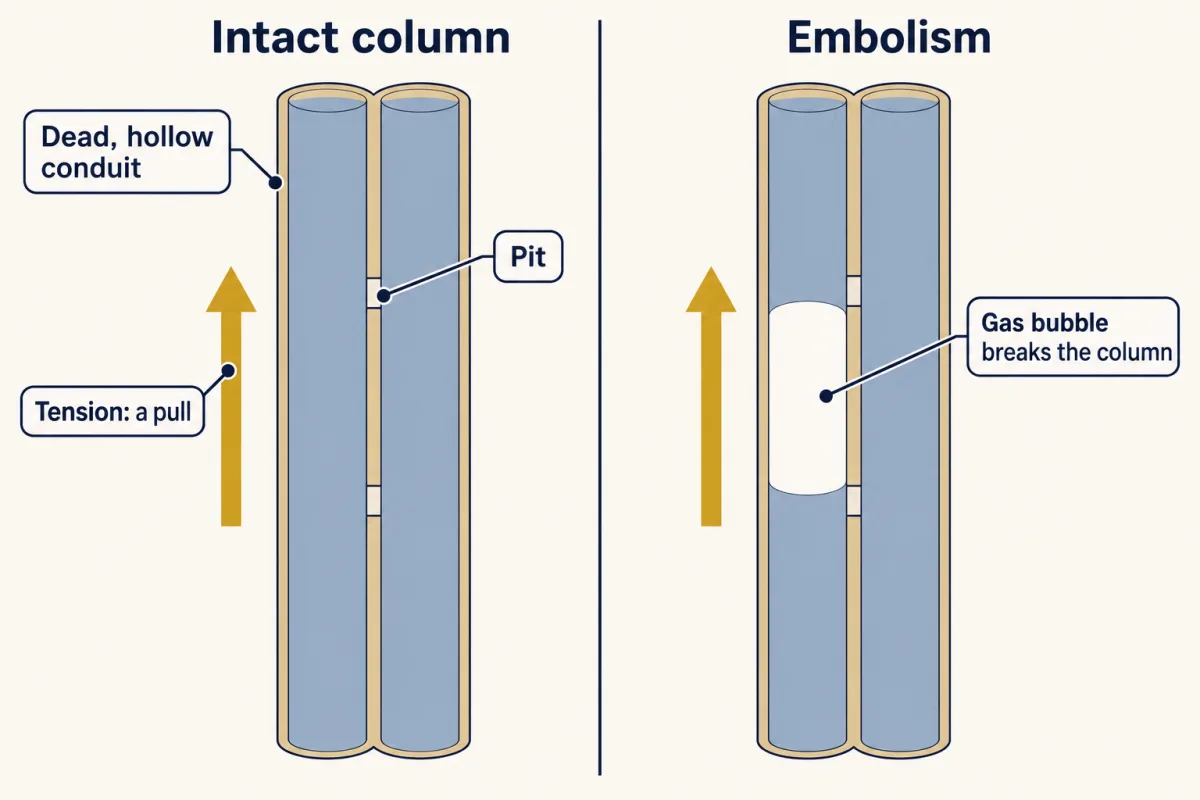
The cohesion-tension mechanism, proposed by Henry Dixon and John Joly in the 1890s, explains how that pull reaches the roots. Cohesion is the attraction between water molecules through hydrogen bonds, covered in water and weak bonds. It lets a thin water column in a narrow tube be pulled without breaking, like a rope. The xylem’s conducting cells, tracheids and vessel elements, are dead when they work: their contents are gone, leaving a continuous hollow pathway from root to leaf. Conifers such as Douglas fir (Pseudotsuga menziesii) move water mainly through tracheids, while most flowering plants also have wider vessels. Evaporation supplies the energy.
Gravity sets a floor on the tension. At about 0.01 MPa per metre (a figure Woodruff and colleagues used in their 2004 study of Douglas fir), a leaf 30 m up needs 0.30 MPa of extra tension just to hold a still column, before any flow. At the top of a 110 m redwood, gravity alone adds over 1 MPa.
A column under tension can fail. An embolism is a gas bubble that fills a xylem conduit and breaks its column. Drought raises tension and makes embolism more likely; pits between neighbouring conduits limit how far a bubble spreads.
Could the roots push water up instead? Root pressure builds when roots move minerals into the xylem and water follows by osmosis; it causes the drops seen on some leaf edges at dawn. But where measured it is small: the highest value in a survey of 109 tropical vines and woody species was about 0.15 MPa, enough in principle to raise water about 15 m, and it is weak or absent when transpiration is fastest. More decisively, the xylem of a transpiring tree is under tension: cut it and air is drawn in rather than sap spurting out. A push cannot explain water under a pull.
Stomata: a valve that trades water for carbon
A waxy cuticle on the leaf blocks both water and carbon dioxide, so gas moves mainly through stomata, pores each bordered by two guard cells. When guard cells take up potassium ions and accompanying anions, their water potential falls, water flows in, turgor rises, and the paired cells bow apart, opening the pore. Losing those solutes reverses this and closes the pore. Light favours opening; drought, through the hormone abscisic acid covered in plant signals, favours closing.
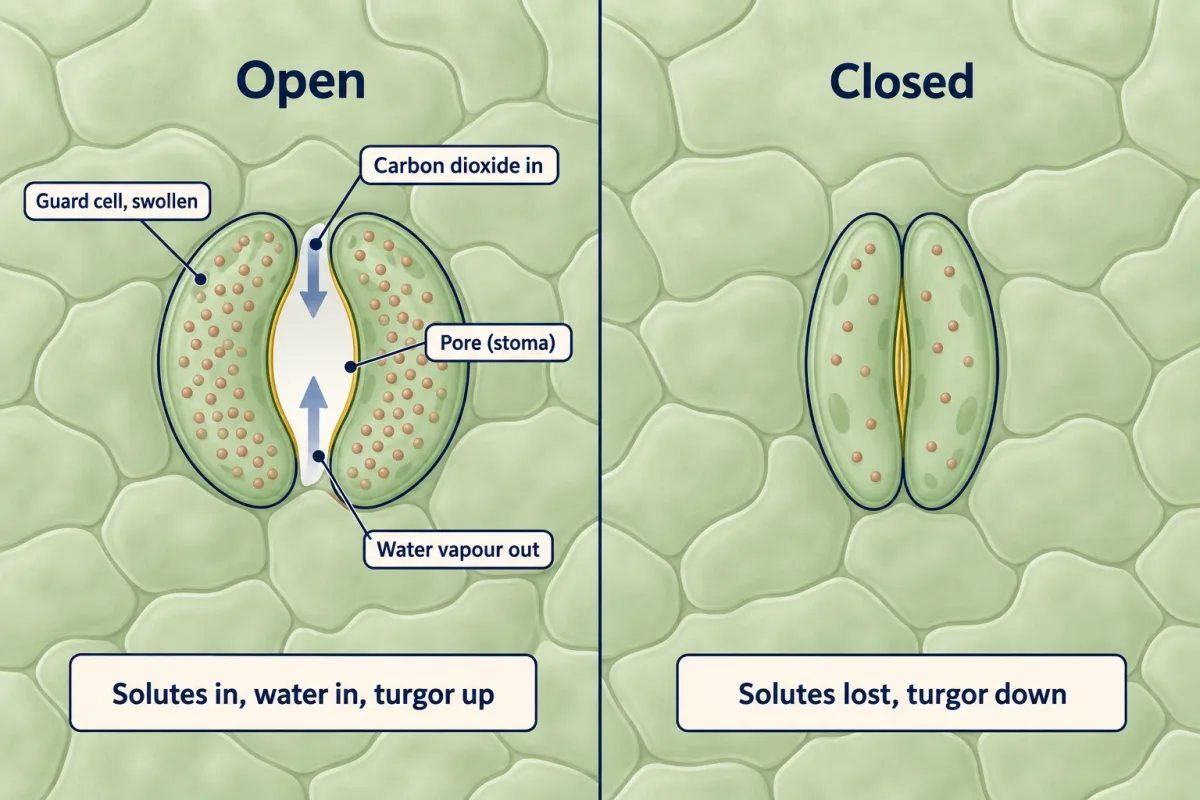
Every open stoma is a trade: the pore that lets carbon dioxide in for photosynthesis also lets water vapour out, and at a leaf-to-air drop of tens of megapascals far more water leaves than carbon enters. You computed water-use efficiency in organism problems. Many cacti use crassulacean acid metabolism (CAM), opening their stomata at night when air is cooler and evaporation slower; the biochemistry is in the Calvin cycle.
Papanatsiou and colleagues (2019) expressed a light-gated potassium channel, BLINK1, in Arabidopsis thaliana guard cells. The stomata opened and closed faster, and under fluctuating light the plants made about 2.2 times the biomass of controls without using more water: one species, one light regime.
Pressure flow in phloem from source to sink
Sugar travels in sieve tubes, chains of living sieve-tube elements joined end to end through perforated end walls called sieve plates. Each has lost its nucleus and depends on a neighbouring companion cell. A source is any part that exports sugar, usually a mature leaf; a sink is any part that takes it up, such as a root, a fruit or a growing shoot tip. A storage organ can switch roles: a potato tuber is a sink while filling and a source when sprouting.
Ernst Münch’s pressure-flow hypothesis (1930) explains the movement. At the source, sucrose is loaded into sieve tubes, lowering their water potential, so water enters from the nearby xylem and turgor rises. At the sink, sugar is removed, water leaves and turgor falls. The pressure difference drives bulk flow from source to sink, so phloem sap can run up toward a shoot tip as well as down toward roots.
Loading comes in more than one form. In Arabidopsis, SWEET proteins export sucrose from cells beside the phloem into the cell walls, and proton-coupled carriers then take it up into the sieve-tube and companion-cell complex, spending energy; Chen and colleagues (2012) found that sweet11 sweet12 double mutants loaded the phloem poorly. Many trees studied so far load passively instead, with sugar moving down its concentration gradient into the phloem (Fu and colleagues surveyed 45 dicot species in 2011).
The morning glory test. The old objection to Münch was that narrow, plate-blocked tubes would need impossible pressures over long distances. In 2016 Michael Knoblauch, N. Michele Holbrook and colleagues tested this in the morning glory Ipomoea nil. In moderate-sized plants they measured a sap speed of about 123 micrometres per second by carbon-11 tracing (three plants), a sap viscosity of about 1.7 mPa s from fluorescence lifetime imaging, and a source sieve-tube turgor of about 1.08 MPa with a pico-gauge pressure probe. Sink pressure was constrained from root cortex cells (about 0.59 MPa), not measured in sieve tubes. From the tube anatomy they calculated that flow needed about 0.21 MPa per metre. They then lengthened the path by removing leaves from long vines. With unchanged tubes, the pressure needed would have climbed out of reach. Instead, sieve-tube conductivity in the long vines was five to six times higher than in young leafy plants, so modest pressures sufficed. Pressure flow is sufficient in this plant.
Two plumbing systems compared: xylem, phloem and a vertebrate circulation
A vertebrate heart pushes blood round a closed loop at positive pressure, as in circulation and the heart; a typical peak (systolic) arterial pressure in a resting adult human, 120 mmHg above atmospheric, is about 0.016 MPa. In a transpiring plant, xylem water moves one way, root to leaf, under negative pressure, powered by evaporation, and most of it is lost to the air rather than returned. Phloem runs under positive pressure, about 1 MPa at the source in morning glory, roughly 70 times that human arterial pressure, with no pump organ: the “pump” is osmosis at each end. Root uptake of water and minerals is in plant nutrition.
Design problem
Plant physiologists count embolized xylem conduits to judge drought damage, and some studies reported overnight refilling. Stems are usually cut under water to keep air out. Torres-Ruiz and colleagues (2015) found that cutting under water while the xylem was under tension itself created embolisms, in Juglans microcarpa, Eucalyptus pauciflora, Helianthus annuus and Acer campestre. Design a test of whether air-filled vessels seen in a cut stem were already there in the living plant.
One way to do it
Image the same stem twice: scan an intact plant with X-ray microtomography, which tells air-filled from water-filled conduits, then cut it under water and scan the same region again. Conduits full before and empty after were emptied by the cut.
Add a control that removes the suspected cause: relax the tension before cutting (let the plant rehydrate so its water potential is near zero), then cut and scan. If cutting at low tension adds few embolisms and cutting at high tension adds many, tension at the moment of cutting is the cause.
Repeat across species and tensions; Torres-Ruiz and colleagues found the effect depended on species, tension and existing embolism.
A clean result shows that cutting can create false embolisms; it does not prove that refilling never happens in intact plants, which needs repeated scans of uncut stems over time.
How we measure it
Scholander pressure chamber
A cut leaf or twig is sealed in a steel chamber with its cut end poking out, and gas pressure is raised until sap just appears at the cut surface. The pressure needed balances the tension the xylem water was under, so it gives an estimate of the shoot's water potential.
Pressure probes in sieve tubes
A fine glass tip is pushed into a single living sieve tube. The tip holds a tiny trapped volume of oil, and how far that oil is squeezed shows the pressure (the pico-gauge Knoblauch and colleagues used). The probe reads the turgor pressure inside a working cell rather than inferring it from the tissue.
Radiotracers and aphid stylets
A leaf fed carbon dioxide labelled with carbon-11 makes labelled sugar, and detectors along the stem time its arrival, giving a flow speed. Separately, an aphid feeding from a sieve tube can be cut away from its mouthparts; sap keeps oozing from the severed stylet, which shows the sieve tube is under positive pressure and yields nearly pure phloem sap.
X-ray microtomography
X-ray images taken from many angles are combined into a three-dimensional picture of a stem. Air-filled and water-filled xylem conduits look different, so the same intact stem can be scanned before and after a treatment to count embolisms.
Finish line
Test yourself
8 questions
Practice and MCAT-style, with explained answers.
Next · Lesson 24
Soil, Nutrients and Partners
Peas grown in sterile sand with a little soil extract and no nitrogen fertiliser ended up richer in nitrogen than their seeds. Where did it come from?
Continue →