Biology · Unit 7: Ecosystems
Matter Cycles
Where do the atoms in a Chesapeake blue crab come from, and where do they go next? You follow one carbon atom and one nitrogen atom through air, plants, animals, soil, water and bacteria, then read real carbon dioxide and nitrogen data. Afterwards you can explain the carbon, water and nitrogen cycles, show how they connect, and use data to describe how people change them.
Where this lesson sits
- Virginia SOL BIO.8b
- Practices BIO.1c, BIO.1d, BIO.1e, BIO.1f
Essential question: How does matter keep moving through ecosystems, and what happens when people change a cycle?
-
Life Science (grade 7) LS.5 a
Review it at grade 7 level
In grade 7 you learned that matter cycles through ecosystems while energy flows through them. You drew the water cycle with evaporation, condensation and precipitation. You saw that plants take in carbon dioxide and that animals and decomposers give it back. You learned that nitrogen moves between the air, soil and living things, without naming each step. Biology adds the names and the workers: the bacteria that make nitrogen usable, and the ways people change how fast each cycle runs.
-
Biology BIO.8b You are here
This lesson
-
Biology II Biology II: Ecology, EC.4 a; Advanced Topics, BIOII.6 c
Preview where it goes next
Virginia’s Biology II: Ecology course treats each cycle as a set of pools and fluxes. You ask which reservoirs act as sources, which act as sinks, and how big each flow is. Advanced Survey of Biology Topics adds the phosphorus cycle, which this lesson left out because it has no gas phase; phosphorus moves mainly through rock, soil and water. It also asks how much new plant matter an ecosystem builds each year, which is the net primary productivity. Both courses link the nitrogen cycle to energy: nitrifying microbes get energy by oxidizing ammonia or nitrite, and some can use that energy to fix carbon.
-
College
Watch first Atoms Move, and No Cycle Runs Alone · 3:06
A blue crab in the Chesapeake Bay is built from atoms that were somewhere else before. Some of the nitrogen in the Bay’s food web may have washed off a farm field in Pennsylvania and down the Susquehanna River, or off a field in Virginia and down the James.
No one has traced the atoms in one particular crab. But you can trace the routes those atoms could take. Where does the carbon in a crab’s shell come from, how does nitrogen reach its muscles, and where do those atoms go when the crab dies?
What do you think? Decide before you read.
-
Scientists disagree: Water running off land carries dissolved nitrogen into rivers and the Bay. Plants also need sugars, built from carbon, to turn nitrogen into proteins. Scientists see these links when they follow nutrients downstream and measure what plants use.
What scientists think
Scientists disagree: Water running off land carries dissolved nitrogen into rivers and the Bay. Plants also need sugars, built from carbon, to turn nitrogen into proteins. Scientists see these links when they follow nutrients downstream and measure what plants use.
-
Scientists disagree: Air is about 78 percent nitrogen gas, but most plants lack the enzymes to use it. Certain bacteria, some living in root nodules of beans and peas, convert it into a form plants can take up. Plants grown without those bacteria or added nitrogen grow poorly.
What scientists think
Scientists disagree: Air is about 78 percent nitrogen gas, but most plants lack the enzymes to use it. Certain bacteria, some living in root nodules of beans and peas, convert it into a form plants can take up. Plants grown without those bacteria or added nitrogen grow poorly.
-
Scientists disagree: Atoms are not destroyed when an organism dies. Fungi and bacteria break down the body, and its carbon and nitrogen return to the air, soil and water in new forms. Other living things then take those atoms up again.
What scientists think
Scientists disagree: Atoms are not destroyed when an organism dies. Fungi and bacteria break down the body, and its carbon and nitrogen return to the air, soil and water in new forms. Other living things then take those atoms up again.
Explore: follow one atom
In the simulation you pick a carbon atom or a nitrogen atom and move it, one step at a time, between the air, a plant, an animal, the soil, the ocean and bacteria. At each step you choose a process, and a counter shows how much sits in each place. A switch lets you burn fossil fuels or add fertilizer and see where the extra atoms end up.
Choose a process for your atom
In this sketch the amounts are made-up relative units, not measurements. Each step moves a made-up fixed share of a reservoir along the lesson’s processes (the shares are invented for this sketch, and no chance is involved). Each choice you make also runs one step.
Atoms are not used up. They move between reservoirs and change form, so extra carbon or nitrogen added in one place has to end up somewhere. The picture is a sketch of the logic, not a prediction.
Try this.
- Predict how a carbon atom in the air could get into a crab. Then find at least two routes.
- Pick a nitrogen atom in the air. Predict whether a plant can take it in directly, then test it.
- Predict where the extra carbon goes when you burn fossil fuels for many steps. Watch the air and ocean counters.
- Add fertilizer and predict which reservoir fills first. Check whether you were right.
Explain: carbon moves, and it sets the temperature
- photosynthesis
- respiration
- combustion
- decomposition
- ocean absorption
- transpiration
- nitrogen fixation
- nitrification
- assimilation
- ammonification
- denitrification
- greenhouse effect
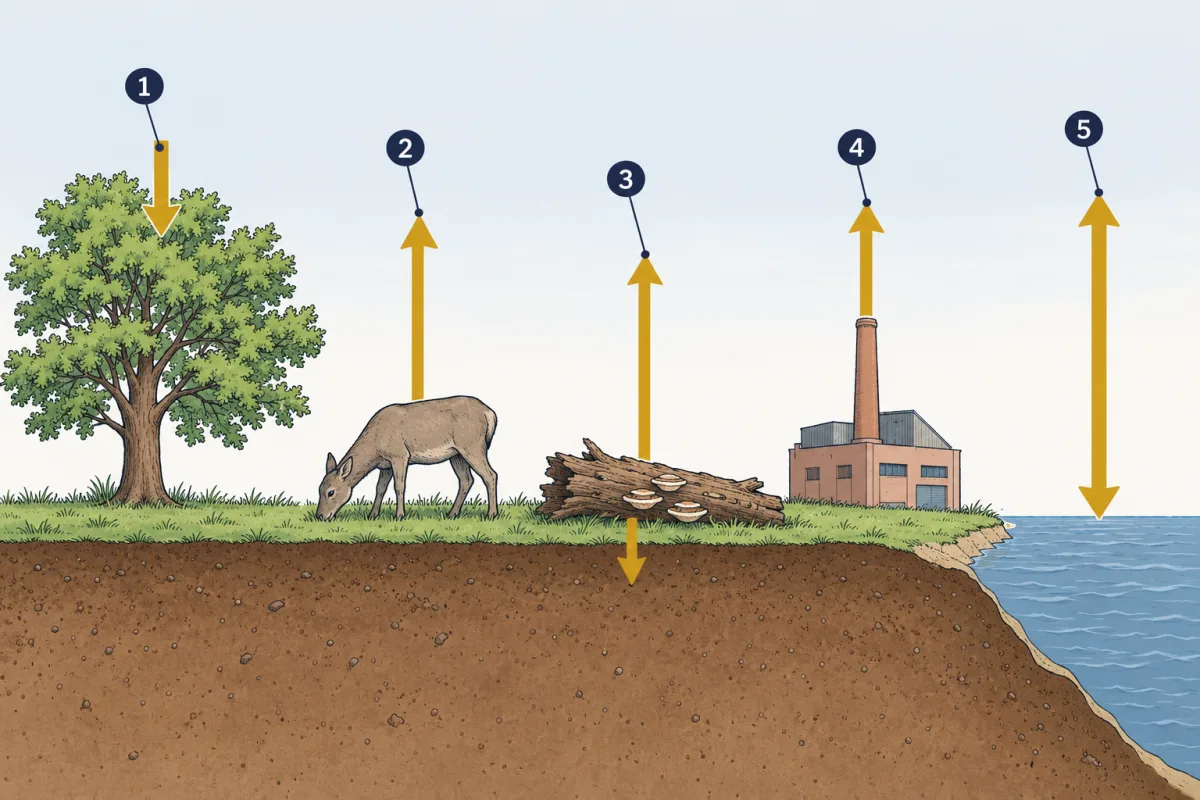
Carbon is in every sugar, fat, protein and piece of DNA in your body. Five processes move it around.
- Photosynthesis is the process in which plants, algae and some bacteria use light energy to build sugar from carbon dioxide and water. It pulls carbon out of the air or water.
- Respiration (cellular respiration) is the process in which cells break down sugar with oxygen and release carbon dioxide. Plants, animals and microbes all do it.
- Combustion is burning. Burning wood, coal, oil or natural gas joins carbon with oxygen and releases carbon dioxide quickly.
- Decomposition is the breakdown of dead organisms and wastes by fungi and bacteria. Their respiration returns much of the carbon to the air, and some stays in the soil for years.
- Ocean absorption is carbon dioxide dissolving into seawater at the surface. Carbon dioxide also comes back out, but today the ocean takes in more than it gives off.
carbon dioxide + water + light energy → glucose + oxygen 6CO2 + 6H2O → C6H12O6 + 6O2
Respiration runs the same equation backward and releases the stored energy for the cell to use. You met both in Capturing Sunlight and Respiration and ATP.
Coal, oil and natural gas formed from ancient organisms, and their carbon was locked underground for millions of years. Burning them adds that old carbon to today’s air.
Carbon dioxide in the air also matters for temperature. Sunlight warms the ground, and the ground gives off heat as infrared light. Carbon dioxide absorbs some of that infrared light and sends heat back toward the surface. This is the greenhouse effect, the warming of Earth’s surface by gases that absorb outgoing heat. Without it Earth would be far colder. More carbon dioxide means more heat held in.
- photosynthesis
- respiration
- decomposition
- combustion
- ocean absorption
- photosynthesis
- blank
- blank
- combustion
- blank
Word bank: decomposition, ocean absorption, respiration
- blank
- blank
- blank
- blank
- blank
Check your labels
- photosynthesis
- respiration
- decomposition
- combustion
- ocean absorption
Explain: water carries everything else
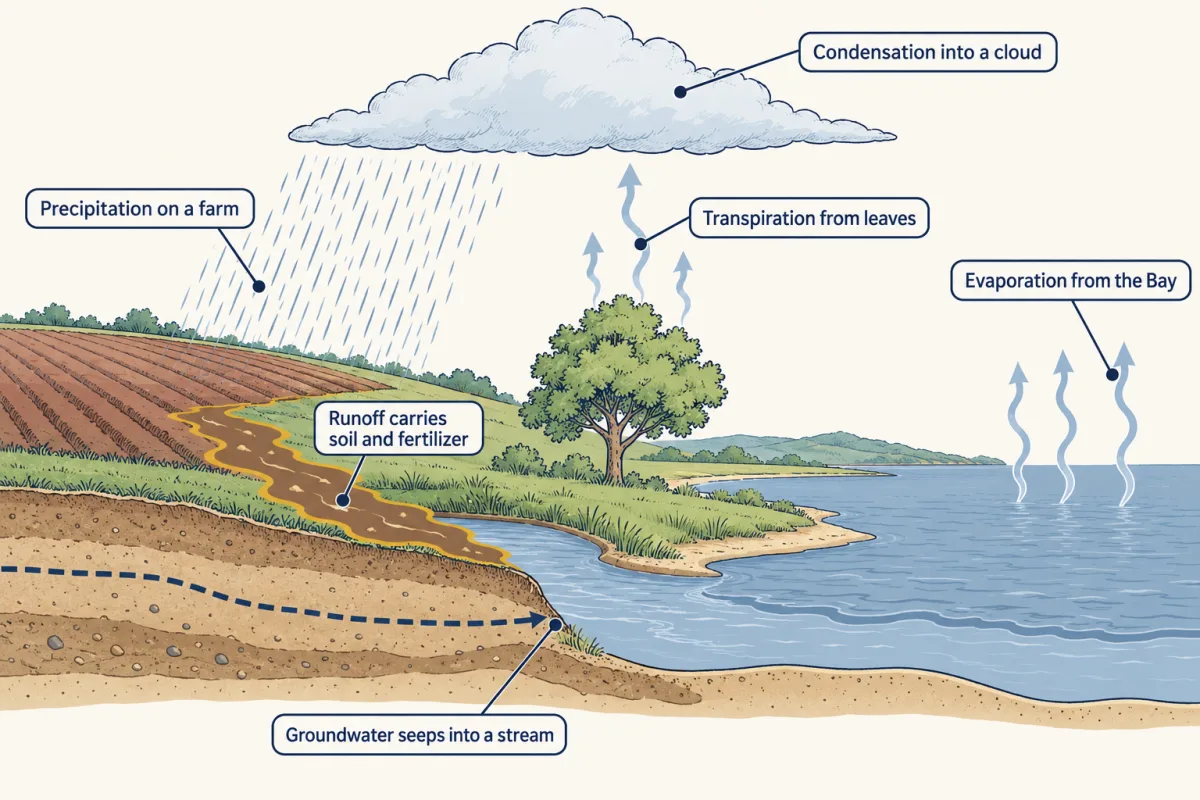
You know the water cycle from grade 7. Evaporation turns liquid water into vapor, using energy from the Sun. Transpiration is the release of water vapor from plant leaves. Condensation turns vapor back into cloud droplets, and precipitation returns water to the ground as rain or snow. Some water soaks into the ground and later seeps back into streams.
The water cycle matters for the other cycles because moving water carries things with it.
| What moving water carries | Example in Virginia |
|---|---|
| Nutrients such as nitrogen | Fertilizer washed from a field into a creek |
| Sediment (soil particles) | Muddy water in a river after a storm |
| Pathogens (germs) | Bacteria from animal waste reaching a swimming spot |
So a rainstorm in Pennsylvania can move nitrogen into the Susquehanna, which flows into the Bay.
Explain: nitrogen needs microbes
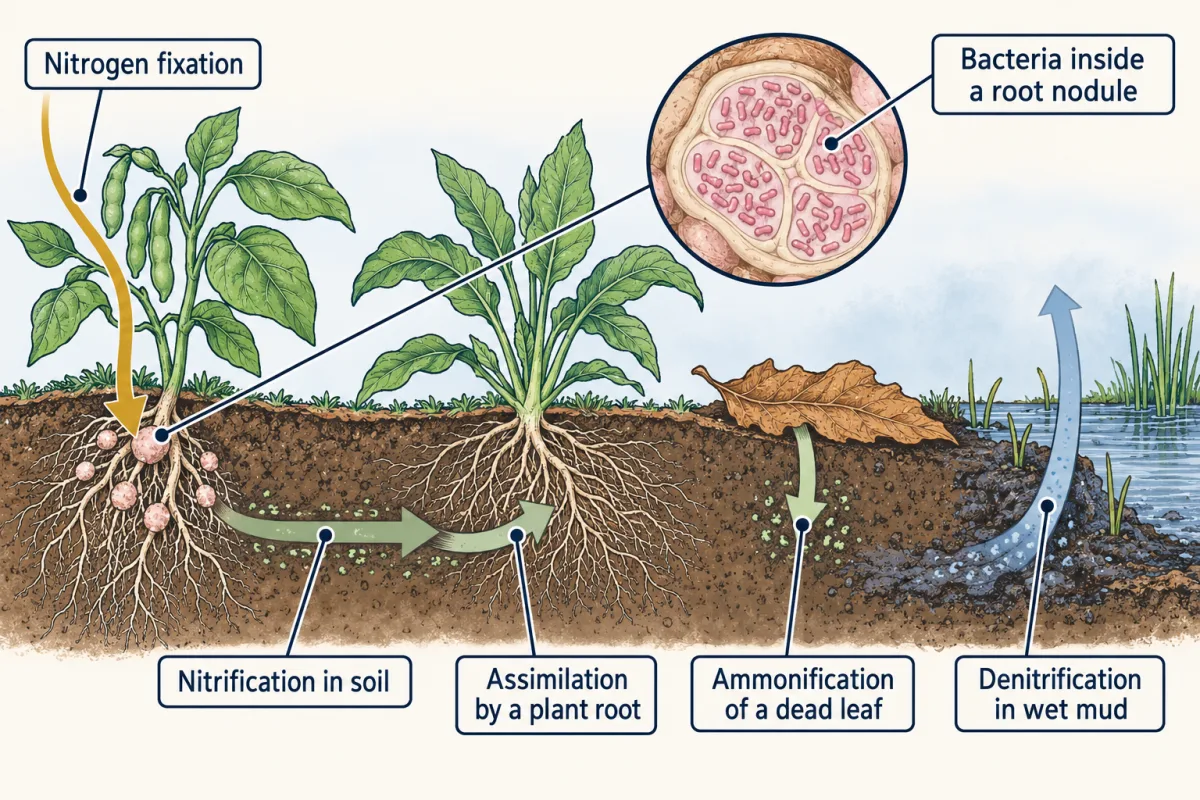
Your body uses nitrogen to build proteins and DNA. Plants also need it for chlorophyll, the green pigment of photosynthesis. Air is about 78 percent nitrogen gas, but the two atoms in each molecule are held by a very strong bond. Most organisms cannot break it. Microbes do most of the work in five steps.
- Nitrogen fixation is the conversion of nitrogen gas into ammonia. Only certain microbes, mostly bacteria, can do it, some free in the soil and some inside nodules on the roots of beans, peas and other legumes. Factories also fix nitrogen to make fertilizer.
- Nitrification is the change of ammonia into nitrite and then nitrate by soil microbes. Most are bacteria, but some are archaea.
- Assimilation is a plant or alga taking up nitrate or ammonium from the soil or water and building it into proteins and DNA. Animals get nitrogen by eating plants or other animals.
- Ammonification is decomposers turning the nitrogen in wastes and dead bodies back into ammonium.
- Denitrification is bacteria turning nitrate back into nitrogen gas, usually in wet soil or mud with little oxygen. The gas returns to the air.
A crab gets nitrogen by eating clams, worms, small animals and dead material, much of whose nitrogen traces back to algae and plants that assimilated it from the water.
Nitrogen also ties to carbon. To build amino acids, a plant needs carbon compounds made by photosynthesis. No cycle runs alone.
Elaborate: what the records show
Here are two real data sets. One is the yearly average carbon dioxide in air at Mauna Loa, Hawaii. The other is the modeled amount of nitrogen reaching the Chesapeake Bay in 2024, by source.
| Data set | Year | What was measured or modeled | Value | Unit |
|---|---|---|---|---|
| Mauna Loa carbon dioxide | 1960 | Yearly average | 316.91 | ppm |
| Mauna Loa carbon dioxide | 1980 | Yearly average | 338.76 | ppm |
| Mauna Loa carbon dioxide | 2000 | Yearly average | 369.71 | ppm |
| Mauna Loa carbon dioxide | 2010 | Yearly average | 390.10 | ppm |
| Mauna Loa carbon dioxide | 2020 | Yearly average | 414.21 | ppm |
| Mauna Loa carbon dioxide | 2025 | Yearly average | 427.35 | ppm |
| Nitrogen to the Bay | 2024 | Agriculture | 116.37 | million lb per year |
| Nitrogen to the Bay | 2024 | Developed land (cities, suburbs) | 39.27 | million lb per year |
| Nitrogen to the Bay | 2024 | Wastewater | 27.10 | million lb per year |
| Nitrogen to the Bay | 2024 | Air, falling on tidal water | 15.75 | million lb per year |
| Nitrogen to the Bay | 2024 | Air, part to be cut under the Clean Air Act (watershed) | 0.22 | million lb per year |
The carbon dioxide values are yearly averages of dry air at the Mauna Loa Observatory, from NOAA’s Global Monitoring Laboratory with Scripps (data file dated October 2026). The nitrogen values are 2024 estimates from the Chesapeake Bay Program’s watershed model (CAST-23), published on ChesapeakeProgress, using average weather. The five nitrogen rows are not the Bay’s whole load: natural land and septic systems are left out. The two air rows show only part of the nitrogen that comes from air pollution: the Bay Program’s nutrient page says air pollution contributes about one-third of the total nitrogen load.
- How many ppm did carbon dioxide rise from 1960 to 2025? Did it rise faster from 1960 to 1980 or from 2000 to 2020?
- Which source sent the most nitrogen to the Bay in 2024? About how many times larger was it than wastewater?
- Carbon dioxide at Mauna Loa dips a little each northern summer. Why does that dip not show in this table?
Claim, evidence, reasoning
Make a claim that answers the essential question: what happens when people change a cycle? Use both data sets.
Start with: The data show that people have blank the carbon cycle and the nitrogen cycle.
Start with: Carbon dioxide rose from blank ppm in 1960 to blank ppm in 2025, and the largest nitrogen source in 2024 was blank at blank million pounds per year.
Start with: This happens because burning fossil fuels blank, and nitrogen from fields reaches the Bay when blank, which can cause blank.
Compare with a model answer
People have sped up parts of both cycles. Carbon dioxide at Mauna Loa rose from 316.91 ppm in 1960 to 427.35 ppm in 2025, and the rise was faster from 2000 to 2020 than from 1960 to 1980. Combustion of fossil fuels adds carbon that was stored underground, faster than plants and the ocean remove it. In 2024, agriculture was the largest modeled source of nitrogen to the Bay, at 116.37 million pounds per year. Rain carries fertilizer and manure nitrogen off fields, feeding algae that later decay and use up oxygen. One limit: Mauna Loa is one station, and the nitrogen values come from a computer model, not direct measurements.
Saved in this browser only.
Design problem
Does fertilizer runoff make algae grow faster? Plan a test you could run in a classroom with jars of pond water that already contain algae.
One way to do it
- Independent variable: the amount of liquid plant fertilizer added: none, a small dose and a large dose.
- Dependent variable: how green the water becomes after 10 days, judged against a color chart or measured with a light sensor.
- Constants: the same pond water, jar size, water volume, light, temperature and number of days.
- Control: the jars with no fertilizer.
- Repeated trials: at least three jars at each dose, so one odd jar does not decide the result.
- What results would mean: if the jars get greener as the dose rises, the data support the idea that added nutrients feed algae.
- Safety and ethics: wear gloves, wash your hands, never drink the water, and pour it down a drain rather than into a stream, so you do not add nutrients to real water.
Evaluate: check your thinking
A blue crab’s atoms keep moving. Its carbon passed through water and food, and some of it left again as carbon dioxide from its own respiration. Its nitrogen passed through bacteria, plants and its food, maybe after washing down a river from a farm. When the crab dies, decomposers return those atoms to the water and air, where they start another trip.
Science practices you used: reading a data table and finding a trend, comparing modeled and measured data, using a model of a cycle and naming its limits, and planning a fair test with a control and repeated trials.
How we measure it
Infrared gas analysis of air
Carbon dioxide absorbs infrared light, so an analyzer shines infrared light through a sample of dried air and measures how much is absorbed. Calibrated against air samples of known concentration, it reports carbon dioxide in parts per million (ppm).
Watershed computer modeling
The Chesapeake Bay Program’s model combines land use, fertilizer and manure, wastewater reports and average weather to estimate how much nitrogen from each source reaches the Bay. The numbers are model estimates, not direct measurements of every stream.
Aerial surveys of underwater grasses
Each year, aircraft photograph the shallow Bay and scientists map the beds of underwater grasses. Comparing maps over many years shows whether the grasses spread or shrink as water quality changes.
Finish line
Test yourself
8 questions
Practice and MCAT-style, with explained answers.
Next · Lesson 32
Succession in Virginia
If you stopped mowing a field in the Virginia Piedmont and walked away for a hundred years, what would be standing there when you came back?
Continue →