Biology · Unit 1: The chemistry of life
Respiration and ATP
How does the energy in food become energy a cell can use, and what changes when oxygen runs short? You run a virtual cell's energy budget with oxygen on and off, then read six years of Chesapeake Bay low-oxygen estimates. Afterwards you can write the respiration equation, explain how ATP carries energy, and compare respiration with fermentation.
Where this lesson sits
- Virginia SOL BIO.2e
- Practices BIO.1c, BIO.1d, BIO.1e, BIO.1f
Essential question: How does the energy in food become energy a cell can use, with or without oxygen?
-
Life Science (grade 7) LS.4 b
Review it at grade 7 level
In grade 7 you learned that every living thing needs energy, and that it gets that energy from food. Cells break food down in a process called cellular respiration, which releases energy in a form the cell can use. Plants make their own food by photosynthesis, and then their cells break that food down by respiration, just as animal cells do. Respiration uses oxygen and gives off carbon dioxide and water. Biology adds the molecule that carries the released energy, ATP, and what cells do when oxygen runs short.
-
Biology BIO.2e You are here
This lesson
-
Biology II Biology II: Advanced Survey of Biology Topics, BIOII.3 c
Preview where it goes next
Biology II opens the summary equation into its three stages. Glycolysis, in the cytoplasm, splits glucose into two molecules of pyruvate for a net gain of 2 ATP and loads electrons onto the carrier NAD+, making NADH. In the mitochondria, the Krebs cycle finishes breaking the carbon down to carbon dioxide and loads more electron carriers. The electron transport chain, in the inner mitochondrial membrane, passes those electrons to oxygen and pumps protons across the membrane; the protons flowing back through the enzyme ATP synthase drive most ATP formation. Fermentation exists because it turns NADH back into NAD+, so glycolysis can keep running without oxygen.
-
College
Watch first Food Energy Becomes ATP · 3:04
After a hard sprint up a few flights of stairs, your legs may burn and you may keep breathing hard for a few minutes. Meanwhile, bread dough in a warm kitchen puffs up with bubbles, and in summer, parts of the deep Chesapeake Bay hold very little oxygen.
Each of these is about how cells get usable energy out of food, and what happens when oxygen is short. One equation and one small molecule explain all three.
What do you think? Decide before you read.
-
Scientists disagree: ATP is a molecule made of atoms you can count: an adenine-and-sugar part with three phosphate groups attached. Energy is released when ATP reacts with water and loses a phosphate, and the cell uses that energy for work. ATP carries energy; it is not energy.
What scientists think
Scientists disagree: ATP is a molecule made of atoms you can count: an adenine-and-sugar part with three phosphate groups attached. Energy is released when ATP reacts with water and loses a phosphate, and the cell uses that energy for work. ATP carries energy; it is not energy.
-
Scientists disagree: Plant cells have mitochondria, just as animal cells do, and they break down sugar for ATP day and night. A plant sealed in a dark jar gives off carbon dioxide. In bright light, photosynthesis takes in more carbon dioxide than respiration releases, which hides the respiration from view.
What scientists think
Scientists disagree: Plant cells have mitochondria, just as animal cells do, and they break down sugar for ATP day and night. A plant sealed in a dark jar gives off carbon dioxide. In bright light, photosynthesis takes in more carbon dioxide than respiration releases, which hides the respiration from view.
-
Scientists disagree: Breathing moves air in and out of your lungs. Cellular respiration is a chemical process inside cells that breaks down food molecules and uses the released energy to build ATP. The two are linked: breathing brings in the oxygen your cells use and removes the carbon dioxide they make. Yeast and bacteria have no lungs, yet many of them respire.
What scientists think
Scientists disagree: Breathing moves air in and out of your lungs. Cellular respiration is a chemical process inside cells that breaks down food molecules and uses the released energy to build ATP. The two are linked: breathing brings in the oxygen your cells use and removes the carbon dioxide they make. Yeast and bacteria have no lungs, yet many of them respire.
Explore: run a cell’s energy budget
In the simulation you run one cell’s energy budget. You choose whether oxygen is present and how much glucose arrives each second. Labelled bars show the ATP made per glucose, the ATP made per second, and which products pile up: carbon dioxide and water, lactate, or ethanol and carbon dioxide.
- Glucose needed to make 60 ATP
- 2
- Oxygen used
- 6 per glucose
In this sketch every glucose supplied is broken down, and the cell makes 30 ATP per glucose with oxygen (the lesson says about 30 to 32) or 2 without. Glucose per second is in sketch units, not a measurement. The sketch does not show speed per enzyme.
Rule to keep: ATP per glucose depends on oxygen (about 30 with it, 2 without); ATP per second also depends on how much glucose arrives.
Try this.
- Predict how the ATP made per glucose will change when you switch oxygen off. Write your guess, then switch it off.
- With oxygen off, choose a muscle cell and then a yeast cell. Predict which products each one shows before you look.
- Keep oxygen off and double the glucose supply. Predict whether ATP per second changes, and whether ATP per glucose changes.
- Turn oxygen back on. Predict how many glucose molecules the cell needs to make 60 ATP, then check.
Explain: how cells get energy out of glucose
- cellular respiration
- mitochondria
- ATP
- ADP
- aerobic
- anaerobic
- fermentation
- lactate
Food holds energy in the way its atoms are bonded. The main example is glucose, the sugar from Capturing Sunlight.
Cellular respiration is the process in which cells break down glucose and other food molecules and use the released energy to build ATP. It goes on in the cells of plants, animals, fungi and most microbes.
When oxygen is available, the overall result fits in one line:
glucose + oxygen → carbon dioxide + water + energy (much of it captured in ATP)
C6H12O6 + 6O2 → 6CO2 + 6H2O + energy
Check the atoms. There are 6 carbons on each side, 12 hydrogens on each side, and 18 oxygens on each side. Matter is rearranged, not created or lost.
This equation is a summary. The real process runs as many small steps, each sped up by an enzyme (see Enzymes at Work). The first steps happen in the cytoplasm. Most of the ATP is made in the mitochondria (one is a mitochondrion): organelles in plant, animal and fungal cells where the later steps of aerobic respiration happen. Bacteria have no mitochondria. In bacteria that use oxygen, the electron transport steps, which make most of the ATP, run on the cell membrane instead.
How much ATP does one glucose give? Modern estimates say about 30 to 32 ATP per glucose. Older textbooks say 36 to 38. Real cells vary, because some energy leaks away along the way.
Part of the energy is released as heat, one reason you warm up when you exercise. No energy is made or destroyed: it moves from glucose into ATP and heat.
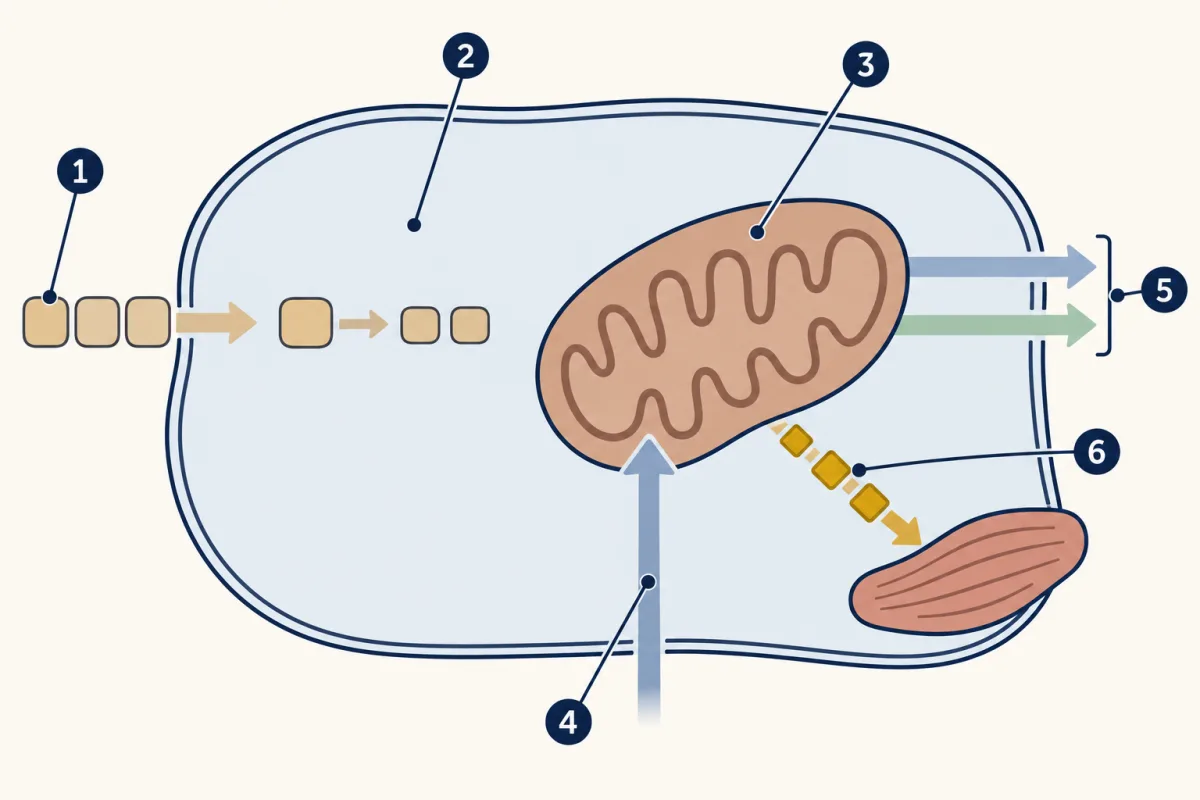
- glucose
- cytoplasm
- mitochondrion
- oxygen
- carbon dioxide and water
- ATP
- glucose
- blank
- mitochondrion
- blank
- blank
- blank
Word bank: ATP, carbon dioxide and water, cytoplasm, oxygen
- blank
- blank
- blank
- blank
- blank
- blank
Check your labels
- glucose
- cytoplasm
- mitochondrion
- oxygen
- carbon dioxide and water
- ATP
Explain: ATP carries energy to where it is used
Every working cell does jobs that cost energy. A muscle cell pulls, a nerve cell pumps charged particles across its membrane, and every cell builds proteins.
ATP (adenosine triphosphate) is a small molecule that carries energy from the breakdown of food to the jobs that use energy. It has three phosphate groups in a row. When ATP reacts with water, the end phosphate group comes off. What is left is ADP (adenosine diphosphate), the same molecule with only two phosphate groups.
ATP + water → ADP + phosphate + released energy (used for cell work)
The energy comes from the whole reaction, not from snapping one bond. Breaking any chemical bond takes energy. The products, ADP and phosphate, end up in a more stable arrangement than ATP and water started in, and that difference is the energy the cell can use.
Running the reaction backwards, building ATP from ADP and phosphate, takes energy. Cellular respiration supplies it. So ATP and ADP go round in a cycle: respiration turns ADP back into ATP, and cell work turns ATP into ADP. A cell keeps only a small supply of ATP, so it rebuilds it all the time.
ATP works a little like a rechargeable battery that is charged by respiration and drained by work. The analogy breaks in one place: a battery stays the same object, while ATP really changes into a different molecule and a loose phosphate, and is then rebuilt.
Explain: with oxygen and without it
Aerobic means using oxygen. Anaerobic means without oxygen. In your muscles during a sprint, and in yeast inside dough, cells can keep making some ATP without oxygen.
The SOL calls this anaerobic respiration. In your muscles and in yeast the process is called fermentation: a way of making a small amount of ATP from glucose without oxygen. Some microbes carry out anaerobic respiration in a stricter sense, using another substance such as nitrate or sulfate in place of oxygen.
- In muscle cells, fermentation turns glucose into lactate, a small molecule that builds up in working muscle.
- In yeast, fermentation turns glucose into ethanol and carbon dioxide. The carbon dioxide forms the bubbles that make bread dough rise.
| Aerobic respiration | Fermentation | |
|---|---|---|
| Uses oxygen? | Yes | No |
| Where in the cell | Starts in the cytoplasm; most ATP made in mitochondria | Cytoplasm |
| ATP per glucose | About 30 to 32 | 2 |
| Products | Carbon dioxide and water | Muscle: lactate. Yeast: ethanol and carbon dioxide |
| Speed | Slower | Faster for the same amount of enzyme, by one 2024 estimate for yeast and mammal cells |
Fermentation gets far less ATP from each glucose, but it can make ATP quickly. A 2024 analysis estimated that, for the same mass of enzyme, the fermentation route made ATP about 2.1 times as fast as respiration in yeast and 3.1 times as fast in mammal cells. In the bacterium E. coli, though, respiration was faster. Scientists still debate this result, because another 2024 study found respiration at least as efficient in its tests.
During a sprint your muscles use ATP faster than aerobic respiration alone can rebuild it, so fermentation adds ATP and lactate builds up. The burn is not caused by lactate alone; experiments point to a mix of acid, lactate and other chemicals. Soreness the next day is a different effect, and lactate is not its cause. After the sprint you keep breathing hard partly because your cells use extra oxygen while they recover.
Respiration and photosynthesis mirror each other. Photosynthesis uses light energy to build glucose from carbon dioxide and water and releases oxygen. Respiration breaks glucose back down with oxygen into carbon dioxide and water. Plants do both. The atoms go round and round between them, while energy arrives as light and leaves as heat (see Matter Cycles).
Elaborate: the Bay’s summer oxygen gap
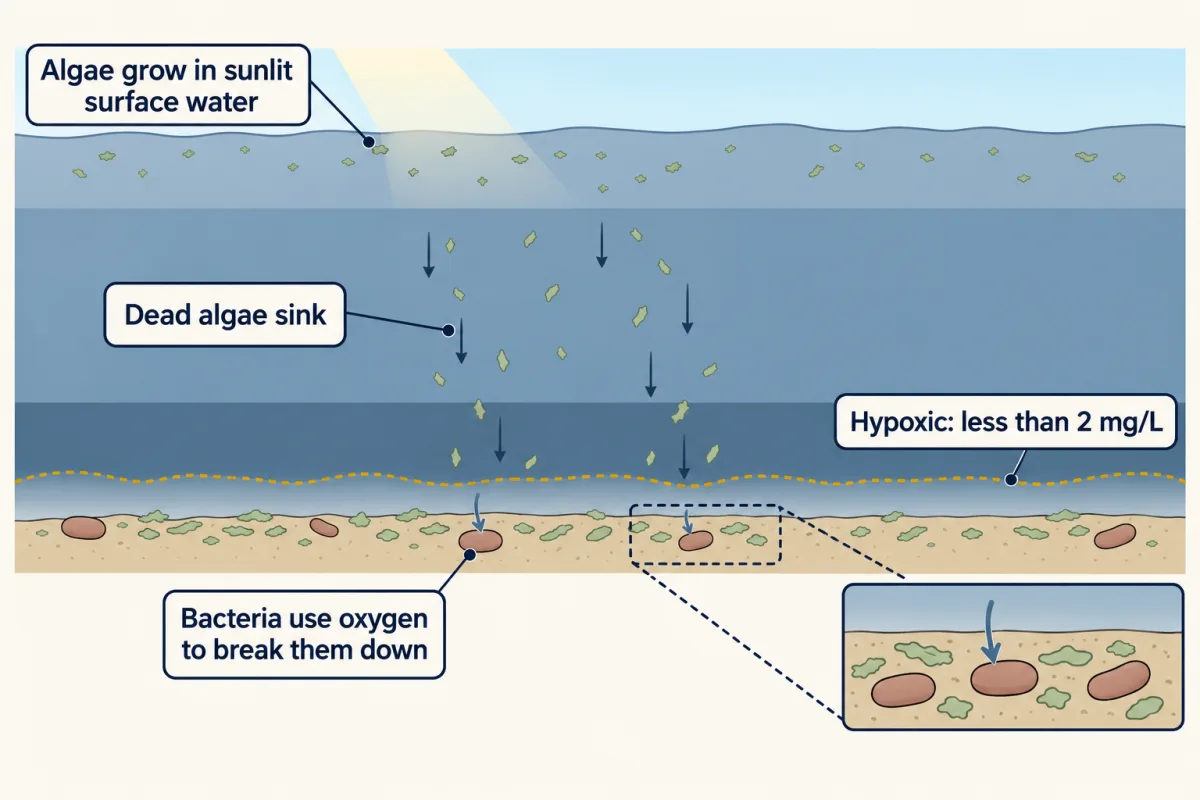
In spring and summer, algae grow in the sunlit surface water. Many die and sink. Bacteria near the bottom break them down by aerobic respiration, which uses up the oxygen dissolved in the water. Water with less than 2 milligrams of oxygen per liter (2 mg/L) is called hypoxic.
| Year | Largest hypoxic volume on any one day (km³) |
|---|---|
| 2020 | 9.8 |
| 2021 | 8.2 |
| 2022 | 10.7 |
| 2023 | 3.3 |
| 2024 | 9.8 |
| 2025 | 10.1 |
Source: Virginia Institute of Marine Science (William & Mary), December 2025 dead-zone report, Table 1. Each value is a computer-model estimate for the whole Bay on that year’s worst day, not a reading at one station. One cubic kilometer (km³) is a trillion liters.
- Which year had the smallest peak volume? About what fraction of the 2022 peak was it?
- Find the mean of the six values, rounded to the nearest whole number.
- Use the respiration equation: why would more sinking algae make the bottom water lose oxygen faster?
Claim, evidence, reasoning
Using the Bay data, make a claim about how bacteria get energy from sinking algae and what that does to the oxygen in deep water.
Start with: Bacteria in the deep Bay get energy from dead algae by blank, which uses up blank.
Start with: In most years from 2020 to 2025 the peak hypoxic volume was about blank km³, but in blank it was only blank km³.
Start with: Aerobic respiration uses blank to break food down into blank and blank, so when more blank sink, the oxygen in the bottom water blank.
Compare with a model answer
Bacteria in the deep Bay break down dead algae by aerobic respiration, which uses oxygen to release the energy in the algae’s food molecules and captures part of it in ATP. In five of the six years from 2020 to 2025, the peak volume of water below 2 mg/L of oxygen was between 8.2 and 10.7 km³; in 2023 it was only 3.3 km³. Because respiration keeps using oxygen and deep water is slow to gain more, a sizable volume of the deep Bay becomes hypoxic every summer. One limit: these are model estimates for one peak day a year, so they do not show how long the low oxygen lasted or why 2023 was lower.
Saved in this browser only.
Design problem
Plan an investigation to test whether bread yeast needs to be alive to make gas from sugar. You have dry yeast, sugar, warm water, small plastic bottles, balloons and a string with a ruler.
One way to do it
- Question: Does gas come from living yeast cells breaking down sugar?
- Independent variable: the yeast in each bottle: live yeast, no yeast (the control), or yeast that your teacher has boiled first so the cells are dead.
- Dependent variable: the distance around each balloon after 30 minutes, measured with the string.
- Constants: the same amount of sugar, water and yeast, the same water temperature, the same bottle and balloon size, and the same time.
- Repeated trials: three bottles of each kind, nine in all. Find the mean for each kind.
- What results would mean: if only the live-yeast balloons inflate, the gas comes from living cells fermenting sugar.
- Safety: use warm tap water, not hot water. Let the teacher do any boiling. Do not taste anything, and wipe up spills.
Evaluate: check your thinking
Your sprinting muscles use ATP faster than aerobic respiration alone can rebuild it, so fermentation adds quick ATP and lactate builds up, and the burn comes from a mix of chemicals. Yeast in dough ferments sugar and releases the carbon dioxide that makes the bubbles. In the deep Bay, bacteria break down sinking algae by aerobic respiration and use up the oxygen faster than it returns.
Science practices you used: making predictions and testing them with a model, reading a data table and finding a mean, planning a fair test with a control and repeated trials, and backing a claim with evidence while naming the limits of the data.
How we measure it
Computer modelling of dissolved oxygen in the Bay
The Chesapeake Bay Environmental Forecast System, run by scientists at the Virginia Institute of Marine Science, estimates every day how much of the Bay's water holds less than 2 mg of oxygen per liter. Yearly summaries of those estimates show how big the low-oxygen zone gets.
Measuring gas from fermenting dough
An instrument called a Risograph records the volume of gas that yeast releases from a sample of dough over time. More gas means more fermentation, although the reading does not measure ATP directly.
Breath-by-breath gas analysis
A person breathes through a mouthpiece connected to sensors that measure the oxygen and carbon dioxide in every breath. Scientists use it to follow how gas exchange changes during and after exercise.
Finish line
Test yourself
8 questions
Practice and MCAT-style, with explained answers.
Next · Lesson 6
The Cell Theory and Its Evidence
Robert Hooke saw tiny boxes in a slice of cork in 1665, so why did it take about 175 more years to claim that plants and animals alike are made of cells?
Continue →