Biology · Unit 1: The chemistry of life
Capturing Sunlight
Where does a tree's mass come from if the soil in its pot hardly changes? You run a virtual leaf-disk race, read a 1600s willow experiment and Chesapeake Bay underwater-grass surveys, and finish able to write the photosynthesis equation, say where its atoms and energy go, and name what limits how fast it runs.
Where this lesson sits
- Virginia SOL BIO.2e
- Practices BIO.1a, BIO.1c, BIO.1d, BIO.1e, BIO.1f
Essential question: Where does a plant's mass come from, and how does sunlight end up stored in sugar?
-
Life Science (grade 7) LS.4 a and b
Review it at grade 7 level
Plants, algae and some bacteria use energy from sunlight to make their own food. They take in carbon dioxide from the air and water from the soil. Inside green parts called chloroplasts, they make sugar and give off oxygen. Sugar and oxygen are the outputs; carbon dioxide, water and light are the inputs. How much food a plant makes depends on things like how much light it gets and how much carbon dioxide is around. In Biology you balance the equation, track where the atoms and the energy go, and follow what the plant does with its sugar.
-
Biology BIO.2e You are here
This lesson
-
Biology II Biology II: Advanced Survey of Biology Topics, BIOII.3 b; Ecology, EC.3 a
Preview where it goes next
The single equation hides two linked stages. In the light-dependent reactions, chlorophyll in the thylakoid membranes absorbs light, water is split and oxygen is released, and the captured energy is held in two carrier molecules, ATP and NADPH. In the Calvin cycle, in the fluid around the thylakoids, enzymes use that ATP and NADPH to attach carbon from carbon dioxide to existing molecules, making a three-carbon sugar called G3P that the cell builds into glucose and other molecules. Biology II: Advanced Survey of Biology Topics (BIOII.3 b) follows these steps. The Ecology course (EC.3 a) scales up to productivity: how much new plant material an ecosystem makes per area per year.
-
College
Watch first Where a Plant's Mass Comes From · 2:48
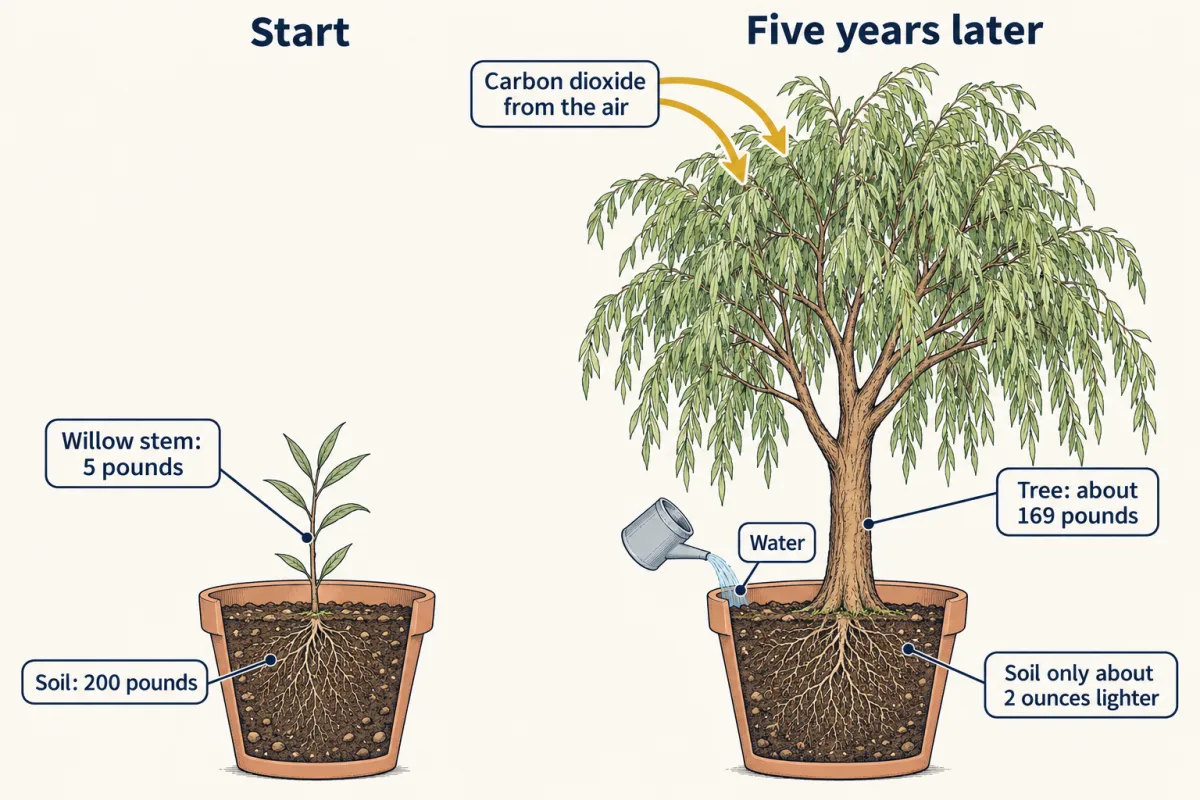
In the 1600s, a man planted a 5-pound willow stem in a pot of 200 pounds of dried soil. Five years later he reported a tree of about 169 pounds, and the soil was only about 2 ounces lighter. So where did more than 160 pounds of tree come from? The same question matters today in Chesapeake Bay, where underwater grasses spread in some years and shrink in others. Before you start, decide what you think now.
What do you think? Decide before you read.
-
Scientists disagree: When scientists dry and weigh plants and soil, the soil hardly changes while the plant gains a lot. Most of a plant’s dry mass is built from carbon dioxide taken in from the air. Roots take in water and small amounts of minerals, which plants need, but they add little mass.
What scientists think
Scientists disagree: When scientists dry and weigh plants and soil, the soil hardly changes while the plant gains a lot. Most of a plant’s dry mass is built from carbon dioxide taken in from the air. Roots take in water and small amounts of minerals, which plants need, but they add little mass.
-
Scientists disagree: Plant cells also carry out cellular respiration, day and night. You can show this with a carbon dioxide sensor: a plant sealed in a dark jar makes the carbon dioxide level rise. In light, photosynthesis usually uses carbon dioxide faster than respiration releases it, so the level falls.
What scientists think
Scientists disagree: Plant cells also carry out cellular respiration, day and night. You can show this with a carbon dioxide sensor: a plant sealed in a dark jar makes the carbon dioxide level rise. In light, photosynthesis usually uses carbon dioxide faster than respiration releases it, so the level falls.
-
Scientists disagree: Animals do breathe oxygen that plants release, but plants do not release it for us. Oxygen comes off when water molecules are split inside the chloroplast. It is a by-product of the process. The plant uses some of it in its own respiration, and the rest leaves the leaf.
What scientists think
Scientists disagree: Animals do breathe oxygen that plants release, but plants do not release it for us. Oxygen comes off when water molecules are split inside the chloroplast. It is a by-product of the process. The plant uses some of it in its own respiration, and the rest leaves the leaf.
Explore: race leaf disks under a lamp
In this virtual lab you punch small disks out of a spinach leaf, pull the air out of them so they sink, and drop them into water with baking soda. Baking soda adds dissolved carbon dioxide. As the disks photosynthesize, oxygen gas collects inside them, and they float back up; the sooner they float, the faster photosynthesis is running. You can change the lamp distance, the amount of baking soda and the water temperature, and the time to float is plotted for you. The simulation is a sketch, not real measurements; the shape of each graph is what to look at.
Each disk has a white centre. Oxygen gas collects there until the disk floats.
expected from the rule this run (5th disk to float) your setting
- Disks floating
- 0 of 10
- Clock (relative units)
- 0.0
- Expected: 5 of 10 float at
- –
- This run: 5th disk floats at
- press Start
Press “Start the race” to drop the disks under the lamp.
In this sketch, the rate follows whichever of light, carbon dioxide and temperature is lowest. The rate level for each setting is made up (relative units), with light dimmer at greater distance and temperature best at ‘warm’. Times are relative, not minutes, and the graph is a sketch of the logic, not a measurement. Each disk floats at a randomly varied time in this sketch; Resample redraws them.
Rule to keep: the factor in shortest supply sets the rate, so the rate rises with a factor and then levels off when another factor runs short.
Try this.
- Predict how the time to float will change as you move the lamp from 40 cm to 10 cm. Then test it.
- Set the lamp close and try no baking soda, then a little, then a lot. Predict first: will more always be faster?
- Keep light and baking soda fixed and change the temperature from cold to warm to hot. Write your prediction, then run it.
- Find a setting where changing one factor stops making a difference. Which factor is holding the rate back there?
Explain: what goes in and what comes out
- photosynthesis
- chloroplast
- chlorophyll
- glucose
- conservation of matter
- chemical energy
- starch
- cellulose
- cellular respiration
- prokaryote
- limiting factor
Photosynthesis is the process in which plants, algae and cyanobacteria use light energy to turn carbon dioxide and water into sugar, releasing oxygen. The sugar is glucose, a small sugar molecule with 6 carbon atoms. In words:
carbon dioxide + water + light energy → glucose + oxygen
With chemical formulas:
6CO2 + 6H2O + light energy → C6H12O6 + 6O2
This equation is a summary. Inside the cell it takes many steps, but you only need the start and the end.
Count the atoms. On the left there are 6 carbon, 12 hydrogen and 18 oxygen atoms. On the right there are exactly the same. This is conservation of matter: in a chemical change, atoms are rearranged, never created or destroyed.
Now the willow makes sense. The atoms in its wood had to come from somewhere. The carbon and much of the oxygen in its sugar came from carbon dioxide in the air. The hydrogen came from water. Soil gave water and a small amount of minerals such as nitrogen, which is why the dried soil barely changed. Most of a living plant’s fresh mass is water, often about 80 to 90 percent in textbook accounts, but most of its dry mass is built from carbon taken in as carbon dioxide.
Energy is conserved too. Light energy is not used up or made. It is transformed into chemical energy, energy held in the arrangement of atoms in molecules. Glucose and oxygen together hold more chemical energy than the carbon dioxide and water they came from.
Explain: where it happens and where the sugar goes
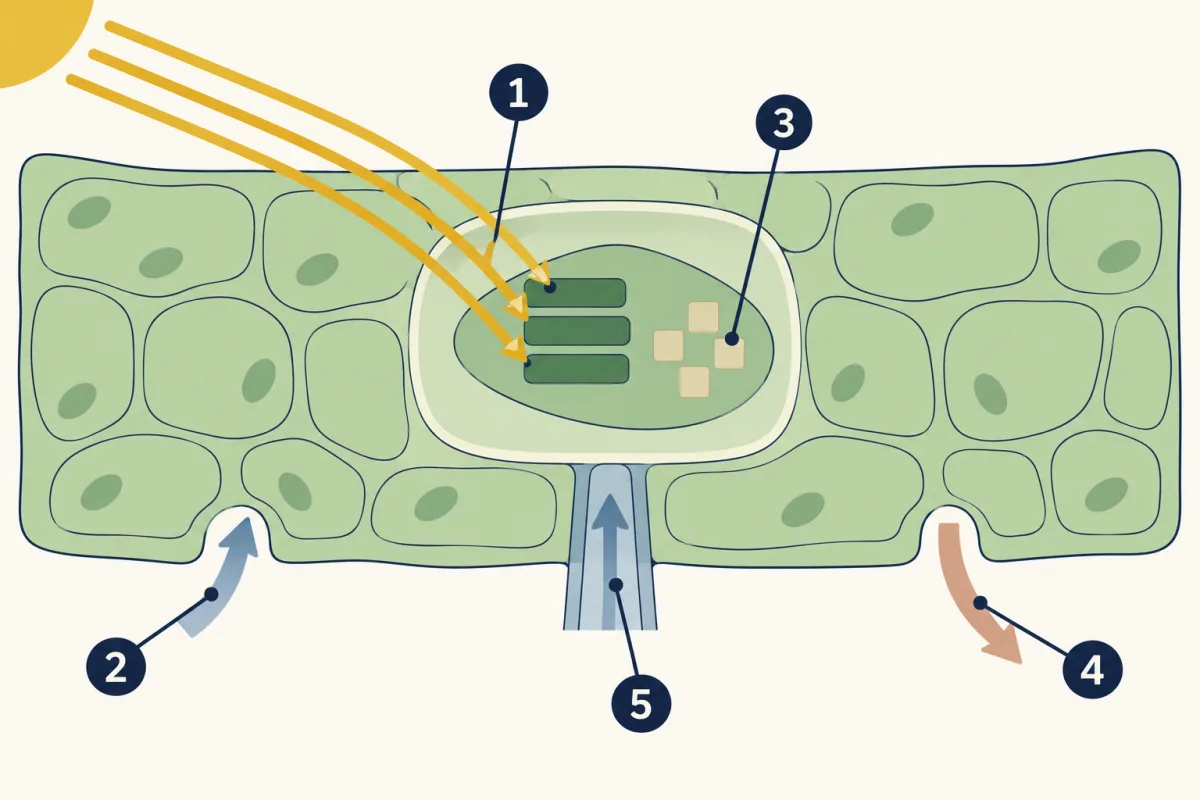
In plants and algae, photosynthesis happens in the chloroplast, a green organelle in leaf cells and other green parts. Inside it, stacks of membranes hold chlorophyll, a green pigment that absorbs light, mostly red and blue. That captured energy powers the reactions that split water and build glucose. The oxygen released comes from the split water. It is a by-product, and it leaves the leaf through tiny pores.
- light
- carbon dioxide
- glucose
- oxygen
- water
- light
- blank
- blank
- blank
- water
Word bank: carbon dioxide, glucose, oxygen
- blank
- blank
- blank
- blank
- blank
Check your labels
- light
- carbon dioxide
- glucose
- oxygen
- water
Not every photosynthetic cell has chloroplasts. A prokaryote is a cell with no nucleus and no membrane-bound organelles, such as a bacterium. Cyanobacteria are prokaryotes that photosynthesize and release oxygen. Their chlorophyll sits on folded membranes inside the cell instead of in chloroplasts.
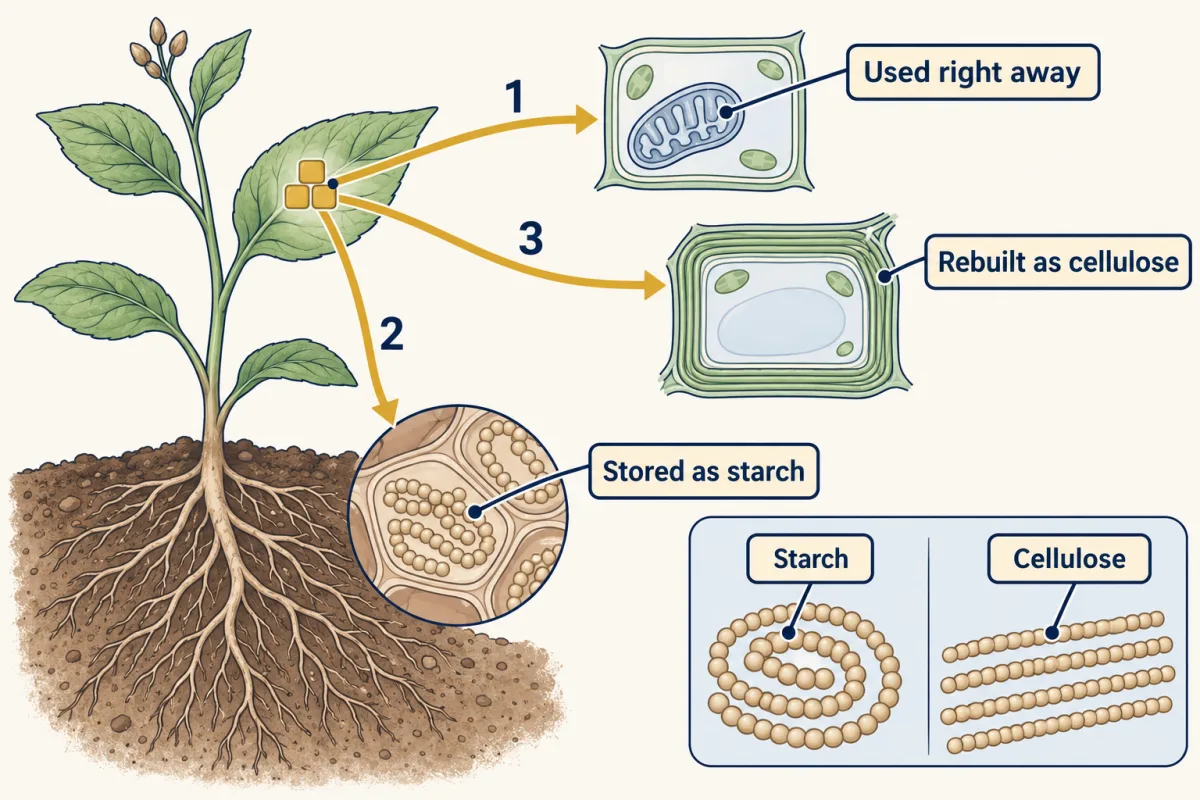
Once a plant has glucose, it has three main uses for it:
- Used right away. Plant cells carry out cellular respiration, which breaks glucose down and releases its energy in a form cells can use. Plants respire all the time, in light and dark. Respiration and ATP follows that path.
- Stored. Glucose molecules are linked into starch, a long chain the plant stores in seeds, roots and leaves.
- Rebuilt. Glucose molecules are linked a different way into cellulose, the tough fiber of plant cell walls. Wood is mostly cell walls. Plants also rebuild glucose, with minerals from soil, into proteins, fats and DNA. What Am I Made Of? covers those molecules.
Explain: what limits the rate
A limiting factor is the condition that holds a process back, such as the resource in shortest supply or a temperature that is too low or too high. Photosynthesis has three main limits:
- Light intensity. More light usually means faster photosynthesis, up to a point.
- Carbon dioxide. More carbon dioxide also speeds it up, up to a point.
- Temperature. The reactions are run by enzymes. Warmth speeds them up to a point, and too much heat slows them as the enzymes lose their shape. Enzymes at Work explains why.
Think of a sandwich line with one worker making bread and one adding fillings. Speeding up the bread maker helps only until the fillings worker can’t keep up. Then the line runs at the slower worker’s pace. The analogy breaks because a plant’s factors also affect each other: heat can change how much water a leaf loses, for example.
That is why a graph of rate against light usually rises and then levels off. At the flat part, more light does nothing, because carbon dioxide or temperature is now the limit.
Elaborate: underwater grass in the Chesapeake
Underwater grasses, which scientists call submerged aquatic vegetation (SAV), live on the bottom of shallow parts of the Bay. Every year the Virginia Institute of Marine Science (VIMS) maps them from the air.
| Survey year | Mapped underwater grass, Bay and tidal rivers (acres) | Coverage note from VIMS |
|---|---|---|
| 2018 | 99,511 | Some tributary areas not fully mapped |
| 2019 | 66,684 | Much of the loss was widgeongrass |
| 2020 | 63,132 | Satellite images replaced aerial ones for the Anacostia and northernmost Potomac |
| 2021 | 68,025 | Weather kept parts of the Mattaponi and Pamunkey rivers from being imaged |
| 2022 | 77,425 | Satellite images filled in for murky rivers; part of the Potomac imaged by satellite only |
| 2023 | 79,716 | Upper Potomac imaged after the grass had peaked |
Source: VIMS annual SAV survey executive summaries, 2018 to 2023, for Chesapeake Bay and its tidal tributaries (all mapped beds, not a single station). For areas mapped in both 2018 and 2019, VIMS compared 98,828 acres with 62,334 acres, a 37% drop.
How much light do these plants need? A Chesapeake Bay Program technical synthesis (2000) set habitat targets for the growing season. In fresher upper reaches, more than 13% of the light at the surface should reach the grass through the water. In the saltier middle and lower Bay, the target is more than 22%. Most eelgrass lives in the lower Bay. Mud and floating algae block light, and so does material growing on the leaves themselves.
- Which year had the smallest mapped area? By how many acres did the area grow from that year to 2023?
- Why is it fairer to compare 2018 and 2019 using the matched areas than the two totals?
- The table has no water-clarity numbers. What would you need to add before claiming that clearer water caused the increase after 2020?
Claim, evidence, reasoning
Make a claim that answers the essential question: where does a plant’s mass come from, and what limits how much it can build? Use the willow numbers and the Bay data.
Start with: A plant’s mass mostly comes from blank, and its growth can be limited by blank.
Start with: The willow gained about blank while the soil lost only blank. Bay grasses need more than blank of surface light, and their mapped area changed from blank to blank.
Start with: Photosynthesis builds glucose from blank and blank using light energy, so if blank is in short supply, the plant blank.
Compare with a model answer
A plant’s dry mass mostly comes from carbon dioxide in the air, and light can limit how much it builds. Van Helmont’s willow gained about 164 pounds while its soil lost about one-eighth of a pound, so soil cannot explain the gain. Photosynthesis builds glucose from carbon dioxide and water using light, and the plant turns glucose into wood. Underwater grasses need more than 13 percent (fresher water) or 22 percent (saltier water) of surface light to reach them. Their area rose from 63,132 acres in 2020 to 79,716 in 2023. One limit: van Helmont had one tree and never weighed the air, and the Bay table has no clarity readings, so it cannot show cause.
Saved in this browser only.
Design problem
Plan a real leaf-disk experiment to test how light intensity affects the rate of photosynthesis. Name your variables, what you keep the same, your control, and how many trials you would run.
One way to do it
- Independent variable: lamp distance, such as 10, 20, 30 and 40 cm.
- Dependent variable: the time for 5 of 10 disks to float, in minutes.
- Constants: same leaf type and disk size, same baking-soda amount, same volume of water, same starting water temperature, same lamp. An LED lamp or a clear water barrier keeps the lamp’s heat from changing the temperature.
- Control: one cup of disks kept in the dark. If those float too, something other than photosynthesis is lifting them.
- Trials: three cups at each distance, and report the mean time.
- Safety: keep cords and lamps away from water, and let hot bulbs cool before you touch them.
If the time to float gets shorter as the lamp gets closer, then levels off, light was limiting at first and then something else became the limit.
Evaluate: check your thinking
The willow gained mass because its leaves took in carbon dioxide and, using light energy, combined it with water to build glucose and then wood. The soil gave water and a little mineral matter, which is why it barely changed. Bay grasses face the same rule underwater: when murky water cuts the light, light becomes the limiting factor.
Science practices you used: making predictions and testing them, planning a fair test with a control and repeated trials, reading a data table and its coverage notes, separating a pattern from a cause, and using a model and naming its limits.
How we measure it
Weighing with drying (gravimetry)
A sample is dried and weighed before and after an experiment. Drying removes water, so the change in mass shows how much solid material was gained or lost.
Aerial mapping of underwater grass beds
Scientists photograph shallow water from aircraft, trace the outline of each visible grass bed and calculate its area. Ground surveys by boat identify which species grow in many of the beds.
Secchi disk
A black-and-white disk on a marked line is lowered until it disappears from view. The depth at which it vanishes is a simple measure of how clear the water is.
Finish line
Test yourself
8 questions
Practice and MCAT-style, with explained answers.
Next · Lesson 5
Respiration and ATP
Why do your legs burn after a sprint, why does bread dough puff up, and why does the deep Chesapeake Bay lose its oxygen in summer?
Continue →