Biology · Unit 7: Ecosystems
Succession in Virginia
What happens to a Virginia field, or a forest, when people stop mowing it or a fire burns through? You step through the decades in a simulation of a field and a patch of bare rock, then compare a published old-field timeline with dated records from a glacier in Alaska. Afterwards you can tell primary from secondary succession, describe how a Piedmont field can become an oak-hickory forest, and use evidence to explain why disturbance changes which species live in a place.
Where this lesson sits
- Virginia SOL BIO.8c
- Practices BIO.1c, BIO.1d, BIO.1f
Essential question: What happens to a field, or a forest, after people or fire leave it alone?
-
Life Science (grade 7) LS.8 c
Review it at grade 7 level
In grade 7 you learned that ecosystems can be disturbed by floods, fires, storms and people. You also learned that an ecosystem may recover over time, depending on how severe the disturbance was and how resilient (able to bounce back) the ecosystem is. A burned forest can grow back, and a pond can slowly fill in. You did not yet learn a name for this recovery or the order in which species return. Biology adds the word succession and shows that the change usually follows stages you can predict, from weeds and grasses to pines to hardwood trees.
-
Biology BIO.8c You are here
This lesson
-
Biology II Biology II: Ecology, EC.7 b; Advanced Topics, BIOII.6 f
Preview where it goes next
Virginia’s Biology II: Ecology course goes back over primary and secondary succession, their stages, the climax community and how people change succession, through farming, logging, fire control and invasive species. Biology II: Advanced Topics adds three ideas this lesson left out. Resilience is how well an ecosystem returns to its earlier state after a disturbance. Functional redundancy means several species can do the same job, such as fixing nitrogen, so losing one species does less harm. A tipping point is a level of change past which an ecosystem shifts to a different state and does not easily return, for example a forest that becomes a shrubland after repeated severe fires.
-
College
Watch first Each Stage Changes the Place · 2:43
Stop mowing a field in the Virginia Piedmont, and within a few years it can fill with broomsedge, blackberry and small pines. A few decades later it can be a pine forest, and after a century or more, oaks and hickories can take over. Nobody plants it; the seeds blow in, drop from birds or wait in the soil. Why do the plants arrive in this order, and does every field end up in the same place?
What do you think? Decide before you read.
-
Scientists disagree: Ecologists mark plots and come back to the same spot years later. At Glacier Bay, Alaska, plots marked in the early 1900s have been resurveyed, and the plants in them kept changing. Even an old forest loses trees to storms and gains new ones in the gaps.
What scientists think
Scientists disagree: Ecologists mark plots and come back to the same spot years later. At Glacier Bay, Alaska, plots marked in the early 1900s have been resurveyed, and the plants in them kept changing. Even an old forest loses trees to storms and gains new ones in the gaps.
-
Scientists disagree: The late stage depends on climate, soil, nearby seeds and how often disturbances strike. In most of Virginia it is usually oak-hickory forest, but at Glacier Bay it is spruce forest. Resurveys there also found that plots did not all follow one fixed timetable.
What scientists think
Scientists disagree: The late stage depends on climate, soil, nearby seeds and how often disturbances strike. In most of Virginia it is usually oak-hickory forest, but at Glacier Bay it is spruce forest. Resurveys there also found that plots did not all follow one fixed timetable.
-
Scientists disagree: In a North Carolina experiment, researchers gave forest plots fire, cutting, both or neither. Only cutting plus fire opened the canopy, and more young oaks grew where it was open. Fire can also do harm, so ecologists ask which fire, how often, and for which species.
What scientists think
Scientists disagree: In a North Carolina experiment, researchers gave forest plots fire, cutting, both or neither. Only cutting plus fire opened the canopy, and more young oaks grew where it was open. Fire can also do harm, so ecologists ask which fire, how often, and for which species.
Explore: run a field through the decades
The simulation shows a plot of land from above. You choose how it starts: bare rock, an abandoned field, or a burned forest. Then you step forward a decade at a time as plant groups replace each other and the shade and soil change. A disturbance button burns or clears part of the plot.
In this sketch an abandoned field follows the lesson’s Piedmont old-field summary (a regional summary with no dates). A burned forest and a cleared patch borrow the old-field timeline; the lesson gives none for them, so a real burned forest may differ. Bare rock follows one Glacier Bay plot (Q2) plus park estimates; other plots and places differ. The alder at about 80 years (park estimate) and the Q2 spruce at 81 years are separate estimates. Light and soil are relative levels, not measurements. Nothing is random.
Rule to keep: each stage changes the light and the soil, and those changes favor the next group of plants. A disturbance that leaves the soil restarts secondary succession.
Try this.
- Start with an abandoned field. Predict which plant group will cover the most ground after 10 years and after 100 years, then step forward and check.
- Start with bare rock instead. Predict whether it will reach forest sooner or later than the field did. Test it and count the decades.
- Let the field reach forest, then press the disturbance button on half the plot. Predict what grows first in the cleared half.
- Watch the light and soil readings as you step. Which one changes first, and which plant group seems to follow it?
Explain: what succession is
- ecological succession
- community
- disturbance
- primary succession
- secondary succession
- pioneer species
- abiotic factors
- biotic factors
- climax community
- biodiversity
A community is all the populations of different species living in one area. Ecological succession is the change, over years to centuries, in which species live in an area. The change is predictable in a general way: certain kinds of plants tend to come early, and others tend to come late.
Succession often starts after a disturbance, an event such as a fire, a flood, a storm or plowing that removes much of a community. What the disturbance leaves behind decides which kind of succession follows.
Primary succession is succession on bare rock or new land where there is no soil. Bare rock, sand and silt left by a melting glacier and fresh lava are examples. The first organisms to live there are pioneer species, usually lichens and mosses that can grow on rock. As they grow, they help break down the rock, and when they die they add the first thin layer of soil.
Secondary succession is succession after a disturbance that leaves the soil in place. Examples are an abandoned farm field, a burned forest and a flooded meadow. The soil already holds nutrients, seeds and roots, so secondary succession usually reaches forest much faster than primary succession.
| Primary succession | Secondary succession | |
|---|---|---|
| Starting point | Bare rock or new land, no soil | Soil remains after a disturbance |
| Virginia or nearby example | Rare in Virginia; a glacier’s retreat in Alaska | Abandoned Piedmont field, burned forest |
| First arrivals | Lichens and mosses | Weeds, grasses, seeds already in the soil |
| Speed | Usually centuries | Usually decades to a century or more |
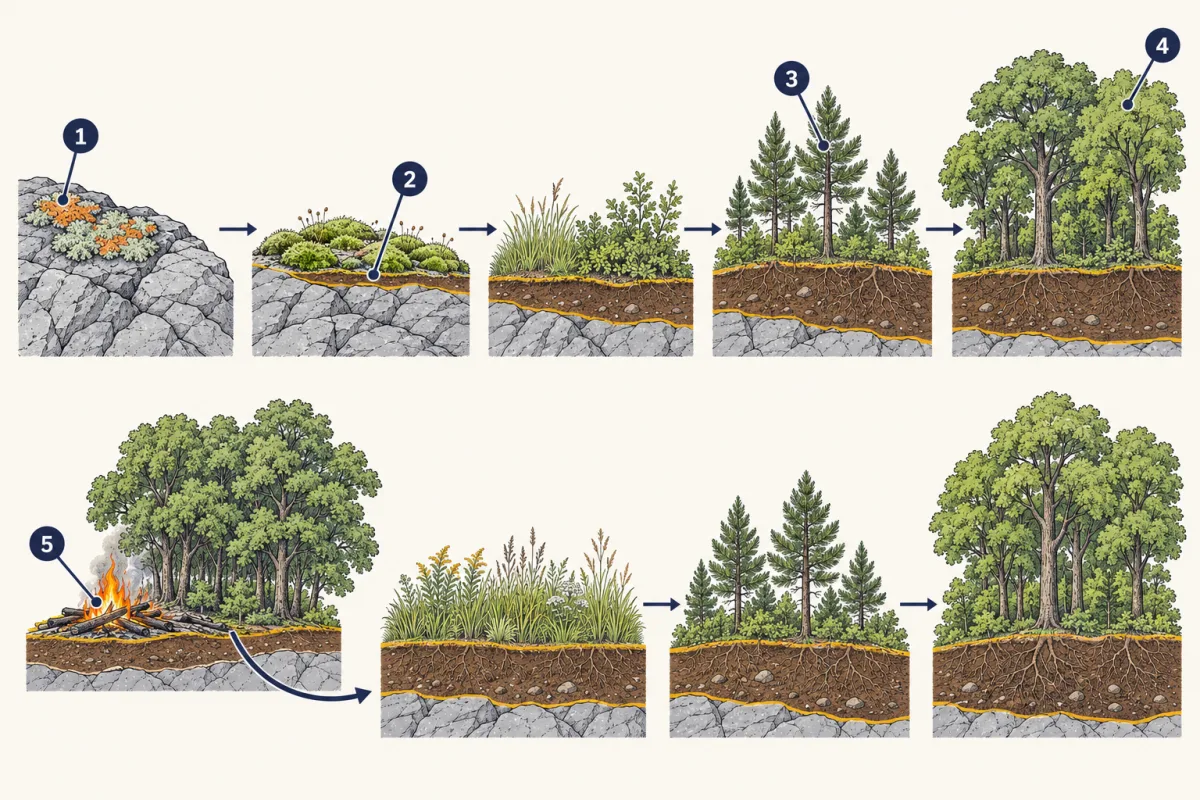
- pioneer species
- soil
- pines
- climax community
- disturbance
- blank
- soil
- pines
- blank
- blank
Word bank: climax community, disturbance, pioneer species
- blank
- blank
- blank
- blank
- blank
Check your labels
- pioneer species
- soil
- pines
- climax community
- disturbance
Explain: how a Virginia field becomes a forest
Each stage changes the place it grows in. Abiotic factors are the nonliving parts of an ecosystem, such as light, water, temperature and soil. Biotic factors are the living parts, such as plants, animals, fungi and microbes. The plants of one stage change the abiotic factors, and the new conditions favor different plants.
Here is the usual path published for old Piedmont fields just south of Virginia.
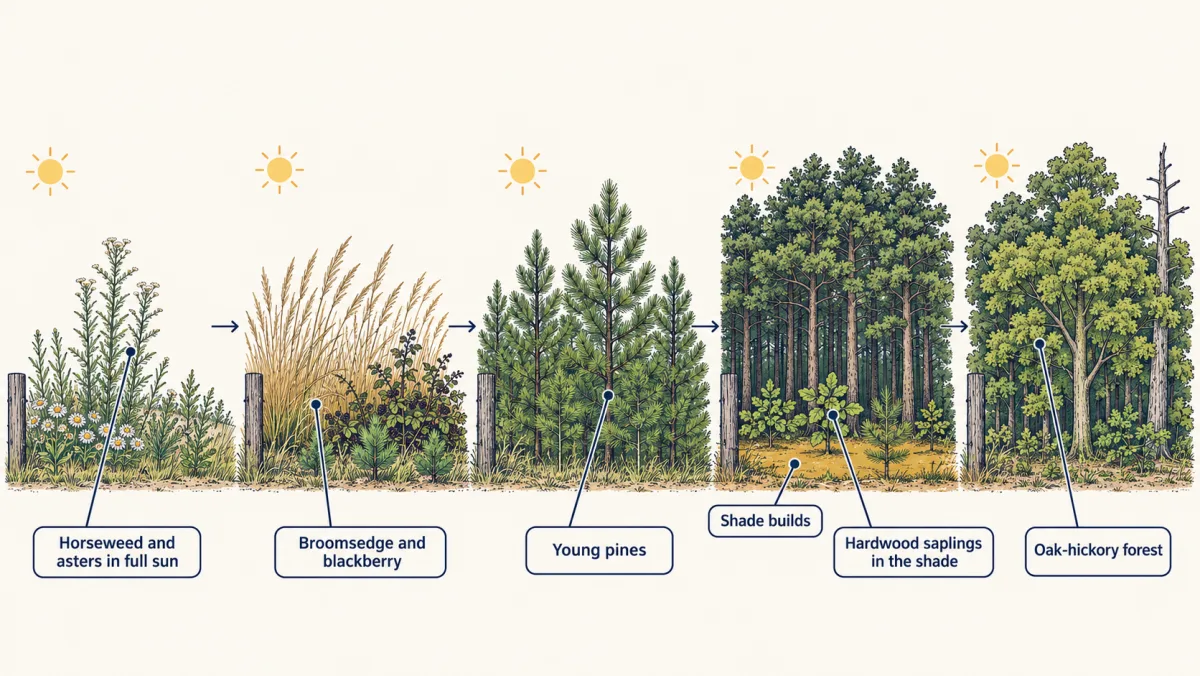
- The first years. Weeds such as horseweed and asters grow fast in full sun. By about the third year, broomsedge, a tall grass, often covers the field.
- Pines move in. Where seed trees grow nearby, pine seedlings and blackberry appear after about five years. Pines grow fast in full sun, and within a few decades the field becomes a young pine forest.
- Shade builds. A closed pine canopy blocks much of the sunlight. Pine seedlings grow poorly in that shade. Young hardwoods, such as oaks and hickories, cope with shade better and grow slowly underneath.
- Hardwoods take over. As the old pines die over the next several decades, the hardwoods below fill the gaps. After a century or more, hardwoods dominate, and one Virginia source puts a mostly hardwood forest at about 200 years.
The late stage that stays fairly stable when no major disturbance strikes is the climax community. In most of Virginia, the climax community is a deciduous oak-hickory forest. A USDA Forest Service inventory estimated that in 2021 the oak-hickory forest type covered about 61 percent of Virginia’s forest land, and loblolly-shortleaf pine about 19 percent.
Explain: disturbance keeps the story open
The climax community is a model. Ecologists now see the late stage as less fixed than older textbooks did. Storms, insects, floods and fires keep opening gaps, so a real landscape is a patchwork of fields, pine stands and hardwood forest of different ages.
Disturbance is not always harmful. In the North Carolina experiment from the opening, only cutting plus fire opened the forest canopy, and young oak saplings were more common where it was open. The same study found no clear difference in the smallest oak seedlings, so the benefit depended on the treatment and on the age of the plant.
Succession also changes biodiversity, the variety of living things in an area. One simple measure is the number of species recorded in a place. It can rise or fall from stage to stage, so scientists say which measure they used.
Elaborate: two timelines, two kinds of evidence
The table compares a published summary of old-field succession in the North Carolina Piedmont with records from one plot at a glacier. The last column says what kind of evidence each row is.
| Place and kind of succession | Years after the start (years) | What dominates or first appears | Kind of evidence |
|---|---|---|---|
| Piedmont old field (secondary) | 1 | Horseweed | Regional summary |
| Piedmont old field (secondary) | 2 | Asters | Regional summary |
| Piedmont old field (secondary) | 3 to 18 | Broomsedge; pines arriving | Regional summary |
| Piedmont old field (secondary) | 19 to 30 | Young pine forest | Regional summary |
| Piedmont old field (secondary) | 30 to 70 | Mature pines over young hardwoods | Regional summary |
| Piedmont old field (secondary) | 70 to 100 | Pines giving way to hardwoods | Regional summary |
| Piedmont old field (secondary) | more than 100 | Oak-hickory forest | Regional summary |
| Glacier Bay plot Q2, Alaska (primary) | 0 (year 1879) | Bare ground left by the ice | Dated record, one plot |
| Glacier Bay plot Q2, Alaska (primary) | 81 (year 1960) | First spruce tree established | Tree-age estimate, one plot |
| Glacier Bay, park narrative (primary) | about 80 | Alder shades the ground | Park estimate, not measured |
| Glacier Bay, park narrative (primary) | about 200 | Sitka spruce forest | Park estimate, not measured |
Sources: rows 1 to 7, Duke Forest (Duke University), forest succession page, a summary for the North Carolina Piedmont that gives no observation dates or field names; rows 8 and 9, Buma and colleagues, Ecology (2019), Cooper plot Q2 in the West Arm of Glacier Bay; rows 10 and 11, National Park Service, plant succession in Glacier Bay page (updated 2021).
- In the old field, about how many years after abandonment do pines begin arriving, and about when do hardwoods take over?
- At Glacier Bay plot Q2, how many years passed before the first spruce took root? Why might an old field’s first pines arrive so much sooner than spruce on bare ground?
- Which rows come from one dated place, and which are a summary or an illustration? Why does that matter for how much you trust each row?
Claim, evidence, reasoning
Make a claim that answers the essential question: what happens to a field, or bare ground, after people or ice leave it alone? Use the table.
Start with: After the disturbance ends, the plants that live there blank, and the change is faster when blank.
Start with: In the old field, pines arrive by about year blank and hardwoods take over after about blank years, while at Glacier Bay plot Q2 the first spruce took root after blank years.
Start with: This happens because each stage changes abiotic factors such as blank and blank, and an old field starts with blank that bare ground lacks.
Compare with a model answer
After a disturbance ends, the plants that live in a place change in a predictable order, and the change is faster when soil is already present. In the Piedmont summary, pines arrive in years 3 to 18 and hardwoods take over after about 100 years. At Glacier Bay plot Q2, bare ground took 81 years to get its first spruce tree. Each stage changes light and soil, and the old field starts with soil and seeds that bare rock lacks. One limit is that the old-field rows are a regional summary with no dates, and the Glacier Bay rows come from a single plot, so other places, with other climates and trees, may follow other schedules.
Saved in this browser only.
Design problem
The lesson says pine seedlings grow poorly in shade, while young hardwoods cope better. Plan a fair test of whether shade slows the growth of pine seedlings more than oak seedlings, using seedlings in pots, shade cloth and a ruler.
One way to do it
- Question and hypothesis: If seedlings grow under shade cloth, then pine seedlings will grow less than in full sun, and oak seedlings will be slowed less, because pines need bright light.
- Independent variables: light (full sun or shade cloth) and kind of seedling (pine or oak).
- Dependent variable: increase in height, in centimeters, after 8 weeks.
- Constants: the same pot size, the same soil from one bag, the same water on the same schedule, seedlings of similar starting height, the same place outdoors.
- Control: the seedlings in full sun are the comparison group for each kind of tree.
- Repeated trials and sample size: at least 10 seedlings in each of the four groups, with the mean height gain calculated for each group.
- Safety and ethics: buy seedlings from a nursery instead of digging them from the wild, wear gloves for soil, and plant the seedlings out afterward.
Bigger gains in sun than in shade, with a larger drop for pines, would support the hypothesis. Height is one measure; weighing each seedling after drying it (its dry mass) would make the test stronger.
Evaluate: check your thinking
When you stop mowing a Piedmont field, secondary succession begins. Weeds and broomsedge come first, pines follow in the sun, and the shade under the pines favors oaks and hickories, the climax community in most of Virginia. Fire, storms and people reset patches, so the path and timing vary.
Science practices you used: making predictions with a model and testing them, reading a table that mixes measured and summarized data, judging how strong each kind of evidence is, and planning a fair test with a control and repeated trials.
How we measure it
Permanent-plot resurvey
Ecologists mark a plot so that they, or later scientists, can find the exact spot again and record what grows there years or decades later. Comparing the same place over time tests a succession timeline directly instead of guessing it from sites of different ages.
Quadrat survey
A quadrat is a small square frame laid on the ground, and every plant inside it is counted and identified. Using the same number and size of squares in each field lets you compare how many kinds of plants two fields hold.
Statewide forest inventory
The USDA Forest Service visits thousands of sample points across a state and records the trees at each one. From those samples it estimates what share of the state's forest land belongs to each forest type, such as oak-hickory or pine.
Finish line
Test yourself
8 questions
Practice and MCAT-style, with explained answers.
Next · Lesson 33
The Chesapeake Under Pressure
How can fertilizer spread on a field far upstream leave crabs and fish short of oxygen at the bottom of the Chesapeake Bay?
Continue →