Organismal Biology · Unit 3: Supply and exchange
Gas Exchange and Breathing
How do animals get oxygen in and carbon dioxide out, when both gases can only cross by diffusion? This lesson uses Fick's law to explain why exchange surfaces are large, thin and moist, compares skin, teleost gills, insect tracheae and the lungs of mammals, birds and alligators, and contrasts how a mammal, a frog and a bird move air. Afterwards you can calculate how area and thickness change a diffusion rate, tell minute from alveolar ventilation, and explain why carbon dioxide, not oxygen, sets resting breathing in mammals.
Watch first How Two Streams Flow Matters · 2:60
Water holds far less oxygen than air, yet a trout’s gill can bring its blood close to the oxygen partial pressure of the water flowing in. Your lung cannot do that with air. Why not?
The answer lies in which way two streams flow past each other. Oxygen has to get in and carbon dioxide out, and both cross by diffusion alone. This lesson starts with the law that governs that diffusion, compares the surfaces animals use, and ends with how breathing is driven and controlled.
Fick’s law: why exchange surfaces are large, thin and wet
Gases move between the outside and the blood by diffusion, the net movement of molecules from where they are more concentrated to where they are less. Oxygen and carbon dioxide cross gills, skin, tracheae and alveoli by diffusion, not active transport.
For a gas, the gradient is measured as partial pressure: the part of a mixture’s total pressure contributed by one gas, equal to the pressure it would exert alone. Dry air at sea level is about 21% oxygen at a total pressure of about 760 mmHg (101 kPa), so its oxygen partial pressure, PO2, is about 0.21 x 760, or roughly 160 mmHg (21 kPa). Oxygen moves from higher PO2 to lower, in air, water or blood.
The rate across a sheet of tissue follows Fick’s law, which builds on the diffusion idea in size and scaling:
rate of gas transfer = k x A x (P1 - P2) / T
A is the area, P1 - P2 the partial-pressure difference, T the barrier thickness, and k a constant for that gas and barrier. More area, a steeper difference and a thinner barrier all raise the rate. Gases must also dissolve in a water film before crossing cells, so working exchange surfaces are moist.
Worked problem. These numbers are invented. Two barriers carry the same gas with the same partial-pressure difference and the same k. Barrier 1 is 50 m2 and 0.5 micrometres thick; barrier 2 is 30 m2 and 1.0 micrometre thick. What fraction of barrier 1’s rate does barrier 2 achieve?
- Ratio. Rate 2 / Rate 1 = (A2 / A1) x (T1 / T2), since k and ΔP cancel. Thickness flips because it sits below the line.
- Area. 30 m2 / 50 m2 = 0.60.
- Thickness. 0.5 micrometres / 1.0 micrometre = 0.50.
- Multiply. 0.60 x 0.50 = 0.30, so 30% remains.
Check: A / T is 30 for barrier 2 and 100 for barrier 1, and 30 / 100 = 0.30. Lost area and added thickness multiply.
- Area ratio, A2 / A1
- Thickness ratio, T1 / T2 (flipped: T is below the line)
- Pressure-difference ratio, ΔP2 / ΔP1
- Rate 2 / Rate 1 (k cancels)
- A / T, barrier 2
- A / T, barrier 1
- Check: (A2 / T2) / (A1 / T1) × ΔP ratio
Rule to keep: rate ∝ A × (P1 − P2) / T. More area, a steeper difference and a thinner barrier all raise the rate; lost area and added thickness multiply. In this sketch: invented numbers; same gas, same k, steady diffusion across a uniform sheet; not to scale.
Water or air: skin, gills and tracheae
Water is hard to breathe. Air-saturated fresh water at 15 to 20 degrees C holds roughly 30 times less oxygen per litre than air, and water is about 800 times denser and far more viscous, so moving it over a gill costs more work for less oxygen.
Skin. An earthworm exchanges gases across its moist skin. Frogs combine skin and lungs, and adult lungless salamanders (family Plethodontidae) breathe through the skin and mouth lining alone. Skin breathing works where skin stays wet and oxygen demand per unit of surface is modest.
Gills. In teleost fish, the large group of bony fishes that includes trout, each gill is folded into filaments carrying thin plates called lamellae: large area, thin barrier. Most teleosts move water one way, in through the mouth and out under the gill cover; tunas ram it through an open mouth as they swim.
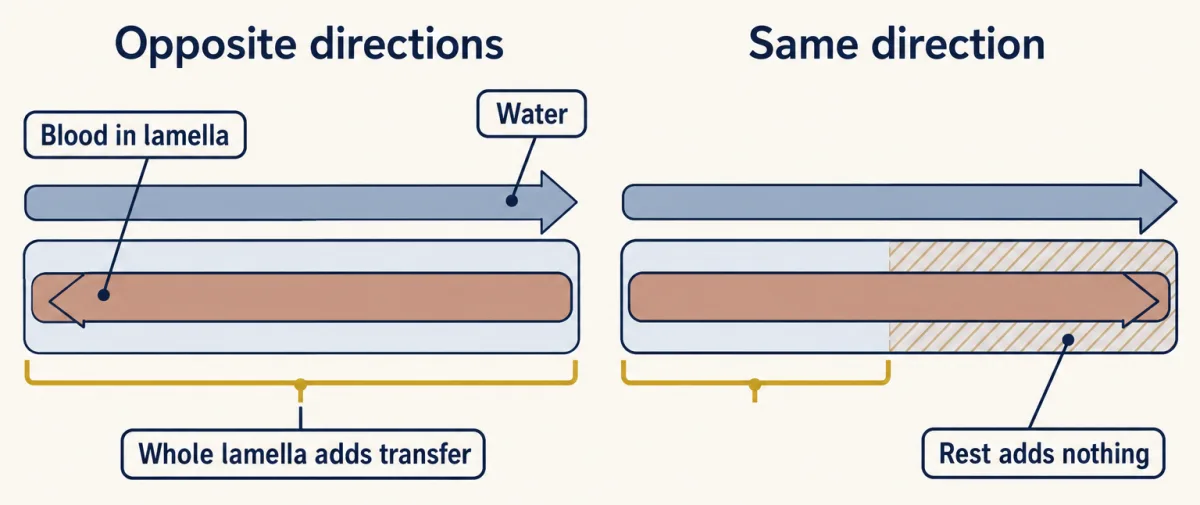
Inside each lamella, blood flows opposite to the water. This countercurrent exchange keeps a PO2 difference along the whole lamella. Picture two escalators running in opposite directions: each rider passes the whole line on the other. Blood about to leave meets water that has just arrived, so leaving blood can approach the PO2 of the incoming water. If the streams ran the same way, they would reach equal PO2 partway along and the rest of the lamella would add nothing. Blood from a teleost gill goes on to the body in a single circuit, as in circulation and the heart.
Tracheae. Most insects carry oxygen in air, not blood. Air enters through openings called spiracles into tracheae, branching air-filled tubes whose finest branches reach the tissues. Many larger insects pump the abdomen, and in 2003 Mark Westneat and colleagues used synchrotron X-ray imaging to watch tracheae in live beetles, crickets and ants compress and expand rhythmically.
A leaf, by contrast, exchanges gases by diffusion through pores called stomata, with no pump; see moving water and sugar in plants.
Three lungs: mammal, bird, alligator
A lung is an internal, air-filled exchange organ.
Mammals: tidal. In mammals, air flows in and out through the same airways, called tidal ventilation, and ends in tiny dead-ended sacs, the alveoli. Each breath mixes with stale air left behind, and the windpipe and bronchi are dead space, where no exchange happens: fresh air left there at the end of a breath is breathed out unused. So alveolar PO2 in a resting adult human is about 100 mmHg, below the roughly 150 mmHg of warmed, humidified inhaled air, and blood can at best match the alveolar gas.
Birds: one way, crosscurrent. Birds have no diaphragm. Their lungs are stiff, keep a nearly constant volume, and exchange gas in tubes called parabronchi. Thin-walled air sacs in front of and behind the lungs act as bellows as the sternum and ribs move. Through most parabronchi, air flows the same way during inspiration and expiration. Capillaries cross the airstream, so exchange is crosscurrent, not countercurrent: each capillary meets the air at a different point along the parabronchus, and the mixed blood leaving the lung can hold a higher PO2 than the air breathed out. The textbook rule that air takes two breaths to pass through is a schematic; helium tracer work in songbirds found some inhaled gas reaching the front air sacs within one breath.
In 1972 Johannes Piiper and Peter Scheid compared idealized models of the three arrangements under matched conditions: countercurrent transferred the most gas by their measure, crosscurrent next, the mixed pool of a mammal lung least. That ranks geometries, not animals.
Alligators: one way, no air sacs. In 2010 C. G. Farmer and Kent Sanders reported one-way airflow in the lungs of the American alligator, Alligator mississippiensis, which has no air sacs. Birds and crocodilians are both archosaurs, and the shared trait fits inheritance from a common ancestor without proving it; see reading phylogenetic trees.
Aspiration and the frog’s buccal pump
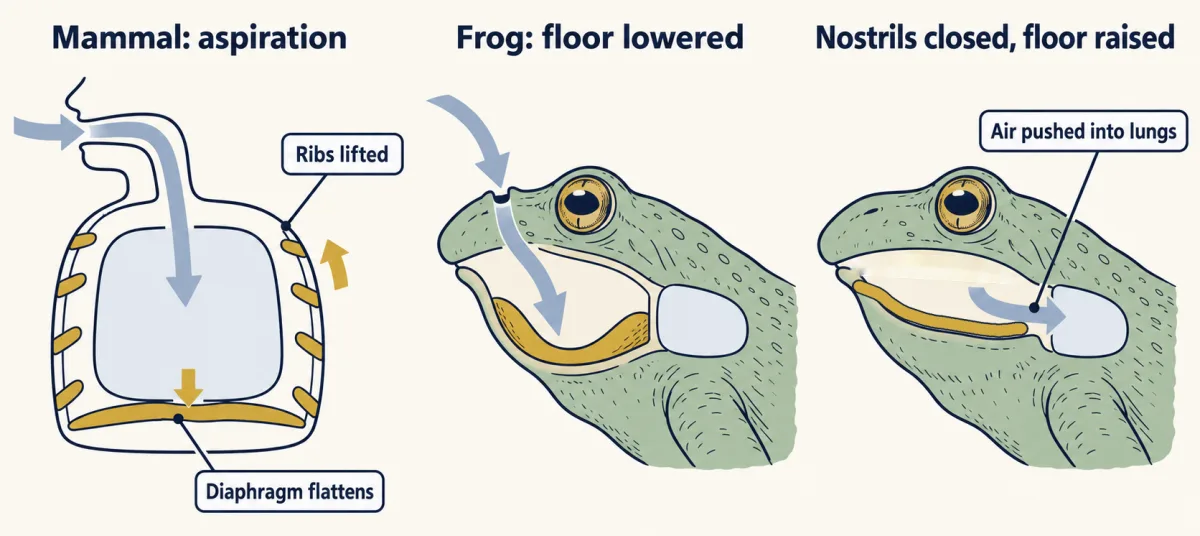
Mammals breathe by aspiration, pulling air in by lowering pressure in the chest. The diaphragm, a dome of muscle beneath the lungs, contracts and flattens, and the external intercostal muscles lift the ribs. The chest enlarges, the lungs follow, alveolar pressure falls below outside pressure, and air flows in. Quiet expiration in adult humans is normally passive recoil of lungs and chest wall once the muscles relax; forceful expiration adds the internal intercostals and abdominal muscles.
The wet lining of the alveoli has surface tension, pulling inward like a soap bubble. Surfactant, a lipid and protein mixture secreted by alveolar cells, lowers it. That raises compliance, how much the lung stretches for a given pressure change, so it inflates with less effort.
A frog works the other way. In buccal pumping it lowers the floor of its mouth with the nostrils open, drawing in air, then closes the nostrils and raises the floor, pushing air into the lungs under positive pressure. Negative pressure in mammals, positive pressure in frogs, bellows in birds: three solutions in three living lineages, none a stage toward another.
Carbon dioxide runs the controller
Breathing rhythm comes from neurons in the brainstem (see the nervous system map and the hypothalamus and autonomic system). What sets how hard they drive the muscles at rest?
In 1905 J. S. Haldane and J. G. Priestley, with themselves and colleagues as subjects at rest, collected the last part of a forced breath out through a tube as a sample of alveolar air and measured its carbon dioxide. They repeated this with added carbon dioxide or less oxygen in the inspired air. If breathing tracked oxygen, ventilation should rise as oxygen fell. Instead, alveolar carbon dioxide partial pressure stayed nearly constant for each man at rest, and a small rise in it greatly increased ventilation. Lowering oxygen did little until it fell far. Carbon dioxide was the main resting stimulus in these men; where the sensor sat, the work did not say.
Later work found two kinds. Carbon dioxide crosses the blood-brain barrier readily and lowers the pH of brain extracellular fluid, which central chemoreceptors near the brainstem surface detect. In mice, a proton-sensing receptor, GPR4, in retrotrapezoid nucleus neurons is needed for much of this response (see GPCRs and G proteins). The carotid bodies, sensory clusters where each carotid artery forks, respond mainly to low arterial oxygen and are also affected by carbon dioxide. In adult humans, ventilation rises steeply with hypoxia only once arterial PO2 falls well below normal. In teleosts, low oxygen in the water is a major ventilatory stimulus.
Worked problem. Illustrative values for an adult human at rest: tidal volume (one breath) 500 mL, dead space 150 mL, 12 breaths per minute.
- Minute ventilation, total air moved, = 12 x 500 mL = 6,000 mL per minute.
- Alveolar ventilation, fresh air reaching alveoli, = 12 x (500 - 150) = 4,200 mL per minute.
- Breathe rapidly and shallowly, 24 breaths of 250 mL: minute ventilation = 24 x 250 = 6,000 mL per minute, unchanged.
- Alveolar ventilation = 24 x (250 - 150) = 2,400 mL per minute, 57% of before.
Equal minute ventilation does not mean equal alveolar ventilation. With carbon dioxide production unchanged, less alveolar ventilation lets alveolar PCO2 rise, and breathing more than production requires drives it down, called hypocapnia. Gas carriage in blood is in carrying oxygen and carbon dioxide, and acid-base adjustment in the kidney.
Design problem
Birds have one-way airflow driven by air sacs. Alligators have none. How would you find out whether air moves one way through an alligator’s lung, and what would the result tell you?
One way to do it
Measure flow direction in identified bronchi of live alligators with directional probes, such as heated thermistors that register which way air moves. Flow in one direction during both inspiration and expiration means one-way flow there. This is the approach Farmer and Sanders reported in 2010.
Then remove muscles and nerves from the question: ventilate an excised lung tidally with a pump through the trachea. If one-way flow persists and the airways have no flap valves, airway geometry must produce it. As a control, put a mammal lung on the same pump; its flow should reverse with each breath, and if it does not, the probes or pump are at fault.
State the limits: few animals (four lungs in the pump tests, one live animal with a direction-sensing probe), and only some bronchi measured. One-way flow in birds and crocodilians is consistent with inheritance from a common archosaur ancestor, but it could have arisen twice; testing that needs more lineages, such as lizards and turtles, placed on a tree.
How we measure it
End-expiratory sampling of alveolar air
The subject breathes out suddenly and deeply through a tube, and the last part of the breath is sampled and analysed. That last portion comes from the gas-exchanging part of the lung, so its carbon dioxide and oxygen give an estimate of alveolar partial pressures.
Directional flow probes in the airways
A heated thermistor placed in a bronchus is cooled by moving air, and a paired arrangement tells which way the air is going. Recording in live animals and in excised lungs ventilated by a pump separates the lung's own geometry from the animal's muscles and nerves.
Synchrotron X-ray imaging of live animals
A synchrotron produces X-rays bright enough to film air-filled tubes inside a small living animal. It shows tubes changing shape; pressure and gas measurements are still needed to say how much air those changes move.
Spirometry and whole-body plethysmography
A spirometer records the volume of air moved into and out of the lungs, giving tidal volume and breathing rate. In small animals such as mice, a sealed chamber records the pressure changes caused by breathing, so ventilation can be measured in a conscious animal breathing test gases.
Finish line
Test yourself
8 questions
Practice and MCAT-style, with explained answers.
Next · Lesson 13
Carrying Oxygen and Carbon Dioxide
Antarctic icefish have no working hemoglobin. Without hemoglobin, your blood would carry only about 1.5 percent of its oxygen.
Continue →