Life Science · Unit 8: Change over time
Natural Selection in Action
Why do some traits become more common in a population over time? You run a model of birds hunting pale and dark moths on clean and sooty bark, then read real counts of dark peppered moths near Cambridge, England. Afterwards you can explain natural selection, adaptation and artificial selection, and use moth data to support a claim.
Where this lesson sits
- Virginia SOL LS.11 a
- Practices LS.1 c, LS.1 d, LS.1 e
Essential question: Why do some traits become more common over time?
-
Life Science (grade 7) LS.11 a You are here
This lesson
-
Biology
Preview it at high school level
In Biology you will name the three things natural selection needs: individuals that differ, differences that are inherited, and differences that change how many offspring survive. You will read real beak measurements from finches that lived or died in a drought. You will learn that selection is not the only way a population changes. Genetic drift is change by chance, and gene flow is change when individuals move between groups. You will also learn how one species can split into two when groups stop breeding with each other.
-
Biology II Biology II: Advanced Survey of Biology Topics, BIOII.5 c-f; Genetics, GEN.6; Ecology, EC.6 a and c
Preview where it goes next
Virginia's Biology II courses look at all the forces that change a population's genes: selection, drift, gene flow, mutation and non-random mating. They use the Hardy-Weinberg model, a population with none of these forces, as a baseline. They study how small populations lose variation, how new species form, and how ecologists tell changes caused by selection from changes caused by chance.
-
College
Watch first Why Some Traits Become Common · 2:39
Peppered moths rest on trees by day, on trunks and branches. Some are pale and speckled and some are nearly black, and birds are more likely to find the moths that stand out.
In smoky industrial areas, soot darkened the trees, and dark moths became common. Later the air got cleaner, and dark moths became rare again, in Britain and in parts of the United States. No moth changed its colour. So what changed?
What do you think? Decide before you read.
-
Scientists disagree: A moth keeps the colour it was born with. Scientists count how common each colour is in a population, year after year. What changes is the share of moths of each colour, as some die and others survive and have young.
What scientists think
Scientists disagree: A moth keeps the colour it was born with. Scientists count how common each colour is in a population, year after year. What changes is the share of moths of each colour, as some die and others survive and have young.
-
Scientists disagree: Colour is inherited, and a moth cannot choose it. Scientists found that birds removed a larger share of the colour that showed up more on the bark, so the other colour became more common.
What scientists think
Scientists disagree: Colour is inherited, and a moth cannot choose it. Scientists found that birds removed a larger share of the colour that showed up more on the bark, so the other colour became more common.
-
Scientists disagree: In peppered moths, colour mattered more than strength. Scientists placed pale and dark model moths on trees and checked which ones birds ate. The model that matched the bark survived better. What counts is which traits suit the environment and help an animal have young.
What scientists think
Scientists disagree: In peppered moths, colour mattered more than strength. Scientists placed pale and dark model moths on trees and checked which ones birds ate. The model that matched the bark survived better. What counts is which traits suit the environment and help an animal have young.
Explore: be the birds that hunt moths
In this model, pale and dark moths rest on bark. You choose the bark: dark and sooty, or clean and pale with lichen. You set how sharp-eyed the birds are and how many generations to run. Eaten moths have no young, and survivors have young of their own colour. A line graph shows the percent of dark moths in each generation. You can switch the bark in the middle of a run, the way cleaner air did.
dark moth pale moth × crossed out = eaten by a bird
simulated (random luck) expected (the rule, no luck)
- Generation
- 0
- Dark moths, simulated (young of this generation)
- 5 of 100
- Dark moths, expected (young of this generation)
- about 5 percent
In this sketch (made up, not measurements): 100 moths in every generation, and 5 of them dark at the start. Colour is inherited, and young are the same colour as their parent, except that 1 baby moth in 100 is born the other colour by chance (the lesson says new variations appear by chance; it gives no rate, and it does not say this happens both ways). Birds are the only cause of death, and no moths arrive or leave. Chance of being eaten, for a moth that stands out / a moth that matches the bark: less sharp-eyed 20 / 5 percent, sharp-eyed 40 / 10 percent, very sharp-eyed 60 / 15 percent. The graph holds up to 90 generations.
Rule to keep: birds find more of the moths that stand out from the bark, so the colour that matches the bark becomes more common over generations. No moth changes its colour.
Try this.
- Predict the line on sooty bark if the population starts with only a few dark moths. Run 30 generations and check.
- Partway through the run, switch to clean bark. Predict the shape of the line before you press play.
- Make the birds less sharp-eyed. Predict whether the change will be faster or slower, then test it.
Explain: how natural selection works
- population
- environment
- generation
- trait frequency
- natural selection
- adaptation
- artificial selection
- evolution
A population is a group of the same kind of living thing in one area. The peppered moths in one wood are a population. An environment is everything around a living thing, such as bark, air, food and predators. A generation is one step from parents to their offspring.
Members of a population are not all the same. Some moths are pale and some are dark, and the colour is inherited. New variations first appear by chance, as you saw in that lesson.
Natural selection is the process in which individuals with traits that suit their environment are more likely to survive and reproduce. Here is how it works in moths.
- Moths in the population vary in colour.
- Birds spot more of the moths that stand out from the bark.
- Moths that are not eaten live to reproduce.
- Their offspring inherit their colour.
- Over generations, the colour that matched the bark becomes more common.
Trait frequency is how common a trait is in a population, often given as a percent. Natural selection shifts trait frequency. It does not change any one moth. As an environment changes, some organisms survive and reproduce. Others may move to a new place or die.
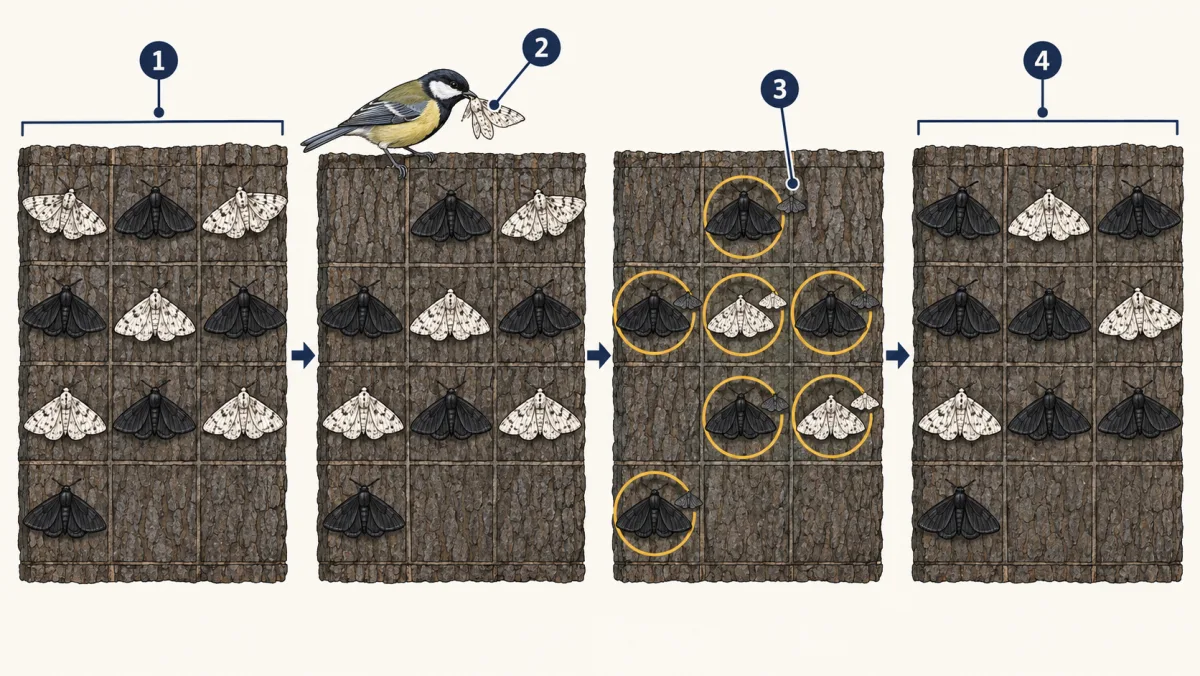
- moths vary in colour
- birds spot moths that stand out
- survivors reproduce
- the next generation
- moths vary in colour
- birds spot moths that stand out
- blank
- blank
Word bank: survivors reproduce, the next generation
- blank
- blank
- blank
- blank
Check your labels
- moths vary in colour
- birds spot moths that stand out
- survivors reproduce
- the next generation
You may hear “survival of the fittest.” In biology, fit means well suited to the environment and able to leave offspring. It does not mean strongest. A dark moth on sooty bark is fit because birds miss it more often.
Explain: adaptations, breeders and evolution
An adaptation is a structure, function or behaviour that comes from natural selection and helps an organism survive and reproduce. A dark colour on sooty bark was an adaptation. On clean, pale bark, the same colour was not. Whether a trait helps depends on the environment.
People can shift traits too. Artificial selection is when people choose which plants or animals breed, so the traits they want become more common. Dog breeds, from tiny Chihuahuas to huge Great Danes, all came from breeding one kind of animal. Corn came from a wild grass called teosinte, after farmers kept seeds from the plants they liked best. The idea is the same as natural selection: some individuals breed and others do not. The difference is who decides.
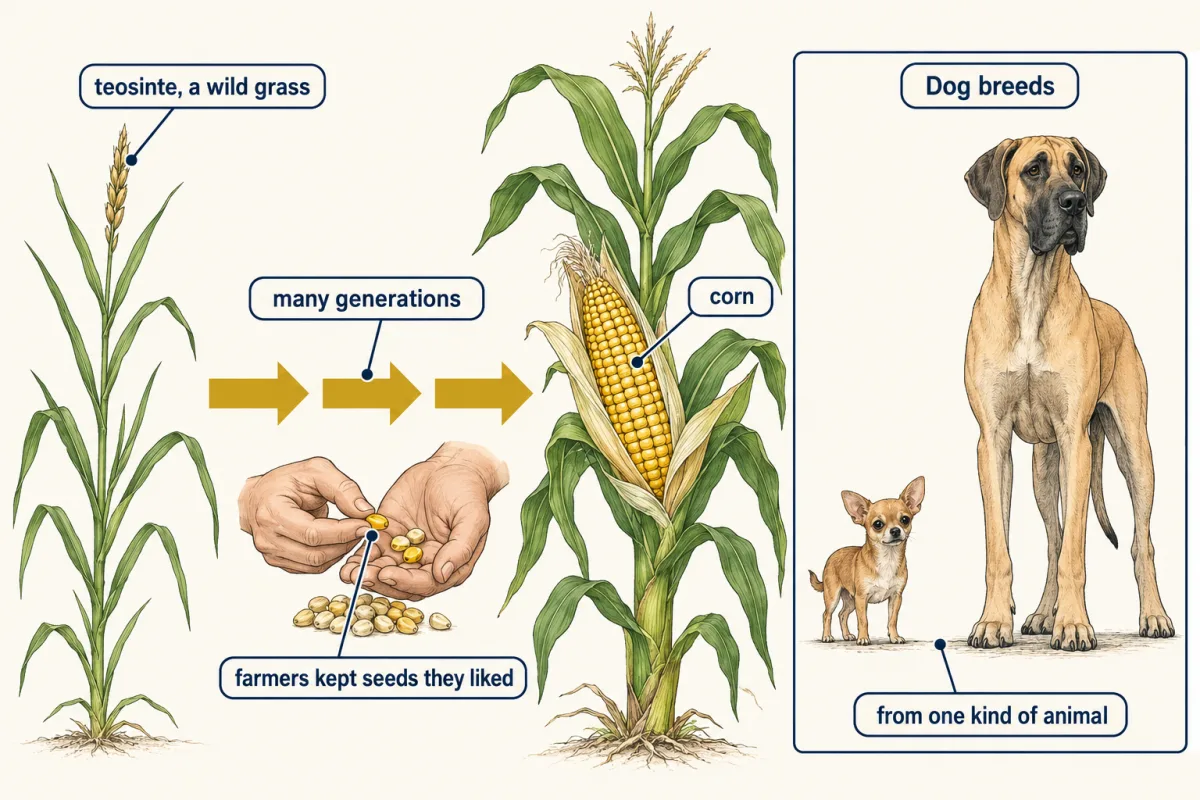
| Natural selection | Artificial selection | |
|---|---|---|
| What decides who breeds | The environment, such as predators or weather | People |
| Example | Dark moths on sooty bark | Dog breeds, corn |
| Time needed | Many generations | Many generations |
Evolution is a change in the inherited traits of a population over many generations. Natural selection drives evolution. If no individuals have traits that suit a changed environment, the population may die out, as you will see in a later lesson. Scientists also have fossils and DNA as evidence for evolution, which that lesson explores.
Elaborate: read the moth counts
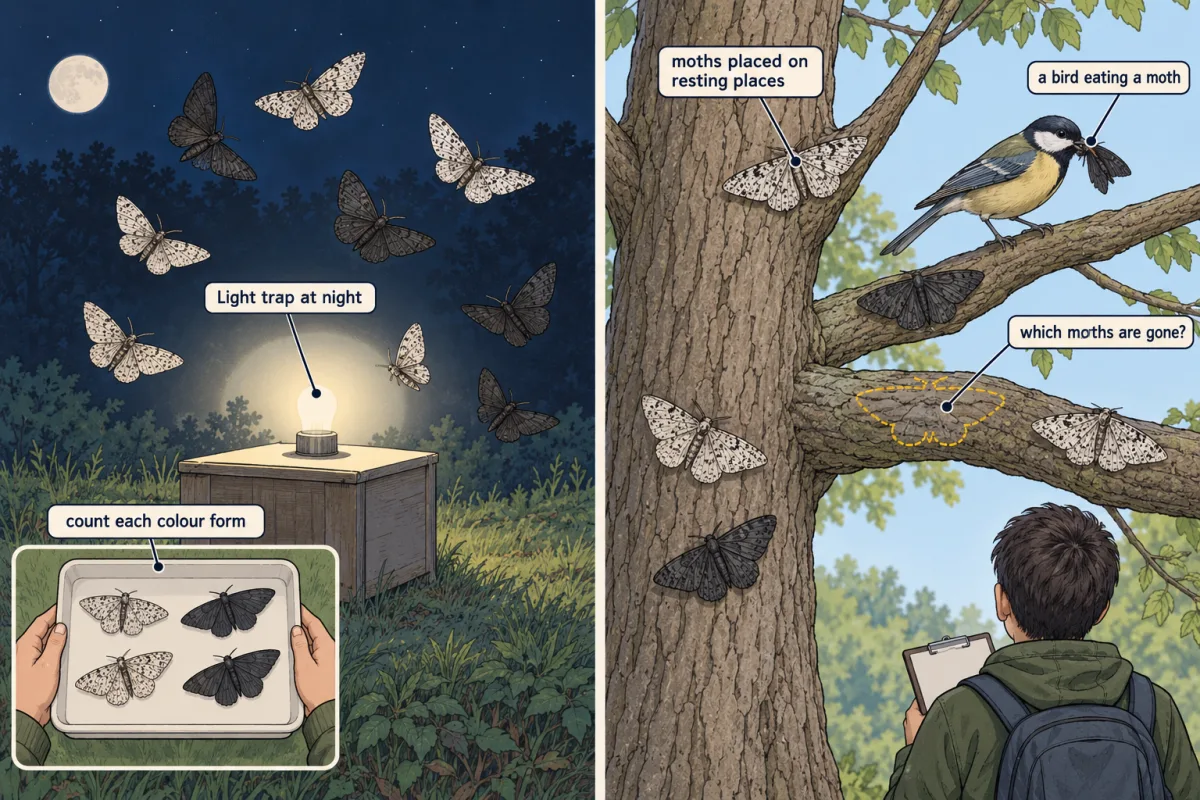
Each year near Cambridge, England, moths were caught in light traps and the dark ones counted.
| Year | Dark moths (percent of moths caught) |
|---|---|
| 2001 | 12 |
| 2002 | 10 |
| 2003 | 6 |
| 2004 | 7 |
| 2005 | 4 |
| 2006 | 2 |
| 2007 | 1 |
Data from Cook, Grant, Saccheri and Mallet (2012), Table 2: wild peppered moths in light-trap samples at Madingley, near Cambridge, England, 2001 to 2007. The authors read these values from a graph by Michael Majerus, so each one is rounded.
From 2002 to 2007, Majerus released pale and dark moths nearby and checked which ones were gone. Birds removed a larger share of dark moths than of pale moths.
- Describe the trend from 2001 to 2007. In which year does the count break the trend?
- By how many percentage points did the dark form drop from 2001 to 2007? (Subtract the 2007 percent from the 2001 percent.)
- Find the mean percent of dark moths for the seven years.
- The percent of dark moths went from blank in 2001 to blank in 2007.
- This happened because birds blank, so blank moths had more young.
Claim, evidence, reasoning
Use these data to make a claim that answers the essential question for the Madingley moths: why do some traits become more common over time?
Start with: The data show that the blank form of the peppered moth became blank common over time.
Start with: In 2001, blank percent of moths caught were dark. By 2007, only blank percent were dark.
Start with: On clean bark, birds spot blank moths more easily, so blank moths survive and pass on their colour to blank.
Compare with a model answer
The dark form of the peppered moth became less common at Madingley. In 2001, about 12 percent of moths caught were dark, and by 2007 only about 1 percent were. On clean bark, birds spot dark moths more easily, and in a nearby experiment birds removed a larger share of dark moths. Pale moths survived and passed on their colour. One limit: this is one place over seven years, and the values were read from a graph, so they are rounded.
Saved in this browser only.
Design problem
Plan a classroom model to test this question: does the colour of the background change which paper moths “predators” find first?
One way to do it
Cut 40 paper moths, each about 2 centimetres wide: 20 white and 20 black. The independent variable is the background: a sheet of white paper or a sheet of black paper, each 50 centimetres by 50 centimetres. The dependent variable is how many moths of each colour a classmate picks up.
Keep these the same: moth size and shape, the number of each colour, a picking time of 10 seconds, and a distance of 1 metre to the sheet. The picker looks away while you spread the moths. Run the white sheet and the black sheet as two cases to compare. Repeat with five different classmates and find the mean for each colour on each background. If fewer black moths are picked on black paper, and fewer white moths on white paper, background matching helps the moths survive. Safety: use safety scissors, and do not use anything to eat.
Evaluate: check your thinking
No moth changed colour. Dark moths first appeared as a rare, inherited form. Where soot darkened the bark, birds were more likely to find pale moths, so dark moths had more young and became common. When the air got cleaner, birds found the dark moths more easily, and the pale form became common again.
Science practices you used: planning a fair test with a comparison and repeated trials, reading a data table and finding a mean, using a model and naming its limits, and making a claim from evidence.
How we measure it
Light-trap surveys
A bright lamp draws night-flying moths into a trap, and researchers count each colour form. Counts from year to year show whether a form is becoming more or less common.
Release-and-watch predation experiments
Researchers place moths of each colour on natural resting spots, then check hours later which ones are missing and watch for birds eating them. They compare the share of each colour that disappears.
Model prey
Paper moths with a small edible body are pinned on tree trunks and checked over two days. Because the models differ only in colour, any difference in how many are eaten points to camouflage.
Finish line
Test yourself
8 questions
Practice and MCAT-style, with explained answers.
Next · Lesson 29
Evidence for Evolution
How can a scallop shell millions of years old, a bat wing and a protein in your cells all tell the same story?
Continue →