Biology Together · Unit 5: Animal bodies, homes and adaptations
The Camouflage Hunt
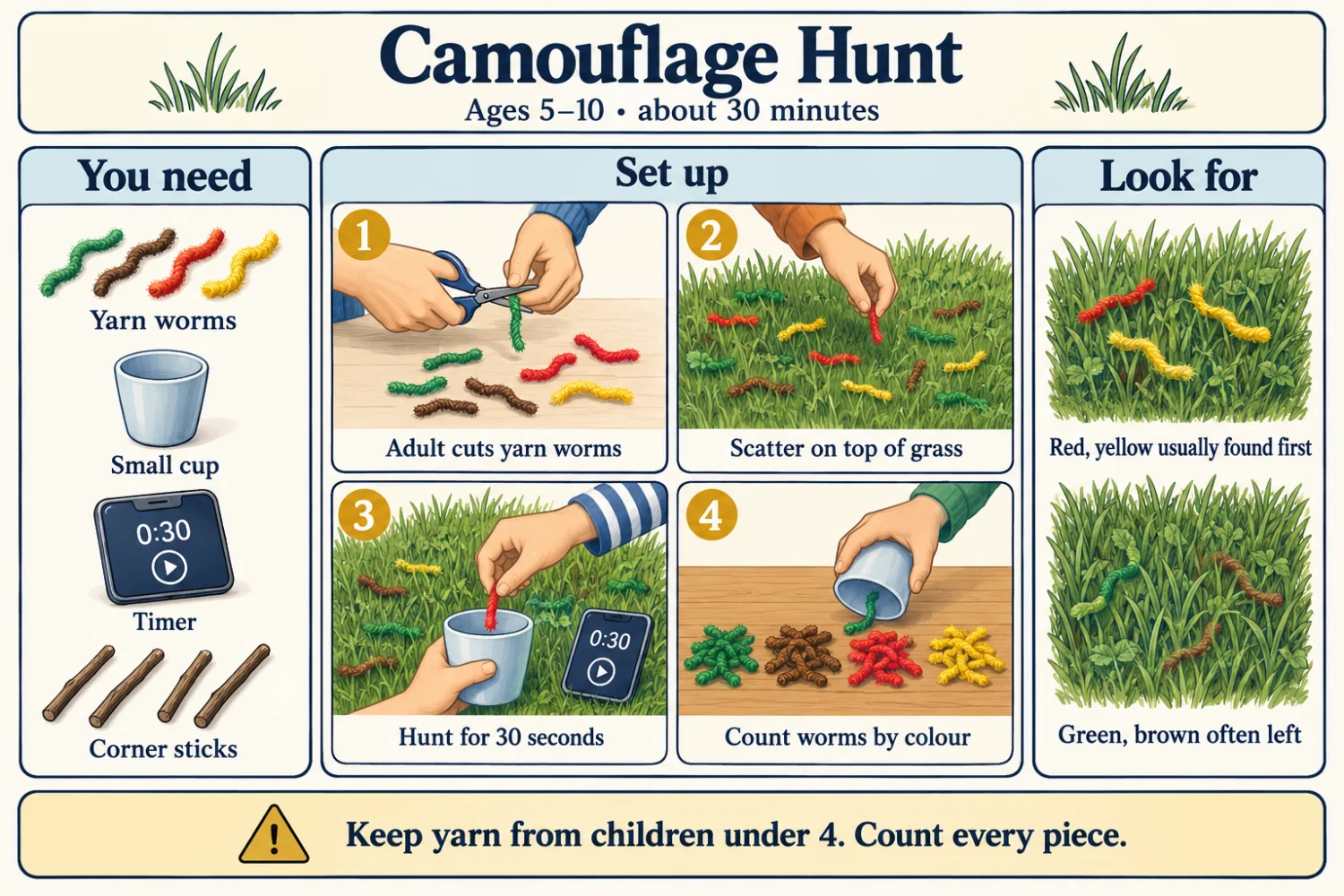
You scatter coloured yarn "worms" on a patch of grass, and your child plays a hungry bird with 30 seconds to find them. Counting the worms by colour shows which ones stay hidden. A second round on bare dirt or a rug shows that the best colour depends on the background.
Watch first Set Up: The Camouflage Hunt · 0:39
Read the transcript of “Set Up: The Camouflage Hunt”
Film transcript: Set Up: The Camouflage Hunt
You need yarn in four colors, cut into 20 pieces about five centimeters long. Mark out a patch of lawn about two meters square. While your child turns away, scatter all 20 worms on top of the grass. Say go, and give 30 seconds to hunt. Then count each color. The red and yellow worms usually go first. Green and brown ones are often left. Then try bare dirt or a rug. Stay with your child the whole time. Count every piece back and keep looking until all 20 are found, because pets can swallow loose yarn.
Before you start
- Hands-on time
- About 30 minutes
- Where
- Indoors or outdoors
- Ages
- 5 to 10, with an easier and a harder version below
- Grown-up
- Stay with your child the whole time. You lay out the worms, keep time, and help count them all back at the end.
What you need
- Yarn in four colours: green, brown, red and yellow (or another bright colour)
- Scissors for the adult, to cut 20 pieces about 5 cm long, 5 of each colour
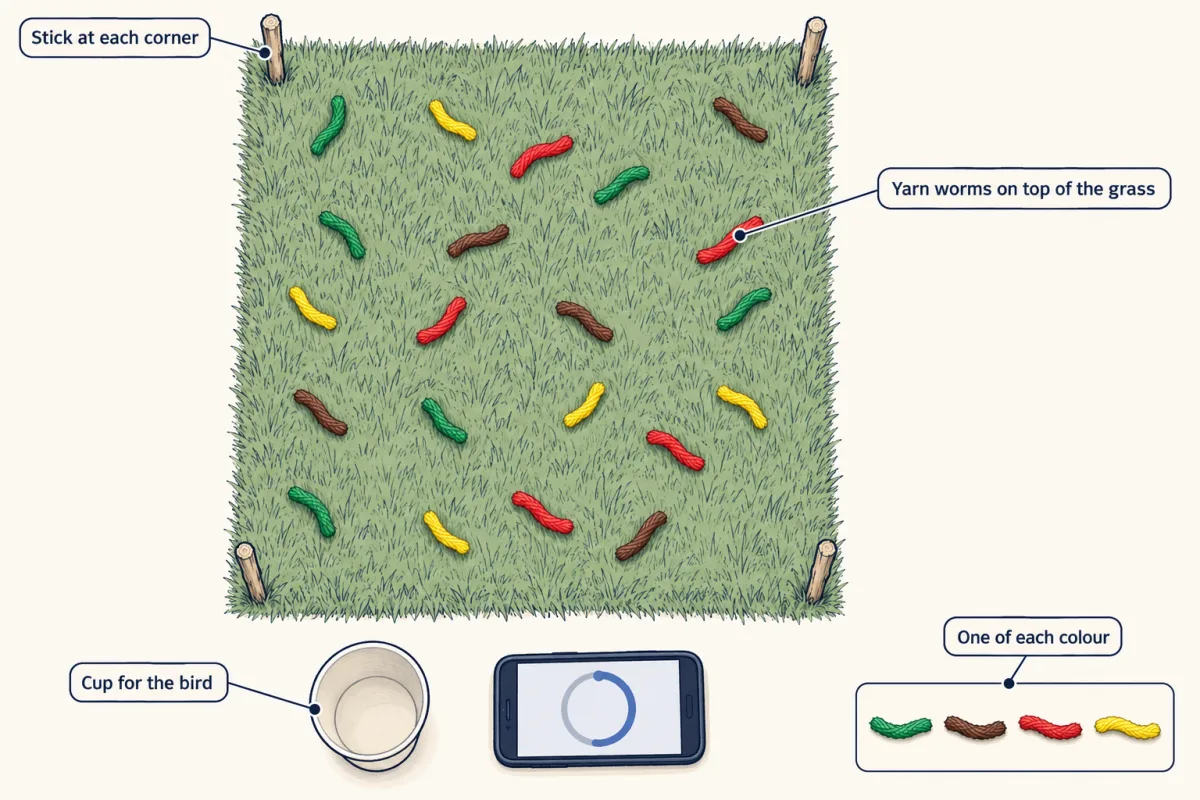
- A patch of lawn about 2 metres by 2 metres, marked at the corners with 4 shoes or short, blunt sticks
- A second background: bare dirt, a rug, or a few sheets of newspaper
- A timer or phone
- A small cup for each 'bird' to drop worms into
- Paper and crayons, or the printed observation sheet below
Virginia science standards SOL 2.7 aSOL 3.4 bSOL 3.4 a
The big idea
Ask your child to find a grasshopper in tall grass, and they will soon see why it is hard. Many animals are coloured like the place where they live. That match is called camouflage: colours or patterns that help an animal blend into its background, so animals that might eat it pass it by.
In this game your child is the hungry bird. Yarn worms that match the grass are hard to see, so they get “eaten” last. On a different background, a different colour wins. The point is not that green is a good colour. The point is that a colour hides an animal only when it matches where the animal lives.
Virginia’s grade 2 standard asks children to see camouflage as one way animals survive. Grade 3 adds that a population, a group of the same kind of living thing in one place, can change over a long time. The game shows the start of that idea. Hidden worms survive, and in real life survivors have young that look like them.
What to do
- Make the worms. Cut 20 pieces of yarn about 5 cm long: 5 green, 5 brown, 5 red and 5 yellow. Show your child one of each colour.
- Predict. Ask, “If you were a bird, which colour would you find first? Which would you miss?” Write down the guess.
- Set the scene. While your child turns away, scatter all 20 worms over the marked patch of lawn. Lay them on top of the grass, not pushed under it.
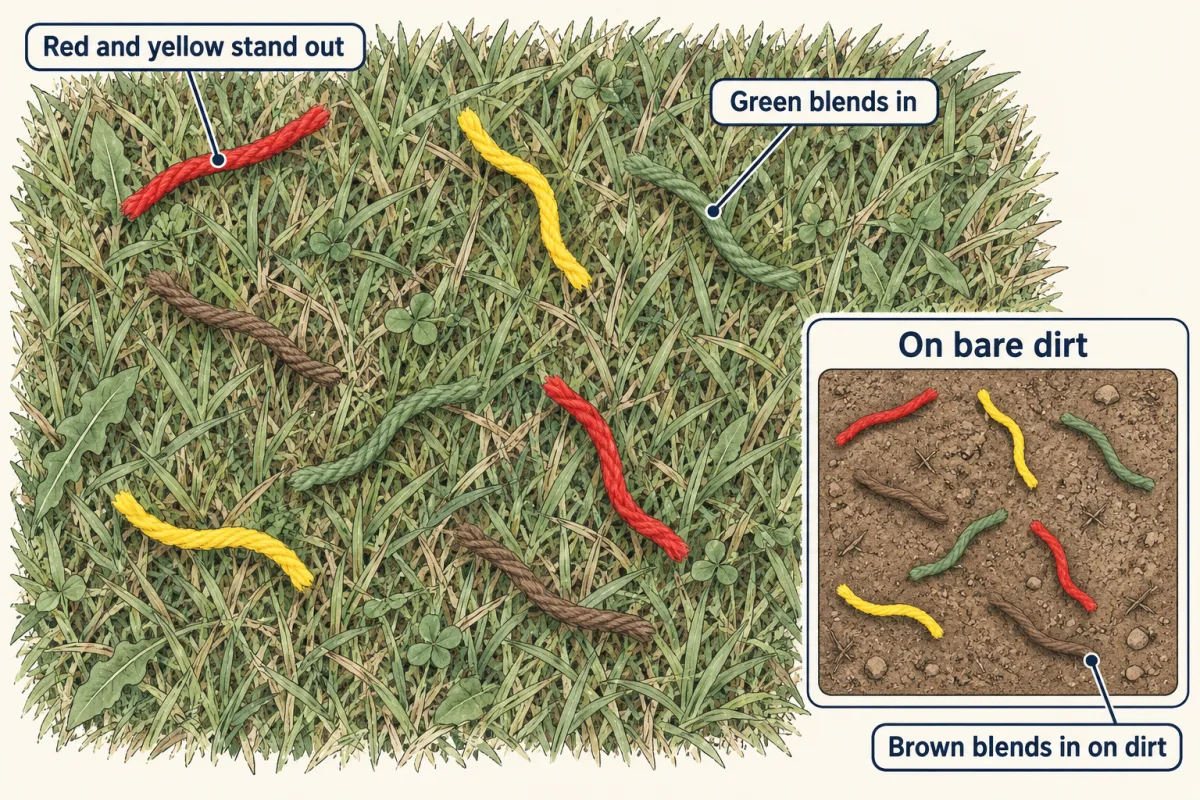
- Hunt. Say “Go,” and give your child 30 seconds to pick up as many worms as they can, one at a time, and drop them in the cup. Expect some worms to be left over; how many depends on the grass and the size of the patch. The red and yellow worms usually go first, and green and brown ones are often left.
- Count and record. Tip out the cup and count each colour. Fill in the table. Then help find every worm still in the grass, until you have all 20.
- Repeat. Do the same hunt twice more on the grass. Three rounds give a fairer answer than one. Add up the totals for each colour.
- Change the background. Now scatter the same 20 worms on bare dirt, a rug or newspaper. Ask your child to predict again before hunting. On brown dirt, brown worms often win. On a busy-patterned rug, the winner can surprise you.
- Talk it over. Ask, “Which worms would still be alive at the end of the day? Which ones would grow up and have baby worms?”
With a class, give each group of four its own patch and its own 20 worms, and add the group totals on one board.
Questions to ask while you do it
Ask your child to guess first, then check.
- “Which colour do you think you’ll find first? Why?”
- “I wonder which worms a real bird would miss on our grass.”
- “What do you think will happen if we play on the dirt instead?”
- “If the hidden worms have babies the same colour, what will the next group of worms look like?”
- “Can you think of a real animal near our house that is hard to see? Where does it live?”
- “Why might some animals be bright and easy to see?”
What children often think
-
A child might say “Animals pick their colour so they can hide.”
You could try Ask, "Could the yarn change colour when it saw you coming?" Then ask where a baby animal’s colour comes from. Most animals are born with their colours, mostly like their parents. The ones that happen to match their home are more likely to survive.
-
A child might say “The green worms were smart. They hid.”
You could try Ask, "Did the green worms move?" Nothing moved; only the colour was different. Some real animals do help themselves hide by keeping still, like a fawn lying quiet in tall plants. Its spotted coat does the rest.
-
A child might say “Green is the best colour for an animal.”
You could try Play on brown dirt or a red rug and see which colour wins now. A colour only hides an animal when it matches the place. A green insect sitting on a tree trunk is easy to spot.
-
A child might say “Bright colours are always bad for an animal.”
You could try Ask why a bee or a monarch butterfly might be bright. Some animals sting or taste bad. A bright colour can be a warning that birds learn to avoid after one bad mouthful.
Why it works
Many predators hunt by sight. In the game, a worm’s colour sets how likely it is to be found. Worms with less contrast against the background get found less often, as camouflaged animals do.
Over many generations, that difference can change a population. Animals pass traits such as colour to their young. If well-matched animals survive more often and have more young, the matching colour slowly becomes more common in the group. No single animal has to change. Scientists call this process natural selection. One well-known case is the peppered moth in England, where darker moths became more common for a time on soot-darkened trees.
Camouflage is one strategy. Its opposite is warning colour, bright colours on animals that sting or taste bad. A monarch butterfly carries toxins from the milkweed it ate as a caterpillar. Many birds that eat one get sick and learn to avoid that pattern.
Easier and harder
Ages 5 to 7
Use two colours only, 10 green and 10 red, and one background. Keep it to one or two rounds. Instead of a table, your child can line up the found worms in two rows, one per colour, and see which row is longer. Then draw a bird and the worm it missed.
Ages 8 to 10
Play three generations. After each hunt, gather the worms still in the grass: these are the survivors. Each survivor “has one baby”: add one new piece of that colour, then scatter the survivors and babies together. Hunt again with the new group. Keep a tally of every piece you add, and at the end find every piece, including the extras. Record each generation in a table and make a bar graph of how many of each colour remain. Discuss how the population changed even though no worm changed colour.
If it doesn’t go as planned
If your child finds all 20 worms quickly, the patch is too small or the grass is too short. Make the patch bigger or cut the time to 15 seconds. If no worms are found, use shorter grass or a longer time. If green and red are found equally, check that the worms are lying on the grass, not tucked under it. A tie can also be chance, so write it down and play again. Some children, more often boys, are red-green colour-blind, and to them red and green yarn can look alike. That is a real result, not a mistake. If a piece is still missing after the count, search the patch again on your hands and knees in good light, and keep pets and young children off it and the mower away until you find it.
Observation sheet
Observation sheet
The camouflage hunt
NameDate
Write how many worms of each colour the bird found.
| Colour | Round 1 | Round 2 | Round 3 | Total found |
|---|---|---|---|---|
| Green | ||||
| Brown | ||||
| Red | ||||
| Yellow |
I think this colour hid best because:
biochemistrypedia.com · Biology Together
Finish line
Test yourself
4 questions
Practice and MCAT-style, with explained answers.
Next · Lesson 19
Backyard Habitat Hunt
Is anything living in a patch of plain grass? A string square and ten minutes of close looking answer that.
Continue →