Biology Together · Unit 5: Animal bodies, homes and adaptations
The Blubber Glove
You build two plastic-bag mittens, one lined with a thick layer of vegetable shortening and one with nothing inside. Your child dips both into ice water for up to a minute and times which hand feels cold first, finding out how a layer of fat helps seals and whales stay warm in cold seas.
Watch first Set Up: The Blubber Glove · 0:44
Read the transcript of “Set Up: The Blubber Glove”
Film transcript: Set Up: The Blubber Glove
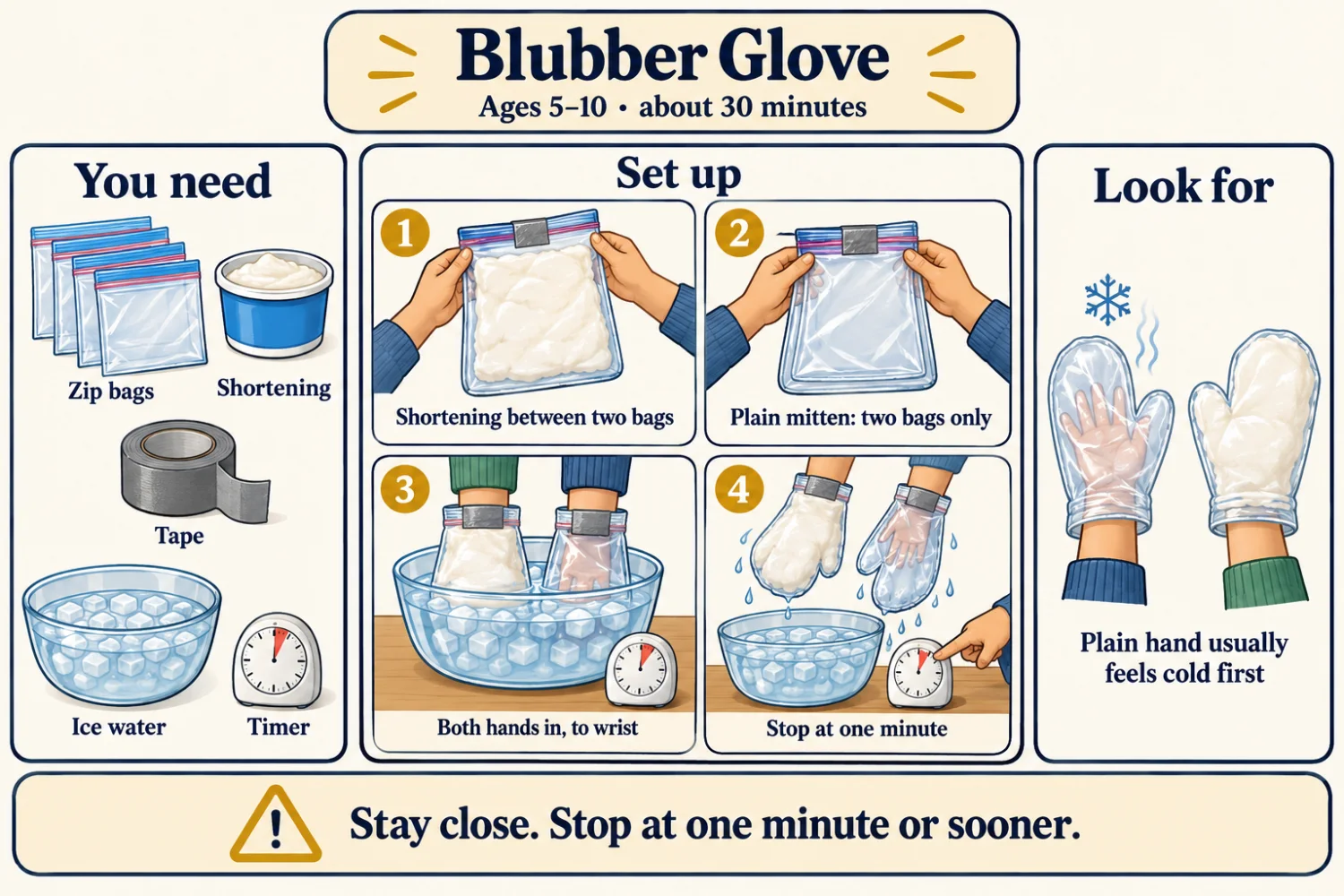
You need four gallon zip bags, about two cups of vegetable shortening, tape, and a bowl of ice water. Make two mittens from pairs of bags. Put shortening between one pair, and nothing between the other. Tape the tops. Then dip both into ice water, up to the wrist. The plain mitten hand usually feels cold well before the other one. Your times will vary. The fat slows the heat leaving, as blubber does for a seal. Stay with your child the whole time, and never leave the bowl of water alone. Every try stops at one minute, and your child can pull a hand out any time. Stop at once if a hand hurts.
Before you start
- Hands-on time
- About 30 minutes
- Where
- Indoors
- Ages
- 5 to 10, with an easier and a harder version below
- Grown-up
- Stay with your child the whole time, and you set up and empty the ice water. Your child can pull a hand out at any moment, and every try stops at one minute.
What you need
- 4 gallon-size zip bags
- About 2 cups of solid white vegetable shortening (about one 16-ounce can)
- Duct tape or packing tape
- A large bowl or dishpan, cold water and 2 trays of ice cubes
- A timer or a clock with a second hand
- 2 towels and some paper towels
- For the harder version: an instant-read kitchen thermometer, 2 sandwich bags, warm tap water, cotton balls and craft feathers (optional)
- Paper and a pencil, or the printed observation sheet below
Virginia science standards SOL 3.4 b
The big idea
Ask your child how a finger would feel in ice water. Most of us would pull it out fast. Now picture a seal swimming in water that cold all day. How does it stay warm?
The answer is blubber, a thick layer of fat just under the skin. Whales, seals and walruses all have it. Your body makes its own heat, and so does a seal’s. Cold water pulls that heat away much faster than cold air does. Heat moves through fat slowly, so blubber slows the loss of the animal’s own warmth. It does not make heat, and it does not “keep the cold out.” It keeps the heat in.
Blubber is a physical adaptation, a body feature that helps an animal survive where it lives. Virginia’s grade 3 standard asks children to tell physical adaptations from behavioral ones, things an animal does, like a seal hauling out onto a rock to rest. The mitten lets your child feel a physical one at work.
What to do
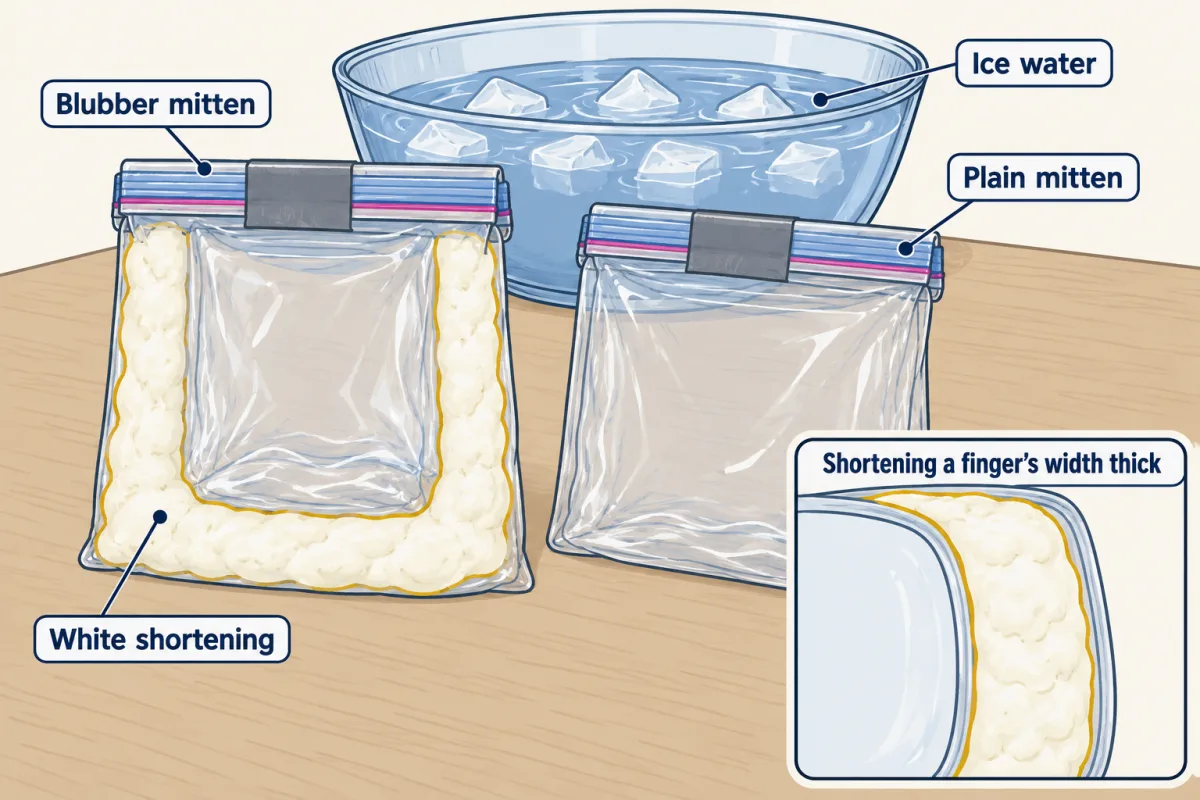
- Build the blubber mitten. Scoop about 2 cups of shortening into a gallon zip bag. Slide a second gallon bag inside it, with the two openings together. Fold the tops over and tape them so the inner bag stays open for a hand. Squish the shortening until it surrounds the inner bag about a finger’s width thick.
- Build the plain mitten. Do the same with the other two bags, but put nothing between them. This mitten is the same in every way except the fat.
- Chill the water. Fill the bowl about two-thirds with cold water and add two trays of ice. Wait 5 minutes. Ice water sits close to 0 °C (32 °F).
- Predict. Ask, “Which hand will feel cold first? How many seconds until each hand feels cold?” Write the guesses down.
- Dip and time. Your child puts one hand in each mitten. Lower both into the ice water up to the wrist, keeping the open tops above the water. Start the timer. Your child calls out “cold” when a hand first feels cold. Write down the seconds for each hand. Stop at 60 seconds, or sooner if your child wants. The plain-mitten hand usually feels cold well before the other one. Your times will vary.
- Warm up and swap. Dry both hands, warm them gently (no hot water, no heater and no hard rubbing), and wait about 5 minutes until they feel normal. Swap the mittens to the other hands and test again. This checks whether one hand is just less sensitive.
- Talk about it. Ask where the warmth in the blubber hand came from. Then look at a picture of a seal or a whale and ask where its “mitten” is.
Questions to ask while you do it
Ask your child to guess first, then check.
- “Which hand do you think will feel cold first? Why?”
- “I wonder where the warmth in the blubber hand came from. Did the shortening make it?”
- “What do you think would happen with a thinner layer of fat? A thicker one?”
- “A seal is in the water all day. What do you think would happen to a seal with no blubber?”
- “What do you think would happen if we put fluffy fur in the mitten and it got wet?”
What children often think
-
A child might say “The fat is warm. It makes heat.”
You could try Touch the shortening before the test. Ask, "Does it feel warm?" It feels cool, like the room. The warmth came from your child’s own hand. The fat only slows that heat from leaving, so the hand stays warm longer.
-
A child might say “The blubber keeps the cold out.”
You could try Ask, "Which way do you think warmth moves, from the hand to the water or the other way?" Heat moves from warm things to cold things. Cold does not move in. Blubber slows the heat leaving the body.
-
A child might say “Fur would work just as well in the water.”
You could try Test it with the thermometer version: dry cotton, then wet cotton. Most fur loses its trapped air when soaked, and that air is what holds the heat. Most seals rely on blubber. Sea otters have no blubber, but their fur is so dense it holds tiny air bubbles.
-
A child might say “My hand got cold because the plain bag is thinner.”
You could try Good thinking about a fair test. Ask your child to count the bags in each mitten. Both mittens use two of the same bags, so the only difference is the fat. That makes the fat the best explanation.
Why it works
Heat always flows from a warmer place to a colder one. Water draws heat away from skin many times faster than air at the same temperature, which is why a cold swim chills you faster than a cold day. Fat conducts heat poorly, so a thick layer of it slows that flow. In a living seal, blood vessels inside the blubber narrow in cold water, sending less warm blood near the surface.
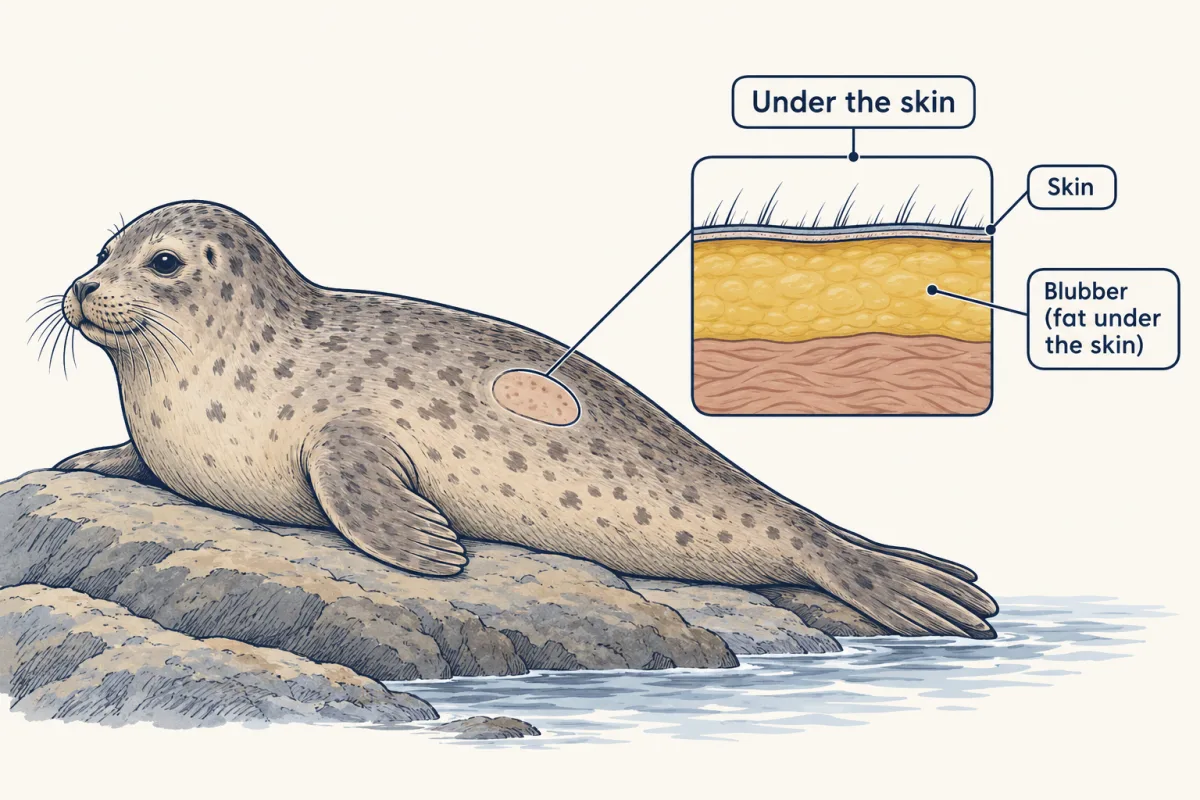
Blubber does other jobs too. It stores energy the animal can use when food is scarce, and it is lighter than seawater, which helps the animal float. It can be very thick. Weddell seals in Antarctica can carry more than 5 cm of blubber, and bowhead whales in the Arctic can carry 43 to 50 cm.
Polar bears have a thick fat layer and thick fur. On ice, the thick dry fur traps air and keeps a polar bear warm. In cold water, wet fur holds less air, so the fat layer matters more. Sea otters have no blubber at all. Their very dense fur traps air instead.
Easier and harder
Ages 5 to 7
Do one round only. Your child does not need to time it, but keep the timer running yourself so the try still stops at one minute. Your child says which hand feels cold first, and you count out loud together. Afterward, ask them to point to where the blubber is on a picture of a seal. Keep the bowl on a low, steady table so they can reach in without leaning over it, and keep any toddler away from it.
Ages 8 to 10
Run the thermometer version as a fair test. Fill two sandwich bags with the same amount of warm tap water and check that both start at the same temperature. Put one inside each mitten in the ice water. Read the water temperature in each bag every 2 minutes for 10 minutes and make a line graph. Then test other linings the same way: cotton balls, craft feathers, wet cotton and nothing.
If it doesn’t go as planned
If the plain mitten does as well as the blubber one, it may be holding a pocket of air, which also insulates. Squeeze the air out before dipping. If water gets into a mitten, end that try at once. Dry and warm the hand, empty or replace the bag, and keep the open tops higher above the water line next time. Hard, cold shortening is hard to spread; leave it at room temperature first. Throw used shortening in the trash, not down the sink.
Observation sheet
Observation sheet
The blubber glove
NameDate
Guess first. Then count the seconds until each hand feels cold. Stop at 60.
| Try | Hand with blubber (seconds) | Hand with no blubber (seconds) | Which felt cold first? |
|---|---|---|---|
| My guess | |||
| Try 1 | |||
| Try 2 (hands swapped) |
The blubber helped because:
biochemistrypedia.com · Biology Together
Finish line
Test yourself
4 questions
Practice and MCAT-style, with explained answers.
Next · Lesson 18
The Camouflage Hunt
Why are so many animals brown or green? A hungry-bird game lets a child find out which colours stay hidden.
Continue →