Biology Together · Unit 5: Animal bodies, homes and adaptations
Backyard Habitat Hunt
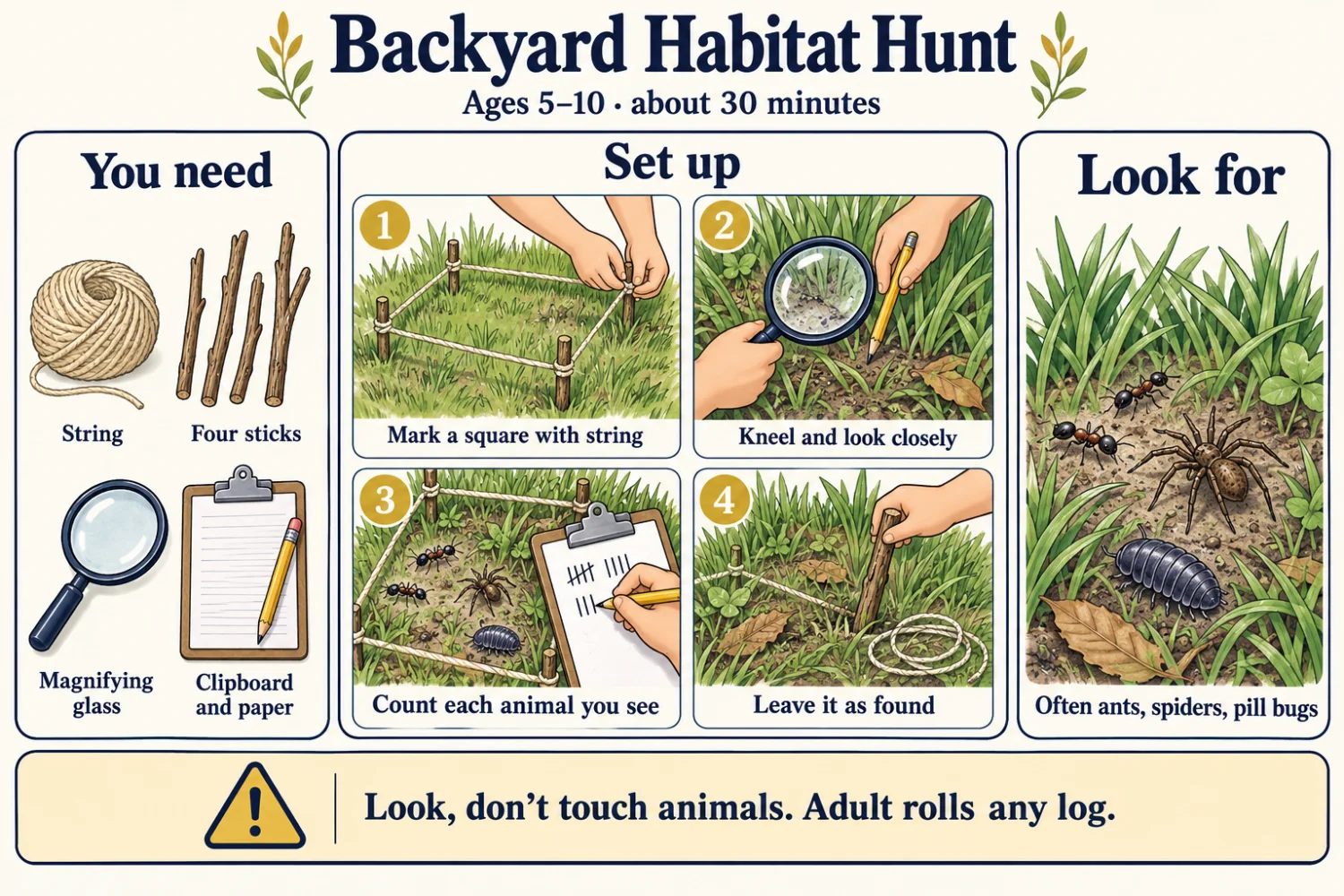
You and your child mark a one-metre square of yard or park with string and look closely at everything in it, or gently roll a log and put it back. Your child counts the small animals, lists the living and nonliving parts, and finds where one animal gets its food, water, shelter and space.
Watch first Set Up: Backyard Habitat Hunt · 1:05
Read the transcript of “Set Up: Backyard Habitat Hunt”
Film transcript: Set Up: Backyard Habitat Hunt
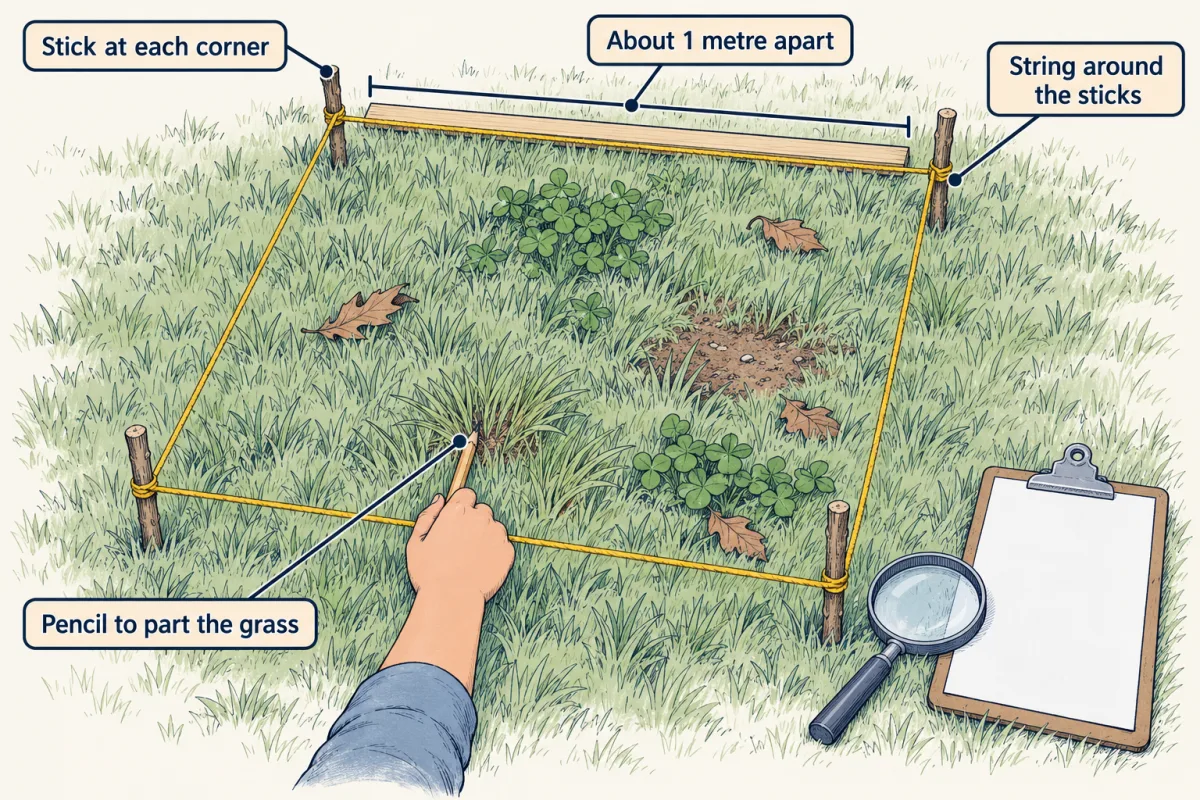
Every animal needs food, water, air, a safe place to hide, and room to move. The place that gives it all of these is its habitat. A habitat has living parts, like grass, and nonliving parts, like soil. You need about four and a half meters of string, four sticks for corners, and a pencil for parting the grass. A magnifying glass helps. Push the four sticks into the ground about one meter apart. Wrap the string around them to make a square. Guess how many animals live inside. Kneel down and look closely for ten minutes. Expect ants, spiders, small beetles, pill bugs, or earthworms, depending on the season and weather. Count the animals you find, and compare with your guess.
Stay within arm's reach the whole time. An adult rolls any log or rock. Never put hands or feet where you cannot see. Touch no animals. If you see a snake, step back and let it go.
Before you start
- Hands-on time
- About 30 minutes
- Where
- Outdoors
- Ages
- 5 to 10, with an easier and a harder version below
- Grown-up
- Stay with your child the whole time, within arm’s reach. You do any log or rock rolling, and you decide what is safe to touch.
What you need
- About 4.5 metres of string or yarn
- 4 sticks, pencils or tent pegs for corners
- A metre stick or tape measure (or a step-sized guess)
- A magnifying glass (optional)
- A pencil or twig, for gently parting grass and leaves (never for poking animals)
- Garden gloves for the adult
- Paper, a pencil and a clipboard, or the printed observation sheet below
Virginia science standards SOL 2.5 aSOL 2.5 bSOL 1.5 aSOL 3.5 aSOL 4.3 a
The big idea
From standing height, a lawn looks like a green carpet. On hands and knees it turns into a busy place, with ants carrying crumbs, spiders on tiny webs, and beetles running for cover.
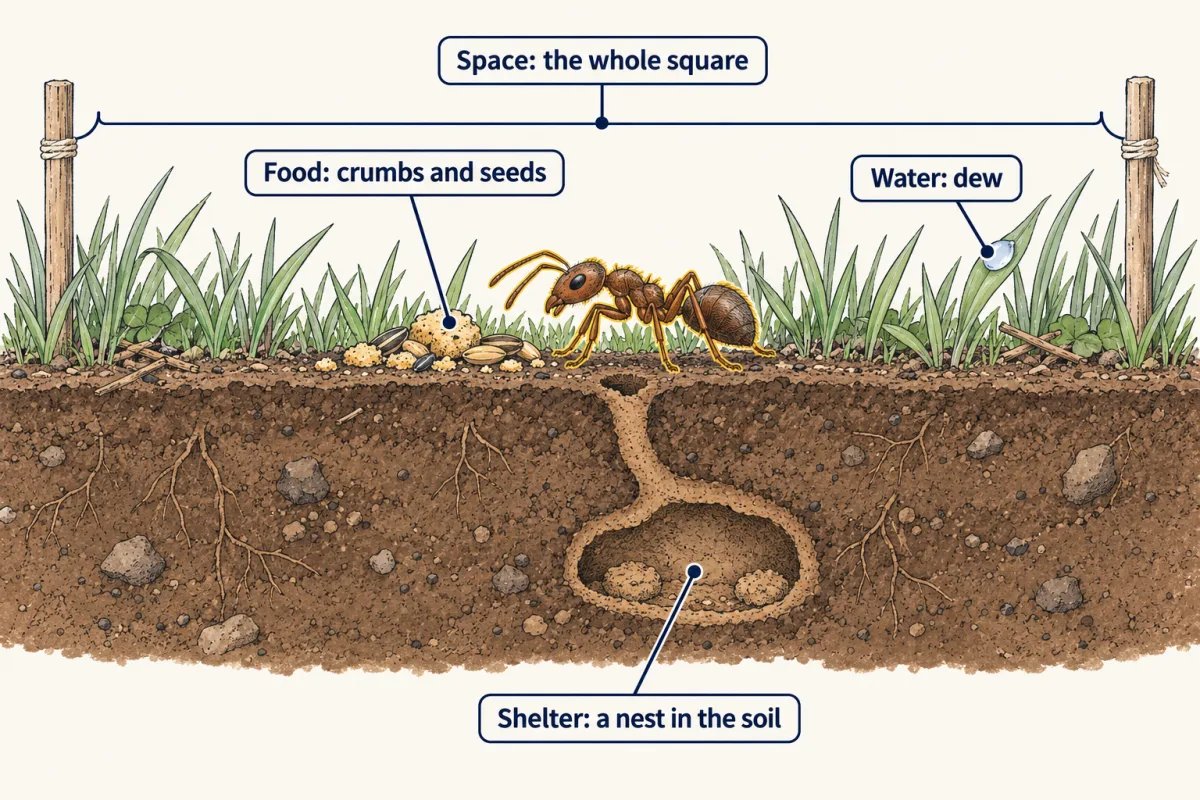
Each of those animals has a habitat: the place that gives it everything it needs to live. Virginia’s standards name those needs as food, water, air, shelter, and space. If one is missing, the animal may move away or may not survive. Shelter can be living, like a tree, or nonliving, like a rock or a crack in the soil.
The string square shrinks a whole yard to a size a child can study. Your child finds the living parts (plants, animals, fungi) and the nonliving parts (soil, rocks, water, air, sunlight), and sees that the animals depend on both. Older children can count one kind of animal, which is a population, a group of one kind of living thing in one place. All the kinds living there together make a community.
What to do
- Pick a spot. Choose a patch of lawn, a garden edge or a schoolyard corner. If there is a log, you can study the ground under it instead.
- Mark the square. Push the 4 sticks into the ground about 1 metre apart to make a square. Wrap the string around them. Your square is now 1 square metre.
- Predict. Ask, “How many animals do you think live in our square?” Write down the guess.
- Look closely for 10 minutes. Kneel down and part the grass with a pencil. Look at the soil, under fallen leaves and at the base of plants. Use the magnifying glass if you have one. Count each animal you see. Expect ants, spiders, small beetles, pill bugs or earthworms, though it depends on the season and the weather. Note birds or insects that fly over too, but list them apart from the animals in the square.
- Roll a log (optional). The adult rolls a log or flat rock toward themselves. Look for pill bugs, worms, beetles, millipedes, or in damp woods a small salamander. Watch for a minute or two. Then roll it back slowly, and let any animals you moved crawl back beside it.
- Sort the parts. Make two lists: living things (grass, clover, ants, a mushroom) and nonliving things (soil, a rock, a puddle, sunlight, air).
- Pick one animal. Choose one animal your child saw. Help them find where it gets its food, water, shelter and space. An ant might eat crumbs and seeds, drink dew, shelter in a nest in the soil, and use the square and the ground around it as space.
- Leave it as you found it. Pull up the sticks and string. Put back any leaves you moved.
With a class, give each group of three its own square and one task (counting, listing, or the four needs), then share results.
Questions to ask while you do it
Ask your child to guess first, then check.
- “How many animals do you think we’ll find? More or fewer than your fingers?”
- “I wonder what this ant eats. Where could it find water?”
- “What do you think is living under this log? Let’s guess before we look.”
- “Is the soil alive? Is anything in it alive?”
- “What do you think will happen to the pill bugs if we leave the log rolled over?”
- “If people built a patio on this square, which animals would have to move?”
What children often think
-
A child might say “A habitat is where an animal sleeps.”
You could try Ask, "Where does the ant eat? Where does it get water?" A habitat is more than a bed. It is the whole place that gives an animal food, water, shelter and space. Sleeping is only one use of shelter.
-
A child might say “Rocks and dirt aren’t part of a habitat. Only plants and animals are.”
You could try Ask what the pill bugs were doing under the log. They hide there because it is damp and dark. Soil, water, rocks and sunlight are nonliving parts of a habitat, and animals depend on them too. The pill bugs need damp soil and a dark hiding place as much as they need food.
-
A child might say “There’s nothing living in plain grass.”
You could try Don’t argue; count. Ten minutes on hands and knees usually turns up ants or spiders. And the grass is alive too, so the square already has many living things.
-
A child might say “The bugs under the log will be happier in our jar.”
You could try Ask, "Where does it get food and water in the jar? Where can it hide?" The log and the ground around it already give it those. That is why we look at it where it lives, and put the log back.
Why it works
A habitat is the place where an animal lives and finds what it needs. What counts depends on the animal, not on a label like “forest” or “yard.” A very small animal can meet all of its needs in a small space. A soil mite may spend its life in a small patch of soil and leaf litter, while a robin uses many backyards. That is why one square metre can hold parts of many animals’ habitats at once. Most of the animals you find also use ground outside the square.
Under a log the soil stays cooler and damper than in the open, so animals that dry out easily, such as pill bugs and salamanders, gather there. Rolling the log back matters because their shelter is part of their habitat. A log left upside down may dry out.
Habitats also change. Mowing, a dry spell, a new patio or the change of seasons can remove food, water or shelter. Unmowed or planted patches often hold more kinds of animals than short lawn, though results vary with the place and the weather.
Easier and harder
Ages 5 to 7
Skip the log and the counting. Hunt for three living things and three nonliving things inside the square, and draw them. Then pick one animal and draw it in its home, with something it eats, something it drinks and a place it hides. Five minutes of looking is plenty.
Ages 8 to 10
Compare two squares: one in mowed lawn and one in a garden bed or unmowed edge. Count animals for the same 10 minutes in each and make a bar graph. Count one kind, like one kind of ant, as a population. List all kinds together as the community. Then build a shoebox model of one animal’s habitat that shows its food, water, shelter and space.
If it doesn’t go as planned
On a cold, hot or very dry day, small animals may stay hidden. Try early morning, after rain, or in a shady spot with leaf litter. If your child loses interest, switch to a “find five” challenge: five animals, five plants, five nonliving things. If you find nothing under a log, put it back and try again in a damper place another day.
Observation sheet
Observation sheet
My habitat square
NameDate
Count and draw what you find inside your string square.
| Animal | How many? | Where was it? |
|---|---|---|
My animal gets food from:
It gets water from:
It hides in:
biochemistrypedia.com · Biology Together
Finish line
Test yourself
4 questions
Practice and MCAT-style, with explained answers.
Next · Lesson 20
Make a Fossil Print
How do we know what lived here before people? Making fossil prints shows how a shell or a footprint can be saved in rock.
Continue →