Biology Together · Unit 5: Animal bodies, homes and adaptations
Beak Buffet
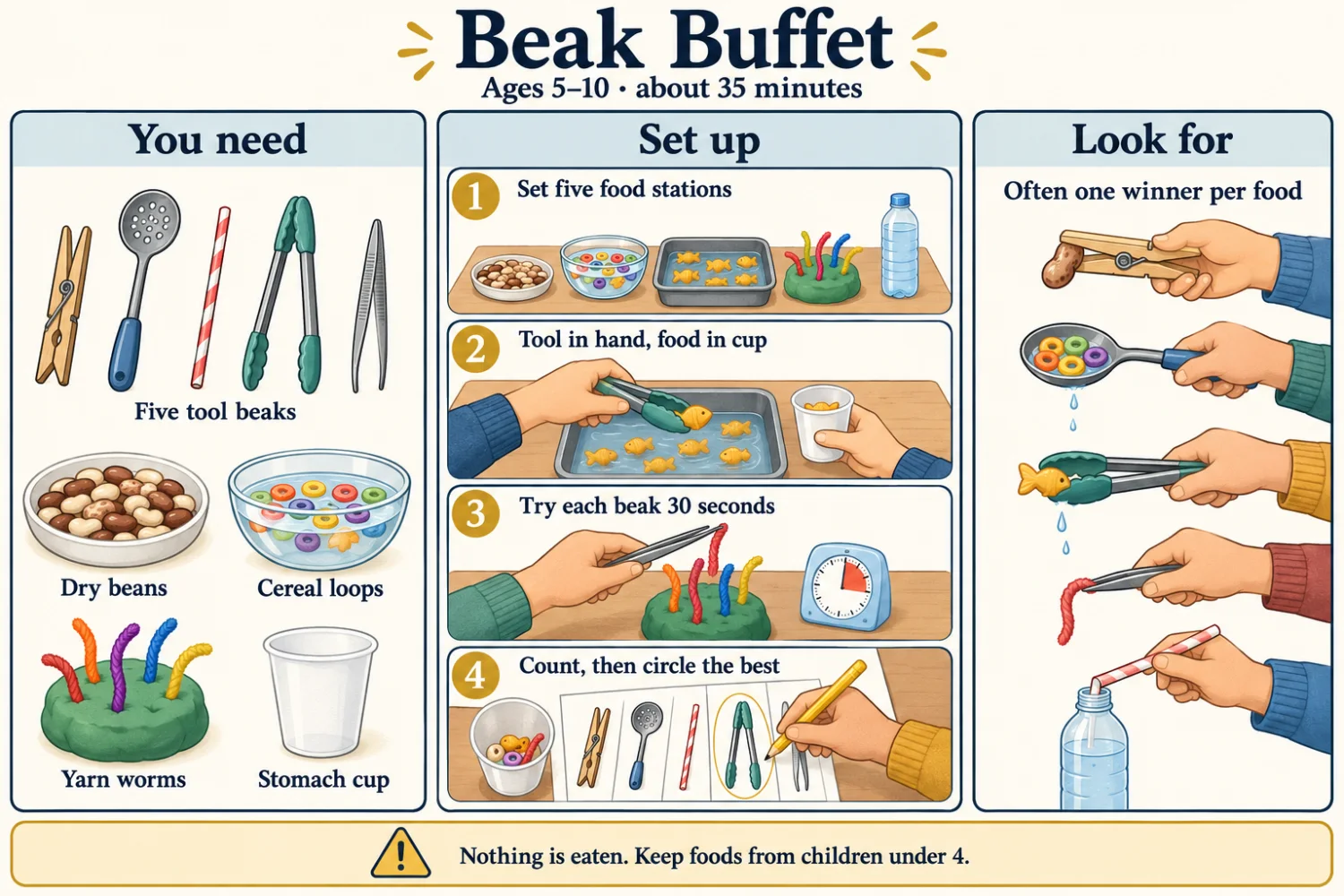
Kitchen tools become bird beaks, and bowls around the table become a buffet of seeds, pond food, worms, fish and nectar. Your child times short trials, counts what each "beak" picks up, and finds that each shape works best for a certain food, then matches the tools to real birds.
Watch first Set Up: Beak Buffet · 0:47
Read the transcript of “Set Up: Beak Buffet”
Film transcript: Set Up: Beak Buffet
You need five kitchen tools to use as beaks, such as a clothespin, tongs, and tweezers. Set up five food stations, from seeds to nectar. Set the five stations around the table. Lay the beak tools in a row. Your child tries three beaks at each station for 30 seconds and counts what lands in the cup. Often the clothespin wins at seeds, and the straw wins at nectar. Your results may differ, and that is useful to talk about. Stay with your child the whole time. Beans, seeds, cereal, and pasta are choking hazards for children under four. Nobody eats the food. Keep toddlers away from the water.
Before you start
- Hands-on time
- About 35 minutes
- Where
- Indoors
- Ages
- 5 to 10, with an easier and a harder version below
- Grown-up
- Stay with your child the whole time. Keep the small food items away from children under 4, and wipe up spilled water right away.
What you need
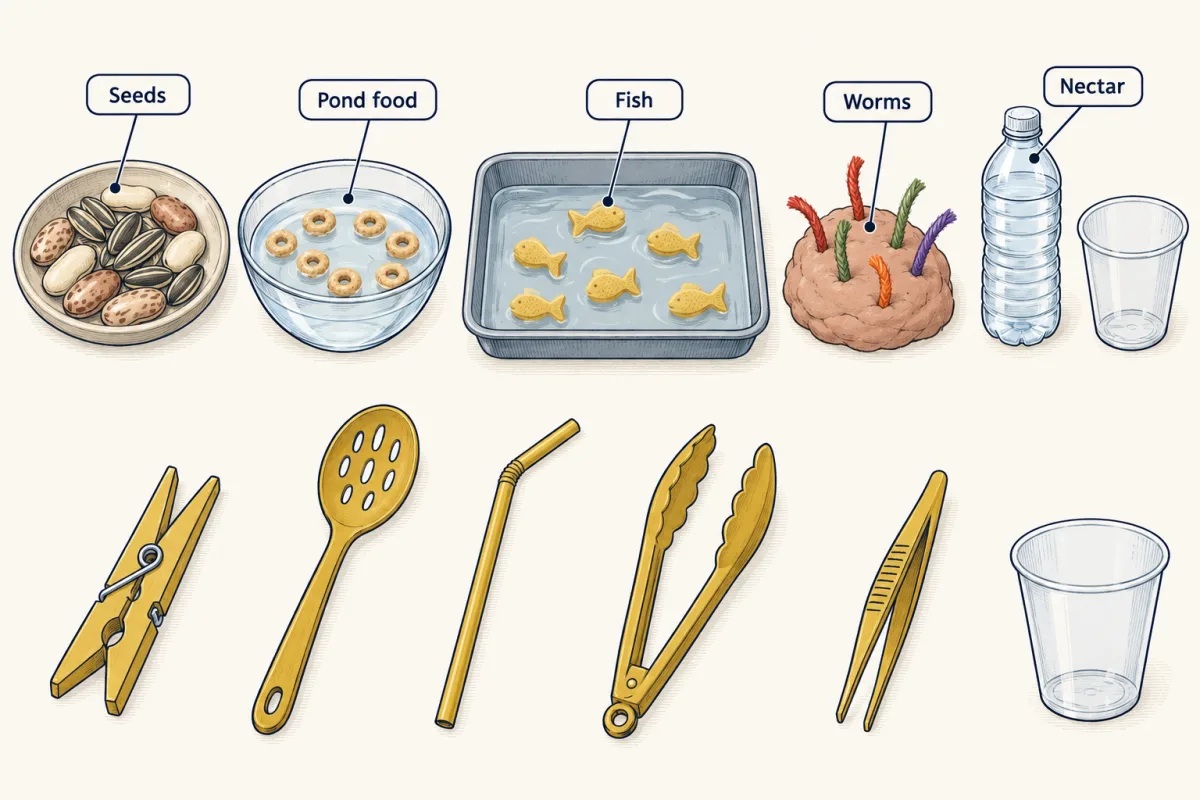
- Five "beaks": a spring clothespin, a slotted spoon or small strainer, a drinking straw (one per child), kitchen tongs or blunt-tipped chopsticks, and tweezers
- Seeds: a handful of large dry beans (lima or pinto, not red kidney) or sunflower seeds in the shell, in a shallow dish
- Pond food: a handful of cereal loops floating in a bowl of water
- Fish: 8 to 10 pieces of dry pasta or sponge cut into fish shapes, in a baking pan with 3 cm of water
- Worms: 8 to 10 short pieces of yarn pushed halfway into play dough or damp sand
- Nectar: water in a narrow plastic bottle or cup (not glass)
- A small cup for each child (the bird's "stomach") and an empty cup for the nectar
- A timer, and towels for spills
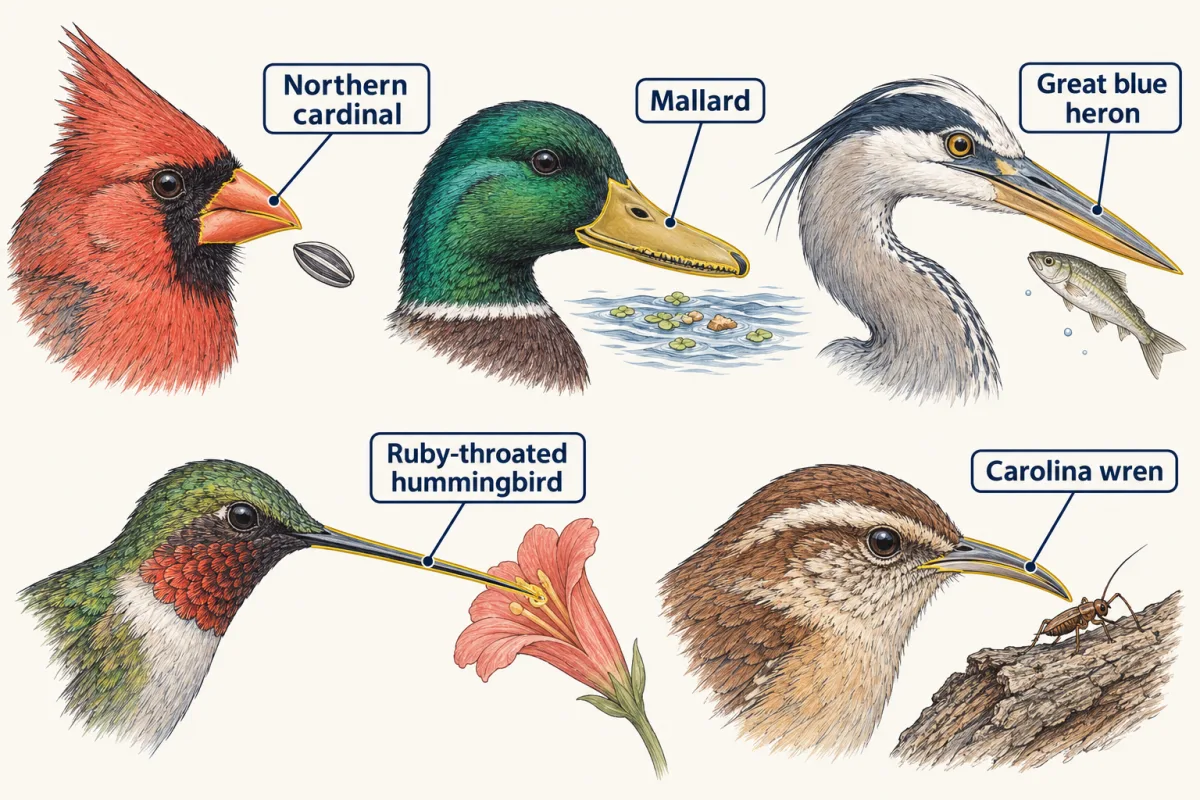
- Pictures of a northern cardinal, a mallard, a great blue heron, a ruby-throated hummingbird and a Carolina wren (optional)
Virginia science standards SOL 3.4 bSOL 1.5 bSOL 3.4 a
The big idea
Hand your child a clothespin and a bowl of floating cereal and they will soon want a different tool. That small frustration is the whole idea of this activity. Each beak shape is good at some jobs and poor at others.
Birds have no hands and no teeth. The beak picks up, cracks, grabs, strains or reaches for food. A beak shape that suits a bird’s food is a physical adaptation, a body feature that helps it survive. The way a bird uses it, like a heron standing still until a fish swims close, is a behavioral adaptation, something the animal does.
Virginia’s grade 3 standard adds one more idea: populations, groups of the same kind of animal living in one place, can change over many generations. A single bird does not grow a new beak because its food changed. Keep that line clear when your child asks.
What to do
- Set the buffet. Put out five stations around the table: seeds, pond food, fish, worms and nectar. Lay the five beak tools in a row.
- Learn the rules. A bird has no hands, so in this game only the beak touches the food. (Some real birds, such as hawks and chickadees, also hold food with their feet.) Your child holds the beak tool in one hand and the stomach cup in the other. Food goes from the station into the cup.
- Predict. At each station, ask, “Which beak do you think will get the most food?” Write the guess down.
- Run timed trials. At each station, your child picks three beaks and tries each one for 30 seconds. Count the pieces in the cup after each try, then tip them back. For the nectar, dip the straw in the water, put a finger over the top, lift it over the empty cup, and take your finger off. Count the strawfuls.
- Find the winners. Circle the best beak for each food. Often the clothespin wins at seeds, the slotted spoon at pond food, tongs at fish, tweezers at worms and the straw at nectar. Your results may differ, and that is useful to talk about.
- Meet the real birds. Show the bird pictures. A northern cardinal has a thick, cone-shaped beak for cracking seeds. A mallard has a flat bill with comb-like edges that strain food from water. A great blue heron has a long, pointed bill for grabbing fish. A ruby-throated hummingbird has a long, thin bill and a long tongue for nectar. A Carolina wren has a thin, slightly curved bill for picking insects off leaves and bark.
- Talk about behavior. Ask how each bird uses its beak. A heron stands still and waits. A mallard tips its tail up and reaches under the water. A hummingbird hovers in front of a flower.
Questions to ask while you do it
Ask your child to guess first, then check.
- “What do you think will happen if we try the clothespin on the floating cereal?”
- “I wonder which beak will be best at every food. Is there one?”
- “If all the seeds were gone, which bird would have a hard time? What could it do?”
- “What do you think a hummingbird would do at the seed station?”
- “Was it only the tool, or also how you used it? What helped?”
- “Birds don’t have teeth. What do you think happens to a seed after a cardinal swallows it?”
What children often think
-
A child might say “If a bird needs to eat different food, its beak will change.”
You could try Ask, "Can you grow longer fingers because you need to reach a high shelf?" A bird’s beak grows and wears a little with use, but a bird cannot grow a different kind of beak because its food changed. Over many generations, birds whose beaks suit the food may survive better and have more chicks, so the whole group slowly changes.
-
A child might say “One beak is the best for everything.”
You could try Test it. Ask your child to pick their favorite tool and try it at every station. Write the counts in a row. Most tools that win at one food struggle at another, just as real beaks do.
-
A child might say “Birds chew their food with teeth.”
You could try Look closely at a bird picture or a bird outside. Ask, "Can you see any teeth?" No living bird has teeth. Birds cannot chew with teeth. Many crack, husk or tear food with their bill, then swallow it, and a muscular part of the stomach called the gizzard grinds it, often with help from small stones the bird swallows.
-
A child might say “The straw is how a hummingbird drinks, like sipping a juice box.”
You could try Ask your child to lick a spoon of water fast without sucking. A hummingbird’s bill is long and thin, but it is not a tube, and the bird does not suck. Its long tongue laps nectar many times a second. The straw is only a stand-in for that long reach.
Why it works
Beak shape and food fit together because of a long history. In any bird population, beaks vary a little. When food is scarce, birds whose beaks handle the food that is left are more likely to survive and raise chicks, and chicks tend to inherit their parents’ beak shape. Over many generations the average beak in the population shifts. This is natural selection. Scientists watched it happen on a Galápagos island in 1977. A drought left mostly large, hard seeds, and medium ground finches with deeper beaks survived better.
Your tools are rough models. A clothespin can pick up a seed, but a cardinal’s thick beak also cracks the hard shell open. A real mallard’s bill has comb-like plates called lamellae along its edges, which let water out and hold food in. Your slotted spoon does the same job. Behavior matters too, and your child’s technique will change the counts.
Easier and harder
Ages 5 to 7
Use three stations (seeds, pond food, fish) and three tools. Skip the timer and count to 20 out loud instead. Your child can draw the winning beak at each station rather than write numbers. Show one real bird for each station.
Ages 8 to 10
Make it a fair test. Use the same time, the same amount of food and the same person for every trial. Run each trial twice and average the counts. Draw a bar graph for one station. Then change one thing, such as removing all the beans, and ask which “bird” would go hungry first.
If it doesn’t go as planned
If counts are all close, the trials may be too long or the food too easy. Cut trials to 20 seconds or spread the food out more. If the cereal sinks or turns to mush, use fresh cereal or small foam pieces. If your child reaches for the food with their hands, remind them that in this game a bird uses only its beak, then let them try one round “beak only” and one round with hands to see the difference.
Observation sheet
Observation sheet
Beak buffet
NameDate
Guess the best beak first. Then count what each beak picks up in 30 seconds.
| Food | My guess | Beaks I tried | How many for each? | Best beak |
|---|---|---|---|---|
| Seeds | ||||
| Pond food | ||||
| Fish | ||||
| Worms | ||||
| Nectar |
The beak that worked for the most foods was:
A real bird with a beak like that one:
biochemistrypedia.com · Biology Together
Finish line
Test yourself
4 questions
Practice and MCAT-style, with explained answers.
Next · Lesson 17
The Blubber Glove
How does a seal stay warm in icy water with only short hair? A shortening-filled mitten lets a child feel the answer.
Continue →