Life Science · Unit 5: Living together
Adaptations for Survival
What happens to a white snowshoe hare when the snow melts early? You run a hillside model where you set when the snow melts and when hares change color, then read real survival estimates from hares in Montana and attack counts on clay mice in Florida. Afterwards you can sort adaptations into physical and behavioral, explain trade-offs and variation, and explain why populations adapt, not single animals.
Where this lesson sits
- Virginia SOL LS.7 b
- Practices LS.1 c, LS.1 d, LS.1 e, LS.1 f
Essential question: What happens to a white snowshoe hare when the snow melts early?
-
Life Science (grade 7) LS.7 b You are here
This lesson
-
Biology
Preview it at high school level
In Biology you will learn where the differences between individuals come from. New versions of genes appear by mutation, animals moving between groups bring in genes, and sexual reproduction shuffles genes into new mixes. You will also learn that in many species most young animals do not live long enough to reproduce. The ones whose inherited traits suit the conditions are more likely to survive and have young. A strong pressure, such as hunting elephants for ivory, can change how common a trait is within a few decades. Individuals do not evolve; populations do.
-
Biology II Biology II: Advanced Survey of Biology Topics, BIOII.5 a and b; Ecology, EC.5 c
Preview where it goes next
In Biology II: Advanced Survey of Biology Topics, you name selective pressures such as predators, climate and human hunting, and you follow how a changing environment changes how common each version of a gene is in a population. Snowshoe hares facing shorter snow seasons are one example scientists study. The Ecology course looks at how populations grow and shrink, and at which living and nonliving factors limit them.
-
College
Watch first A White Hare on Bare Ground · 2:23
In fall, a snowshoe hare’s brown fur turns white over several weeks. On snow it is hard to see, but what if the snow melts early and the hare is still white?
Snowshoe hares live in snowy forests in Canada and the northern United States, including Montana. Scientists there put radio collars on hares and checked on them each week. They asked a plain question. Does a coat that stands out cost a hare its life?
What do you think? Decide before you read.
-
Scientists disagree: Scientists in Montana watched white hares on bare ground. The hares did not move to snowier spots, and many were still the wrong color for the ground. Traits change in a population over many generations, when animals with helpful inherited traits leave more young.
What scientists think
Scientists disagree: Scientists in Montana watched white hares on bare ground. The hares did not move to snowier spots, and many were still the wrong color for the ground. Traits change in a population over many generations, when animals with helpful inherited traits leave more young.
-
Scientists disagree: Adaptations usually have a cost somewhere. A white coat hides a hare on snow, but the same coat stands out on brown ground. Survival estimates from Montana show what that cost looks like.
What scientists think
Scientists disagree: Adaptations usually have a cost somewhere. A white coat hides a hare on snow, but the same coat stands out on brown ground. Survival estimates from Montana show what that cost looks like.
-
Scientists disagree: Hares in the same Montana forest turned white at different times. In some places with little snow, snowshoe hares stay brown all winter. These differences matter when the weather changes.
What scientists think
Scientists disagree: Hares in the same Montana forest turned white at different times. In some places with little snow, snowshoe hares stay brown all winter. These differences matter when the weather changes.
Explore: change when the snow melts
In this model, a hillside goes from fall to spring. Each dot is a hare. You choose the week the snow melts and when the hares change color. A warmer climate switch makes the snowy season shorter. Hares that stand out are highlighted, and a bar shows how many hares are lost to predators each week.
Dot color = coat color. Orange ring = coat and ground differ by 60 points or more. ✕ = lost this week. Dashed circle = lost earlier. Chart: bars = this run, black ticks = expected.
Season’s end: press Run season, or drag the week slider to the last week, to see how many hares are alive.
| This run | Expected | |
|---|---|---|
| Alive at the end | ||
| Lost before the melt | ||
| Lost after the melt |
Made up for this sketch: 100 hares; 22 weeks that are not real dates; snow arrives in week 6 and melts in week 12, 15 or 18; a warmer climate makes snow arrive one week later and melt one week sooner; a coat change takes 4 weeks; hares differ by up to 2 weeks either way; chances between the lesson’s three values are joined by straight lines; a hare that predators spot is lost; the color-change slider moves every hare’s fall and spring change together, by up to 3 weeks; a hare is ringed when its coat differs from the ground by 60 points or more (a threshold chosen for the sketch).
In this sketch, the more a coat differs from the ground, the lower the chance of surviving a week. The lesson’s Montana estimates are 96 percent (matched), 92 percent (60 points different) and 89 percent (100 points different). The model shows only color, covers one season, and shows no inheritance or change over generations. They are model estimates from two Montana sites, not counts, and they do not show that coat color caused each death.
Try this.
- Set the snow to melt early, and keep the hares’ color change normal. Predict which hares will be lost most. Then run it and check.
- Shift the hares’ color change earlier. Predict whether more hares will survive the spring. Then test it.
- Turn on the warmer climate switch. Write down how many hares you think will survive. Then run it and compare.
The model shows only color. Real predators also use smell, sound and movement, and real hares differ in many ways.
Explain: what an adaptation is
- adaptation
- physical adaptation
- behavioral adaptation
- camouflage
- migration
- hibernation
- trade-off
- variation
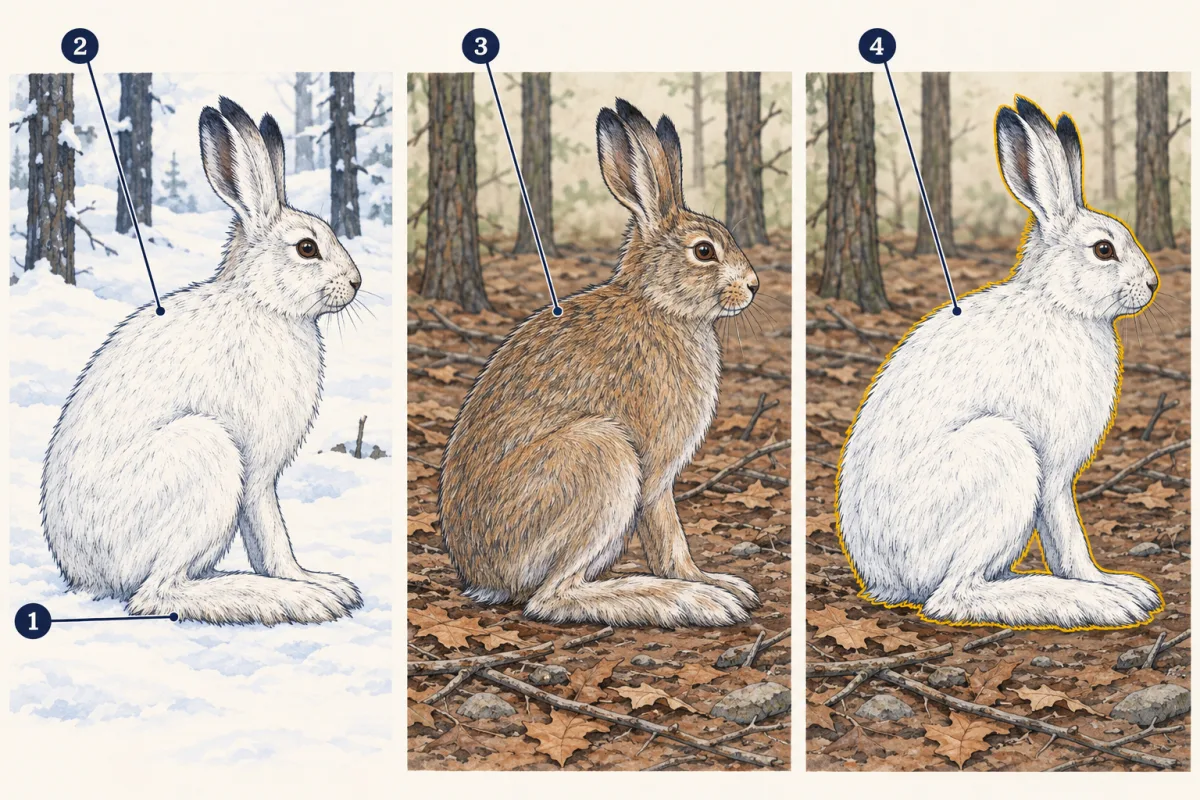
Look at a snowshoe hare’s back feet. They are large, and fur covers the bottoms. Big feet help the hare move on top of soft snow. The fur helps keep its feet warm.
An adaptation is an inherited trait that helps a living thing survive and reproduce in its ecosystem. Inherited means it passes from parents to their young. Scientists sort adaptations into two groups.
- A physical adaptation is a feature of the body: a body covering, a color, or a structure.
- A behavioral adaptation is an action or a pattern of actions.
| Adaptation | Type | How it helps |
|---|---|---|
| Hare’s large, furry back feet | Physical (structure and covering) | Moves on snow; keeps feet warm |
| Hare’s white winter coat | Physical (coloration) | Harder for predators to see on snow |
| Eastern box turtle’s shell | Physical (covering) | Shields its soft body from predators |
| Great blue heron’s long legs | Physical (structure) | Wades into water to catch fish |
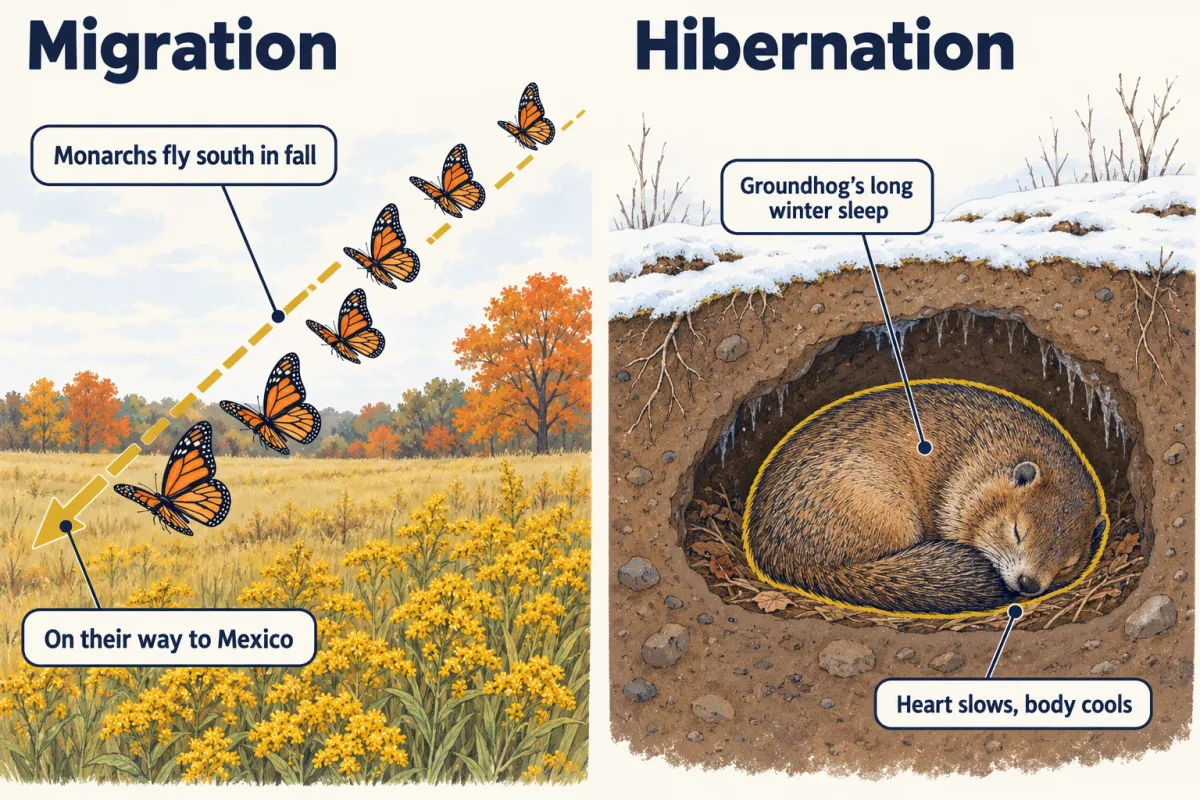
| Monarchs flying south in fall | Behavioral (migration) | Reach a warmer place for winter |
| Groundhog’s long winter sleep | Behavioral (hibernation) | Needs much less food while food is scarce |
The hare’s white coat is camouflage, coloring that helps an animal blend in with its background. Blending in lowers the chance that a predator notices the hare. It does not make the hare invisible.
Bird beaks work a bit like tools. A cardinal’s short, thick beak cracks seeds. A hummingbird’s long, thin beak reaches nectar deep in a flower. A heron’s long, sharp beak grabs fish. The comparison breaks here: you can put a tool down, but a bird cannot swap its beak.
- large, furry back feet
- white winter coat
- brown summer coat
- white hare on bare ground
- blank
- white winter coat
- brown summer coat
- blank
Word bank: large, furry back feet, white hare on bare ground
- blank
- blank
- blank
- blank
Check your labels
- large, furry back feet
- white winter coat
- brown summer coat
- white hare on bare ground
Explain: behaviors, trade-offs and who changes
Migration is a regular journey between places used in different seasons. Many monarch butterflies pass through Virginia in fall on their way to Mexico. The monarchs that make this trip have never made it before. Hibernation is a deep, inactive state some animals enter for winter. A hibernating groundhog’s heart beats much more slowly, and its body cools. So hibernation changes the whole body, not only what the animal does. Many behaviors like these are instinctive: animals do them without being taught. How animals respond to seasons is the topic of the next lesson.
A trade-off means a trait helps in one way but costs in another. A white coat hides a hare on snow. On bare brown ground, the same coat stands out. A box turtle’s heavy shell protects it, but it is also heavy to carry. No living thing is perfectly adapted.
Hares in one forest are not all alike. In Montana, some hares turned white earlier than others. In some places with little snow, snowshoe hares stay brown all winter. These differences between individuals of a species are called variation.
A single hare cannot decide to change color. Its coat changes on a yearly schedule, day length seems to help set it, and snow can nudge the timing a little. Montana studies found no sign that white hares moved to snowier spots. Change in an inherited trait happens to a population, all the members of one species in one area. Hares whose inherited timing fits the snow may survive and have more young. Over many generations, that timing can become more common. This is natural selection, which you will study in a later lesson. If the climate changes faster than that, a population can struggle.
Elaborate: survival of matched and mismatched hares
Scientists followed 186 snowshoe hares with radio collars at two sites in Montana. Each week they found each hare by its radio signal. They scored how white its coat was and how much snow covered the ground. Then a math model estimated the chance of surviving one week for hares at each level of mismatch.
| Coat compared with the ground | Difference in whiteness (percent) | Estimated chance of surviving one week (percent) |
|---|---|---|
| Matched (white on snow, or brown on bare ground) | 0 | 96 |
| Partly mismatched | 60 | 92 |
| Fully mismatched (for example, all white on bare ground) | 100 | 89 |
Source: Zimova, Mills and Nowak, Ecology Letters (2016), Discussion and Figure 3. Hares were near Seeley Lake (2009 to 2012) and Gardiner (2010 to 2012), Montana. These are rounded estimates from a model, not counts of hares.
A second team tested color directly, with clay mice instead of live ones.
| Model color | Ground | Attacks recorded (number) |
|---|---|---|
| Dark | Light beach sand | 5 |
| Light | Light beach sand | 2 |
| Light | Dark inland soil | 16 |
| Dark | Dark inland soil | 5 |
Source: Vignieri, Larson and Hoekstra, Evolution (2010), Table 1. Models sat out in the field at Topsail Hill Preserve State Park (beach) and at an inland site, in Florida.
- By how many percentage points does weekly survival drop from matched to fully mismatched hares?
- Imagine 100 matched hares and 100 fully mismatched hares. About how many in each group would you expect to be alive after one week?
- On each kind of ground, which model color was attacked more? What fraction of all 28 attacks hit models that did not match?
Claim, evidence, reasoning
Make a claim that answers this question: what happens to a white hare when the snow melts early? Use both tables.
Start with: When the snow melts early, a white hare is blank likely to survive, because blank.
Start with: Matched hares had an estimated blank percent chance of surviving a week, and fully mismatched hares had blank percent. Mismatched clay models got blank of 28 attacks.
Start with: A coat that does not match the ground makes it blank for predators to blank, so blank.
Compare with a model answer
When the snow melts early, a white hare is less likely to survive than a hare that matches the ground. In Montana, matched hares had an estimated 96 percent chance of surviving a week, and fully mismatched hares had 89 percent, 7 percentage points lower. In Florida, mismatched clay models got 21 of 28 attacks. A coat that stands out is easier for predators to find. One limit: the hare numbers are model estimates from two Montana sites over about three years, so they cannot show that coat color caused each death.
Saved in this browser only.
Design problem
You cannot test live hares at school. Plan a safe classroom test of whether matching the background protects prey, using paper “prey” and classmates as “predators.”
One way to do it
- Question: Are paper squares that match the background picked up less often than squares that do not?
- Independent variable: whether a square matches the background (white squares and brown squares on a white sheet, then on a brown sheet).
- Dependent variable: the number of each color picked up.
- Constants: 20 squares of each color, each 1 cm by 1 cm, a sheet about 1 m by 1 m, and 15 seconds per turn.
- Control: the same mix of squares on both backgrounds, so color matching is the only change.
- Repeated trials: five classmates each take three turns on each background. Find the mean for each color.
- Safety: use only paper, keep the floor clear so no one trips, and pick up every square afterward.
If matching squares are picked up less on both backgrounds, the result supports camouflage. Your test is a model: real predators also use smell and movement.
Evaluate: check your thinking
When the snow melts early, a white hare stands out on brown ground. In Montana, mismatched hares had a lower estimated chance of surviving each week. Snow can nudge a single hare’s timing only a little; only a population can shift its timing much, over many generations, if hares vary in an inherited way.
Science practices you used: making predictions and testing them with a model, reading data tables, calculating a difference in percentage points, planning a fair test with constants and repeated trials, and naming the limits of a model and of the data.
How we measure it
Radio collars (radio telemetry)
A small radio on a collar sends a signal, so scientists can find the same animal again and again. In the Montana study they found each hare about once a week and checked whether it was still alive.
Scoring coat color and snow cover
Observers looked at each hare, and used photos, to estimate what percent of its coat was white. They also estimated what percent of the ground around it was covered by snow, and compared the two numbers.
Clay model test
Scientists set out clay models of mice in light and dark colors on light and dark ground. Bite, beak and claw marks in the clay show which models predators attacked.
Finish line
Test yourself
8 questions
Practice and MCAT-style, with explained answers.
Next · Lesson 22
Daily and Seasonal Rhythms
How does a cherry tree with no calendar know when to bloom, and why might that day change?
Continue →