Biology Together · Unit 8: Virginia and Chesapeake nature
A Watershed in a Pan
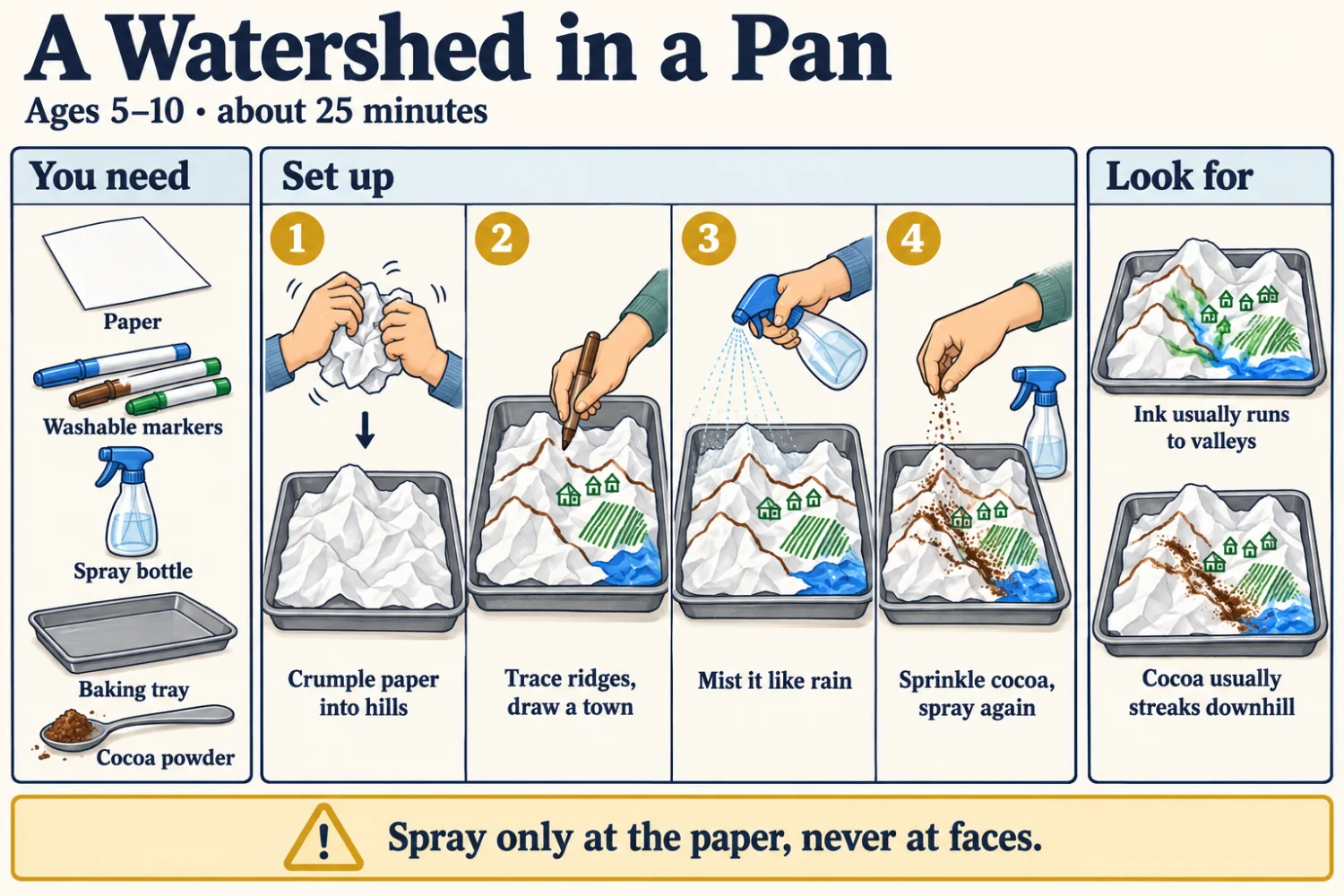
You and your child crumple a sheet of paper into hills and valleys, draw ridges, towns and farms on it, then make it rain with a spray bottle. Colour runs downhill, much of it into one low "bay," carrying pretend fertilizer and litter with it. Your child finds out what a watershed is and which one your home is in.
Watch first We All Live Downstream · 2:03
Read the transcript of “We All Live Downstream”
Film transcript: We All Live Downstream
Where does rain go after it lands on your street? Watch a puddle after a storm and you will see water moving downhill. Some rain soaks into the ground. When the ground is full or hard, the rest runs downhill. In the activity, your child crumples paper into hills and valleys. One low corner is coloured blue and called the bay. The high ground is called a ridge. Rain on one side of a ridge flows one way. Rain on the other side flows the other way. All the land that drains to the same stream, river or bay is called a watershed. A ridge splits one watershed from the next. If water pools in more than one low spot on the paper, each pool is collecting rain from its own small patch of land, and some of those pools never reach the bay.
Little streams join bigger streams, and bigger streams join rivers. As water runs across the land, it picks things up. Soil, litter, pet waste and lawn fertilizer can all go along. Much of it can end up downstream. In most places, storm drains carry rain straight to a creek without cleaning it. More than half of Virginia drains to the Chesapeake Bay. Most of the rest drains south to the sounds of North Carolina or west toward the Gulf of Mexico. A map of Virginia's watersheds helps you find your town. Virginia's grade 4 standard asks children to model a watershed and name the one they live in. It also asks them to explain: we all live downstream.
If your home is in the Bay watershed, rain that runs off your yard can reach it. It travels through creeks and rivers. Your child can trace which way rain runs from your yard on a map. For a younger child, one idea is enough: what we put on the land can reach the water. The safety notes are on the page.
Before you start
- Hands-on time
- About 25 minutes
- Where
- Indoors
- Ages
- 5 to 10, with an easier and a harder version below
- Grown-up
- Stay nearby to help with spraying and spills. Keep paper bits and cocoa away from toddlers and pets.
What you need
- 1 sheet of white printer paper per landscape
- Washable markers: blue, brown or black, green and one other colour (they must be washable)
- A spray bottle of plain water (new, or one that only ever held water)
- A baking tray, roasting pan or shallow plastic tub
- Paper towels or an old towel
- A pinch of cocoa powder, or a few drops of food colouring in a spoonful of water
- A few hole-punch paper dots or tiny torn paper bits for litter
- A printed or on-screen map of Virginia’s watersheds (optional)
Virginia science standards SOL 4.8 aSOL 3.8 aSOL 3.8 bSOL K.11 c
The big idea
Watch a puddle after a storm and you will see water moving, always downhill. This activity follows that water.
A watershed is all the land that drains to the same stream, river or bay. High ground called a ridge splits one watershed from the next. Rain on one side of the ridge flows one way, and rain on the other side flows the other way.
As water runs across the land, it picks things up: soil, litter, pet waste and lawn fertilizer. Much of it can end up downstream. More than half of Virginia drains to the Chesapeake Bay. Most of the rest drains south to the sounds of North Carolina or west toward the Gulf of Mexico.
Virginia’s grade 4 standard asks children to model a watershed, name the one they live in, and explain “we all live downstream.” Younger children only need the idea that what we put on the land can reach the water.
What to do
- Crumple. Crumple a sheet of paper into a tight ball. Open it gently, but don’t flatten it. You want hills and valleys. Set it in the tray.
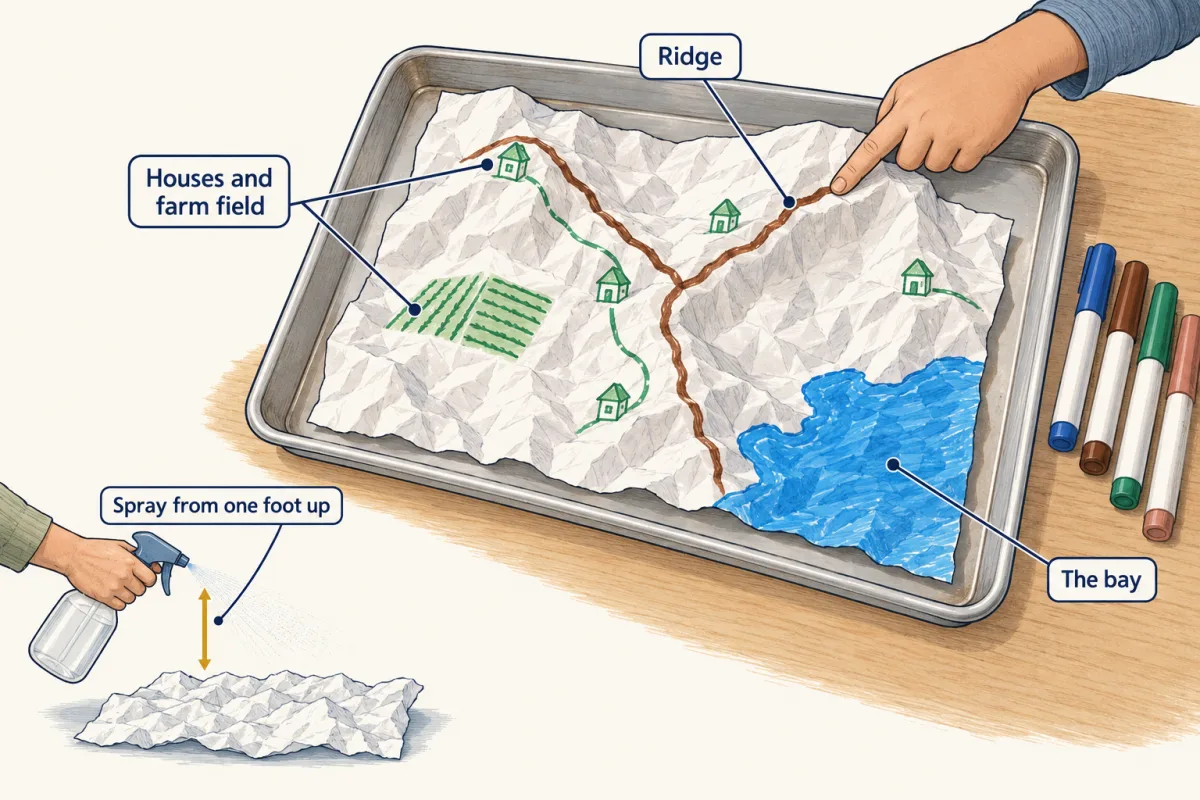
- Find the high ground. Ask your child to run a finger along the tops of the ridges. Trace each ridge with a brown or black marker. Colour one low corner blue and call it “the bay.” Slip a folded towel under the opposite end of the tray so the bay corner sits lowest.
- Build a town. Draw small houses, a farm field and a road with green and the other colour. Put some on hilltops and some in valleys.
- Predict. Point to three spots, one on each side of a ridge and one by a house. Ask, “If rain lands here, where will it go?” Have your child draw a little arrow for each guess.
- Make it rain. Mist the paper from about 30 cm (one foot) above, 10 to 20 squirts. It can take several squirts before anything moves. Watch the marker colour bleed and run down the creases. Most of it should collect in the valleys, and some in the bay. If water pools in more than one low spot, each pool is collecting rain from its own small patch of land, and some of those pools never reach the bay. Check the predictions.
- Add pollution. Sprinkle a pinch of cocoa (“fertilizer” or “soil”) near the farm, or drip a little of your food-colouring water there instead. Drop a few paper dots (“litter”) on the road. Ask where they will go, then spray again. The cocoa usually streaks downhill. The paper dots may need more water before they move.
- Find your watershed. Look at a map of Virginia’s watersheds together and find your town. Follow the river from your area to where it ends. Ask, “Who lives downstream from us?”
- Plan three things. Talk about what your family can do: pick up pet waste (an adult job, with a bag and soap and water afterwards), keep trash out of storm drains, sweep spilled fertilizer and grass off driveways and back onto the lawn, never into the street (also an adult job, with hands washed afterwards), plant trees or a garden, and save water at home, such as turning off the tap while brushing teeth. Clean water is limited, and pollution leaves less of it fit to use. Have your child pick three and draw them.
Questions to ask while you do it
Ask your child to guess first, then check.
- “I wonder where this drop will go if it lands right on top of a ridge.”
- “What do you think will happen to the farm if we spray a lot?”
- “Will the bay get more colour or less if we keep spraying?”
- “What do you think will happen if we put the litter on the hilltop instead?”
- “Where does the rain go after it lands on our roof?”
- “If crabs lived in our bay, what would be best to keep out of the water?”
What children often think
-
A child might say “Rain just soaks in where it lands.”
You could try Some does, and that is a good observation. Ask, "Where do puddles go on a sidewalk?" Then spray a little more and watch. When the ground is full or hard, the rest runs downhill. Pavement and roofs let almost none soak in.
-
A child might say “Only factories make water dirty.”
You could try Point to the cocoa near the farm and the dots on the road. Ask, "Was there a factory here?" Factories can pollute, but so can lawns, streets, pet waste and farms. Small amounts from many places add up downstream.
-
A child might say “The water from my house stays at my house.”
You could try Go outside after rain, or think about where the gutter goes. Ask, "Which way does the water go from the end of the downspout?" Follow it with an adult as far as your own yard or the sidewalk goes, and stay away from the road and from any running water or deep ditch. Some soaks into the yard. The rest joins a ditch, drain or creek, and keeps going.
-
A child might say “One piece of trash can’t matter.”
You could try Ask, "What if every house on our street dropped one?" Drop one paper dot for each house on your paper and spray. One piece is small, but many pieces from many places can reach the same bay.
Why it works
Water flows downhill because of gravity, so the shape of the land sets its path. The crumpled paper is a small copy of real hills and valleys. The washable ink dissolves in the spray and rides along with it, showing the path the way a dye would.
On real land, rain soaks into soil, especially under plants. Water that runs off the surface is called runoff. Runoff carries soil and nutrients, such as nitrogen and phosphorus from fertilizer and animal waste. In the Chesapeake Bay, too many nutrients make algae grow too fast. Thick algae block sunlight from underwater grasses. When the algae die and rot, the rotting uses up oxygen and can leave low-oxygen “dead zones.” Farms, lawns, wastewater and air pollution all add nutrients. In most places, storm drains carry rain straight to a creek without cleaning it, which is why “we all live downstream.”
Easier and harder
Ages 5 to 7
Skip the map and the litter. Draw one house and one farm, trace the ridges with your child, and spray. Ask one question each time: “Where did the colour go?” End with one family action your child can do this week, such as putting trash in the bin. Your child can draw the bay before and after the rain.
Ages 8 to 10
Make two landscapes from the same kind of paper. On one, lay a strip of paper towel (“a strip of plants”) along the stream below the farm. Put the same pinch of cocoa in the same spot near each farm, spray both the same number of times, and compare how much cocoa reaches the bay. The two crumples never match exactly, so look for a big difference. Have your child find their watershed on a map, name the river, and write a short note to a neighbour about one thing everyone can do.
If it doesn’t go as planned
If nothing runs, keep spraying. The paper soaks up water first. If everything turns into one big blur, you sprayed too much at once; try a new sheet and spray in short bursts. If the marker does not move at all, it is probably not washable. Thin printer paper works better than card or construction paper.
Observation sheet
Observation sheet
A watershed in a pan
NameDate
Draw an arrow for where you think the rain will go. Then spray and check.
| Where the drop started | My guess | Where it went |
|---|---|---|
| Top of a ridge | ||
| Next to a house | ||
| On the farm | ||
| On the road |
Our watershed is:
The river near us is:
biochemistrypedia.com · Biology Together
Finish line
Test yourself
4 questions
Practice and MCAT-style, with explained answers.
Next · Lesson 29
Roots Hold the Soil
Why does a muddy stream run brown after a storm? Two trays of soil and a watering can show where the mud comes from.
Continue →