Life Science · Unit 6: Changing ecosystems
Big Changes: Dead Zones, Storms and Climate
How can too much fertilizer make part of the Chesapeake Bay run out of oxygen? You test nitrogen, warm water and a big storm in a model of the Bay, then read eight years of real spring nitrogen and summer dead-zone numbers. Afterwards you can explain eutrophication step by step and describe how climate changes, hurricanes, floods and fires change ecosystems.
Where this lesson sits
- Virginia SOL LS.8 c
- Practices LS.1 a, LS.1 c, LS.1 d, LS.1 e
Essential question: How can too much fertilizer make part of the Bay run out of oxygen?
-
Life Science (grade 7) LS.8 c You are here
This lesson
-
Biology
Preview it at high school level
In Biology you follow the same eutrophication chain with more real Bay numbers: the volume of low-oxygen water, which scientists call hypoxia, the nitrogen coming from the whole watershed, and the area of underwater grass. You design and test a fix for a watershed, weighing what it must do against limits of money, land and time. You also learn a name for the way life returns after a fire, a flood or an abandoned farm: succession. In much of Virginia, an old field usually changes from weeds and grasses to pines to an oak-hickory forest, and you learn why each stage helps the next one arrive.
-
Biology II Biology II: Ecology, EC.2 d and f, EC.7 c; Advanced Topics, BIOII.6 f
Preview where it goes next
Virginia’s Biology II: Ecology course studies threats from people to biodiversity, and ways to fix each one. It asks how biodiversity helps an ecosystem resist a change or bounce back from it, which ecologists call resilience. It also studies invasive species in a local ecosystem. The Advanced Topics course adds tipping points, where a small extra push moves an ecosystem into a different state, and the idea that when several species do the same job, losing one matters less.
-
College
Watch first Extra Nutrients, Less Deep Oxygen · 2:39
Each summer, part of the deep water in the Chesapeake Bay runs very low on oxygen. Fish and crabs swim away from it, and animals that cannot leave may get sick or die.
People call this low-oxygen water a dead zone. Its size changes from year to year. Scientists compare it with how much nitrogen the rivers carried into the Bay that spring. Why would something that plants need take oxygen away from animals?
What do you think? Decide before you read.
-
Scientists disagree: Scientists measure oxygen in the Bay every summer, and the amount of low-oxygen water changes a lot from year to year. Forests change too. In Yellowstone, researchers counted far fewer young trees where a forest burned twice in a short time.
What scientists think
Scientists disagree: Scientists measure oxygen in the Bay every summer, and the amount of low-oxygen water changes a lot from year to year. Forests change too. In Yellowstone, researchers counted far fewer young trees where a forest burned twice in a short time.
-
Scientists disagree: Rain can wash farm fertilizer and manure into streams, and some wastewater still carries nutrients. River stations measure the nitrogen flowing toward the Bay each spring, and scientists use those numbers to help predict the summer dead zone.
What scientists think
Scientists disagree: Rain can wash farm fertilizer and manure into streams, and some wastewater still carries nutrients. River stations measure the nitrogen flowing toward the Bay each spring, and scientists use those numbers to help predict the summer dead zone.
-
Scientists disagree: Algae need nitrogen and phosphorus to grow. In a lake experiment in Canada, both halves of a lake got nitrogen, but only one half also got phosphorus. That half became thick with algae. Too many algae can lead to trouble, as you will see.
What scientists think
Scientists disagree: Algae need nitrogen and phosphorus to grow. In a lake experiment in Canada, both halves of a lake got nitrogen, but only one half also got phosphorus. That half became thick with algae. Too many algae can lead to trouble, as you will see.
Explore: feed the Bay and watch the oxygen
The simulation shows the Bay from the side, with a surface layer and a deep layer. You set the nitrogen washing in from land (low, medium or high) and the summer water (cool or warm). A storm button mixes the layers for a few days.
Try this.
- Predict what happens to the algae and the deep-water oxygen when nitrogen goes from low to high. Test it.
- Keep nitrogen high. Predict whether warm or cool water leaves more deep oxygen. Switch and compare.
- When the deep layer is low on oxygen, predict what a big storm will do for fish and crabs. Press it.
Explain: how extra nutrients use up oxygen
- nutrient
- algae bloom
- decomposer
- eutrophication
- dissolved oxygen
- dead zone
- climate change
- catastrophic disturbance
- biodiversity
Pond water left on a sunny windowsill often turns green, because tiny living things called algae grow in it.
A nutrient is a substance living things need to grow. Algae and water plants need nitrogen and phosphorus. Farm fertilizer and manure contain them. So do wastewater and some air pollution.
Here is the chain, step by step:
- Rain washes nutrients from fields and lawns into rivers. Some wastewater adds more.
- In the Bay, algae grow very fast. A thick, fast growth of algae is an algae bloom. The green water shades underwater grasses.
- The algae die and sink to the bottom.
- A decomposer is a living thing that breaks down dead matter. Bacteria decompose the dead algae, and they use oxygen as they do. (More on decomposers.)
- The deep water runs low on oxygen. Fish and crabs often swim away. Oysters cannot swim, and animals that cannot leave may get sick or die.
Eutrophication is when extra nutrients in water feed too much algae growth, which can lead to low oxygen.
extra nutrients → algae bloom → algae die and sink → decomposers use up oxygen → animals leave or die
Dissolved oxygen is oxygen gas mixed into water. Scientists measure it in milligrams per liter (mg/L). In this lesson, a dead zone is water with less than 2 mg/L of dissolved oxygen. It is not empty: bacteria live there, and the water may hold only a little oxygen, or almost none.
Why the deep water, and why summer?
- Warm water can hold less dissolved oxygen than cool water.
- In summer, fresher river water floats on saltier Bay water. The layers mix poorly, so new oxygen reaches the deep water slowly.
- Strong wind can stir the layers and carry oxygen down.
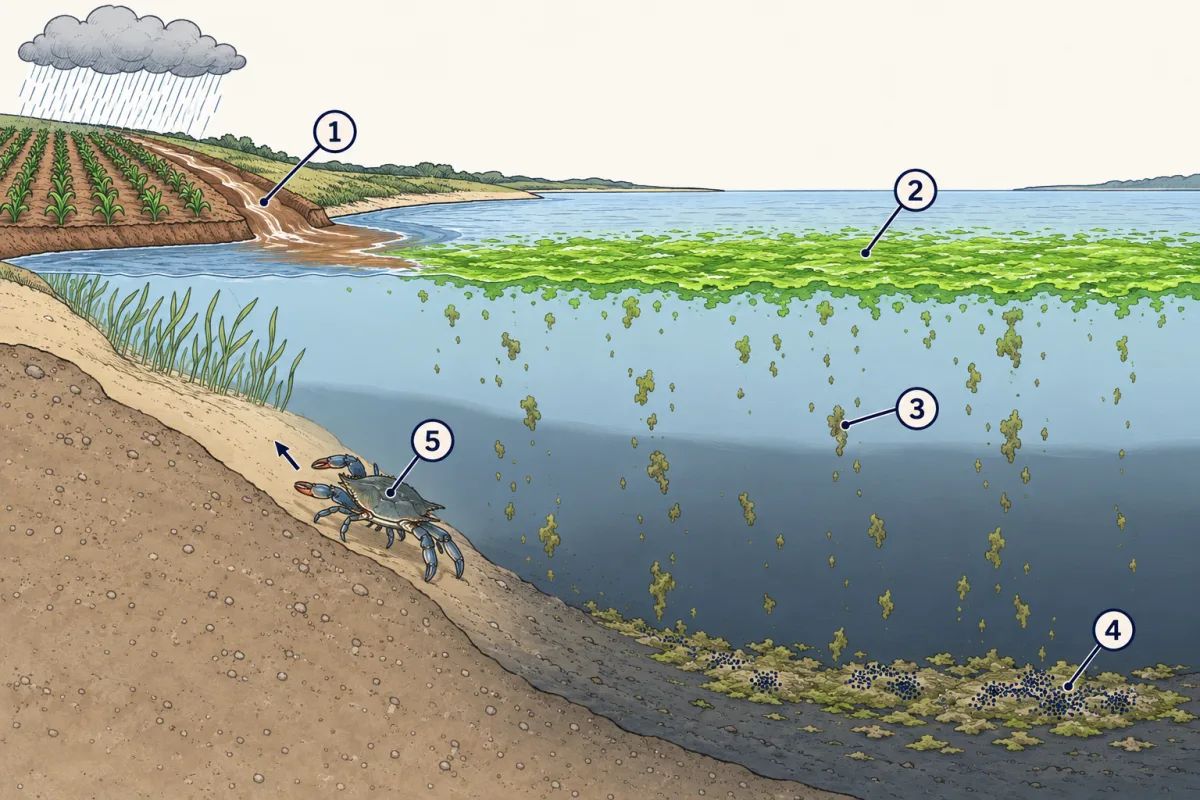
- nutrients washing from fields
- algae bloom
- dead algae sinking
- bacteria using oxygen
- crab leaving the deep water
- nutrients washing from fields
- algae bloom
- blank
- blank
- blank
Word bank: bacteria using oxygen, crab leaving the deep water, dead algae sinking
- blank
- blank
- blank
- blank
- blank
Check your labels
- nutrients washing from fields
- algae bloom
- dead algae sinking
- bacteria using oxygen
- crab leaving the deep water
Explain: climate changes and sudden disasters
A climate change is a shift in a place’s usual temperature, rain or weather that lasts for many years.
- Warmer water holds less oxygen. A 2022 model study found that warming canceled out part of the oxygen gained by cutting nitrogen.
- Sea level is rising along Virginia’s coast. Salt water can now reach some low marshes and forests near the shore.
- A 2022 world report found that about half of the species studied had moved toward the poles or up mountains.
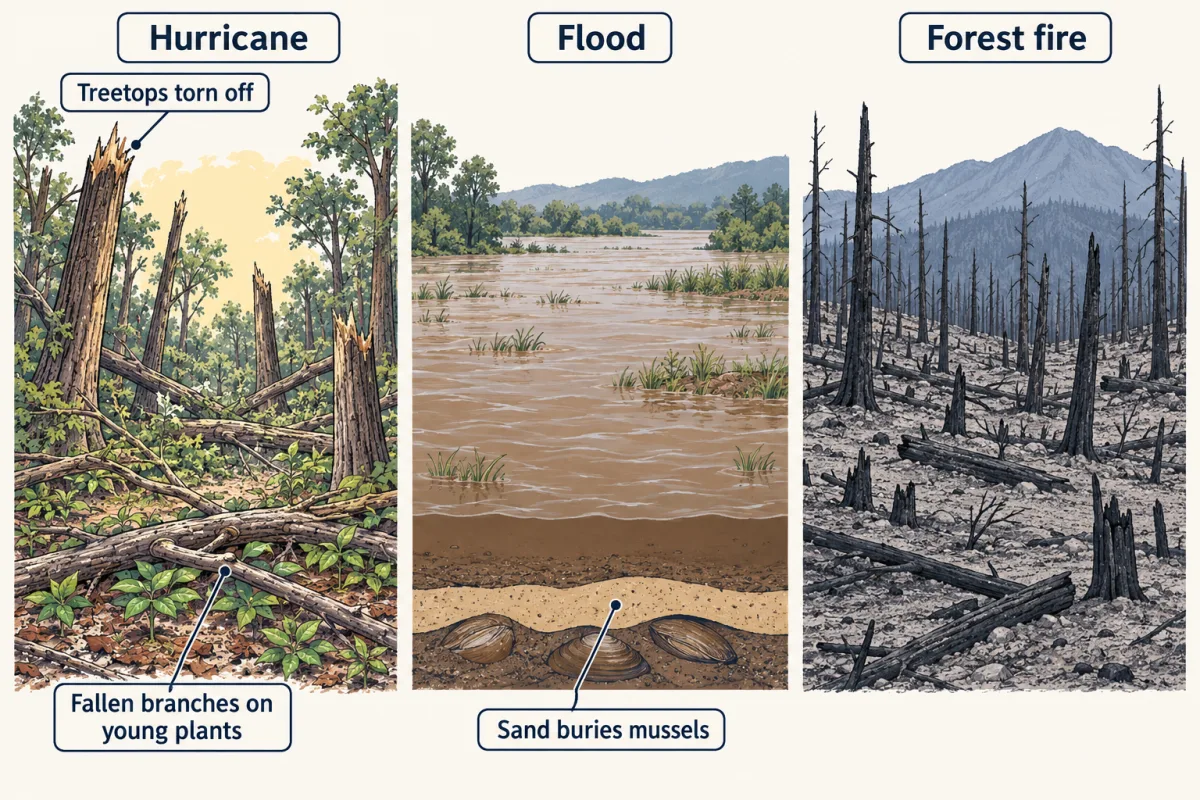
A catastrophic disturbance is a sudden event, such as a hurricane, flood or forest fire, that harms many living things at once. In September 2003, Hurricane Isabel brought strong winds and flooding to eastern Virginia. Forest fires also burn in Virginia’s mountains.
| Disturbance | What it does | What scientists measured |
|---|---|---|
| Hurricane | Tears off treetops and drops branches | In Puerto Rico, researchers cut treetops and piled branches like a storm. Fallen branches killed young plants. Extra light on the forest floor lasted about 18 months. |
| Flood | Covers land with water and mud | In the 1993 Midwest flood, sand about 30 to 60 cm deep buried some freshwater mussels in the Upper Mississippi River. Many fish feed and lay eggs on flooded land. |
| Forest fire | Burns trees and plants | In Yellowstone, forests that burned twice in a short time had about one sixth as many young trees. |
Explain: losing variety, and coming back
Biodiversity is the variety of living things in an area. A big change can lower it. In a dead zone, animals leave the deep water or die.
A disturbance does not lower every kind of life, though. In the Puerto Rico forest, a review reported that opening the treetops let more kinds of plants grow, while several animal groups became less common.
Ecosystems are usually stable, but they can change. Whether one recovers depends on how severe the change is and how long it lasts.
- In fall, cooler water and winds usually mix the Bay, and oxygen returns to the deep water.
- Northern Rocky Mountain forests have grown back after fires 100 to 300 years apart.
- Forests that burn again before they recover may not grow back the same way.
An ecosystem is a bit like a rubber band: stretch it a little and it snaps back, too far and it stays out of shape. The comparison is not perfect, because a changed ecosystem can still work, just differently.
People cause many changes (People Change Habitats), and people can help (Helping Ecosystems Recover).
- When blank washes into the Bay, algae blank, and later the deep water blank.
- In the year with more nitrogen, the dead zone was blank, but I cannot rule out blank.
Elaborate: read eight years of Bay numbers
| Year | Spring nitrogen from 9 rivers, January to May (million kg) | Summer dead-zone volume, June to September average (km³) |
|---|---|---|
| 2017 | 43.5 | 1.9 |
| 2018 | 58.5 | 4.8 |
| 2019 | 77.5 | 11.6 |
| 2020 | 46.8 | 3.5 |
| 2021 | 40.6 | 3.7 |
| 2022 | 47.9 | 5.1 |
| 2023 | 33.1 | 1.5 |
| 2024 | 59.2 | 3.9 |
Nitrogen: U.S. Geological Survey estimates (2024 River Input Monitoring data release), nine river stations added together, January 1 to May 31. Dead zone: computer-model estimates of water below 2 mg/L of oxygen, averaged June to September, from the historical table of the Virginia Institute of Marine Science (VIMS) Bay forecast system, read October 2026. VIMS may revise old estimates, and the numbers for the whole model area can differ between its tables. One km³ is a cube of water 1 kilometer on each side.
- Which year had the most nitrogen? The largest dead zone?
- Compare 2019 with 2023. How much more nitrogen came in, and how much larger was the dead zone?
- Find the mean dead-zone volume. Then find two years where more nitrogen did not come with a larger dead zone.
Claim, evidence, reasoning
Make a claim that answers the question: how can too much fertilizer make part of the Bay run out of oxygen? Use the table.
Start with: The data show that years with more spring nitrogen usually had blank summer dead zones.
Start with: In blank, the rivers carried blank million kg of nitrogen, and the dead zone averaged blank km³. In blank, they carried blank and it averaged blank.
Start with: More nitrogen feeds more blank. When they die, decomposers use up blank in the deep water.
Compare with a model answer
Years with more spring nitrogen usually had larger summer dead zones. In 2019, the rivers carried 77.5 million kg of nitrogen, and the dead zone averaged 11.6 km³. In 2023, they carried 33.1 million kg, and it averaged 1.5 km³. More nitrogen feeds more algae. When the algae die, decomposers use up oxygen in the deep water. One limit: 2017 had more nitrogen than 2021 but a smaller dead zone, so weather matters too. These are eight years of model estimates, not direct counts.
Saved in this browser only.
Design problem
Does adding more fertilizer to pond water change how much oxygen is left a few weeks later? Plan a fair test with clear jars.
One way to do it
- Question: How does the amount of fertilizer in pond water affect algae and dissolved oxygen after three weeks?
- Independent variable: fertilizer added to each jar: 0, 1, 2 and 4 drops of liquid plant fertilizer per liter.
- Dependent variables: how green the water is (a color chart, every three days) and dissolved oxygen in mg/L (a test kit, at the end).
- Control: jars with no fertilizer.
- Constants: the same pond water, 1 liter per jar, window, temperature and time.
- Repeated trials: three jars per amount; find each mean.
- Safety: wear gloves and goggles, never taste the water, wash your hands, and dispose of it as your teacher says.
- Meaning: greener jars that later test lower in oxygen support the chain. Jars are a model with no layers or tides.
Evaluate: check your thinking
Fertilizer does not take oxygen from the Bay by itself. Its nutrients feed algae blooms. The algae die and sink, and decomposers use up the oxygen in deep summer water that does not mix. Climate changes and disasters change ecosystems too; some recover and some stay changed.
Science practices you used: asking a question, testing a model and naming its limits, reading a data table and finding a mean, planning a fair test, and making a claim from evidence.
How we measure it
Dissolved-oxygen profiling
A sensor lowered on a cable reads the oxygen in the water at each depth, from the surface to the bottom. Readings from many places and dates show where deep water runs low on oxygen.
River load monitoring
River stations measure how much water flows past and how much nitrogen the water carries. Together these give an estimate of the total nitrogen a river delivers to the Bay.
Computer model of the Bay
A computer model uses river flow, weather and nutrients to estimate how much low-oxygen water the Bay holds each day. Scientists average those daily estimates over the summer.
Finish line
Test yourself
8 questions
Practice and MCAT-style, with explained answers.
Next · Lesson 25
People Change Habitats
People put blue catfish into Virginia rivers for fishing, so what could that mean for the crabs and native fish already living there?
Continue →