Biology Together · Unit 4: Flowers, seeds and life cycles
Seeds on the Move
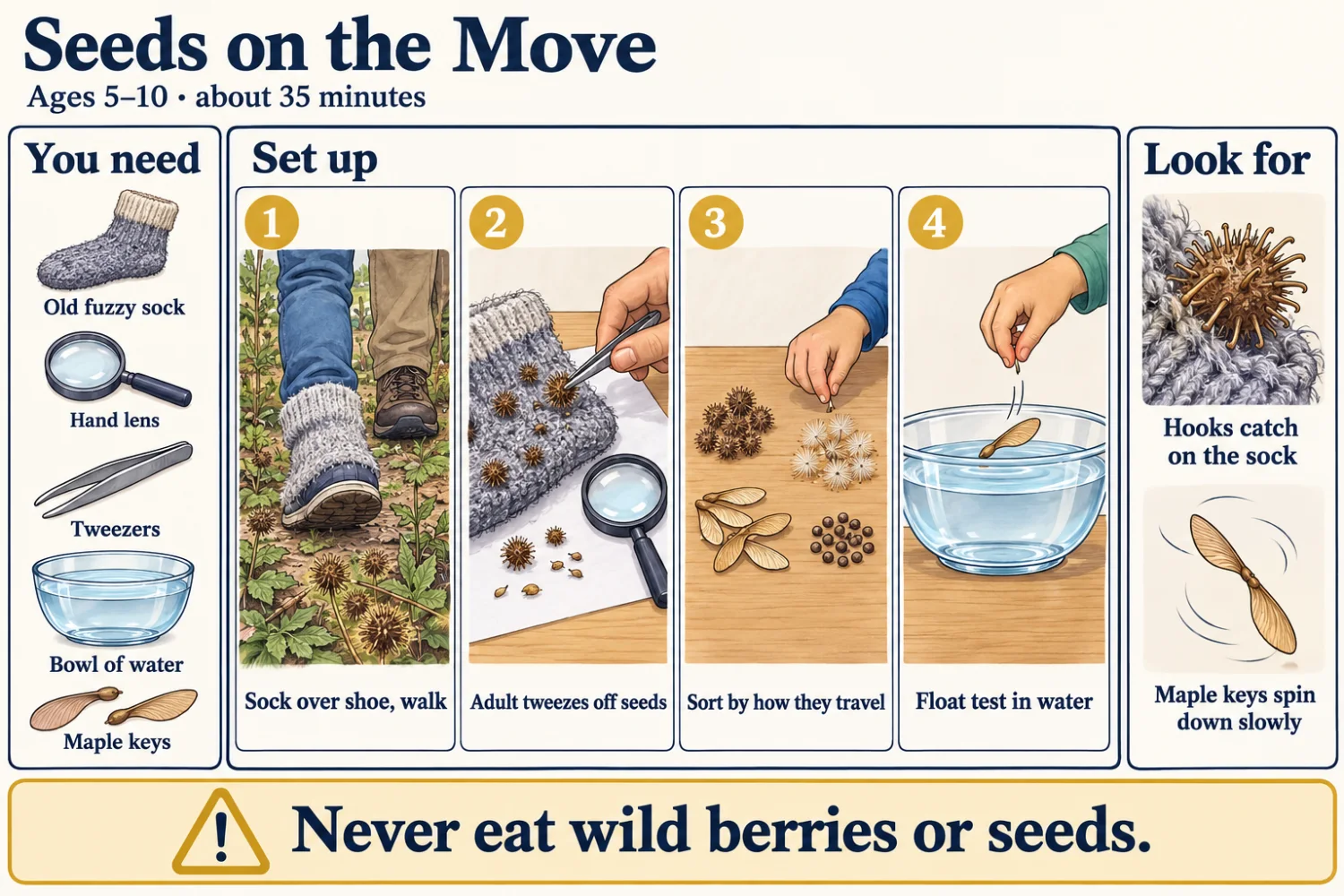
You and your child walk through a weedy patch with an old fuzzy sock over one shoe, then look at what stuck to it. Back inside you sort the seeds by how they travel, test which ones float, and time maple "helicopters" as they fall. Your child finds out that seeds have shapes that carry them away from the parent plant by wind, water and animals, including people.
Watch first Set Up: Seeds on the Move · 0:48
Read the transcript of “Set Up: Seeds on the Move”
Film transcript: Set Up: Seeds on the Move
You need an old fuzzy sock, long pants, closed shoes, tweezers, and a hand lens. Pull the sock over one shoe. Walk slowly along the edge of a weedy patch for three to five minutes. Staying outdoors, an adult uses tweezers to pull off what stuck, and looks for ticks. Count the seeds. Look for the hooks, spines, or barbs that held on. Then sort the seeds into four piles: flies, floats, sticks, gets eaten. Some seeds fit two piles, and that is fine. Drop one of each kind in water, and check again after ten minutes. Stay within arm's reach outdoors. Never eat wild berries or seeds.
Before you start
- Hands-on time
- About 35 minutes, plus an optional few weeks of watering the sock to see what sprouts
- Where
- Indoors or outdoors
- Ages
- 5 to 10, with an easier and a harder version below
- Grown-up
- Stay within arm’s reach outdoors and choose the patch to walk through. You set up and run any fan.
What you need
- An old fuzzy or wool sock, big enough to pull over a shoe
- Long pants and closed shoes
- A paper bag or egg carton for collecting
- A zip-top plastic bag for the sock
- For growing the sock (optional): a shallow tray, potting soil and a clear plastic bag that closes over the tray
- A hand lens or magnifying glass
- Tweezers
- A clear bowl of water
- 5 to 10 maple keys (the winged seeds), if you can find them
- Paper, scissors, tape and a paper clip
- A phone or watch with a stopwatch
- A small fan with a guard over the blades (optional, for the harder version)
Virginia science standards SOL 2.4 b
The big idea
Pull burrs off a dog or a pair of socks after a walk and you have already seen a plant spreading its seeds. Your child probably has not thought about it that way yet.
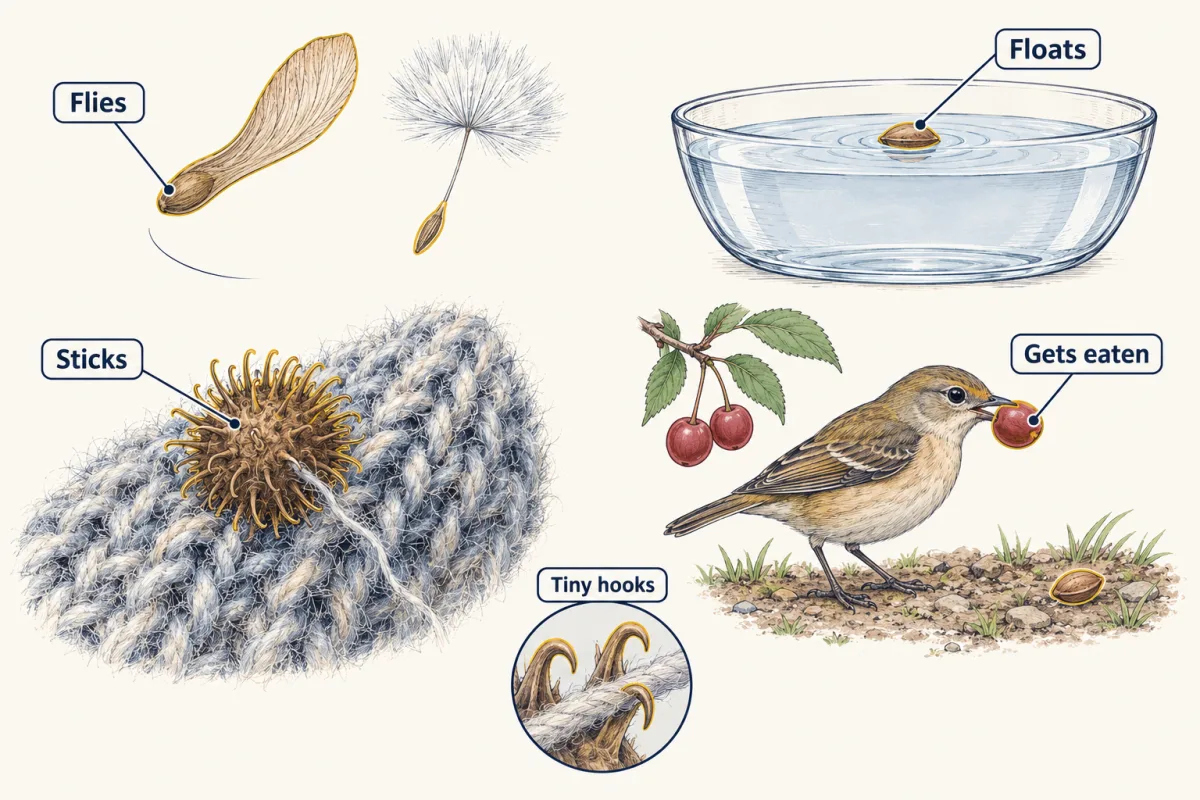
A plant stays rooted in one place, but its seeds can move. Moving seeds away from the parent plant is called seed dispersal. Many seeds have shapes that suit one way of travelling. Winged and fluffy seeds ride the wind. Seeds with hooks catch on fur and clothes. Seeds inside juicy fruits are eaten by animals and dropped somewhere else. Some seeds float on water. Seeds that land away from the parent often have more room and light, and they can reach new places.
Virginia’s grade 2 standard says seeds are dispersed by wind, water and animals, including humans. The sock is your child’s proof that people carry seeds too.
The best time is late summer and fall, when weeds are full of ripe seeds. Some maples drop their keys in spring instead.
What to do
- Predict. Before you go out, ask, “Plants can’t walk. How do you think their seeds get to new places?” Write down every idea.
- Sock walk. Pull the old sock over one shoe. Walk slowly back and forth along the edge of an unmowed, weedy patch for 3 to 5 minutes. Brush through the plants without trampling deep into them.
- Collect what you see. On the way back, look for other seeds without pulling up plants: maple keys, dandelion fluff, acorns, and the winged seeds that fall out of open pine cones. Put a few in the bag. Point out berries, but leave them on the plant.
- Check the sock. Stay outdoors, on a step or an outdoor table. Lay the sock on white paper and look with the hand lens. You use tweezers to pull off what stuck, and look for ticks as you go. Young ticks can be as small as a poppy seed. Stick any tick to tape, fold the tape over it, and throw it away. Count the seeds. Look at the hooks, spines or barbs that held on. Then seal the sock in the zip-top bag before you go inside.
- Sort by travel. Make four piles: flies, floats, sticks, gets eaten. Let your child decide where each seed goes and explain why. Some seeds fit two piles, and that is fine.
- Float test. Ask your child to predict which seeds will float. Drop one of each kind into the bowl of water. Check again after 10 minutes.
- Helicopter drop. Stand on the floor and hold a whole maple key as high as you can reach. Drop it and time the fall. Snap the wing off another key and drop the seed part from the same height. Do three drops of each. If you have no maple keys, cut a paper copy: a strip about 10 cm by 3 cm with a paper clip on one end as the seed.
- Grow the sock (optional). Lay the sock on damp potting soil in a shallow tray. Slip the whole tray into a clear plastic bag and close it, so nothing still on the sock can crawl out. Keep it in a bright spot out of hot direct sun. Over the next few weeks, some seeds may sprout. Many wild seeds picked in fall wait for a winter’s cold before they sprout, so a tray with nothing growing is a real result too. If mould grows, keep the bag closed and throw it away. You check the tray, nobody tastes the sprouts, and when you are done you seal the sock, sprouts and soil in a bag and put it in the trash, not the garden.
With a class, give each group of four one sock and walk together, then compare piles across groups.
Questions to ask while you do it
Ask your child to guess first, then check.
- “I wonder how many seeds will be stuck to the sock. What’s your guess?”
- “What do you think these little hooks are for?”
- “Which seeds do you think will float? Why?”
- “What do you think will happen if we drop the key without its wing?”
- “If every seed fell straight down under its tree, what would happen to all those seedlings?”
- “How do you think seeds got onto the sock that was on your shoe? Could people carry seeds too?”
What children often think
-
A child might say “Seeds come from the store.”
You could try Ask where the seeds on the sock came from, since nobody bought them. Look at the weeds you walked through. Every seed grew on a plant, and most plants make their own seeds without any help from people.
-
A child might say “Seeds just fall straight down under the tree.”
You could try Drop a maple key and a pebble side by side, or wave a hand fan at dandelion fluff. Many seeds do land close by, but wind, water and animals carry plenty of them much farther.
-
A child might say “A heavier seed flies farther.”
You could try Ask your child to predict, then compare the whole key and the wingless one. The whole key is a little heavier, yet it stays up longer and drifts more, because its spinning wing slows the fall. For wind seeds, what counts is how much wing or fluff a seed has for its weight. A light seed with a big wing or lots of fluff stays up longest.
-
A child might say “The plant throws its seeds far away because it wants babies everywhere.”
You could try Ask, "Can a plant think?" Plants do not plan. Over a very long time, plants whose seeds happened to spread farther had more young plants survive. That is how wings and hooks became common.
Why it works
Seedlings that sprout right under the parent compete with it for light, water and soil. Seeds that travel can reach open ground, and some land somewhere better.
Each shape works in a different way. A maple key spins as it falls, and the spinning wing slows its drop, so a breeze has more time to push it sideways. Dandelion fluff acts as a tiny parachute. Burdock and beggar’s ticks have hooks or barbs that cling to fur and cloth. The hooks on burdock burrs inspired the hook-and-loop fastener. Cherries and other fleshy fruits are eaten by birds, and the hard seeds often pass through unharmed. Squirrels bury acorns and forget some. Coconuts and the seeds of many streamside plants float.
Some plants scatter their own seeds. Jewelweed pods, common in damp Virginia woods, burst open when touched. Scientists usually describe these shapes as adaptations, traits that became common over many generations because they helped plants spread.
Easier and harder
Ages 5 to 7
Skip the timing and float test. Do the sock walk, then sort into just two piles: “sticks to things” and “blows in the wind.” Your child can tape one of each onto the observation sheet and draw how it travels. Then drop a maple key and watch it spin, without timing.
Ages 8 to 10
Time three drops of each seed and work out the average. Then make a paper seed that falls as slowly as possible: change one thing at a time, such as wing length or the number of paper clips. For a wind test, you set a guarded fan on low on a table and keep fingers away from it. Your child drops each design 50 cm in front of the fan and measures in centimetres how far it lands.
If it doesn’t go as planned
A sock with nothing on it usually means the plants were mowed or the seeds are not ripe yet. Try a taller, weedier edge a few weeks later, or look along fences and path edges. If you find no maple keys, use the paper copy, or try dandelion fluff in spring and pine cones in fall.
Observation sheet
Observation sheet
Seeds on the move
NameDate
Draw each seed. Circle how you think it travels.
| Draw the seed | Where I found it | How it travels: flies, floats, sticks or gets eaten |
|---|---|---|
Whole maple key fell in ___ seconds. Key with no wing fell in ___ seconds.
The seed that travels best is:
biochemistrypedia.com · Biology Together
Finish line
Test yourself
4 questions
Practice and MCAT-style, with explained answers.
Next · Lesson 14
Mealworms to Beetles
Is a mealworm a worm? Raising a few shows a child what it turns into.
Continue →