Biology Together · Unit 4: Flowers, seeds and life cycles
Mealworms to Beetles
You and your child set up a tub of mealworms from a bait shop or pet store and check on them a few times a week for about 4 to 10 weeks. The child records each change: mealworms shedding their skins, still pupae, and finally beetles. They find out that some animals look very different from their parents and pass through distinct stages as they grow up.
Watch first Set Up: Mealworms to Beetles · 0:44
Read the transcript of “Set Up: Mealworms to Beetles”
Film transcript: Set Up: Mealworms to Beetles
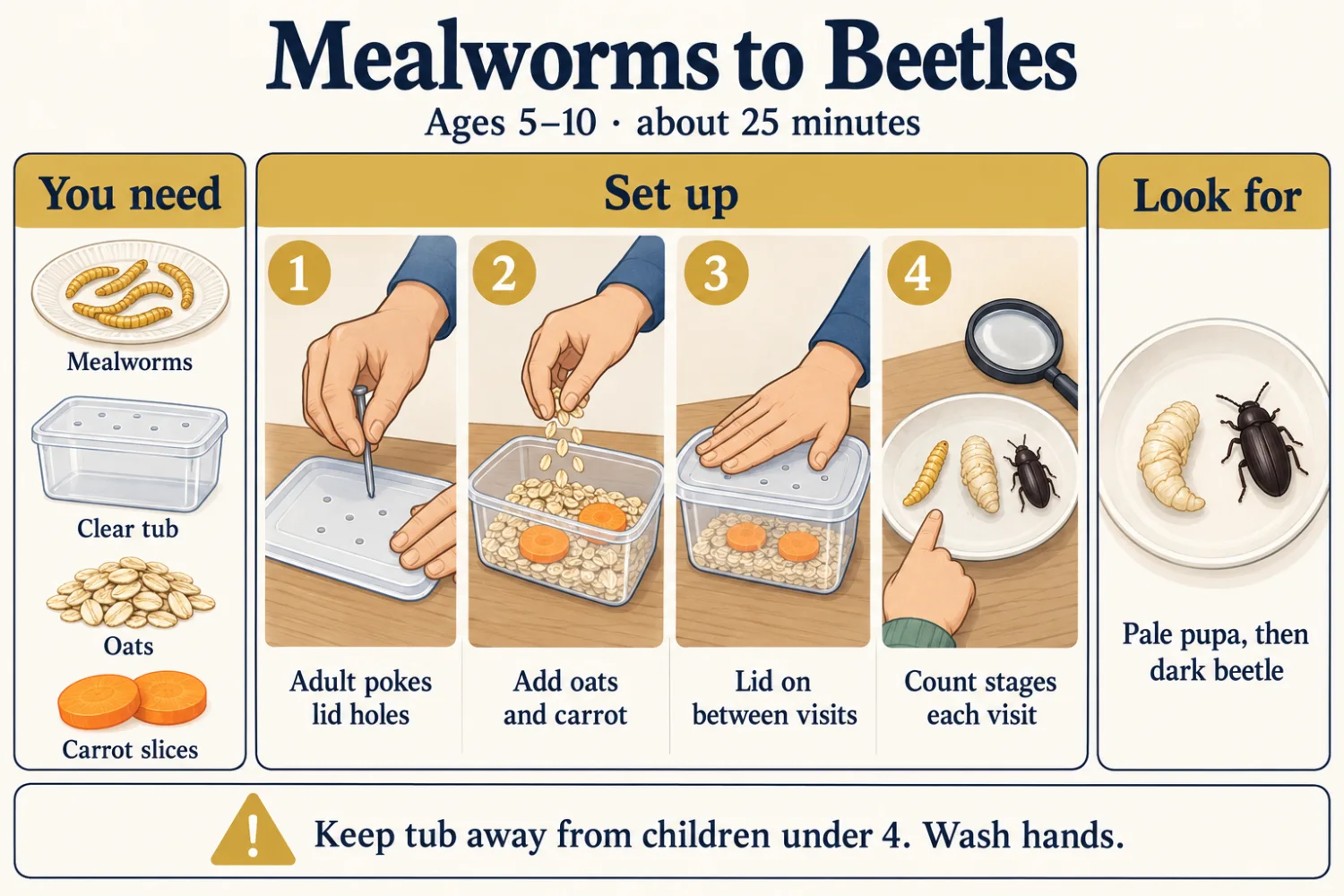
You need 10 to 20 ordinary mealworms, a clear plastic tub with a lid, and rolled oats or wheat bran. An adult pokes 10 to 20 small holes in the lid. Spread oats or bran three to five centimetres deep. Lay two thin slices of carrot or potato on top. Spoon the mealworms in. Look for shed skins two or three times a week. The first pupae often appear within a few weeks. A beetle comes out after about one to three weeks as a pupa. Mealworms can cause allergy and asthma symptoms. If your child has asthma or a shellfish or dust mite allergy, ask their doctor first, and skip it if in doubt.
Before you start
- Hands-on time
- About 25 minutes, then 5 to 10 minutes, two or three times a week, for about 4 to 10 weeks
- Where
- Indoors
- Ages
- 5 to 10, with an easier and a harder version below
- Grown-up
- Stay with your child whenever the tub is open, and keep the lid on between visits. You decide where the insects go when the project ends.
What you need
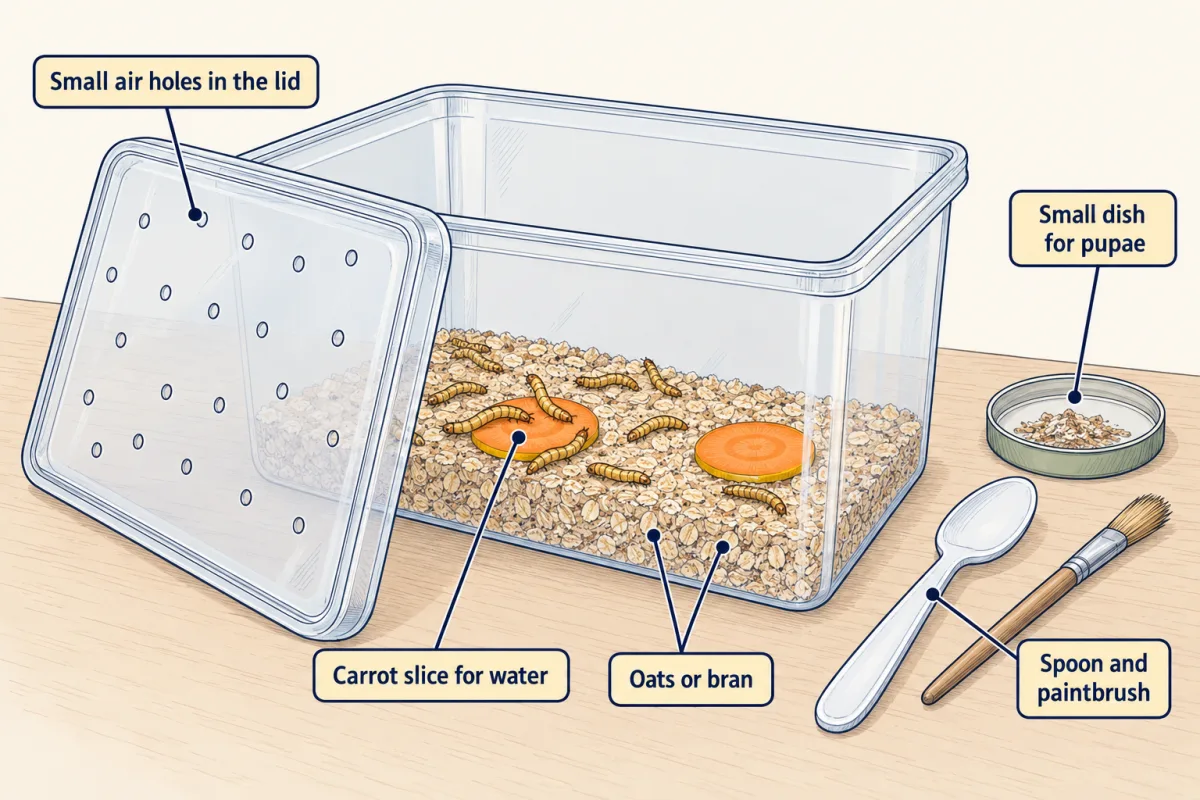
- 10 to 20 ordinary mealworms from a bait shop or pet store (not giant or king mealworms)
- A clear plastic tub with smooth sides, about the size of a shoebox, with a lid
- A nail or skewer to poke small air holes in the lid (adult only)
- Rolled oats or wheat bran, enough to fill the tub 3 to 5 cm deep (see the safety box if anyone in the home has a wheat allergy)
- A few thin slices of carrot or potato
- A plastic spoon and a soft paintbrush for moving them
- A small dish or jar lid for pupae
- A hand lens and a ruler marked in centimetres
- A notebook or the printed observation sheet below
Virginia science standards SOL 2.4 aSOL 4.3 cSOL K.7 b
The big idea
A kitten looks like a small cat from the day it is born. A mealworm looks nothing like the beetle it will become. Watching that change over a few weeks lets your child see a whole insect life cycle up close.
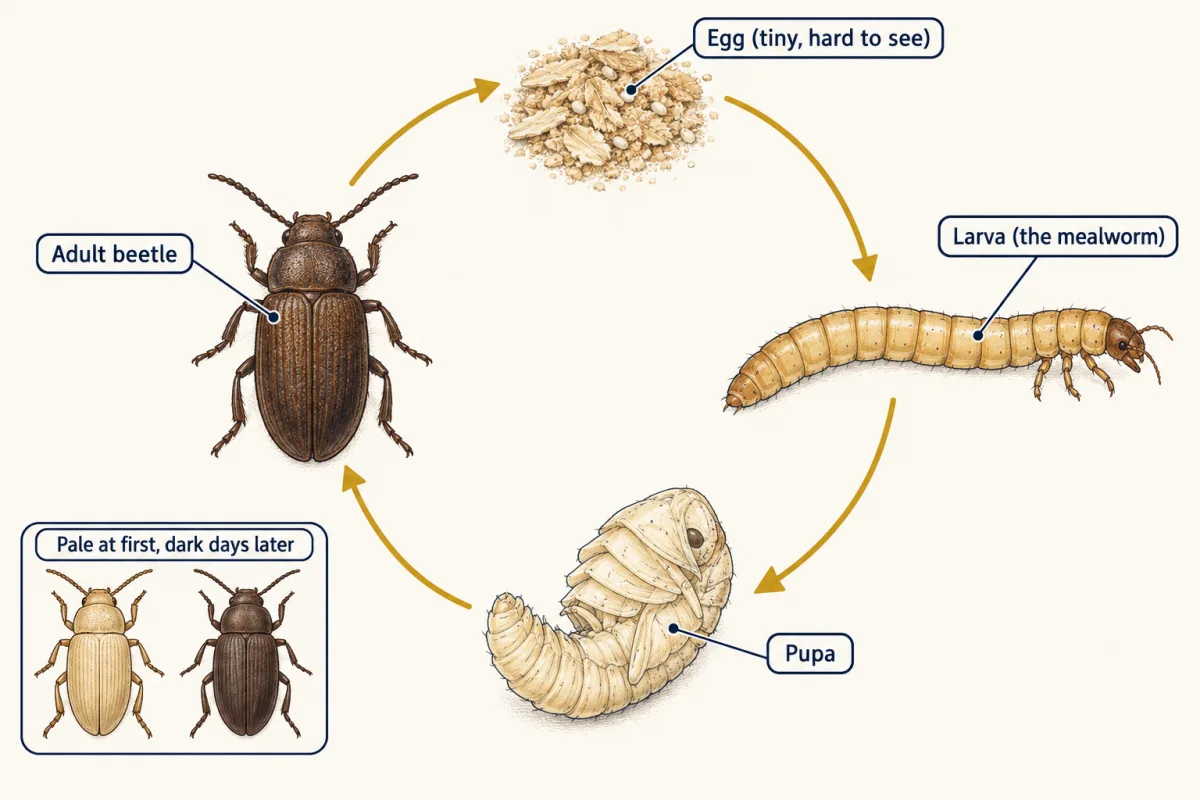
Mealworms are the young of a darkling beetle. They go through four stages: egg, larva (the mealworm, which eats and grows), pupa (a still stage that does not eat while the body is rebuilt) and adult beetle. This kind of life cycle, with a pupa in the middle, is called complete metamorphosis. Butterflies, ladybugs and bees grow up the same way.
Virginia’s grade 2 standard asks children to compare a life cycle like this with one like a kitten’s, where the young look like the parents from birth. The grade 4 standard adds that what an animal does and needs can change from one life stage to the next. The usual example there is the tadpole and frog, and the mealworm shows a smaller version of the same idea in a tub.
What to do
- Set up the tub. You poke 10 to 20 small holes in the lid. Spread oats or bran 3 to 5 cm deep. You cut two thin slices of carrot or potato and lay them on top. The slices give the mealworms water, so no water dish is needed.
- Meet the mealworms. Tip the mealworms onto a paper plate. With the hand lens, your child counts legs and body parts. Ask, “Is this a worm? What do you think it will turn into?” Write down their guess.
- Measure and settle them. Measure two or three mealworms in centimetres, then move all the mealworms into the tub with the spoon. Put the lid on and keep the tub at room temperature, out of direct sun, away from heaters and out of the fridge.
- Visit two or three times a week. Look for shed skins, which are thin and see-through. Count larvae, pupae and beetles, and write the numbers in the table. Swap in fresh carrot every few days.
- Spot the pupae. Most store mealworms are already large, so the first pupae often appear within a few weeks. A pupa is pale cream and curled. Its legs are folded tight against its body, and it cannot walk. Move each one gently into the small dish with a little bran. Before you look each time, ask, “What do you think the pupa will look like next?”
- Meet the beetles. After about 1 to 3 weeks as a pupa, a beetle comes out. It starts pale cream or tan and darkens to dark brown or black over a few days. Once a beetle has turned dark, move it back to the main tub. Measure one and compare it with the mealworms you measured.
- Look for the next round. Beetles lay tiny eggs in the bedding that are very hard to see. After a few weeks, look for very small mealworms. If you see them, the circle is complete.
- Compare with a mammal. Draw the four stages in a circle. Next to it, draw a kitten growing into a cat. Ask, “Which one looks like its parent from the start?”
Cool rooms slow everything down. Below about 20 °C (68 °F), the whole project can take two or three months.
With a class, use one tub per table and a shared chart of how many larvae, pupae and beetles there are each week.
Questions to ask while you do it
Ask your child to guess first, then check.
- “I wonder what this thin, empty skin is. Where did it come from?”
- “How many legs do you think a mealworm has? Let’s count.”
- “Is the pupa alive? What could we watch for to find out?”
- “What do you think the beetle will look like when it first comes out?”
- “Do you think the beetle will be bigger or smaller than the mealworm?”
- “What do you think will happen if the tub gets too wet?”
What children often think
-
A child might say “Mealworms are worms.”
You could try Count the legs together with a hand lens. Earthworms have none, and mealworms have six, near the head. A mealworm is a young insect, a beetle larva, so the name is a little misleading.
-
A child might say “The pupa is dead. It doesn’t move.”
You could try Ask, "What would happen if we wait?" A pupa does not eat and barely moves, but its body is changing inside. Some pupae wiggle a little if the dish is tilted. Keep watching for a beetle. A pupa that turns dark all over and goes soft or shrivelled has died, and an adult removes it.
-
A child might say “A beetle came and ate the mealworm.”
You could try Ask your child to watch one pupa every day. They will see the same pupa change into the beetle, often with the old pupa skin left behind. The beetle and the mealworm are the same animal at different ages.
-
A child might say “Grown-up insects get bigger.”
You could try Ask your child to measure a big mealworm and a beetle. The beetle is usually shorter. In insects like this, the larva does all the growing. The adult does not grow any more.
Why it works
An insect has a hard outer skeleton that cannot stretch. To grow, a mealworm splits its old skin and crawls out in a new, larger one. This is called molting, and a mealworm may molt 9 to 20 times, sometimes more, before it is fully grown.
When the larva is big enough, it molts into a pupa. Inside, much of the larval body is broken down and rebuilt as an adult with legs, wings and new mouthparts. The adult beetle does not grow any more. Its job is to mate and lay eggs.
Temperature controls the pace. Mealworms take the temperature of their surroundings, so, up to a point, warmth speeds them up and cold slows them down. In warm rooms a pupa may become a beetle in about a week. In cool rooms it can take three weeks or more. Some “giant” mealworms are raised with a hormone that keeps them from turning into beetles, so ordinary mealworms work better.
Easier and harder
Ages 5 to 7
Keep just five mealworms so counting stays easy. Use picture tallies: draw a worm, a curl and a beetle. At every visit, add a mark under the matching picture for each one you count. Focus on two questions: “Does it look like its parent?” and “What changed?” Let your child hold the hand lens while you move the insects.
Ages 8 to 10
Keep a weekly table of how many larvae, pupae and beetles there are, then make a bar graph for each week. Measure in centimetres at each stage. Try a fair test: set up two tubs the same way, one in a warm spot and one in a cooler room. Change only the temperature and record which tub has pupae first.
If it doesn’t go as planned
If no pupae appear after five or six weeks, the room may be cool, or the mealworms may be a “giant” kind. Move the tub somewhere warmer, around 24 to 27 °C (75 to 80 °F). A smell or fuzzy mould means the bedding is too wet: an adult replaces it outdoors and uses thinner slices. Larvae and beetles sometimes chew on pupae, which is why the pupae get their own dish.
Observation sheet
Observation sheet
Mealworms to beetles
NameDate
Each visit, count how many you see of each.
| Date | Mealworms (larvae) | Pupae | Beetles |
|---|---|---|---|
The mealworm was ___ cm long. The beetle was ___ cm long.
Does a baby beetle look like its parent?
biochemistrypedia.com · Biology Together
Finish line
Test yourself
4 questions
Practice and MCAT-style, with explained answers.
Next · Lesson 15
Fur, Feathers and Scales
Why does a bird have feathers and a fish have scales? Feeling the real thing helps a child find out.
Continue →