Biology Together · Unit 4: Flowers, seeds and life cycles
From Bean to Bean
You and your child plant a few bush bean seeds and visit them once a week for about three months, measuring and drawing as they grow. The plants sprout, grow leaves, flower, make pods and new seeds, and then die. At the end your child turns the drawings into a life-cycle wheel that comes back to a bean.
Watch first Set Up: From Bean to Bean · 1:00
Read the transcript of “Set Up: From Bean to Bean”
Film transcript: Set Up: From Bean to Bean
A bean plant has a whole life, and it is a circle. A seed sprouts, grows leaves and flowers, and makes pods with new seeds. Then the plant dies, and the new seeds can start the circle again. You need bush bean seeds labelled untreated, potting mix, and two or three pots with drainage holes. Fill each pot with potting mix to about two centimetres below the rim. Push two or three seeds about three centimetres deep. Water until it drips out the bottom. Set the pot in the sunniest window. Visit once a week. In warm weather, a hooked stem usually pushes up in five to fourteen days. Flowers usually open about four to seven weeks after planting. Flowers come first, then pods that hold new seeds.
Do not eat raw bean pods or seeds. Keep loose seeds away from children under four.
Before you start
- Hands-on time
- About 30 minutes, then 10 minutes once a week for about 10 to 15 weeks
- Where
- Indoors or outdoors
- Ages
- 5 to 10, with an easier and a harder version below
- Grown-up
- Stay with your child while planting and handling seeds. Weekly visits need an adult nearby to help measure and water.
What you need
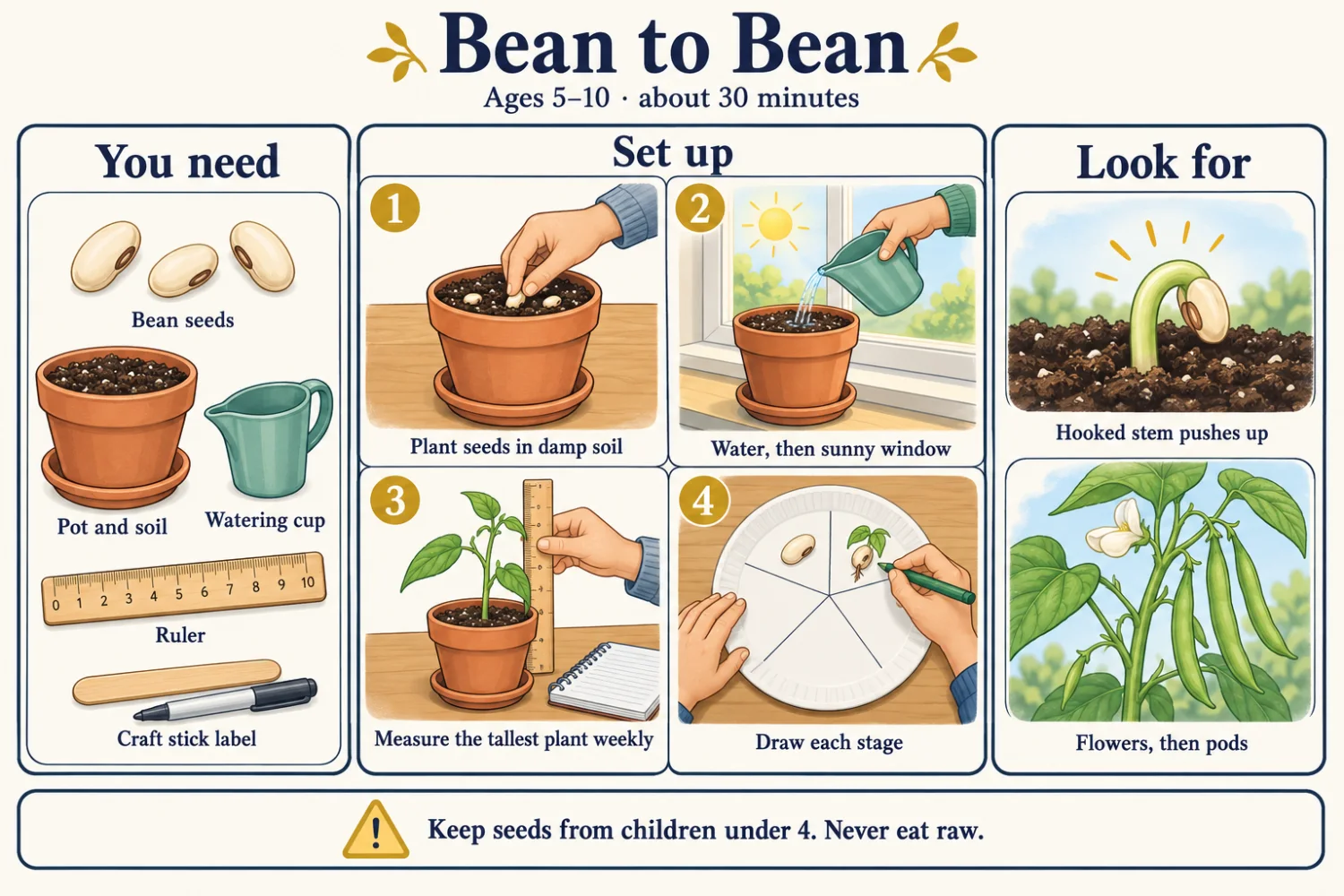
- A packet of bush bean seeds (snap or green beans), labelled untreated
- Bagged potting mix, or a sunny spot of garden soil
- 2 or 3 pots at least 20 cm (8 inches) wide and deep, with drainage holes, and a saucer for each
- A watering can or cup
- A ruler marked in centimetres, or string and building blocks for younger children
- Craft sticks and a marker for labels
- A notebook or the printed observation sheet below
- A paper plate, crayons and glue for the life-cycle wheel
- A grow light, if no window gets at least 6 hours of direct sun (optional)
Virginia science standards SOL 2.4 bSOL K.7 bSOL K.10 cSOL 1.4 b
The big idea
A child who eats green beans has seen only one moment in a bean plant’s life. Growing one from seed shows the whole story, and it ends where it began: with a bean.
A bean plant goes through these stages in order. A seed takes in water and sprouts, a step called germination. Roots and a stem grow, then leaves. Flowers form, and pollen reaches the centre of each flower. That centre swells into a pod, which is the plant’s fruit, and new seeds ripen inside it. Then the plant dies. Bush beans are annuals, plants that live for just one growing season.
Virginia’s grade 2 standard lists exactly these stages, from seed to death. In kindergarten, children are not expected to name the stages in order. For them, it is enough to notice that the plant gets bigger, grows more leaves, and makes pods and seeds.
What to do
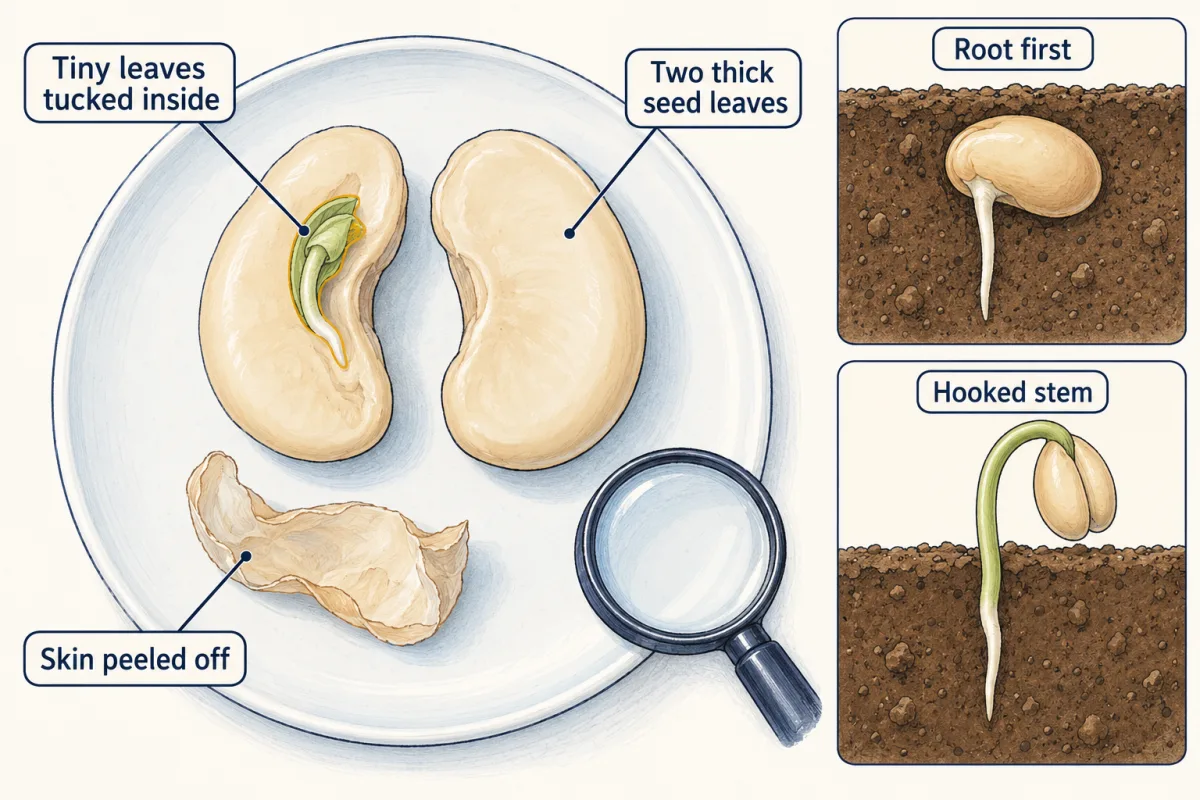
- Look inside a seed. Soak one extra bean overnight. Help your child peel off the skin and split it in half. With a magnifying glass, look for the tiny leaves tucked inside. Ask, “What do you think this will become?” Then throw the bean away, because it is raw and not for eating, and wash hands.
- Plant. Fill each pot with potting mix to about 2 cm below the rim. Push 2 or 3 seeds about 3 cm deep, cover them, and water until water drips out the bottom. Label the pot with the date. Put it in the sunniest window you have, or outdoors after the last spring frost.
- Predict. Ask your child to guess how many days until something shows above the soil, and to draw what they think it will look like. Write the guess down.
- Visit once a week. On the same day each week, measure the tallest plant in centimetres from the soil to the top, draw it, and count the leaves. Water when the top of the soil feels dry. When plants are about 5 cm tall, keep the strongest one or two in each pot, and you snip off the rest at the soil.
- Watch the stages. In warm weather, a hooked stem usually pushes up in 5 to 14 days. Leaves follow within days. Small white or purple flowers usually open about 4 to 7 weeks after planting, sometimes later indoors or in cool weather. Tiny pods show up within a week or two of the first flowers. Before the flowers open, ask, “What do you think will grow where the flowers are?”
- Let some pods ripen. Green beans are ready to pick about 7 to 9 weeks after planting. Leave at least three pods on the plant. Over the next 3 to 6 weeks, they turn yellow, then dry and papery, and the seeds inside rattle. Ask, “Will the new seeds look like the one we planted?” Then open a dry pod and compare.
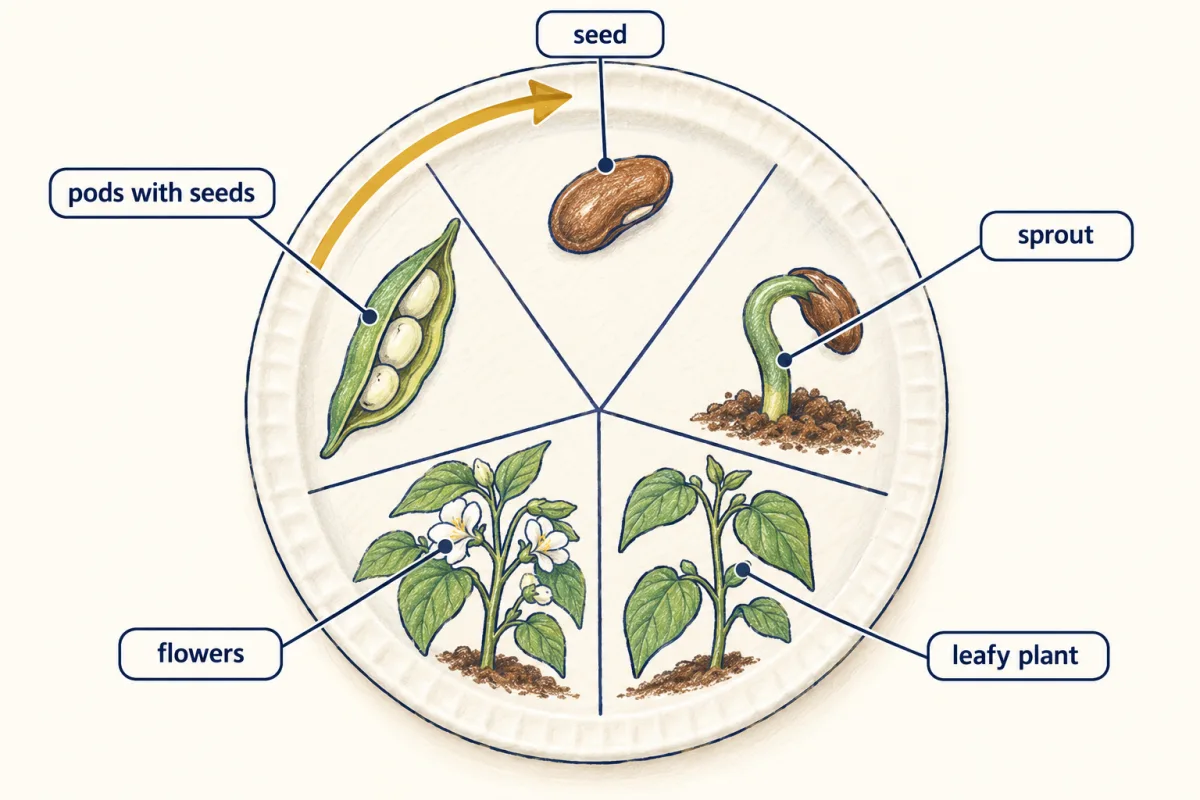
- Make a life-cycle wheel. Divide a paper plate into five slices. Your child draws, in order around the circle: seed, sprout, leafy plant, flowers, pods with seeds. Draw an arrow from the last slice back to the first.
With a class, give each group one pot and one ruler, and keep a shared wall chart of heights.
Questions to ask while you do it
Ask your child to guess first, then check.
- “I wonder what comes out of the seed first, a root or a leaf. What do you think?”
- “How many centimetres do you think it will grow by next week?”
- “What do you think will happen if we forget to water it for a week?”
- “Where do you think the pods will grow? Look for clues on the plant.”
- “I wonder if the new beans will be bigger, smaller or the same as the one we planted.”
- “What do you think will happen to the plant after the pods dry?”
What children often think
-
A child might say “The pod is a kind of leaf.”
You could try Ask where on the plant the pods grew. Did a flower come first? Then open a pod and look inside. Leaves make food for the plant. A pod grows from the centre of a flower and holds the seeds, so it is a fruit.
-
A child might say “The new beans will be giant, because the plant is so big.”
You could try Ask your child to predict, then line up a new dry bean beside one from the packet. They are usually close in size. A big plant makes many seeds, not bigger ones.
-
A child might say “The plant is dying. We did something wrong.”
You could try Ask, "What did the plant make before it started to dry up?" Bush beans live for one season. After the seeds ripen, the plant dies on its own. The seeds are the next part of the circle.
-
A child might say “The bean eats the dirt to get big.”
You could try Ask whether the soil in the pot looks lower after all that growing. It barely changes. Roots take in water and small amounts of minerals. The plant makes its own food in its leaves, using light, air and water.
Why it works
A bean seed holds a tiny plant and two thick seed leaves packed with stored food. Warmth and water wake it. The root comes out first, then a hooked stem pulls the seed leaves up into the light. Once the true leaves open, the plant makes its own food by photosynthesis, using light, water and carbon dioxide from the air.
Bean flowers mostly pollinate themselves. In most flowers, pollen has already reached the centre of the same flower by the time it opens, which is why beans set pods on a windowsill with no bees. Each fertilized ovule becomes a seed, and the surrounding ovary becomes the pod.
Timing depends on the variety and, above all, on temperature. Seeds in cold soil sprout slowly and may rot. Very hot days can make flowers drop before they set pods. Seed packets list “days to harvest,” which means green pods. Dry, ripe seeds take several weeks longer.
Easier and harder
Ages 5 to 7
Measure with string: hold a piece against the plant, cut it, and tape it in the journal, one string per week. Line the strings up to see the plant grow. Or count how many blocks tall it is. Use only drawings and three words: sprout, flower, pod. Let your child do the watering and pick the day of the week for visits.
Ages 8 to 10
Keep a table of height in centimetres and number of leaves each week, then draw a line graph of height. Try a fair test: plant two pots the same way, then put one in a sunny window and one in a dim corner. Change only the light. Record which flowers first and how many pods each makes.
If it doesn’t go as planned
No sprouts after two weeks usually means the soil was too cold or too wet, and the seeds rotted. Dig one up to check, then replant in a warmer spot and water less. Tall, pale, floppy plants need more light: move them to the sunniest window, or outdoors for a few hours at first and a little longer each day. If flowers drop without making pods, heat or dry soil is the usual cause, and more flowers often follow.
Observation sheet
Observation sheet
From bean to bean
NameDate
Each week, measure, count and draw your bean plant.
| Date | How tall (cm) | Number of leaves | What I see |
|---|---|---|---|
Something new I noticed:
biochemistrypedia.com · Biology Together
Finish line
Test yourself
4 questions
Practice and MCAT-style, with explained answers.
Next · Lesson 13
Seeds on the Move
How does a plant that can’t walk get its seeds to new places? A sock walk catches some in the act.
Continue →