Biology Together · Unit 3: What plants need and how they work
Plant Parts We Eat
You and your child sort foods from the grocery store onto a big drawing of a plant: roots, stems, leaves, flowers, fruits and seeds. Your child finds out that every food came from a part with a job, that a tomato is a fruit, and that a potato is not a root.
Watch first Set Up: Plant Parts We Eat · 1:03
Read the transcript of “Set Up: Plant Parts We Eat”
Film transcript: Set Up: Plant Parts We Eat
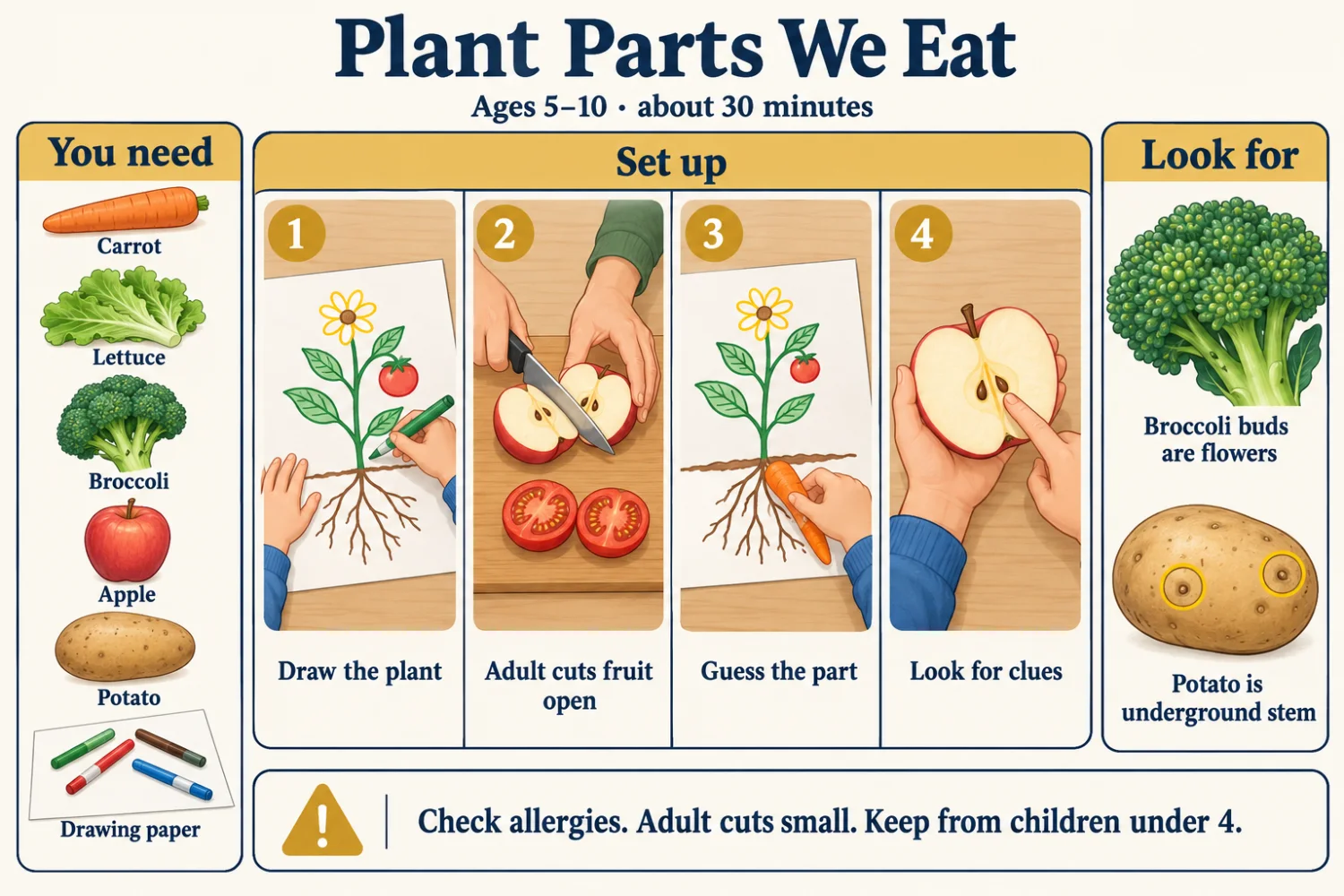
Every plant food we eat is a part of a plant. Roots, stems, leaves, flowers, and fruits each have a job. A carrot is a root, and lettuce is a leaf. Sort the foods to find which part each one is. You need a big sheet of paper and markers, and foods from the grocery store. Get a carrot, lettuce, broccoli, an apple, and a tomato. Add a potato and celery as trick cards. Draw a plant with roots, stem, leaves, flower, and fruit. An adult washes the food and cuts the apple and tomato in half. Your child places each food on the drawing, and guesses its part. Look for clues. Seeds inside means fruit, so a tomato is a fruit. A potato is not a root. It is an underground stem.
Stay with your child while food is out. An adult does all the cutting. Check for allergies before anyone tastes anything.
Before you start
- Hands-on time
- About 30 minutes
- Where
- Indoors
- Ages
- 5 to 10, with an easier and a harder version below
- Grown-up
- An adult does all the cutting and checks allergies before any tasting. Stay with your child the whole time food is out.
What you need
- A large sheet of paper and markers
- A carrot or a sweet potato (root)
- A few spears of asparagus (stem)
- A few leaves of lettuce or spinach (leaf)
- A head of broccoli (flower buds)
- An apple, plus a tomato, cucumber or green pepper (fruit)
- A handful of frozen peas (cook and cool them first if anyone will taste them) or canned beans, rinsed (seeds)
- A potato (the first trick card)
- A celery stalk with its leaves (the second trick card)
- A knife and cutting board, for the adult
- A cotton sock, a paper bag and a wooden spoon (optional, ages 8 to 10)
Virginia science standards SOL 1.4 bSOL 2.8 aSOL 2.8 bSOL 4.2 b
The big idea
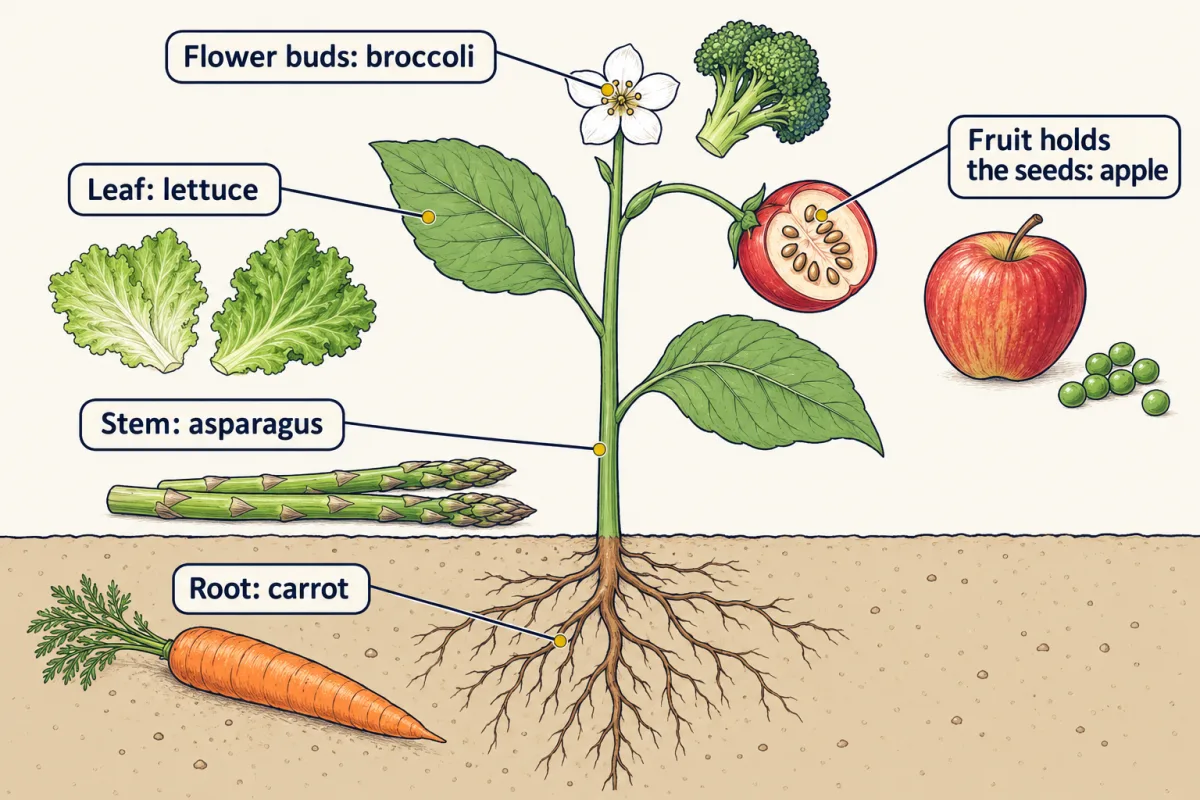
Every fruit, vegetable and grain on a dinner plate came from some part of a plant, and that part had a job. A carrot is a root. Lettuce is a leaf. Broccoli is a bunch of flower buds that have not opened yet. Sorting groceries onto a drawing of a plant ties each food to its part and to that part’s job.
Roots hold the plant in the ground and take in water and nutrients. Stems hold the plant up and carry water and nutrients. Leaves make the plant’s food using light. Flowers make seeds. A fruit is the part that grows from a flower and holds the seeds. That is why a scientist calls a tomato or a cucumber a fruit, even if the kitchen calls it a vegetable.
Plants give us more than food: cotton for clothes, wood for houses and paper, and rubber. They feed animals too. Virginia’s grade 2 standard covers both ideas.
What to do
- Draw the plant. On a big sheet, help your child draw a plant: roots under a soil line, a stem, leaves, a flower, and a fruit with seeds inside. Label each part. With a class, give each group of four one drawing and one bag of foods.
- Wash and cut. Wash the produce. You cut the apple and the tomato (or cucumber or pepper) in half across the middle so the seeds show. Leave everything else whole.
- Predict. Hold up one food at a time and ask, “Which part of the plant do you think this is?” Let your child put it on the drawing. Don’t correct anything yet.
- Look for clues. Go back through the pile. Seeds inside means fruit. Look along a carrot for thin side roots, or the small marks where they were trimmed. Look closely at broccoli: each small green bump is a flower bud. If broccoli is left to grow, the buds open into small yellow flowers. Lettuce is flat and green, with veins like other leaves.
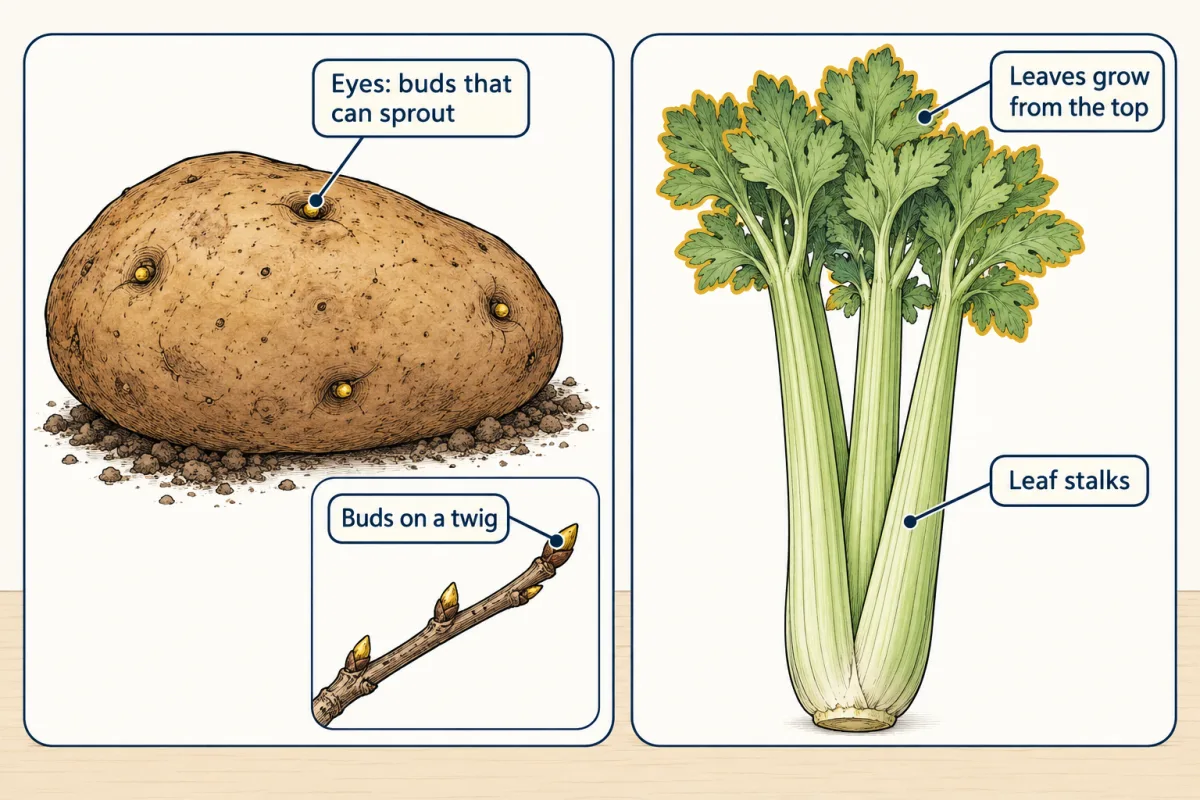
- Play the trick cards. Hand over the potato. Ask, “It grew underground. Is it a root?” Then look at the eyes. Each eye is a bud that can sprout a new shoot, set in neat spots like the buds along a stem. A potato is an underground stem, called a tuber. Next, hold up the celery. Point out that the leaves grow from the top of the stalk. The celery we buy is mostly long leaf stalks, so it belongs with the leaves.
- Taste (optional). If allergies are checked and rules allow, taste one food from each part, in small pieces the adult has cut, from a clean plate. Take out the apple core and seeds before cutting tasting pieces. Ask which part your child likes best.
- Talk about jobs. Point to each part on the drawing and ask what it does for the plant. Then ask which animals eat it: rabbits eat leaves, squirrels eat seeds and nuts, birds eat fruit.
Questions to ask while you do it
Ask your child to guess first, then check.
- “Which part of the plant do you think this came from? What is your clue?”
- “I wonder if everything we eat grows above the ground. Can you find one that doesn’t?”
- “What do you think we will find inside the tomato?”
- “Do you think a fruit always tastes sweet? What about a cucumber?”
- “What do you think would happen to a carrot plant if we ate all its leaves?”
- “I wonder which part of a plant your shirt or this paper came from.”
What children often think
-
A child might say “A tomato is a vegetable, not a fruit.”
You could try Cut one open together and ask what is inside. Seeds mean fruit to a scientist. "Vegetable" is a kitchen word for plant foods we eat in savoury dishes, so a tomato is a fruit to a scientist and a vegetable to a cook.
-
A child might say “Fruits and vegetables grow on different kinds of plants.”
You could try Ask your child to think of one plant, like a pea plant. It has roots, a stem, leaves, flowers, pods and peas. The pod is a fruit and the peas are seeds. One plant can give us several parts to eat.
-
A child might say “Everything we eat grows above the ground.”
You could try Hold up the carrot and the potato and ask where the dirt on them came from. Many plants store food underground, in roots like carrots and sweet potatoes or in underground stems like potatoes.
-
A child might say “A potato is a root.”
You could try Ask your child to find the eyes and compare them with the buds on a twig. The eyes are buds that can grow into new shoots. That makes a potato an underground stem. A sweet potato, though, really is a root.
Why it works
Scientists sort plant parts by how they grow and what they do, while cooks sort foods by taste. The two systems often disagree. “Vegetable” has no exact meaning in science. “Fruit” does: the part that develops from the flower and usually holds the seeds. So tomatoes, cucumbers, peppers, green bean pods and apples are all fruits.
Storage parts are the most puzzling. Many plants pack food away underground to regrow later. A carrot stores it in a root. A potato stores it in a stem tip that swells into a tuber, and its eyes are buds that can sprout. A sweet potato stores it in a swollen root.
Easier and harder
Ages 5 to 7
Use six foods, one for each part, and skip the trick cards at first. Place each food on the drawing, then add the potato last as a puzzle. Ask simple job questions: “Which part drinks? Which part holds it up?” Your child can draw a line from each food to its part instead of writing.
Ages 8 to 10
Add the trick cards and harder foods: an onion (fleshy leaves), a green bean pod (a fruit with seeds inside) and ginger (an underground stem). Ask your child to write each part’s job beside it. Then sort things that are not food: a cotton sock, a paper bag, a wooden spoon. Which plant part did each come from? (Cotton fibres grow on the seeds; wood, and the paper made from it, comes from tree trunks, which are stems.)
Going deeper
Corn kernels and sunflower seeds
A corn kernel or an unshelled sunflower “seed” is botanically a tiny fruit with one seed inside, so this activity leaves them out.
Carrot sugar and the sweet potato
A carrot stores its food mostly as sugar. A sweet potato stores it in a swollen root, and it is only a distant relative of the potato.
Observation sheet
Observation sheet
Plant parts we eat
NameDate
Write or draw each food. Which part of the plant is it?
| Food | My guess | Plant part | Its job for the plant |
|---|---|---|---|
The trickiest food was:
Something we use from a plant that is not food:
biochemistrypedia.com · Biology Together
Finish line
Test yourself
4 questions
Practice and MCAT-style, with explained answers.
Next · Lesson 9
Thirsty Celery
How does water get from the bottom of a plant to the top? Coloured water and a celery stalk make the path visible.
Continue →