Life Science · Unit 2: Organizing and classifying life
From Cells to Organisms
How can one cell do everything a whole body does, and why does your body need trillions of cells? You share out five life jobs among cells in a model and read real counts of cells and cell kinds in organisms from one cell to a human. Afterwards you can explain how cells build tissues, organs and organ systems, and use data to link an organism's size to division of labor.
Where this lesson sits
- Virginia SOL LS.3 a
- Virginia SOL LS.3 b
- Practices LS.1 c, LS.1 d, LS.1 e
Essential question: How can one cell do everything a whole body does, and why do I need trillions of them?
-
Life Science (grade 7) LS.3 a, LS.3 b You are here
This lesson
-
Biology
Preview it at high school level
In Biology you will ask a new question: if nearly all your body cells came from one first cell and carry the same DNA, why do they look so different? The answer is that each kind of cell uses a different set of its genes. You will also learn the names of the main kinds of animal tissue and the tissue systems of plants. And you will look more closely at how each cell's shape fits its job, from a nerve cell about a metre long to a root hair cell that reaches into soil and guard cells that open and close pores in a leaf.
-
Biology II Biology II: Advanced Survey of Biology Topics, BIOII.2 c
Preview where it goes next
Virginia's Biology II: Advanced Survey of Biology Topics course (BIOII.2 c) returns to the idea that form fits function. Students compare many specialized cells and the tissues they build. Plants have dermal, vascular and ground tissues. Animals have epithelial, connective, muscle and nerve tissues. For each one, students explain how its structure helps the organism survive, and they plan their own investigations.
-
College
Watch first Sharing the Work Among Cells · 2:32
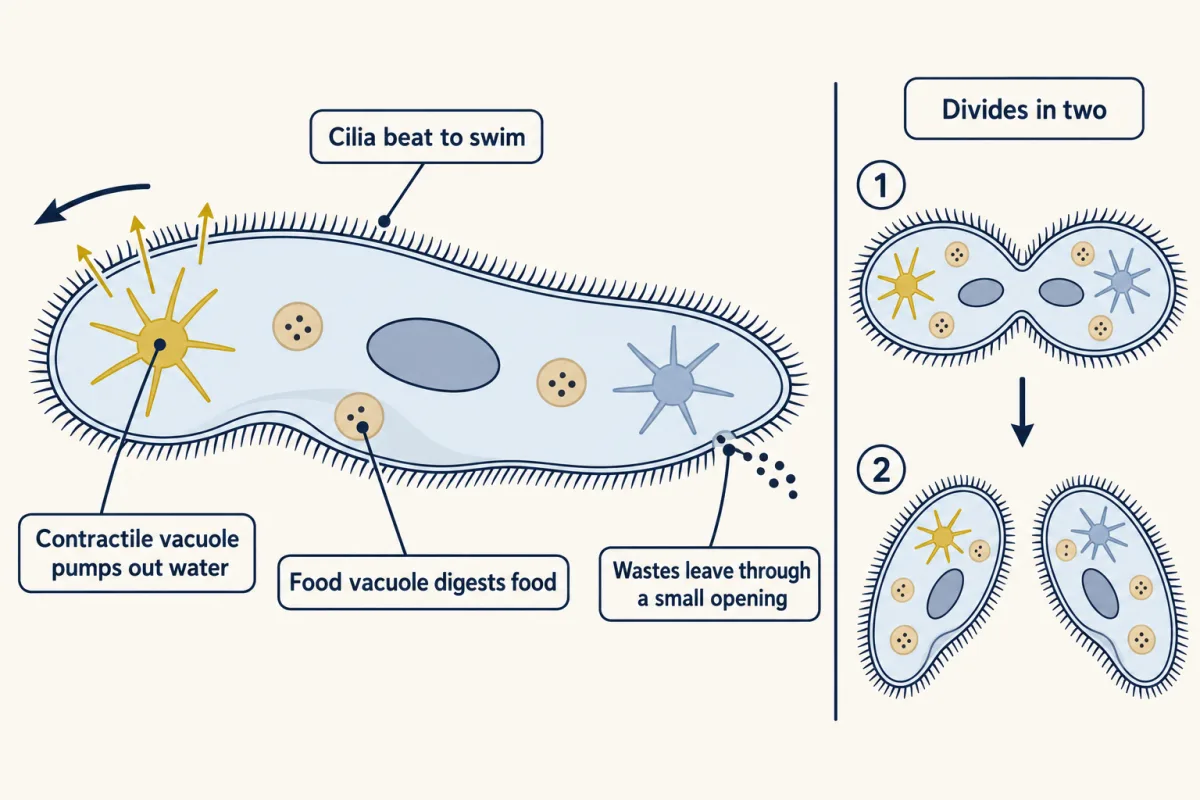
Imagine a drop of pond water under a microscope. A Paramecium, one cell shaped a bit like a slipper, swims fast across it. That one cell moves, eats, gets rid of extra water and wastes, and can split in two. Your body does the same kinds of jobs. But it shares them out among trillions of cells of many different kinds. Why does a body need so many cells, when one cell can do it all?
What do you think? Decide before you read.
-
Scientists disagree: Under a microscope, a Paramecium has hair-like cilia for swimming, sacs that digest food and a sac that pumps out water, all in one cell. Biologists also find that evolution is not a ladder from worse to better. One-celled life is complex in its own way.
What scientists think
Scientists disagree: Under a microscope, a Paramecium has hair-like cilia for swimming, sacs that digest food and a sac that pumps out water, all in one cell. Biologists also find that evolution is not a ladder from worse to better. One-celled life is complex in its own way.
-
Scientists disagree: Microscope studies show very different cells. A muscle cell is long, a nerve cell has long branches, and a red blood cell is a small disc dented on both sides. Scientists who measured human cells found big differences in size between kinds.
What scientists think
Scientists disagree: Microscope studies show very different cells. A muscle cell is long, a nerve cell has long branches, and a red blood cell is a small disc dented on both sides. Scientists who measured human cells found big differences in size between kinds.
-
Scientists disagree: When scientists compare mammals, a larger animal generally has more cells, not much larger cells of the same kind. Most cells of the same kind in an elephant and a mouse are about the same size. The elephant simply has far more of them.
What scientists think
Scientists disagree: When scientists compare mammals, a larger animal generally has more cells, not much larger cells of the same kind. Most cells of the same kind in an elephant and a mouse are about the same size. The elephant simply has far more of them.
Explore: share the jobs
In the model, an organism has five life jobs: moving, getting food, gas exchange, response and reproduction. You choose how many cells it has: 1, 10, 100 or 1,000. Then you choose whether all the cells are alike or split into jobs, and you watch five bars show how well each job keeps up as the organism grows. A strip at the side zooms out from cell to tissue, organ, organ system and organism.
Made up for this sketch, not measured: the bars are relative units. A bigger body of alike cells strains gas exchange and getting food the most, and reproduction the least. Five or more cells can be split into five job groups. Tissues, organs and organ systems appear at 10, 100 and 1,000 cells when cells are split into jobs. Real organisms do not follow cell-count cut-offs: the lesson lists Trichoplax (about 320 cells, a rough estimate) and Volvox carteri (about 2,000 cells) with no organs. No real organism is a ball of alike cells that fails: Volvox carteri has about 2,000 cells and only 2 kinds. Blocks are not to scale; at 1,000 cells one block stands for 10 cells.
Rule to keep: a bigger organism has more cells, and it tends to have more kinds of cells that share the work. This is a sketch of the logic, not a measurement of any real organism.
Try this.
- Start with 1 cell. Predict whether all five bars keep up. Then test it.
- Grow to 1,000 cells with all cells alike. Predict which jobs fall behind first in the model. Then test it.
- Keep 1,000 cells and switch on jobs. Predict what happens to the bars. Then compare with step 2.
Explain: one cell does every job
- unicellular
- multicellular
- cilia
- contractile vacuole
- specialized cell
- tissue
- organ
- organ system
- division of labor
A unicellular organism is a living thing made of just one cell. A multicellular organism is made of many cells. Bacteria and Paramecium are unicellular. You and an oak tree are multicellular. You met the idea that all living things are made of cells in that lesson.
A Paramecium has no tissues or organs. Its one cell still does every life job:
- It moves. Short, hair-like parts called cilia cover the cell and beat to push it along.
- It eats. Food, such as bacteria, is taken into small sacs called food vacuoles and digested.
- It removes extra water. Water keeps moving into the cell from the pond. A contractile vacuole is a sac that fills with this extra water and squeezes it out. That lesson shows why water moves in.
- It removes wastes. Bits of food it cannot digest leave through a small opening.
- It reproduces. One cell can divide to form two new cells.
So one cell is not simple. Its parts work as a system, as you saw in that lesson.
Volvox, a green alga, sits in between a Paramecium and you. It is a ball of many cells living together, but with only a few kinds of cells.
Explain: cells, tissues, organs, systems
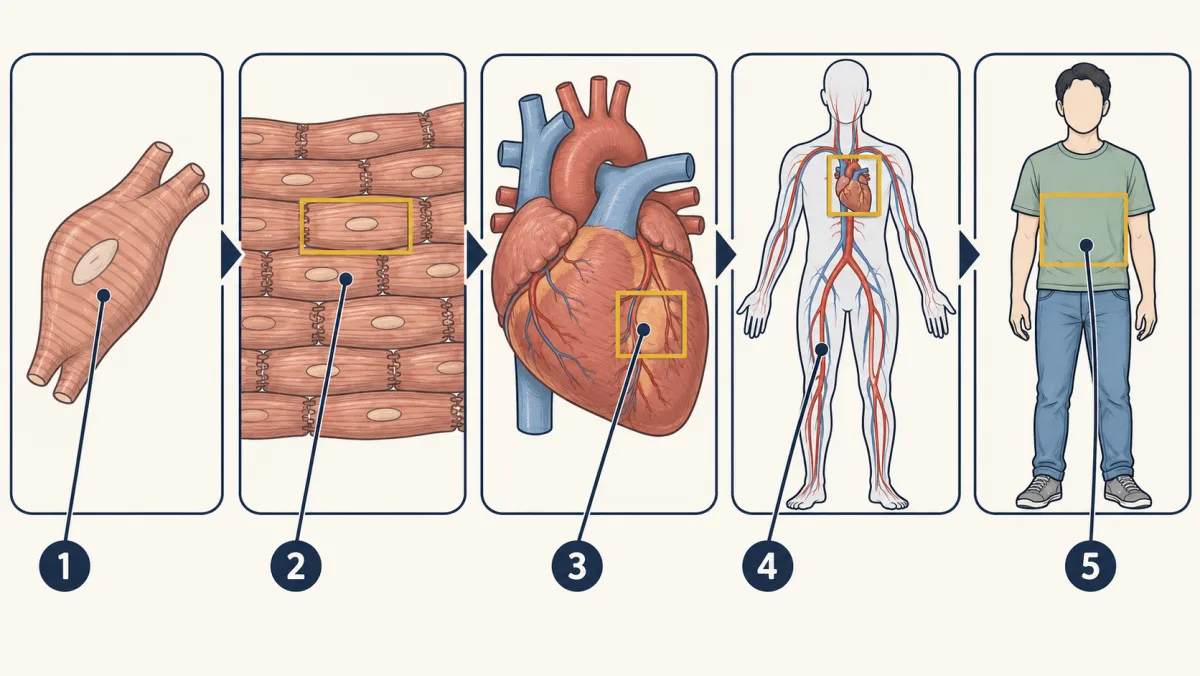
In a multicellular organism, cells share the work. A specialized cell is a cell whose shape and parts suit it to one kind of job. Sharing the work this way is called division of labor. Cells are grouped into levels:
- A tissue is a group of similar cells doing one job, such as muscle tissue.
- An organ is made of different tissues working together, such as the heart.
- An organ system is a group of organs working together, such as the heart and blood vessels.
cell → tissue → organ → organ system → organism
- cell
- tissue
- organ
- organ system
- organism
- cell
- blank
- blank
- blank
- organism
Word bank: organ, organ system, tissue
- blank
- blank
- blank
- blank
- blank
Check your labels
- cell
- tissue
- organ
- organ system
- organism
Together, the levels help the whole organism grow, repair itself, reproduce, exchange gases, carry out metabolism and respond. The levels depend on each other. If heart tissue is damaged, the whole body can suffer.
A school play works a bit like this. One group builds sets, one runs lights, and one acts. The comparison breaks in one way: no cell chooses its job or plans the show.
Not every multicellular animal has all these levels. Trichoplax, a tiny ocean animal, has several kinds of cells but no organs.
Explain: a shape for every job
Specialized cells look very different. Their shapes and parts fit their jobs.
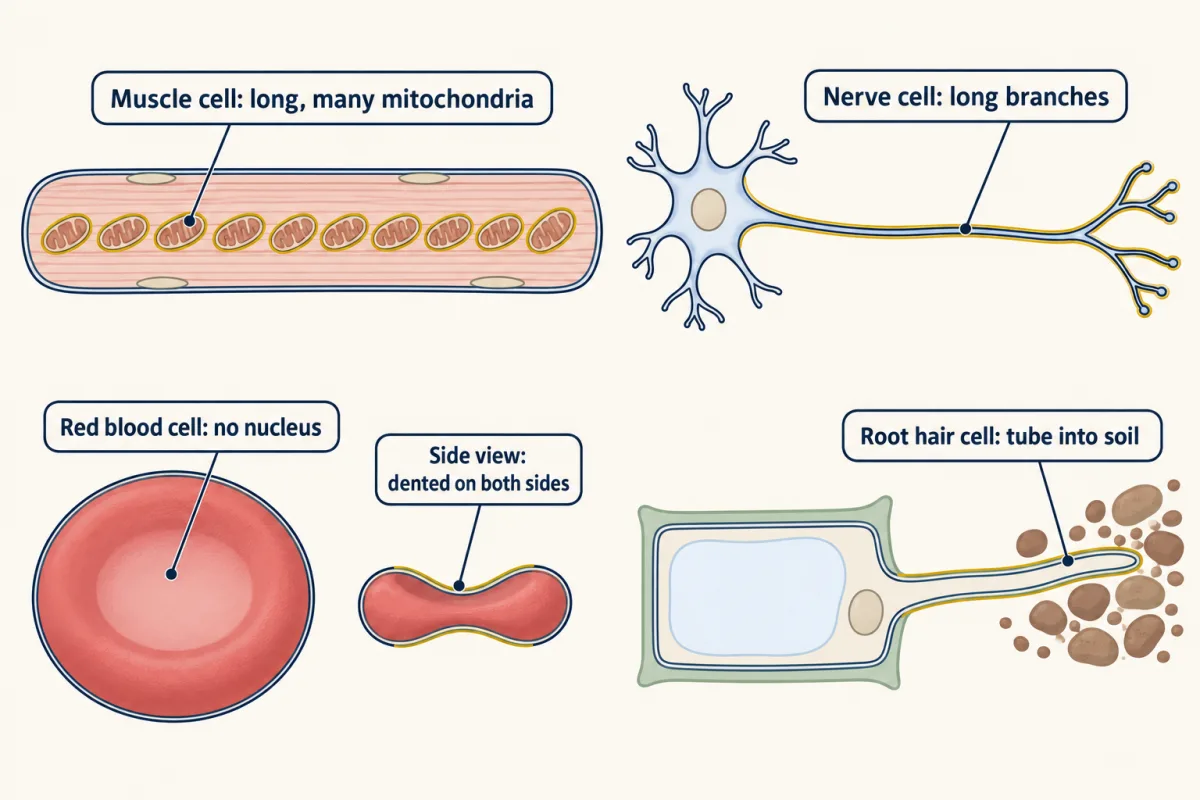
| Cell | Shape and parts | How it fits the job |
|---|---|---|
| Muscle cell (in your arm) | Long and thin, with many mitochondria | Shortens to pull on bones and move the body |
| Nerve cell | Long branches | Carries signals over long distances, in some cases about a metre |
| Red blood cell | Small, flexible disc, dented on both sides; no nucleus when mature (in humans) | Carries oxygen and bends through very narrow vessels |
| Root hair cell (plant) | Long, thin tube growing into the soil | More surface touches the soil, where water comes in |
Bigger organisms do not mostly get bigger cells. Most cells of one kind are about the same size in a mouse and an elephant. The elephant has far more of them.
- A blank cell has a blank shape, which helps it blank.
- A Paramecium can live alone because blank.
Elaborate: more cells, more kinds of cells?
Scientists have counted or estimated the cells in many organisms. They have also sorted those cells into kinds.
| Organism | Number of cells | Kinds of cells | How the numbers were found |
|---|---|---|---|
| A bacterium | 1 | not counted | One cell by definition |
| Paramecium | 1 | not counted | One cell by definition |
| Trichoplax adhaerens | about 320 (rough body-size estimate, not a count) | 4 | 1997 table; later studies found more kinds |
| Volvox aureus | about 560 (estimate) | 2 | 1997 table |
| C. elegans worm, adult hermaphrodite | 959 body cell nuclei | 24 | Nuclei counted (1983); kinds from 1997 table |
| Volvox carteri | about 2,000 plus about 16 large cells | 2 | 2018 study |
| Hydra | about 63,000 (estimate) | 15 | 1997 table |
| Human, reference adult man | about 30 trillion | about 400 | Cells: 2016 estimate; kinds: 2023 classification |
Sources: Bell and Mooers, 1997, a table built from older studies, which estimated cell numbers from body size; Matt and Umen, 2018 (Volvox carteri, lab strain); Sulston and colleagues, 1983, and WormAtlas, 2009 (worm nuclei); Sender and colleagues, 2016, and Hatton and colleagues, 2023 (human). These are lab and reference values, not samples from Virginia, and the rows use different methods.
- As you read down the table, the number of cells goes up. What happens to the number of kinds?
- Compare the two Volvox rows. Does adding cells always add new kinds of cells?
- How many times more kinds of cells does Hydra have than Volvox carteri?
Claim, evidence, reasoning
Make a claim that answers the essential question: why does a big organism need many cells of many kinds? Use the table.
Start with: The data show that organisms with more cells tend to have blank.
Start with: Volvox carteri has about blank cells and blank kinds, while blank has about blank cells and blank kinds.
Start with: More kinds of cells means blank, which helps a large body because blank.
Compare with a model answer
Organisms with more cells tend to have more kinds of cells. Volvox carteri has about 2,000 cells and 2 kinds, Hydra about 63,000 and 15 kinds, and a human about 30 trillion and about 400 kinds. More kinds means more division of labor, so a large body can share out many jobs. One limit: the rows come from different studies and methods, and some cell numbers are estimates from body size, not counts.
Saved in this browser only.
Design problem
A Paramecium’s contractile vacuole pumps out extra water. Does adding a little salt to its water change how often the vacuole empties? Plan an investigation with a Paramecium culture from a science supply company.
One way to do it
- Question: Does the amount of salt in the water change how often the contractile vacuole empties?
- Independent variable: salt added, such as 0 g, 0.1 g and 0.2 g per 100 mL of spring water.
- Dependent variable: number of times the vacuole empties in 60 seconds.
- Constants: same culture, same temperature, same microscope, and the same wait (10 minutes) before counting.
- Control: spring water with no salt added.
- Repeated trials: count 5 paramecia in each kind of water, and find the mean.
- Safety: wash your hands, handle glass slides with care, never taste anything, and give the culture back to your teacher.
- What it means: if the counts differ, salt changed this one cell’s water job.
Evaluate: check your thinking
A Paramecium can live alone because its one cell has parts for every job: cilia to swim, food vacuoles to digest, and a contractile vacuole to pump out water. Your body shares the same kinds of jobs among trillions of cells. They are grouped into tissues, organs and organ systems, and each kind of cell has a shape that fits its job.
Science practices you used: using a model and naming its limits, reading a data table and comparing rows, and planning a fair test with a control and repeated trials.
How we measure it
Light microscope
A light microscope magnifies living cells, such as a Paramecium in pond water, so you can watch its parts at work. Scientists use what they see to sort cells into kinds by shape and job.
Estimating cells from measurements
No one counts 30 trillion cells one by one. Scientists count the cells in a small, measured sample, such as a drop of blood, work out the count in one litre, and multiply by the total amount in the body. Adding up many such estimates gives a whole-body total.
Finish line
Test yourself
8 questions
Practice and MCAT-style, with explained answers.
Next · Lesson 7
Sorting Living Things
In Virginia some people call a vulture a buzzard, and in Britain the buzzard is a hawk, so how can a scientist say which bird they mean?
Continue →