Biology Together · Unit 3: What plants need and how they work
What Do Plants Need?
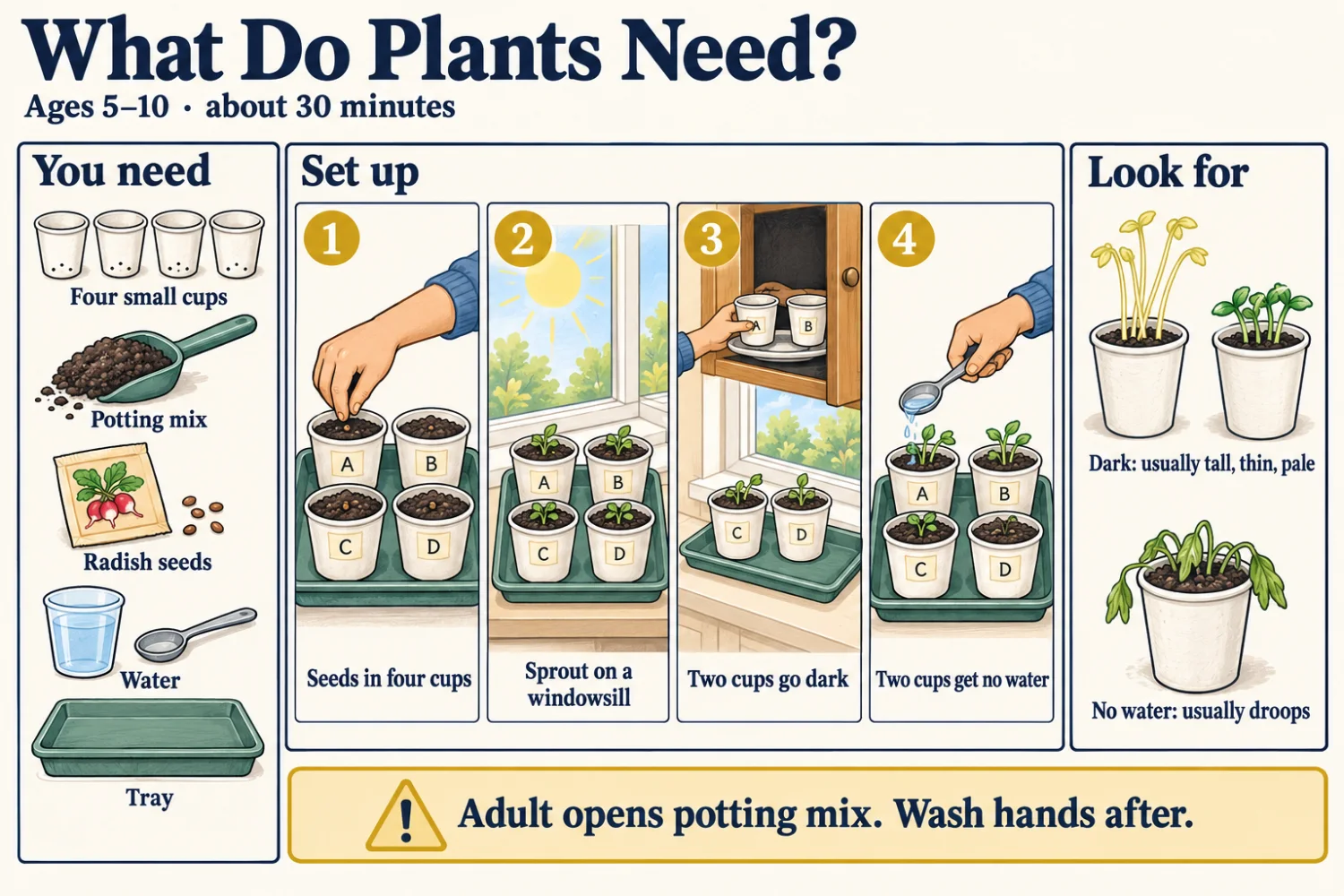
You and your child grow radish seedlings in four cups, then take away light, water or both and watch for two weeks. Your child finds out that a plant kept in the dark grows tall, thin and pale before it weakens, and that a plant with no water droops first.
Watch first Run a Fair Test With Your Child · 2:05
Read the transcript of “Run a Fair Test With Your Child”
Film transcript: Run a Fair Test With Your Child
Does a plant really need sunlight if it already has water? Ask your child for a guess. A fair test is a test where only one thing changes and everything else stays the same. Four cups of radish seedlings can show you how. First, grow all four cups the same way. Same soil, same cups, same seeds, all on a sunny windowsill. Wait until most seedlings are about two centimetres tall. Before you change anything, ask your child what will happen to each cup. Write or draw the guesses. The safety notes are on the page. Now change things. Move two cups into the cupboard, where it is dark. Two cups keep their water. Two get nothing more. Change nothing else.
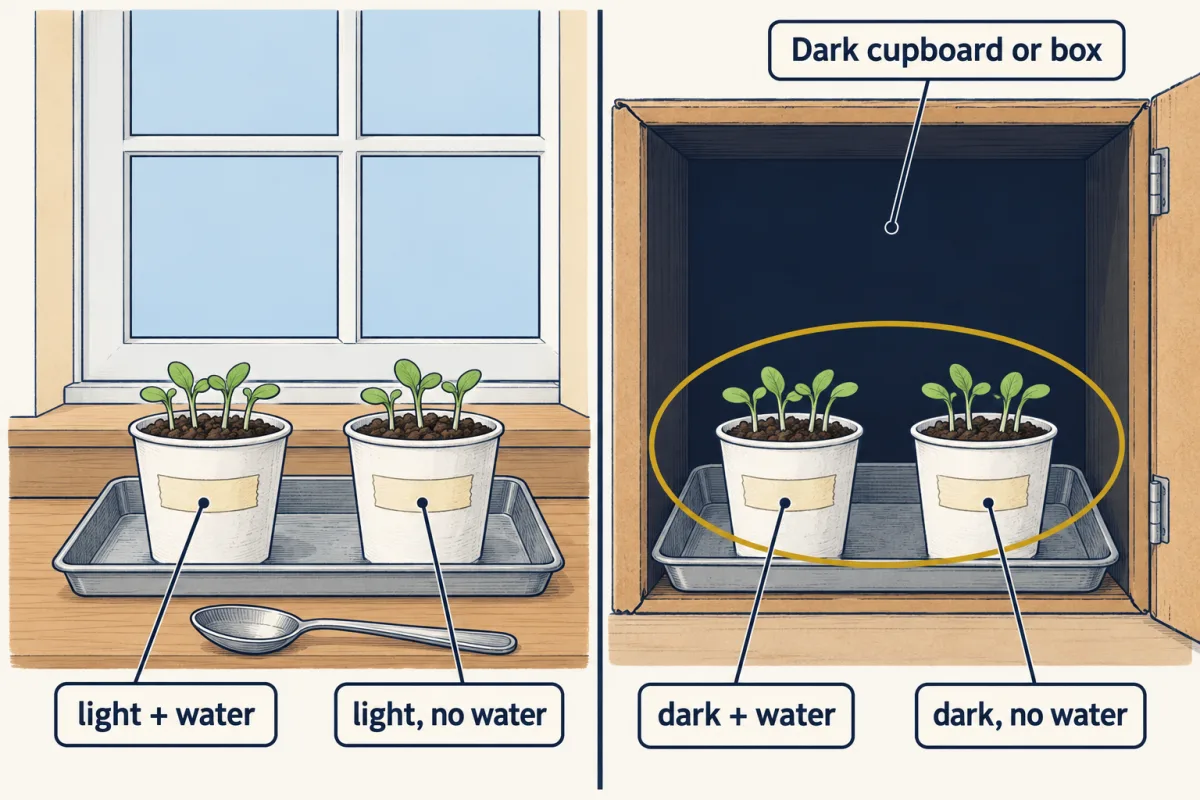
Next to the light and water cup, the dark and water cup differs only in light. The light, no water cup differs only in water. Now look and compare. Check every day or two, and draw each cup. The cups with no water usually droop within two to five days. Within about a week, the watered seedlings in the dark are often taller, thinner and paler. The cup with light and water stays green and upright. Look again at the dark seedlings. They are the tallest. Your child may call them the best. So ask about colour and strength, not only height. A seedling in the dark stretches on food it has stored. Once that food runs out, it grows weaker. Height alone is not health.
If a result surprises your child, it is still real, so do not throw it out. If your child wants extra water for one cup, do not change that cup. Add an extra cup to try the idea, and the first test stays fair. Here is the short version. Predict first. Change one thing at a time. Keep everything else the same. Look and compare. Keep every real result.
Before you start
- Hands-on time
- About 30 minutes, plus 3 to 10 days for seeds to sprout, then 5-minute checks every day or two for about 2 weeks
- Where
- Indoors
- Ages
- 5 to 10, with an easier and a harder version below
- Grown-up
- An adult pokes the drainage holes and opens the potting mix. Stay nearby while your child plants and waters; the child does the looking, drawing and measuring.
What you need
- 4 small cups (paper or clear plastic, about 9 oz), with 3 or 4 holes poked in each bottom by an adult
- A tray or baking dish to stand the cups in
- Potting mix, enough to fill the cups
- A packet of radish seeds (grass seed also works but is slower)
- Water and a tablespoon
- A sunny windowsill, plus a cupboard or a large cardboard box for a dark place
- Masking tape and a marker for labels
- A fifth cup for a seed-in-the-dark test (optional)
- A ruler marked in centimetres (ages 8 to 10)
- Paper and a pencil, or the printed observation sheet below
Virginia science standards SOL 1.4 aSOL K.7 aSOL 4.2 aSOL 4.2 b
The big idea
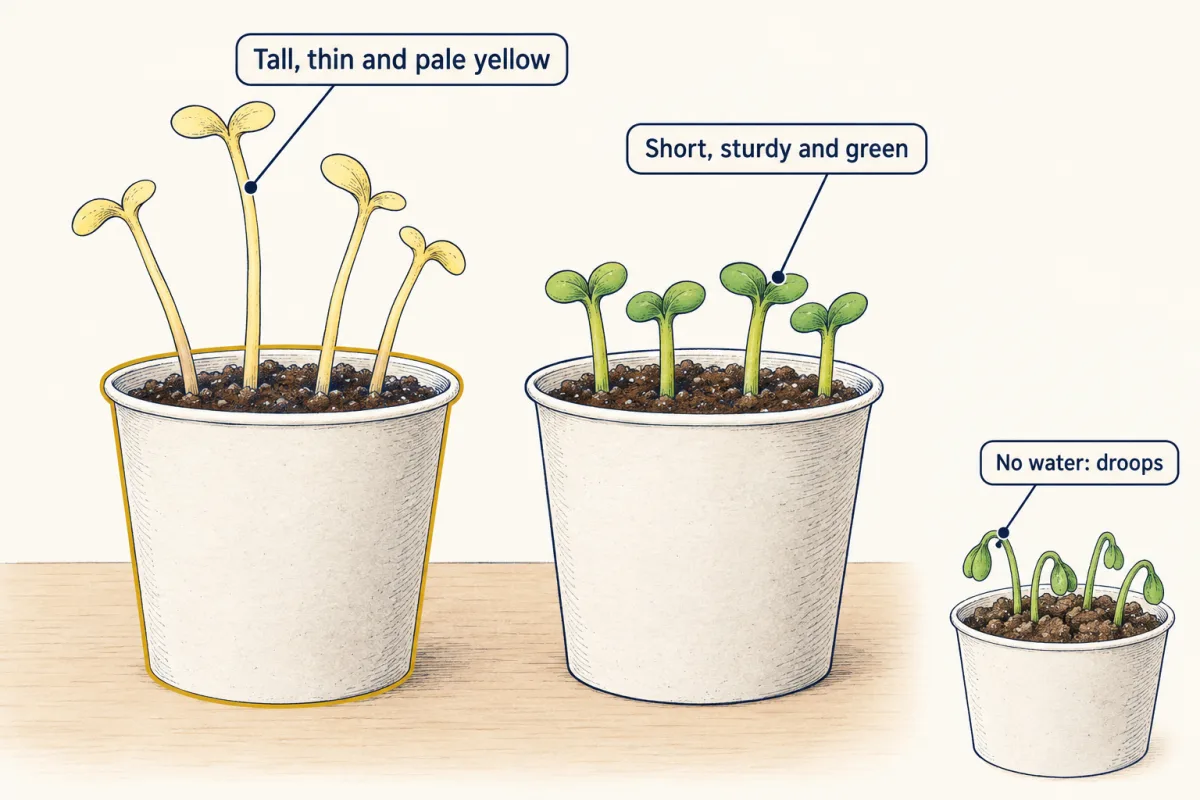
Put one cup of seedlings in a cupboard and leave one on a windowsill. Within a week they often look like different plants. The one in the dark grows tall, thin and pale yellow. The one in the light stays shorter, sturdier and green.
Plants need water, air, light, nutrients and a place with room to grow. This activity tests two of those needs, light and water, with a fair test: a test where only one thing changes and everything else stays the same. Same soil, same cups, same seeds. Each pair of cups you compare differs in just one thing, light or water.
Light matters because a green plant makes its own food. Its leaves use light energy to turn water and carbon dioxide, a gas from the air, into sugar, and they give off oxygen. This is photosynthesis. A seedling in the dark lives on food it has stored, some from its seed and some made earlier in the light. When that runs out it cannot make more. Plants do not get their food from soil. Soil holds the roots, water and small amounts of nutrients.
What to do
- Set up. An adult opens the bag and dampens the mix first (see the safety box). Then fill four cups with damp potting mix to about 2 cm below the rim. Label them “light + water”, “dark + water”, “light, no water” and “dark, no water”. Stand them on the tray.
- Plant. Have your child press 4 or 5 radish seeds about 1 cm deep into each cup and cover them. Give each cup 2 tablespoons of water. With a class, give each group of four one tray of four cups.
- Grow them all the same. Keep all four cups on a sunny windowsill. Water each the same amount whenever the top feels dry. Radish sprouts usually appear in 3 to 10 days, faster in a warm room. Wait until most seedlings are about 2 cm tall.
- Predict. Before you change anything, ask your child what will happen to each cup. Write or draw their guesses on the sheet.
- Start the test. Move the two “dark” cups, on a plate or a second tray, into the cupboard or under the box. Keep giving the two “water” cups 2 tablespoons when the top feels dry. Give the two “no water” cups nothing more. Change nothing else. If you have a fifth cup, plant fresh seeds in it, water it, and put it straight into the dark.
- Check every day or two. Open the cupboard, look quickly, and put the cups back. Draw each cup. Ages 8 to 10 measure the tallest seedling in each cup in centimetres. Note the colour, the height, and whether the leaves droop.
- Notice the changes. The dry cups usually droop within 2 to 5 days, sooner in small cups and warm rooms. Within about a week, the dark, watered seedlings are often taller, thinner and paler than the windowsill ones, and they lean or flop. Over 1 to 2 weeks they grow weaker. The “light + water” cup stays green and upright.
- Bring one back (optional). Move a pale “dark + water” cup back to the windowsill. If it is not too weak, its leaves usually turn green over a few days.
Questions to ask while you do it
Ask your child to guess first, then check.
- “What do you think will happen to a plant that gets water but no light?”
- “I wonder which cup will droop first. Why that one?”
- “The dark plant is the tallest. Is it the healthiest? How could we tell?”
- “I wonder if a seed needs light to sprout. How could we find out?”
- “What do you think will happen if we put the pale plant back in the sun?”
- “Where do you think a plant gets its food?”
What children often think
-
A child might say “Plants eat dirt.”
You could try Ask, "If plants ate soil, what would happen to the soil in the pot?" It hardly goes down as the plant grows. Plants make their own food in their leaves from air, water and light. Soil holds the roots and gives water and small amounts of nutrients.
-
A child might say “More water is always better.”
You could try Ask how they could test it, then add a cup that stands in a dish of water all the time. Over a week or two its leaves may yellow or droop. Roots need air as well as water, and soaked soil holds very little air.
-
A child might say “The dark one grew tallest, so it’s the best.”
You could try Ask your child to look at colour and strength as well as height. Is it green? Can it stand up? A seedling in the dark stretches on food it has stored, and it grows weaker once that food runs out.
-
A child might say “Seeds need light to sprout.”
You could try Try the fifth cup, kept in the cupboard from the day you plant. Radish seeds sprout in the dark, using food stored in the seed. Light matters once the seedling has leaves and its stored food runs low.
Why it works
A seed carries stored food. It uses that food to sprout and push up its first leaves. Radish seeds do this in light or in dark, though a few kinds, such as some lettuce, need light to sprout. After that, a green plant makes nearly all of its own food by photosynthesis. Chlorophyll, the green colouring in leaves, captures light energy. The plant uses that energy to join carbon dioxide with water, making sugar and giving off oxygen.
In the dark, seedlings grow in a different way, called etiolation. A seed that sprouts in the dark, like the one in the fifth cup, grows a long pale stem with tiny yellow leaves, because little chlorophyll forms. Green seedlings moved into the dark do something similar: the stem keeps stretching and new growth is pale, while the green leaves slowly turn yellow. In nature this stretching can carry a buried or shaded seedling up to light. In a cupboard there is no light to reach, so the seedling uses up its stored food and then weakens and dies.
Water has several jobs too. It is one of the raw materials for sugar, it keeps the cells firm so stems stand up, and it carries nutrients up from the roots.
Easier and harder
Ages 5 to 7
Use only two cups, both watered: one on the windowsill and one in the dark. That gives one clear difference. Skip measuring. Have your child draw both cups every few days, using crayons that match the real leaf colours. At the end, hold the two plants side by side and ask which one looks stronger and why.
Ages 8 to 10
Let your child plan the test: what will change, what stays the same, and what to measure. Measure the tallest seedling in each cup in centimetres every two days and keep a table. At the end, make a bar graph with one bar per cup. Ask whether one cup for each condition is enough. Two cups of each makes the result more trustworthy.
If it doesn’t go as planned
No sprouts after 10 days usually means a cold room or old seeds; try a fresh packet in a warmer spot. Fuzzy mould on the soil means it is staying too wet. An adult throws that cup away, as the safety box says, and you can start a new one with a little less water. If the “no water” cups do not droop, the mix may hold a lot of water; give it a few more days. If light leaks into the cupboard, use a box with no gaps. If the windowsill seedlings are also tall and floppy, the window is too dim; next time, use your brightest window.
Observation sheet
Observation sheet
What do plants need?
NameDate
Each time you check, draw or measure each cup.
| Day | Light + water | Dark + water | Light, no water | Dark, no water |
|---|---|---|---|---|
I think the plant in the dark will:
What really happened:
biochemistrypedia.com · Biology Together
Finish line
Test yourself
4 questions
Practice and MCAT-style, with explained answers.
Next · Lesson 8
Plant Parts We Eat
Which part of a plant is a carrot, and what does that part do? A grocery sort onto a drawn plant shows where each food came from and what its part does.
Continue →