Biology · Unit 1: The chemistry of life
What Am I Made Of?
How can a turkey sandwich become part of you? You chain small building blocks into large molecules in a simulation, learn the four classes of large molecule and their jobs, and read real USDA food data. Afterwards you can name each class, its building blocks and its main job, and judge the claim that fats and carbohydrates are bad for people.
Where this lesson sits
- Virginia SOL BIO.2b
- Practices BIO.1c, BIO.1d, BIO.1e, BIO.1f
Essential question: How can four kinds of large molecule, built from a small set of building blocks, make every part of a living thing?
-
Life Science (grade 7) LS.10 a
Review it at grade 7 level
In grade 7 you learned that cells are the building blocks of living things. You learned that proteins help build cells and carry out life processes. You also learned that carbon is a building block of living things, and that nitrogen is used to make proteins and DNA. Food gives your body matter and energy. Biology adds the words carbohydrate and lipid, and shows that all four kinds of large molecule are chains or groups of smaller pieces that cells join together and break apart.
-
Biology BIO.2b You are here
This lesson
-
Biology II Biology II: Advanced Survey of Biology Topics, BIOII.3 a; Genetics, GEN.2 d
Preview where it goes next
Virginia’s Biology II: Advanced Survey of Biology Topics course looks closely at how monomers join into polymers and at the energy changes when chemical bonds break and form. You draw the actual rings of sugars and the side chains of amino acids that this lesson left out. In the Biology II: Genetics course, you study four levels of protein structure. The primary structure is the order of amino acids in the chain. That chain coils and folds into local shapes, then into a full three-dimensional shape, and some proteins join several chains together. A change in the order can change the final shape and the job the protein can do.
-
College
Watch first Small Blocks Build Living Things · 3:01
Picture a turkey sandwich on whole-wheat bread. Within hours of eating it, your body takes its large molecules apart into small pieces and uses many of those pieces to build parts of you. The bread came from wheat plants and the turkey from a bird, so the sandwich is made from the cells of plants and animals. Your body is made of cells too. So what are cells made of, and how can one living thing’s food become another living thing’s body?
What do you think? Decide before you read.
-
Scientists disagree: Your body uses both. Carbohydrate-rich foods supply quick energy and fiber. Fats store energy for a long time and insulate the body. Phospholipids, another kind of lipid, build every cell membrane. A few fatty acids must come from food because the body cannot make them. Nutrition scientists judge whole foods and diets, not one class of molecule as good or bad.
What scientists think
Scientists disagree: Your body uses both. Carbohydrate-rich foods supply quick energy and fiber. Fats store energy for a long time and insulate the body. Phospholipids, another kind of lipid, build every cell membrane. A few fatty acids must come from food because the body cannot make them. Nutrition scientists judge whole foods and diets, not one class of molecule as good or bad.
-
Scientists disagree: USDA food data list protein in bread, peanut butter and milk as well as turkey, because plant and animal cells all build proteins. In your body, proteins do far more than build muscle. They form skin and hair, carry oxygen in blood, and speed up most of the chemical reactions in cells.
What scientists think
Scientists disagree: USDA food data list protein in bread, peanut butter and milk as well as turkey, because plant and animal cells all build proteins. In your body, proteins do far more than build muscle. They form skin and hair, carry oxygen in blood, and speed up most of the chemical reactions in cells.
-
Scientists disagree: Chemical analysis shows that carbohydrates, lipids, proteins and nucleic acids are all built mostly from the same three elements: carbon, hydrogen and oxygen. Proteins add nitrogen, and nucleic acids add nitrogen and phosphorus. The classes differ mainly in how those atoms are arranged.
What scientists think
Scientists disagree: Chemical analysis shows that carbohydrates, lipids, proteins and nucleic acids are all built mostly from the same three elements: carbon, hydrogen and oxygen. Proteins add nitrogen, and nucleic acids add nitrogen and phosphorus. The classes differ mainly in how those atoms are arranged.
Explore: build big molecules from small blocks
The simulation gives you four kinds of building block: a simple sugar, an amino acid, a nucleotide, and a set of fatty acids with glycerol. You pick one kind and snap the blocks together into a chain. The simulation names the large molecule you built, tells you its main job, and counts the water molecules released each time two blocks join.
- Blocks
- Links
- Water released
- Large molecule
- Main job
- Elements
In this sketch each block is one monomer drawn as a labelled box, not a molecule. A chain stops at 12 blocks to fit the screen; a real polymer has many monomers.
Rule to keep: joining two monomers releases one water molecule, so a chain of n blocks has n − 1 links and releases n − 1 waters. A common fat is one glycerol joined to three fatty acids, so it is not a true polymer.
Try this.
- Predict how many water molecules will be released when you link 4 sugars in a row. Build the chain and check.
- Now predict the count for 10 sugars. Can you write a rule that works for any number of blocks?
- Switch to amino acids. Predict whether the name of the molecule changes, and whether your water rule still works. Then test.
- Try fatty acids and glycerol. Predict whether you can keep adding blocks to make a very long chain, then try it.
Explain: small blocks, big chains
- monomer
- polymer
- macromolecule
- dehydration synthesis
- hydrolysis
- carbohydrate
- protein
- amino acid
- nucleic acid
- nucleotide
- lipid
Think of a necklace of beads. Each bead is small, but a string of hundreds of them is long. Cells build their largest molecules the same way.
A monomer is a small molecule that can join to others like it. A polymer is a large molecule made of many monomers linked in a chain. A macromolecule is a very large molecule in a living thing, such as a polymer. The necklace analogy breaks in one place: real chains fold, coil and branch, and their shape matters for their job.
When a cell links two monomers, it removes a hydrogen from one and an oxygen and hydrogen from the other. Those atoms leave as one water molecule. This joining reaction is dehydration synthesis, which means “making something by removing water.” Breaking the link runs the other way. Hydrolysis splits a polymer into smaller pieces by adding water.
simple sugar + simple sugar → double sugar + water (dehydration synthesis)
C6H12O6 + C6H12O6 → C12H22O11 + H2O (two glucose molecules form maltose and water)
double sugar + water → simple sugar + simple sugar (hydrolysis)
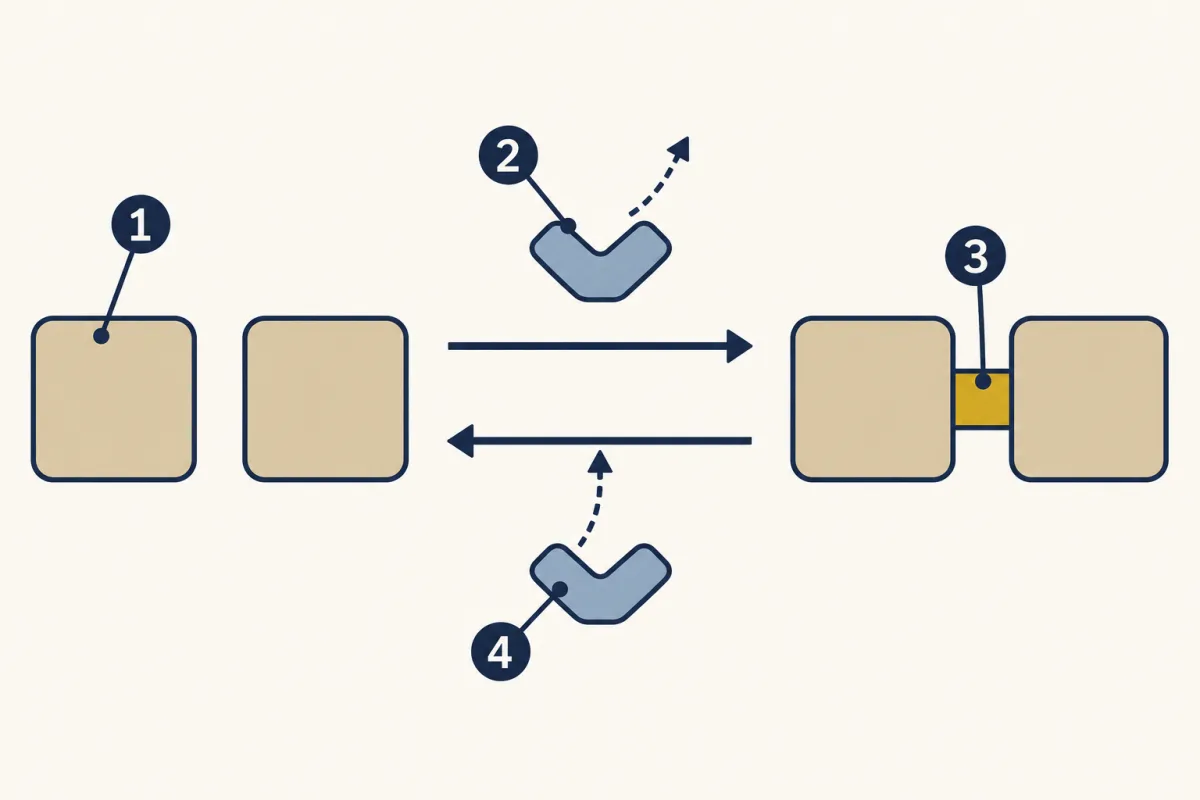
- monomers
- water molecule
- link
- water added
- monomers
- blank
- link
- blank
Word bank: water added, water molecule
- blank
- blank
- blank
- blank
Check your labels
- monomers
- water molecule
- link
- water added
Digestion is mostly hydrolysis. Your gut breaks the bread’s starch into sugars and the turkey’s proteins into amino acids. Your cells then use dehydration synthesis to build their own polymers from those pieces. A turkey protein does not become a human protein; its amino acids are reused in new chains.
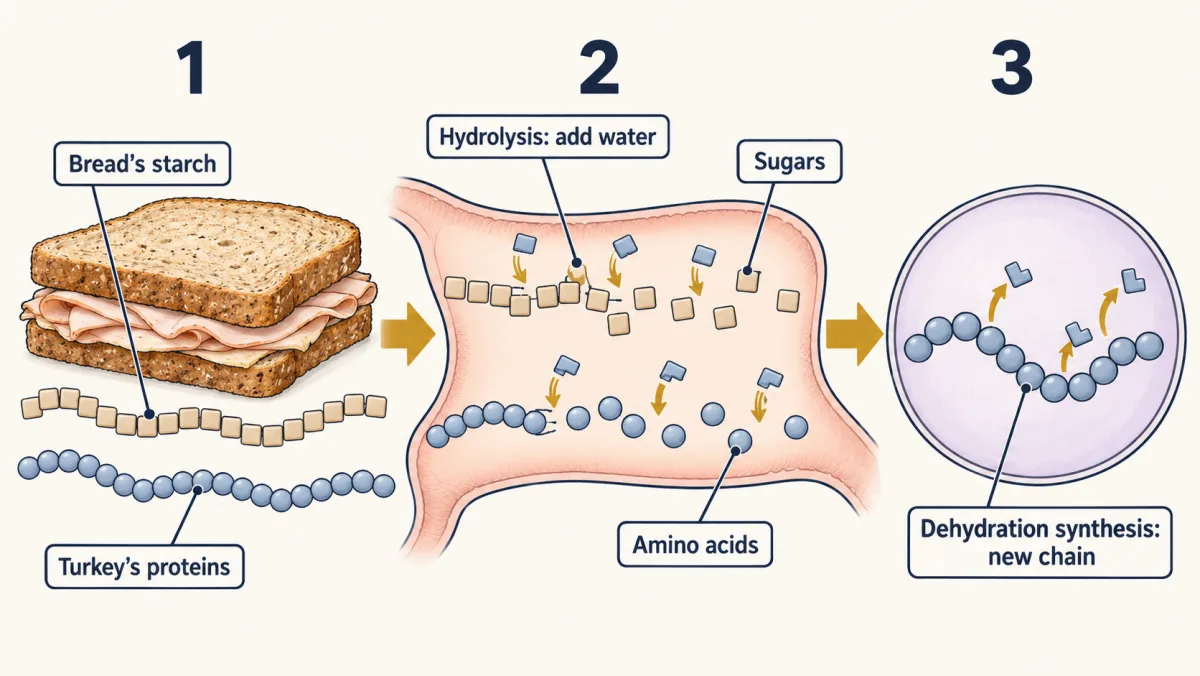
Most of these molecules share carbon, hydrogen and oxygen. Cells can take the carbon, hydrogen and oxygen from sugar and join them with nitrogen to make amino acids. Plants make their amino acids in a similar way, using nitrogen they take up from the soil as nitrate or ammonium; in legumes such as peas, bacteria in root nodules also supply nitrogen. Your cells can make some amino acids, but about nine must come from food.
Explain: four classes, four kinds of job
Scientists sort the large molecules of life into four classes. Each has its own building blocks and main jobs.
A carbohydrate is a molecule made of simple sugars, such as glucose, starch or cellulose. A protein is a chain of amino acids folded into a shape. An amino acid is a small molecule containing nitrogen that is the building block of proteins. A nucleic acid is a chain of nucleotides, such as DNA or RNA. A nucleotide is a building block made of a sugar, a phosphate group and a base containing nitrogen. A lipid is a molecule that mostly does not mix with water, such as a fat, oil or phospholipid, which has one end that attracts water.
| Class | Building blocks | Main jobs | Elements |
|---|---|---|---|
| Carbohydrates | simple sugars | quick energy; plant cell walls | C, H, O |
| Proteins | amino acids | building tissues; running cell processes | C, H, O, N (often S) |
| Nucleic acids | nucleotides | storing and passing on genetic information | C, H, O, N, P |
| Lipids (fats) | fatty acids and glycerol | long-term energy storage; insulation; cell membranes | mostly C, H, O |
Two cautions. Not every lipid is a fat: phospholipids and steroids such as cholesterol are lipids too. And fats are not true polymers. A common fat is one glycerol joined to three fatty acids, not a long chain of repeating blocks.
Explain: shape decides the job
A key only opens a lock its shape fits. Molecules work in a similar way, although the analogy breaks because molecules bend and move. Here is one example from each class.
- Carbohydrate: cellulose. Long chains of glucose lie side by side and hold together in strong fibers. Those fibers stiffen the walls of plant cells. Much of the fiber in whole-wheat bread comes from plant cell walls.
- Protein: an enzyme. An enzyme is usually a protein that speeds up a reaction. Its folded shape forms a pocket where one kind of molecule fits. If heat or acid changes that shape, the molecule may no longer fit. You will test this in Enzymes at Work.
- Nucleic acid: DNA. DNA has two strands whose bases pair in a fixed way. Each strand can therefore guide the copying of the other, so the information can be passed to new cells. DNA: Structure and Copying shows how.
- Lipid: a phospholipid. Each phospholipid has a head attracted to water and two tails that avoid it. In water they form a double layer, heads out and tails in. That layer is the basic structure of the cell membrane.
Together these molecules carry out life processes. Proteins and lipids build new cells for growth and repair. DNA passes information on in reproduction. A protein in red blood cells carries oxygen for gas exchange. Enzymes run metabolism (the chemical reactions in cells), and proteins in membranes detect signals so cells can respond.
Elaborate: what is in the sandwich and its neighbors
These values come from a food database. Each row is grams of nutrient in 100 grams of a reference food, so you can compare foods fairly. Carbohydrate already includes the fiber.
| Food (100 g) | Carbohydrate (g) | Protein (g) | Fat (g) | Fiber (g) |
|---|---|---|---|---|
| Whole-wheat bread | 42.71 | 12.45 | 3.5 | 6 |
| Turkey breast, roasted | 0 | 30.13 | 2.08 | 0 |
| Peanut butter, smooth | 22.31 | 22.21 | 51.36 | 5 |
| Apple, raw, with skin | 13.81 | 0.26 | 0.17 | 2.4 |
| Whole milk | 4.8 | 3.15 | 3.25 | 0 |
| Olive oil | 0 | 0 | 100 | 0 |
Source: USDA FoodData Central, SR Legacy reference foods (FDC IDs 172688, 171496, 174266, 171688, 171265, 171413), published April 2019. These are averaged reference values, not one sample from one store or lab. This table does not include nucleic acids. Food scientists estimate energy in kilocalories (kcal) with general factors of about 4 kcal per gram for carbohydrate and protein and about 9 kcal per gram for fat.
- Which two foods have the most protein per 100 grams? Is one of them a plant food?
- Bread lists 42.71 grams of carbohydrate, including 6 grams of fiber. How many grams are not fiber? Compare with the apple.
- Using the energy factors, about how much energy is in the fat of 100 grams of peanut butter? How does that compare with the energy estimated for its carbohydrate?
Claim, evidence, reasoning
Make a claim that answers this question, using the table: are fats and carbohydrates simply bad for people?
Start with: The data show that fats and carbohydrates are blank.
Start with: For example, blank contains blank g of carbohydrate including blank g of fiber, and blank contains blank g of fat along with blank g of protein.
Start with: This matters because the body uses carbohydrates for blank and fats for blank, so blank.
Compare with a model answer
Fats and carbohydrates are not simply bad; they are parts of many foods and do different jobs. Whole-wheat bread has 42.71 g of carbohydrate per 100 g, including 6 g of fiber, and 12.45 g of protein. Peanut butter is about half fat, 51.36 g, yet also has 22.21 g of protein. The body uses carbohydrates for quick energy and fats for long-term energy storage and insulation, with other lipids in membranes. A limit: these are averaged reference foods, and the table cannot show whether a whole diet is healthy.
Saved in this browser only.
Design problem
Your teacher gives you three tests used in many school labs. Iodine solution turns blue-black with starch. Biuret solution turns violet with protein. A drop of fat leaves a see-through spot on brown paper that stays after the paper dries. Plan an investigation to find which of these molecules are in bread, turkey and apple.
One way to do it
The independent variable is the food. The dependent variable is the color change or spot. Keep the amount of food, the amount of test solution and the waiting time the same. Use water as a negative control, and a known starch, protein or oil sample as a positive control for each test. Run each test three times. Based on the table, you might expect starch in the bread and protein in the turkey and bread. The apple has very little protein or fat, and a ripe apple may show little starch. Treat these as predictions to test. Wear goggles, never taste lab samples, and handle iodine and biuret solution with care.
Evaluate: check your thinking
The sandwich holds carbohydrates, proteins and fats, and, because its ingredients came from cells, nucleic acids too. Your digestive system splits those large molecules into sugars, amino acids, nucleotides, fatty acids and glycerol. Your cells then join those pieces into new large molecules with shapes that fit your own body’s jobs.
Science practices you used: making and testing predictions with a model, naming where an analogy breaks, reading a data table on a fair 100-gram basis, calculating with energy factors, and planning a test with controls and repeated trials.
How we measure it
Food-composition database lookup
A food-composition database such as USDA FoodData Central lists how many grams of carbohydrate, protein, fat and fiber are in 100 grams of a reference food. You can scale those values to any portion with one multiplication: grams of nutrient = value per 100 g × grams of food ÷ 100.
Nutrition-label reading
A Nutrition Facts label gives the grams of each nutrient in one serving. Comparing foods only makes sense on the same basis, such as the same serving size or 100 grams, and a single total like grams of fat does not decide whether a food is healthy.
Finish line
Test yourself
8 questions
Practice and MCAT-style, with explained answers.
Next · Lesson 3
Enzymes at Work
Why does fresh pineapple keep gelatin from setting, while canned pineapple lets it set?
Continue →