Biology · Unit 1: The chemistry of life
Water and Life
Why does a Bay buoy record the air swinging by several degrees in a day while the water under it barely moves? You heat water and sand in a simulation, learn how the shape and charges of a water molecule make it stick to itself and to other things, and read real buoy data from Stingray Point. Afterwards you can explain water as a solvent, cohesion, surface tension, adhesion and heat capacity, each with a living example.
Where this lesson sits
- Virginia SOL BIO.2a
- Practices BIO.1a, BIO.1c, BIO.1d, BIO.1e
Essential question: Why does water behave so strangely, and how do those oddities keep living things alive?
-
Life Science (grade 7)
Review it at grade 7 level
In grade 7 you met water in two places. In the water cycle, water evaporates, forms clouds, falls as rain and runs back to rivers and the ocean. In photosynthesis, plants take in water and carbon dioxide and use light energy to make sugar. You learned that living things need water, but not why water is so useful. Biology adds the reason: the tiny charged ends of each water molecule make it dissolve nutrients, stick together and warm up slowly.
-
Biology BIO.2a You are here
This lesson
-
Biology II Biology II: Advanced Survey of Biology Topics, BIOII.2 b
Preview where it goes next
Virginia’s Biology II: Advanced Survey of Biology Topics course uses water’s polarity to explain the cell membrane. A phospholipid has a polar, charged head that is attracted to water and two long nonpolar tails that are not. In water, phospholipids line up in a double layer with the heads facing the water on both sides and the tails hidden in the middle. That arrangement comes from the same rule that keeps oil and water apart. This lesson left out why nonpolar tails cluster: water molecules hydrogen bond with each other more easily when the tails are tucked away. Biology II also studies how pH changes enzyme activity, and pH depends on water itself splitting into charged pieces.
-
College
Watch first Why Water Warms So Slowly · 2:46
On July 9, 2025, a buoy in the Chesapeake Bay at Stingray Point, Virginia, recorded the air warming by about 8 °C between 3 a.m. and late afternoon. The water just under the buoy changed by less than 1.5 °C all day. Both went through the same day and night. An insect can stand on a pond, and a paper towel can pull water up against gravity. What is it about water that makes it act this way, and why does that matter to living things?
What do you think? Decide before you read.
-
Scientists disagree: Water carries dissolved sugars, salts and minerals through plants and animals, and it warms and cools slowly. Chemists trace both to the charged ends of water molecules and the attractions between them. One clue is that hydrogen sulfide, a similar small molecule, boils at about −60 °C, far below room temperature, while water boils at 100 °C.
What scientists think
Scientists disagree: Water carries dissolved sugars, salts and minerals through plants and animals, and it warms and cools slowly. Chemists trace both to the charged ends of water molecules and the attractions between them. One clue is that hydrogen sulfide, a similar small molecule, boils at about −60 °C, far below room temperature, while water boils at 100 °C.
-
Scientists disagree: Inside one molecule, the atoms are held by covalent bonds, where they share electrons. A hydrogen bond is a weaker attraction between two neighboring molecules. Boiling water breaks hydrogen bonds and turns liquid to vapor, but the steam is still water, so the bonds inside each molecule survive.
What scientists think
Scientists disagree: Inside one molecule, the atoms are held by covalent bonds, where they share electrons. A hydrogen bond is a weaker attraction between two neighboring molecules. Boiling water breaks hydrogen bonds and turns liquid to vapor, but the steam is still water, so the bonds inside each molecule survive.
-
Scientists disagree: Most oil is lighter than water. That is why spilled oil spreads as a film on top of rivers and the ocean. Oil stays separate for a different reason, which has to do with how its molecules attract water molecules, or fail to. You will find out which below.
What scientists think
Scientists disagree: Most oil is lighter than water. That is why spilled oil spreads as a film on top of rivers and the ocean. Oil stays separate for a different reason, which has to do with how its molecules attract water molecules, or fail to. You will find out which below.
Explore: heat water and sand side by side
The simulation shows two beakers on the same heater. One holds water and the other holds dry sand, and both hold the same mass. You choose how long to heat them, and a thermometer in each beaker shows how much its temperature rises.
Thermometers read 20 to 90 °C. The dashed mark on the water thermometer shows the rise the sand showed after 1 minute: +10.5 °C.
Both beakers start at 20 °C. Move the heating-time slider to switch the heater on.
Water
specific heat: about 4.18 J per g per °C
rise = heat added ÷ (mass × specific heat)
Dry sand
specific heat: about 0.8 J per g per °C
rise = heat added ÷ (mass × specific heat)
Heat added so far: 0 J.
In this sketch: temperature of each beaker over time
In this sketch: 100 g of each material starts at 20 °C. The heater adds 836.8 joules each minute to each beaker, the same for both. After the heater is off, each beaker loses 836.8 joules each minute until it is back at 20 °C. The numbers are a model, not a measurement.
Rule to keep: heat added = mass × specific heat × temperature change. The same heat makes a smaller temperature change in the material with the higher specific heat, so water warms and cools slowly. This picture is a sketch of the logic.
Try this.
- Before you start, predict which beaker will get hotter after 5 minutes of heating. Write your guess down, then run it.
- Double the heating time. Predict whether each temperature rise will also double, then test it.
- Find a heating time for the water that gives the same temperature rise the sand got in 1 minute. How many times longer is it?
- Turn the heater off and watch both beakers cool. Predict which one cools faster before you look.
Explain: a molecule with charged ends
- polar
- covalent bond
- hydrogen bond
- solvent
- cohesion
- surface tension
- adhesion
- capillary action
- specific heat
- heat capacity
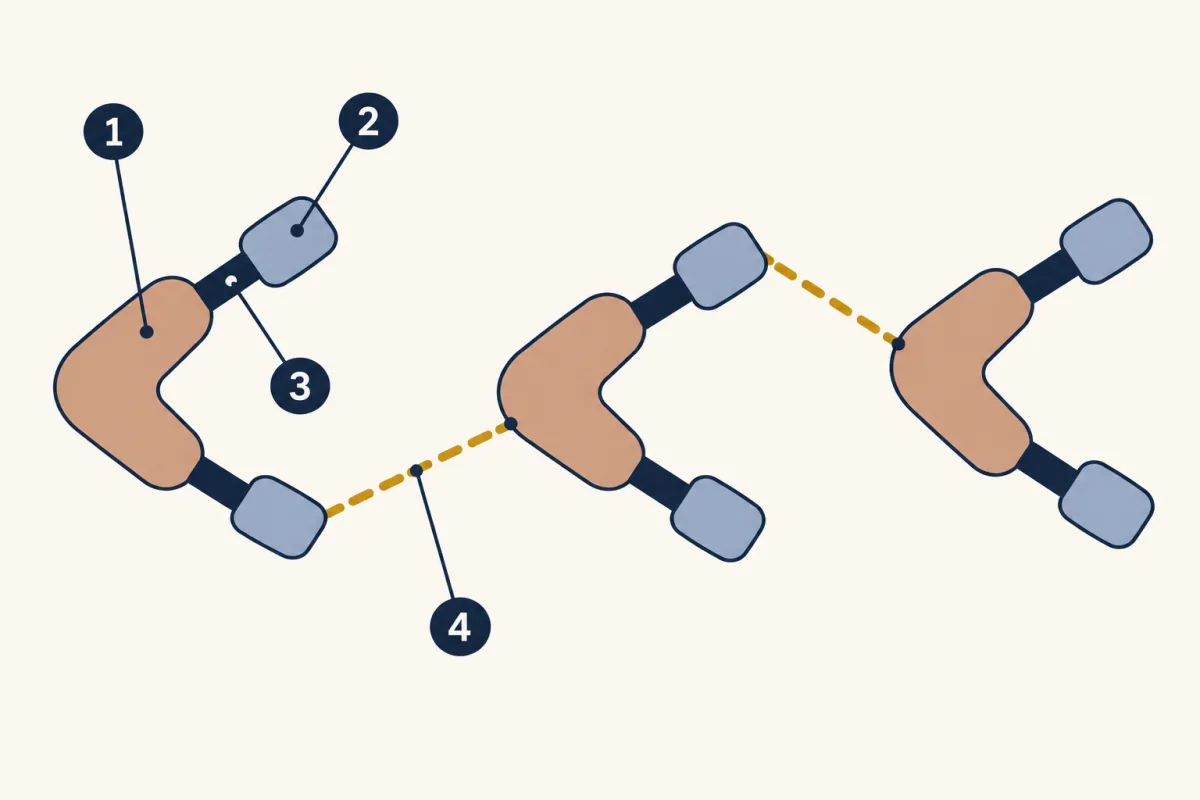
A water molecule has one oxygen atom and two hydrogen atoms. Each hydrogen is joined to the oxygen by a covalent bond, a bond in which two atoms share electrons. The molecule is bent, a little like a wide letter V, with oxygen at the point.
Oxygen pulls the shared electrons closer to itself than hydrogen does. So the oxygen end carries a slight negative charge, and each hydrogen end carries a slight positive charge. A molecule with a slightly negative end and a slightly positive end is polar. These are partial charges, smaller than the full charge on a particle of salt, and the molecule as a whole has no net charge.
Opposite charges attract. The slightly positive hydrogen of one water molecule is drawn to the slightly negative oxygen of a neighbor. That attraction is a hydrogen bond, a weak attraction between molecules. In liquid water, hydrogen bonds form and break constantly as the molecules jostle.
- oxygen end
- hydrogen end
- covalent bond
- hydrogen bond
- oxygen end
- hydrogen end
- blank
- blank
Word bank: covalent bond, hydrogen bond
- blank
- blank
- blank
- blank
Check your labels
- oxygen end
- hydrogen end
- covalent bond
- hydrogen bond
Keep the two kinds of bond apart. Covalent bonds hold the atoms of one molecule together. Hydrogen bonds hold neighboring molecules near each other, and they are much weaker.
Explain: dissolving, sticking and climbing
Almost every special property of water comes from those charged ends and hydrogen bonds, and these properties support the chemical reactions of metabolism that keep cells alive.
Water as a solvent
A solvent is a liquid that dissolves other substances. When you stir salt into water, the charged ends of water molecules surround each charged particle of salt and pull it away from the crystal. Sugar molecules have polar parts of their own, so water dissolves sugar too. Oil molecules are nonpolar. Water molecules attract one another more strongly than they attract oil, so the oil is left out in its own layer. Water is sometimes called the universal solvent, but it does not dissolve everything.
Cohesion and surface tension
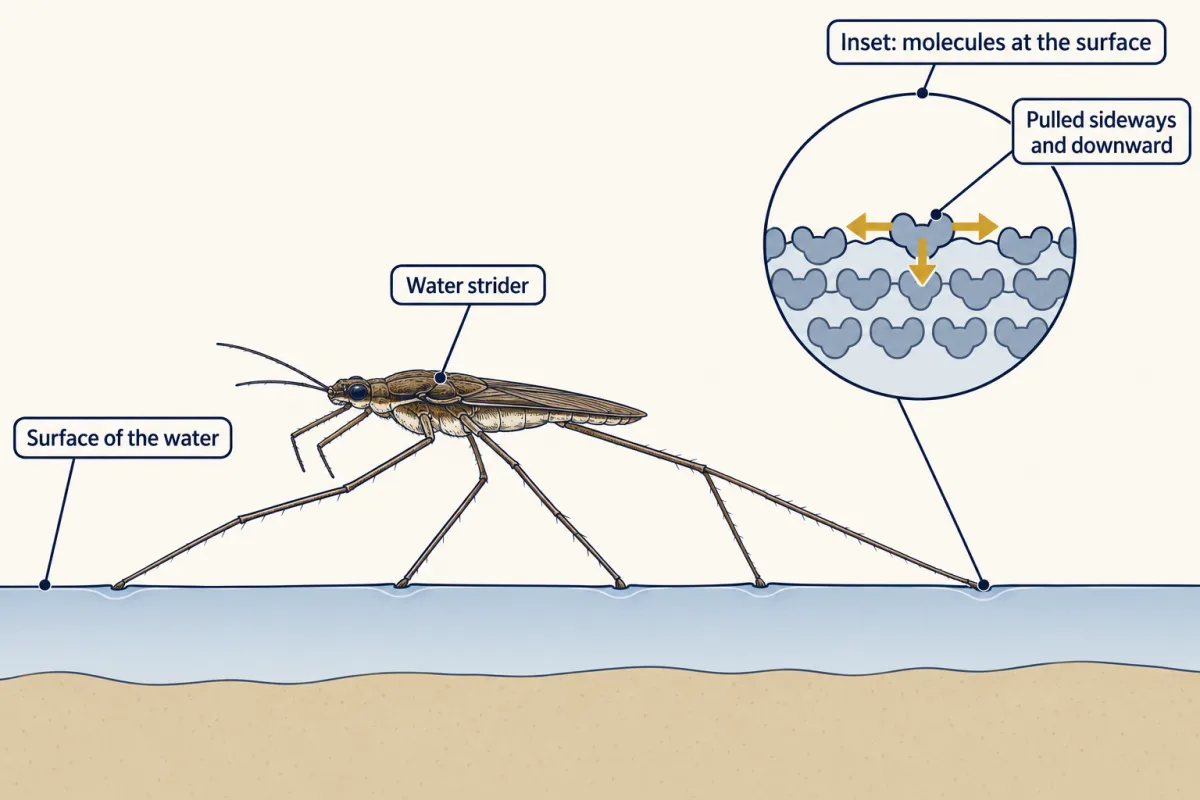
Cohesion is the attraction of water molecules to other water molecules. At the surface, each molecule is pulled sideways and downward by its neighbors, so the surface resists being stretched. That resistance is surface tension. It is still liquid water at the surface, not a separate skin.
Adhesion and capillary action
Adhesion is the attraction of water to a different substance. Paper is made of cellulose fibers, and plant cell walls contain cellulose. Cellulose has many polar parts that water clings to. When water climbs a narrow space or a fiber because of adhesion and cohesion working together, that is capillary action.
| Property | What causes it | Living example |
|---|---|---|
| Solvent | Charged ends surround charged and polar particles | Plants carry dissolved sugar in the sap of their phloem |
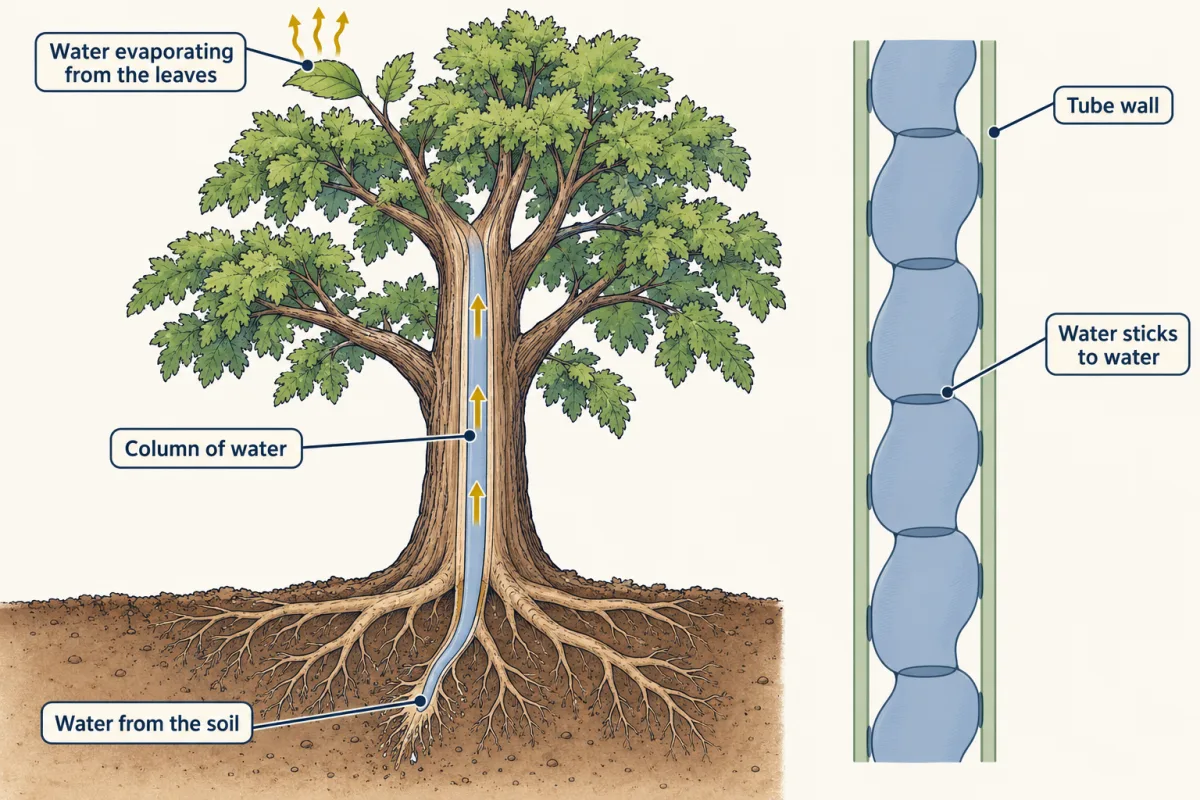
| Cohesion | Hydrogen bonds between water molecules | A column of water holds together inside a plant’s xylem tubes |
| Surface tension | Cohesion at the water’s surface | A water strider stands on a pond |
| Adhesion | Attraction of water to other polar materials | Water clings to the cellulose in the walls of plant cells |
In a tall tree, water evaporating from the leaves pulls the next molecules up behind it, and cohesion keeps the column from breaking. Most of the lift comes from that evaporation. Adhesion to the tube walls helps hold the column in place.
One more oddity: ice floats. As water freezes, hydrogen bonds lock the molecules into an open pattern with more space between them, so ice is less dense than liquid water. A frozen pond that is deep enough keeps liquid water underneath, where fish can survive the winter.
Explain: why water warms slowly
Specific heat is the energy needed to warm one gram of a substance by one degree Celsius. For liquid water it is about 4.18 joules per gram per degree. For dry sand it is about 0.8, roughly a fifth as much. Heat capacity is the same idea for a whole object, so a big body of water has an enormous heat capacity.
Why so high? When you add heat to water, part of the energy goes into stretching, bending and breaking the hydrogen bonds between molecules, so less of it shows up as faster motion and a rise in temperature. When water cools, those bonds re-form and release energy back.
heat added (joules) = mass (grams) × specific heat × temperature change (°C)
To find the temperature change, divide the heat by the mass times the specific heat. For example, 100 grams of water that takes in 836.8 joules warms by 836.8 ÷ (100 × 4.184) = 2 °C. The same energy would warm 100 grams of dry sand by about 10 °C.
This slow warming matters to life. Large bodies of water such as lakes and the Bay change temperature slowly, so the fish, crabs and grasses in them usually face gentler daily temperature swings than the air over land does. Your body is about half water or more. Blood, which is mostly water, carries heat from warm working muscles to cooler parts of the body, and the water in your tissues helps slow changes in your temperature, along with sweating and other ways your body controls it.
Elaborate: air and water at a Bay buoy
These readings come from one buoy on one day. Each row pairs the air temperature, a few meters above the water, with the water temperature just below the surface, taken at the same moment.
| Local time, July 9, 2025 | Air temperature (°C) | Water temperature (°C) |
|---|---|---|
| 12:00 a.m. | 26.4 | 28.6 |
| 3:00 a.m. | 23.0 | 28.7 |
| 6:00 a.m. | 24.9 | 28.7 |
| 9:00 a.m. | 25.9 | 28.6 |
| 12:00 p.m. | 28.4 | 28.9 |
| 3:00 p.m. | 29.9 | 29.6 |
| 6:00 p.m. | 30.1 | 29.8 |
| 9:00 p.m. | 26.8 | 29.0 |
Source: NOAA National Data Buoy Center, station 44058 (Chesapeake Bay Interpretive Buoy System, Stingray Point, Virginia), 2025 historical standard meteorological archive, every third hour on July 9, 2025, Eastern Daylight Time. The full day had 190 paired readings; across all of them the air ranged by 8.1 °C and the water by 1.4 °C.
- Find the range of the air temperatures in the table (highest minus lowest). Then find the range of the water temperatures. Give units.
- At which times was the air warmer than the water? What was true at every other time?
- How many times larger is the air’s range than the water’s range?
Claim, evidence, reasoning
Make a claim that answers the essential question for this Bay habitat: how does water’s heat capacity affect the temperature that living things in the water experience? Use the buoy data.
Start with: At this buoy on this day, the water temperature blank than the air temperature.
Start with: Across the eight readings, the air ranged from blank °C to blank °C, a change of blank °C, while the water ranged from blank °C to blank °C, a change of blank °C.
Start with: Water has a high specific heat because blank, so the same energy from the sun blank. This matters for animals in the Bay because blank.
Compare with a model answer
At Stingray Point on July 9, 2025, the water temperature changed much less than the air temperature. In the eight readings, the air ranged from 23.0 °C to 30.1 °C, a change of 7.1 °C, while the water ranged from 28.6 °C to 29.8 °C, a change of only 1.2 °C. Water has a high specific heat because part of the energy it absorbs goes into its hydrogen bonds, so sunshine raises its temperature only a little. Fish and crabs in the Bay therefore face steadier daily temperatures than the air around them, at least on a day like this. This is one buoy on one day, and the Bay’s large volume and mixing also help, so the data fit the idea but do not prove heat capacity is the only cause.
Saved in this browser only.
Design problem
A paper towel wicks water upward. Does the width of a strip of paper change how high the water climbs? Plan a fair test you could do with paper, a ruler, a tray of water and a timer.
One way to do it
- Question and hypothesis: If strips are wider, then water will climb higher in 10 minutes, because the edges of a narrow strip may slow the water more.
- Independent variable: strip width, for example 5, 10 and 20 millimeters.
- Dependent variable: height the water reaches after 10 minutes, measured in millimeters from the water line.
- Constants: the same kind of paper cut from one sheet, the same strip length, the same depth dipped into the water, the same water at the same temperature, the same timer.
- Comparison: the 5 mm strip serves as the baseline the wider strips are compared with.
- Repeated trials: test at least five strips of each width and calculate the mean height for each width.
- Safety: wipe up spills so no one slips.
A 2020 study did a version of this with laboratory filter paper. It ran five repeats at each of three widths, 5, 10 and 20 mm, and the wider strips showed greater rise in the range tested. A simple formula did not predict every measured height, which is a reminder that paper is more complicated than a model of tiny tubes.
Evaluate: check your thinking
The air over the Bay swung by several degrees while the water barely moved. The data fit the idea that each gram of water needs a lot of energy to warm and that the Bay holds a vast amount of water. Water’s polar molecules, held near one another by hydrogen bonds, help explain that slow warming. They also explain the strider on the pond and the water climbing the towel.
Science practices you used: making a prediction before testing, reading a data table and calculating a range, making a claim from evidence, planning a fair test with constants and repeated trials, and naming the limits of a single buoy’s data.
How we measure it
Temperature logging on a buoy
A buoy anchored in the Bay carries one thermometer in the air above the water and another just under the surface, and it records both on a schedule. Because both readings are taken at the same moment, you can compare how much the air and the water changed over the same hours.
Calorimetry
Calorimetry measures the heat that flows into or out of a substance. Knowing the heat added, the mass and the temperature change lets you calculate a substance's specific heat, which is how water's value of about 4.18 joules per gram per degree Celsius was found.
High-speed video
A camera that takes hundreds of pictures each second slows down a fast motion, such as a water strider jumping. One 2020 study filmed striders at 500 frames per second to see how their legs pushed on the water surface.
Finish line
Test yourself
8 questions
Practice and MCAT-style, with explained answers.
Next · Lesson 2
What Am I Made Of?
How can a turkey sandwich on whole-wheat bread end up as part of your own body?
Continue →