Biology Together · Unit 2: Our senses
The Listening Walk
You and your child sit still outside for two minutes and draw a sound map of everything you hear: near or far, loud or soft, high or low, made by something living or not. Then your child cups their hands behind their ears to make bigger "animal ears" and finds out why many animals have large ears they can turn.
Watch first Set Up: The Listening Walk · 1:03
Read the transcript of “Set Up: The Listening Walk”
Film transcript: Set Up: The Listening Walk
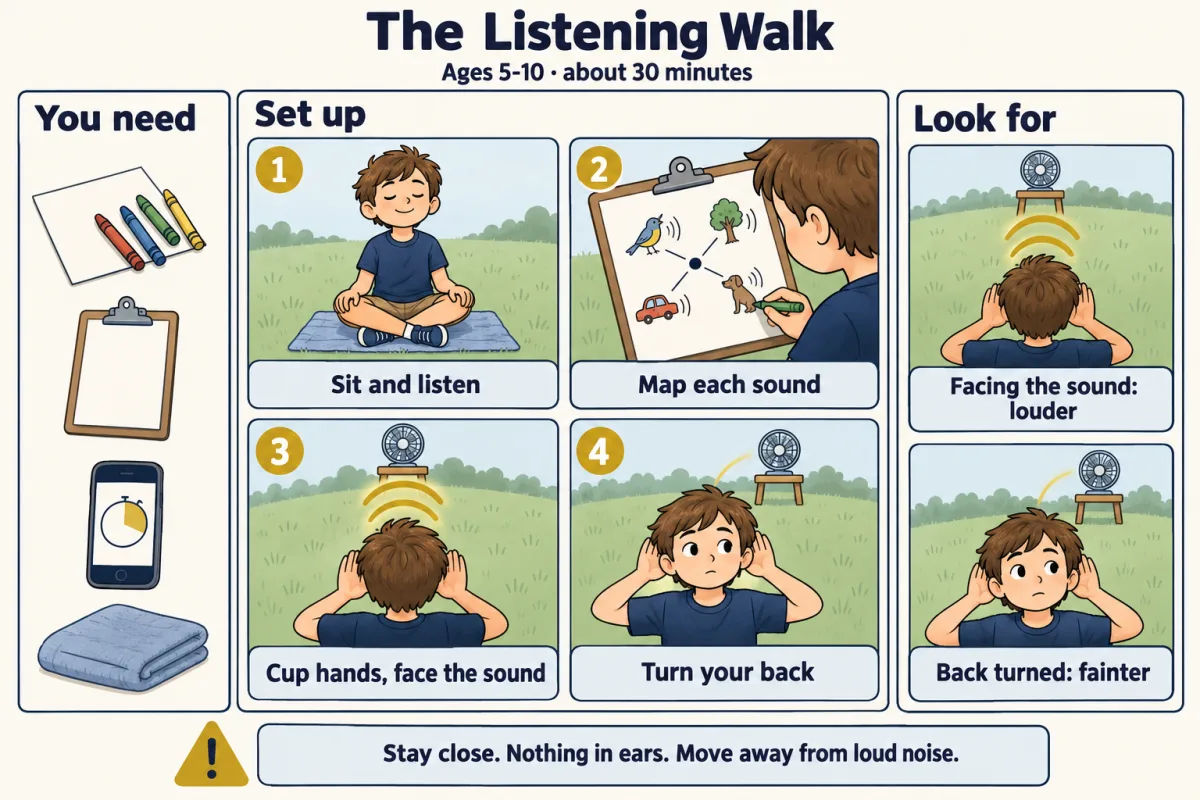
Most of the time we hear without really listening. When we sit still and listen, the backyard fills up with sounds. Ears catch them like funnels, and cupped hands make a bigger funnel. You need paper and crayons or pencils, a timer, such as a phone, and a towel or mat to sit on outside. Pick a quiet spot away from roads and water. Ask how many sounds your child expects, and write the number down. Set the timer for two minutes. Your child closes their eyes and holds up one finger for each new sound. Expect anything from a few sounds to a dozen or more. Then your child cups both hands behind the ears. Most children hear it louder. Cupped hands catch more sound, like a cat's big ears.
Stay close enough to touch. Cup hands only for quiet or everyday sounds, never toward a road. Nothing goes into the ear.
Before you start
- Hands-on time
- About 30 minutes, optional: repeat at another time of day, such as early morning or late afternoon while it is still light, and compare maps
- Where
- Indoors or outdoors
- Ages
- 5 to 10, with an easier and a harder version below
- Grown-up
- Stay with your child the whole time, close enough to touch. Choose a spot away from roads and water.
What you need
- Paper and crayons or pencils, with a clipboard or a book to lean on
- A timer, such as a phone
- A towel or mat to sit on outdoors
- A pet cat, dog or horse to watch, or pictures of animals with large ears (optional)
- The printed observation sheet below (optional)
Virginia science standards SOL K.5 aSOL K.5 bSOL 1.5 bSOL 3.4 b
The big idea
Most of the time we hear without listening. Ask a child to sit still for two minutes, eyes closed, and count the sounds, and the backyard fills up: a bird, a car, wind in a tree, a far-off dog.
Ears catch sound and the brain makes sense of it. Virginia’s kindergarten standard pairs ears with hearing and gives four words for sounds: loud, soft, high and low. Having two ears, one on each side of the head, helps the brain tell which way a sound came from.
Many animals have large outer ears they can turn, such as cats and horses. These ears gather sound like funnels. Cupping hands behind the ears gives a child a bigger funnel and lets them feel the difference. In grade 1, Virginia asks children to link body parts with what they do. In grade 3, it calls features like these adaptations: body parts or behaviours that help a living thing survive where it lives.
What to do
- Pick a spot. Find a place to sit outside, such as a yard, a park bench or the schoolyard. On a cold or rainy day, sit near a window opened no more than 4 inches, with chairs and anything to climb on moved away from it. A screen will not stop a child falling out.
- Predict. Ask, “How many different sounds do you think we will hear in two minutes?” Write the number down.
- Sit and listen. Set a timer for two minutes. Your child closes their eyes and holds up one finger for each new sound. Expect anything from a few sounds to a dozen or more, depending on the place and the time of day.
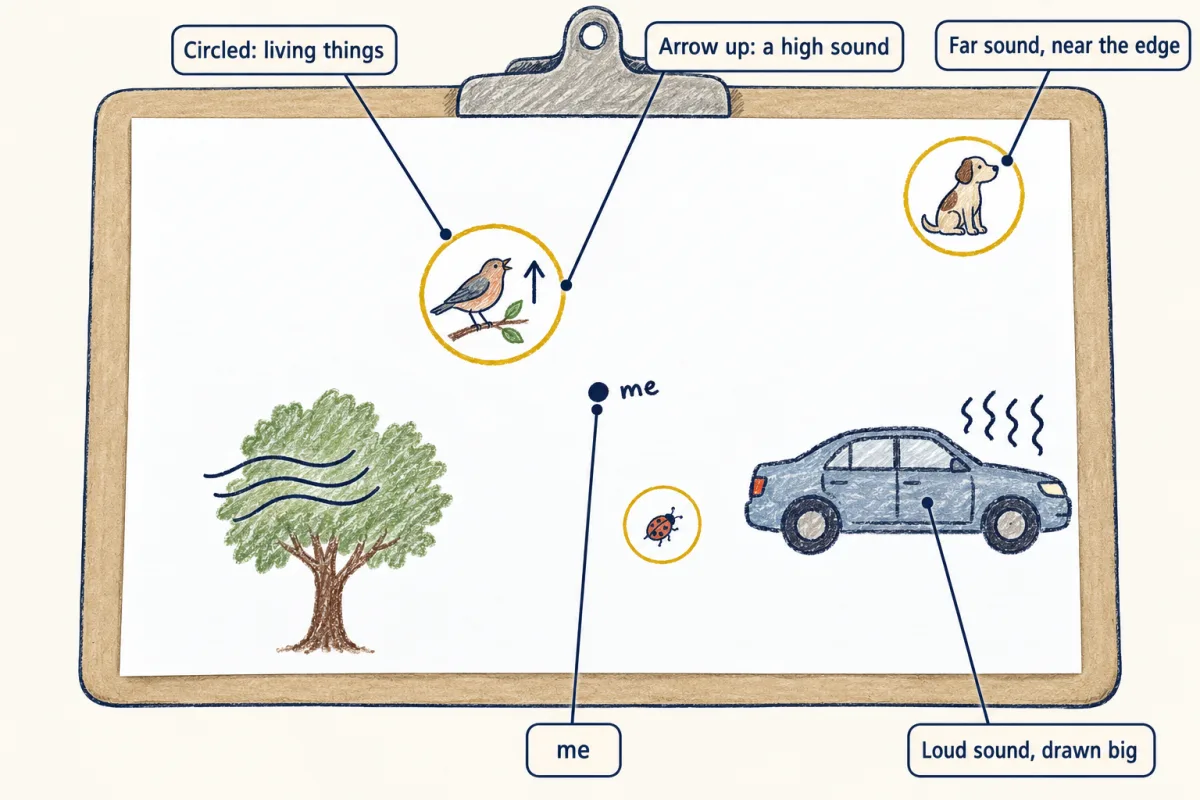
- Make a sound map. Put a dot in the middle of the paper and label it “me.” Your child draws each sound in the direction it came from. Near sounds go close to the dot and far sounds go near the edge. Loud sounds are drawn big, soft sounds small. Add an arrow pointing up for a high sound and down for a low one.
- Living or not. Circle the sounds made by living things, such as birds, insects, dogs and people. Talk about the tricky ones. Rustling leaves come from a tree, but the wind makes them move.
- Cupped-hand ears. Find one steady sound, such as an air conditioner, a fan or wind in the trees. If you use a fan, choose one with a guard, set it where it cannot tip, keep the cord out of the way, and have your child sit at least an arm’s length from it. Ask, “What will happen if you cup your hands behind your ears?” Your child faces the sound and cups both hands behind the ears, fingers together. Most children hear it louder.
- Turn around. Ask your child to predict first. Then, keeping the cupped hands in place, they turn their back to the sound. The sound usually gets fainter, because the funnels now point the wrong way.
- Watch animal ears (optional). If you have a cat or dog that your child knows well, stay beside your child, keep a little space from the pet, and watch its ears when someone quietly opens a cupboard nearby. Watch a horse only from outside its fence or stall, with an adult who knows the horse handling it. Do not startle the animal, and never walk behind a horse. Do not use a stranger’s or stray animal. Or look at pictures of animals with large ears and talk about what those ears might help with.
Questions to ask while you do it
Ask your child to guess first, then check.
- “How many sounds do you think we will hear? Was it more or fewer?”
- “Is that sound near or far? How can you tell without looking?”
- “I wonder if that loud sound is close. What else could make it loud?”
- “What do you think will happen when you cup your hands behind your ears?”
- “What will happen if you turn your back to the sound?”
- “What do you think a cat’s big ears help it do?”
What children often think
-
A child might say “It was silent.”
You could try Sit for two more minutes and count each sound on a finger. Listen for a hum, the wind or your own breathing. Places with no sound at all are rare. Quiet sounds are easy to miss until you stop and listen for them.
-
A child might say “Loud sounds are always close.”
You could try Ask about thunder or a plane high overhead. Are they close? Then whisper right next to them. How loud a sound seems depends on how loud it was to begin with and how far it travelled. Sounds get fainter as they travel.
-
A child might say “Animals hear just like us.”
You could try Ask, "Can you turn your ears like a cat?" Many animals can turn their outer ears toward a sound. Some hear differently too: dogs and cats hear high sounds that are too high for people to hear at all.
-
A child might say “I hear with the outside part of my ear.”
You could try Try the cupped hands again. The outside part catches sound and sends it inward, like a funnel. The parts that turn sound into signals for the brain are deep inside the head, behind a thin eardrum that is easy to hurt. That is why nothing ever goes in the ear.
Why it works
Sound is a vibration that travels through air. The part of the ear you can see is called the pinna. It funnels sound into the ear canal. Its shape boosts sounds from the front a little and dims sounds from behind. Cupped hands make a bigger funnel facing forward, so a sound in front seems louder and a sound behind seems fainter.
The brain finds direction partly by comparing the two ears. A sound from the left reaches the left ear a tiny bit sooner and a little louder than the right ear.
Cats have many small muscles that turn each pinna a long way, and each ear can move on its own. Horses can point each ear in a different direction. Large, movable ears are a physical adaptation, and turning them toward a sound is a behaviour. Features like these build up in a population over many generations. A single animal does not grow bigger ears because it needs them.
Easier and harder
Ages 5 to 7
Listen for one minute instead of two, and skip the arrows for high and low. Your child can draw each sound as a small picture and tell you whether it was loud or soft. For the cupped-hand test, ask only “louder or quieter?” Then let them be the one to say “Turn around” to you.
Ages 8 to 10
Do the sound map at two places or two times of day, then compare in a table: number of sounds, living, nonliving, loudest, highest. Make a bar graph of living and nonliving sounds. For a fair test of cupped hands, use the same sound, the same spot and three tries each way, and rate loudness from 1 to 5. Ask what other things could change the result.
If it doesn’t go as planned
If your child cannot sit still for two minutes, start with 30 seconds and build up. If a busy road drowns out everything else, map it from where you sit (do not move closer to the road), then try again at a quieter time or place. If the cupped hands seem to make no difference, pick a steady hissing or rustling sound, such as a fan or leaves in the wind, instead of a deep hum, and make sure the fingers are closed. Cupped hands boost middle and high sounds more than low ones.
Observation sheet
Observation sheet
My sound map
NameDate
Put yourself in the middle. Draw each sound where you heard it.
| Sound | Loud or soft? | High or low? | Living or nonliving? |
|---|---|---|---|
With cupped hands, the sound got:
When I turned around, the sound got:
biochemistrypedia.com · Biology Together
Finish line
Test yourself
4 questions
Practice and MCAT-style, with explained answers.
Next · Lesson 7
What Do Plants Need?
Does a plant really need sunlight if it already has water? Four cups and a cupboard give a fair answer.
Continue →