Biology Together · Unit 2: Our senses
Smell Detectives
You make covered smell cups from kitchen foods, and your child matches the pairs and names each smell. Then they taste two similar foods with the nose pinched and unpinched, and find out how much of what we call flavour comes from the nose.
Watch first Set Up: Smell Detectives · 0:49
Read the transcript of “Set Up: Smell Detectives”
Film transcript: Set Up: Smell Detectives
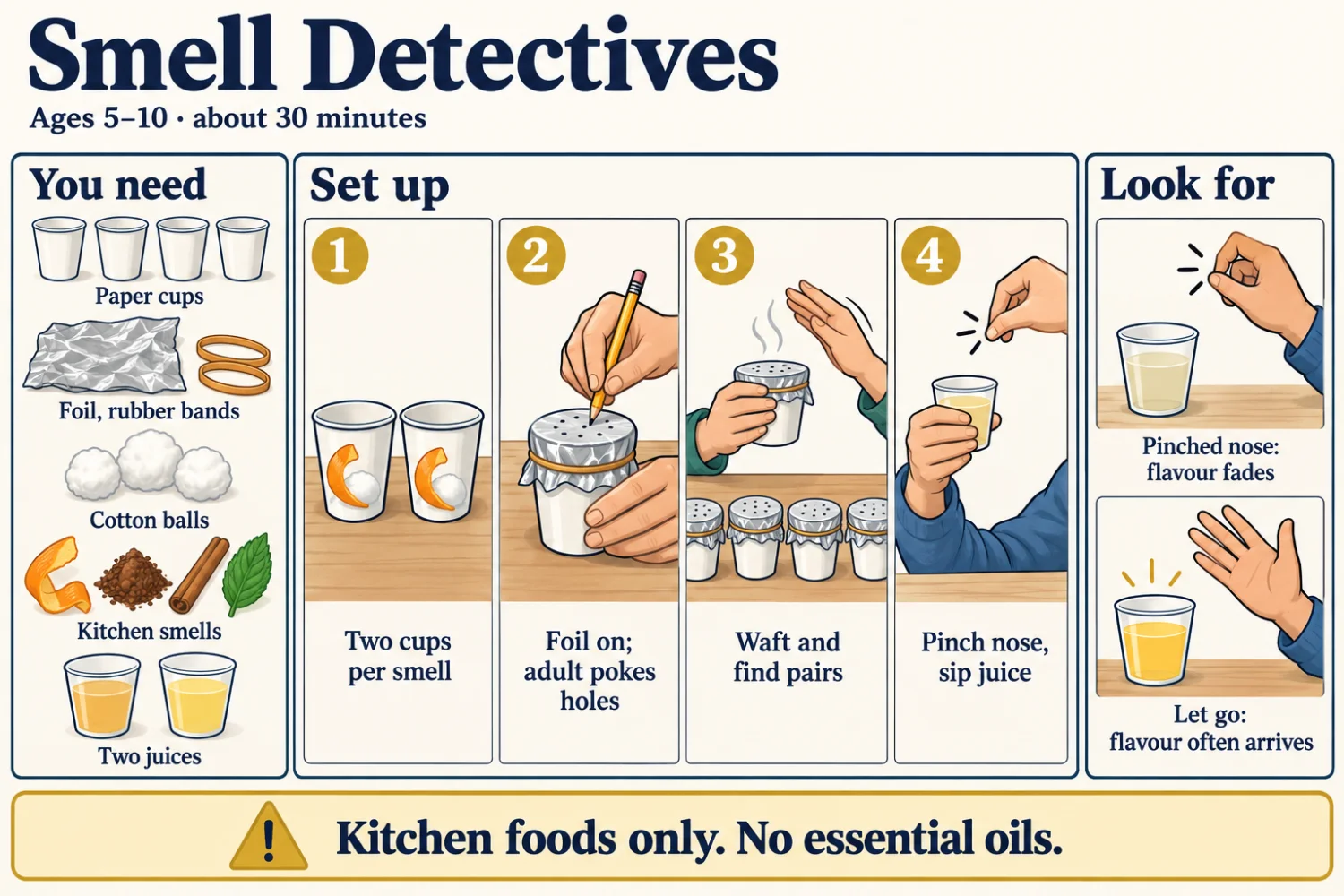
You need small paper cups you cannot see through, cotton balls, foil, and rubber bands. For smells, use kitchen foods like orange peel and a cinnamon stick. Add two juices that look alike. Put a cotton ball in each cup, and add one smell to two cups, so every smell has a pair. An adult covers each cup with foil and pokes the holes. Label the cups. Your child sniffs and matches the pairs. Later, they pinch their nose, sip juice, then let go. Many children notice more flavour arrive when the nose opens. Stay with your child. Use kitchen foods only. Check every food for allergies before tasting.
Before you start
- Hands-on time
- About 30 minutes
- Where
- Indoors
- Ages
- 5 to 10, with an easier and a harder version below
- Grown-up
- Stay with your child the whole time. You handle the extract bottles, poke the holes in the foil and serve the tasting foods.
What you need
- 6 to 10 small paper cups you cannot see through, plus 2 more for the vanilla test (5 for ages 8 to 10), foil, and rubber bands
- A cotton ball for each cup and a pencil for poking holes
- 3 to 5 kitchen smells: a strip of orange or lemon peel, a teaspoon of ground coffee, a cinnamon stick, a few drops of vanilla extract, a crushed fresh mint leaf
- A marker for labels A, B, C and so on
- Two juices that look alike, such as apple and white grape, 2 tablespoons of each in small cups
- A peeled apple and a peeled pear cut into 1 cm pieces (optional)
- Water for sips between tastes
- The printed observation sheet below (optional)
Virginia science standards SOL K.5 aSOL K.5 b
The big idea
A child walks into a kitchen and says, “Cookies,” before seeing a single one. The nose got there first.
Smell and taste are two of the five basic senses. The nose smells and the tongue tastes. Virginia’s kindergarten standard lists four tastes (sweet, sour, bitter, salty) and three smell words (strong, faint, pleasant). Your child uses all of them here.
The smell cups hide what each smell is, so the nose has to work alone. The taste test then shows how the two senses team up. When you chew, smells from the food rise from the back of the mouth into the nose. The brain blends them with taste into flavour, the full sense of what a food is like. Pinch the nose and much of that flavour fades, leaving mostly sweet or sour. Foods that seemed different can become hard to tell apart.
What to do
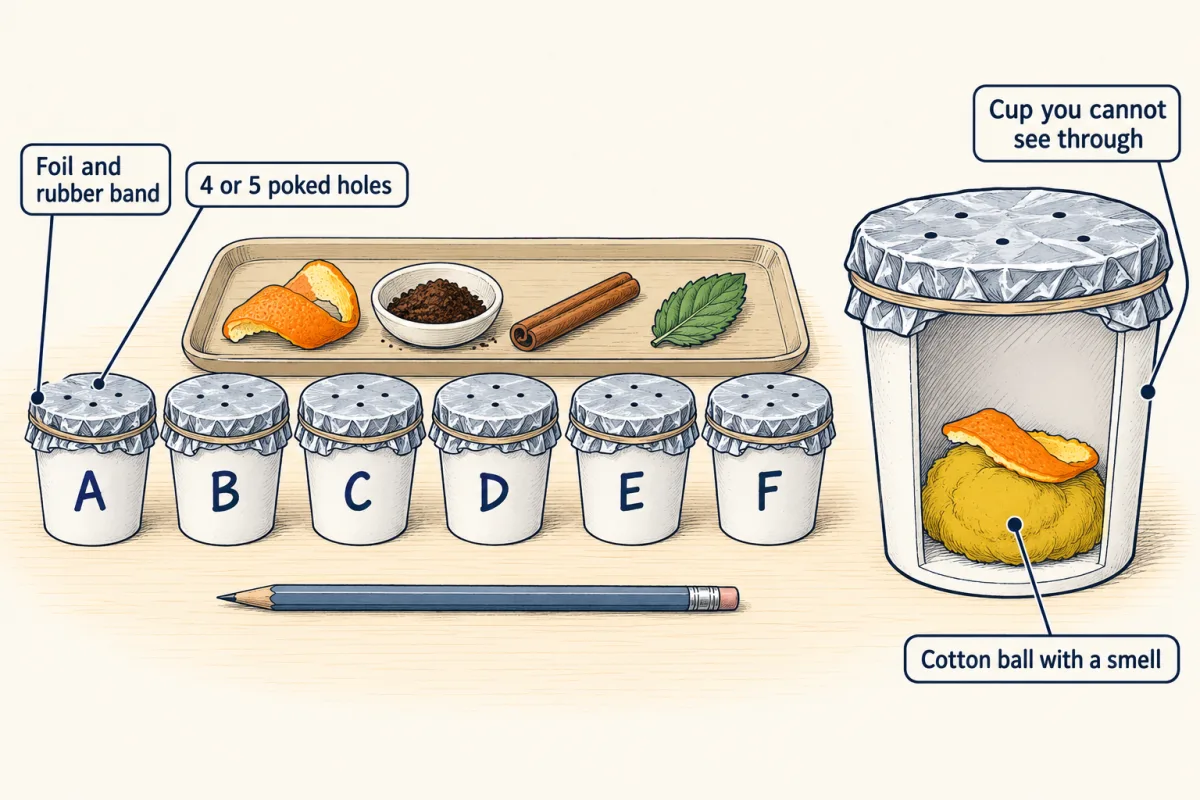
- Make the smell cups. Put a cotton ball in each cup. Add one smell to two cups each, so every smell has a pair: a strip of peel, a pinch of coffee, a piece of cinnamon stick, 3 drops of vanilla, a crushed mint leaf. You cover each cup with foil and a rubber band, and poke 4 or 5 holes with a pencil yourself, with the cup set on a table, not held in anyone’s hand. Label the cups with letters and keep a secret key.
- Learn to waft. Show your child how to hold a cup a hand’s width below the nose and wave the air toward the face. Sniff gently, never hard.
- Find the pairs. Mix up the cups. Your child smells each one and puts matching cups side by side. Ask for a describing word for each: strong or faint, pleasant or not.
- Name the smells. Now they guess what each smell is. Write the guesses, then peel back the foil to check. It is common to know a smell well and still not find its name.
- Strong or faint. You make two new vanilla cups, one with 1 drop and one with 6 drops. Ask, “Which will smell stronger?” Then check. Rest a minute between rounds, because a smell can seem fainter after many sniffs.
- Predict the taste test. For each child, you pour the two juices into separate small cups marked 1 and 2. Ask, “If you hold your nose, will you still know which juice is which?” Write the prediction.
- Pinch and taste. With eyes closed, your child pinches their nose, takes a small sip and holds it in the mouth. “Which juice is it? Hold up 1 or 2 fingers.” Then they let go of the nose while the juice is still there, and swallow before they say anything. Many children notice more flavour arrive when the nose opens. Sip water and repeat with the other juice, or with apple and pear pieces while your child sits still and you watch.
Questions to ask while you do it
Ask your child to guess first, then check.
- “I wonder which cup matches this one. What words describe it?”
- “What do you think will happen when we smell the 6-drop cup?”
- “If you hold your nose, will the juice still taste sweet?”
- “What do you think will happen when you let go of your nose?”
- “Why do you think food tastes different when you have a cold?”
- “Does everyone in the family like the same smells? How could we find out?”
What children often think
-
A child might say “You taste with your tongue only.”
You could try Try the pinched-nose test and ask what changed when they let go. The tongue senses sweet, sour, salty and bitter. Much of the rest of flavour comes from smell, and taste cells also sit on the roof of the mouth and in the throat.
-
A child might say “The tip of my tongue tastes sweet and the back tastes bitter.”
You could try Use a new clean cotton swab for each child: you dip it once in sugar water and touch it to the side of their tongue, then the tip, while they sit still. Throw it away afterwards. Is it sweet both times? The "tongue map" in old books is a myth. Every part with taste buds senses all the basic tastes.
-
A child might say “Smells are good or bad.”
You could try Ask each person at home to rate the coffee cup: nice, not nice, or in between. People often disagree. Smells can be strong or faint, sweet or sharp, and liking a smell is partly a personal thing.
-
A child might say “A stronger smell means there is more of it.”
You could try For one smell that is often true, as the 1-drop and 6-drop cups show. With different things, though, a little of one can smell stronger than a lot of another. Gas companies add a strong-smelling chemical to natural gas, which has no smell, so a leak can be noticed.
Why it works
Smell starts with smell-sensing cells high inside the nose. They respond to tiny particles, called molecules, that drift off things like orange peel or coffee. Smells reach these cells two ways: through the nostrils when you sniff, and from the back of the mouth when you breathe out while chewing. The second route is how food aromas join taste.
Taste buds on the tongue, the roof of the mouth and the throat sense a short list of qualities. Virginia’s kindergarten list is sweet, sour, bitter and salty. Scientists usually add a fifth, umami, a savoury taste found in foods like broth and cheese. Without smell, many foods taste bland. Flavour also includes texture, temperature and spicy heat, so the pinched-nose test does not remove every clue.
The tongue map, with sweet at the tip and bitter at the back, came from a misreading of a 1901 study. That study found only small differences in sensitivity across the tongue.
Easier and harder
Ages 5 to 7
Use three smells (six cups) with big differences, such as orange peel, coffee and mint. Show your child the real foods first, then hide them in cups and play “find the twin.” For the taste test, use one pair of juices and do it once. Your child can draw a face for each smell (happy, so-so, yuck) instead of writing.
Ages 8 to 10
Use five smells (ten cups) and add a fair test. Give each juice three times in random order. Each time, your child holds up 1 or 2 fingers for the juice with the nose pinched, then again after letting go, and swallows before talking. Count correct answers. Make a table and a bar graph: correct with nose pinched, correct with nose open. Ask them to rank five vanilla cups (1 to 5 drops) from faint to strong without looking at the labels.
If it doesn’t go as planned
If the smells are too faint, add more of the food and wait 10 minutes for the smell to build. If your child guesses the juices right with the nose pinched, the colours or textures may differ: cover the cups and close eyes, or switch to two juices that taste more alike. A child who will not taste can be the tester for an adult instead.
Observation sheet
Observation sheet
Smell detectives
NameDate
Smell each cup. Find its twin and guess what it is.
| Cup | Strong or faint? | Do I like it? | My guess | What it really was |
|---|---|---|---|---|
With my nose pinched, the juice tasted:
When I let go of my nose, the juice tasted:
biochemistrypedia.com · Biology Together
Finish line
Test yourself
4 questions
Practice and MCAT-style, with explained answers.
Next · Lesson 6
The Listening Walk
How many sounds are there in a quiet backyard? Two still minutes and a sound map help a child find out.
Continue →