Biology Together · Unit 1: Alive and growing
Like Their Parents, Not the Same
You and your child open pea pods, cut an apple and a pepper, and collect leaves from one plant. Your child lines up the seeds, brothers and sisters from one parent, and the leaves, measures them and finds ways they are alike and different. Then you look at pictures of animal families, including some whose babies look nothing like their parents.
Watch first Set Up: Like Their Parents, Not the Same · 0:45
Read the transcript of “Set Up: Like Their Parents, Not the Same”
Film transcript: Set Up: Like Their Parents, Not the Same
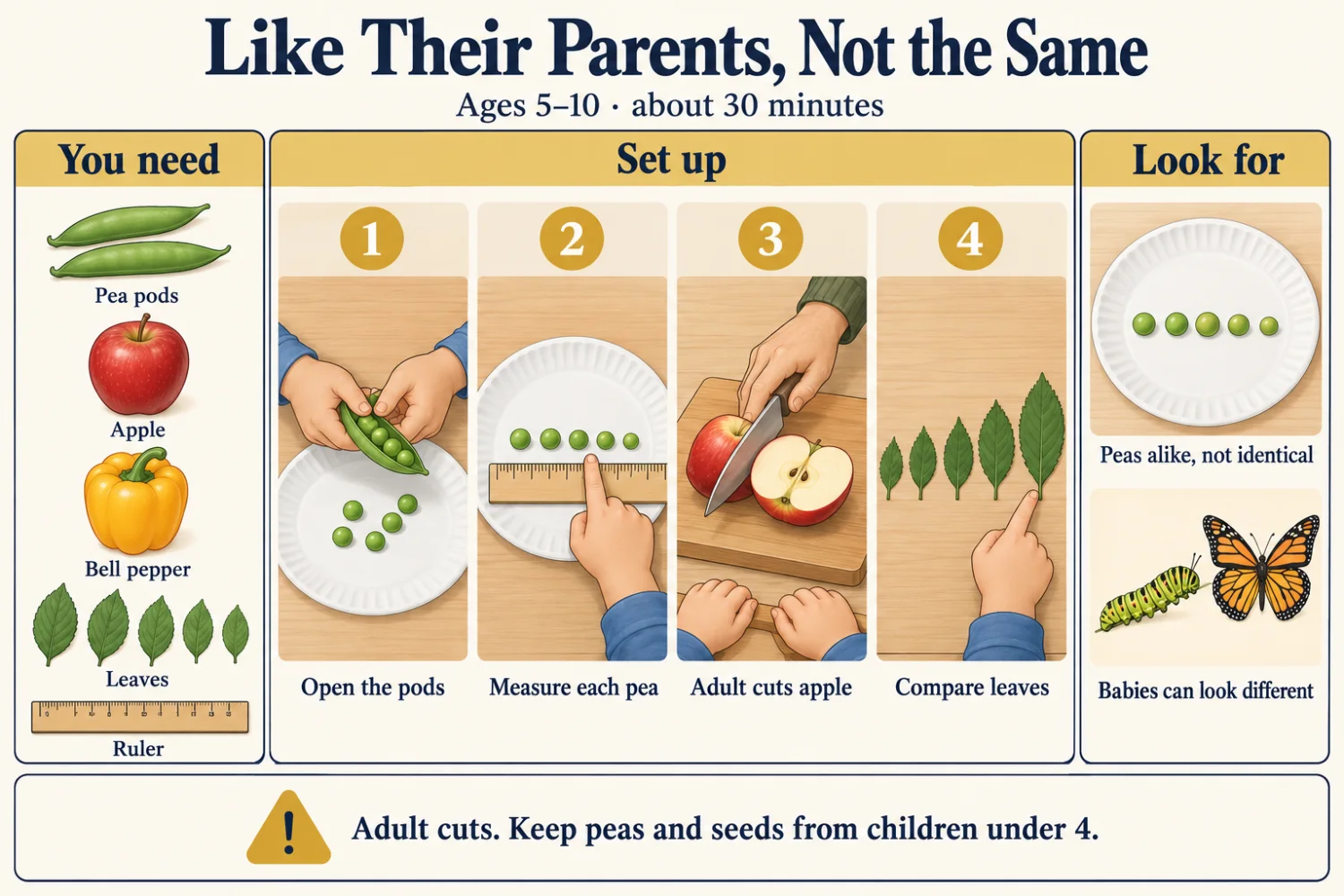
You need three or four fresh pea pods from the grocery store, an apple, a sweet bell pepper, a ruler, and leaves from one tree or shrub you know is safe to touch. Open each pod and line the peas up on a plate. Measure each pea across with a ruler. An adult cuts the apple and pepper so the seeds show. Later, look at pictures of animal families. Peas from one pod are alike, but not identical. Look for the biggest, the smallest, and any with a different shade. Stay with your child. An adult does all the cutting. Keep peas and seeds away from children under four.
Before you start
- Hands-on time
- About 30 minutes
- Where
- Indoors
- Ages
- 5 to 10, with an easier and a harder version below
- Grown-up
- Stay with your child the whole time. You do all the cutting, and you keep peas and seeds away from children under 4.
What you need
- 3 or 4 fresh pea pods from the grocery store (garden peas, sugar snap peas or snow peas)
- 1 apple and 1 sweet bell pepper
- 5 or 6 leaves picked from one tree or shrub you know is safe to touch (not poison ivy, poison oak, poison sumac, oleander, yew, azalea or rhododendron, and not a dieffenbachia or philodendron houseplant, whose sap irritates skin and eyes)
- A ruler marked in centimeters, or a piece of string and scissors
- A cutting board and a knife (adult only)
- A paper plate and a pencil
- Pictures of animal families from a library book: a litter of puppies or kittens, and a caterpillar with a butterfly or a tadpole with a frog
Virginia science standards SOL K.7 cSOL K.7 bSOL 2.4 a
The big idea
Open a pea pod and the peas look like a row of twins. Line them up next to a ruler, though, and they are not the same. One is bigger. One is paler. One is tiny and flat.
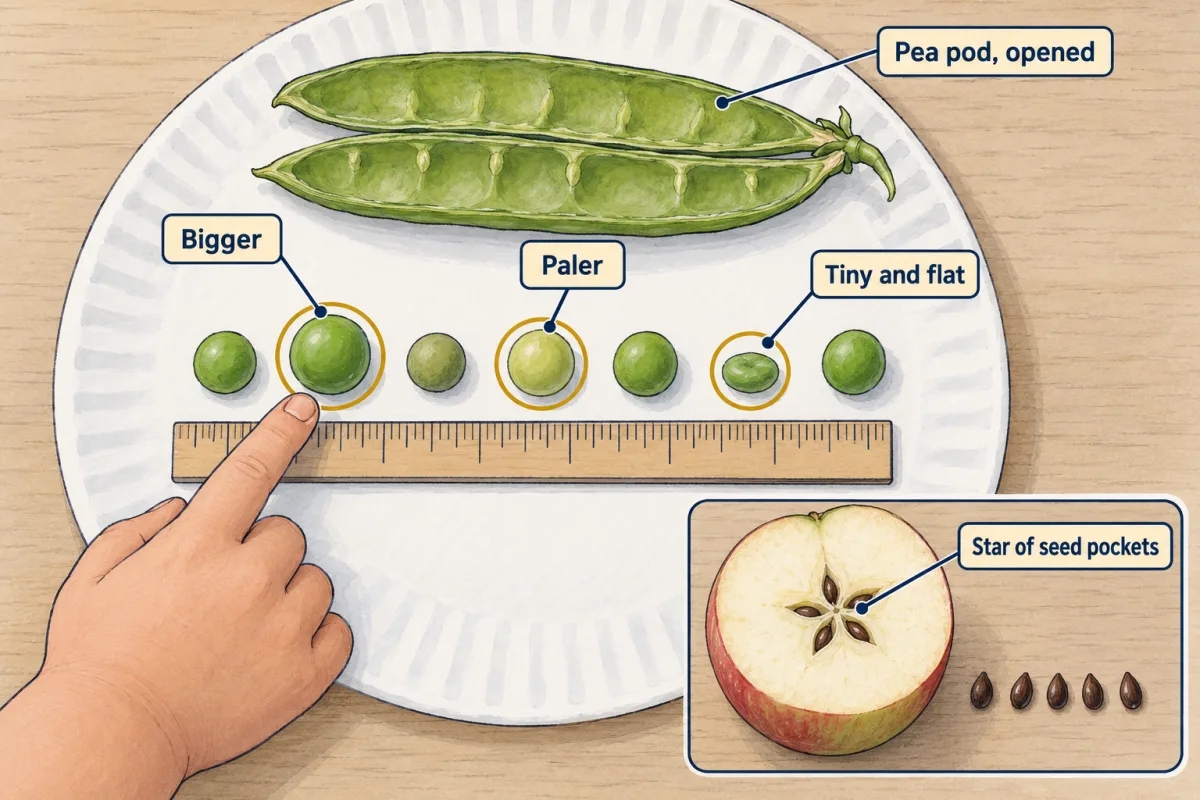
All the peas in a pod came from the same parent plant. They are its offspring, the young that a living thing makes. Offspring are like their parents, and like each other, but not identical. Seeds from one apple or one pepper show the same thing. Leaves are parts of a plant, not offspring, but leaves from one plant are never exactly alike either.
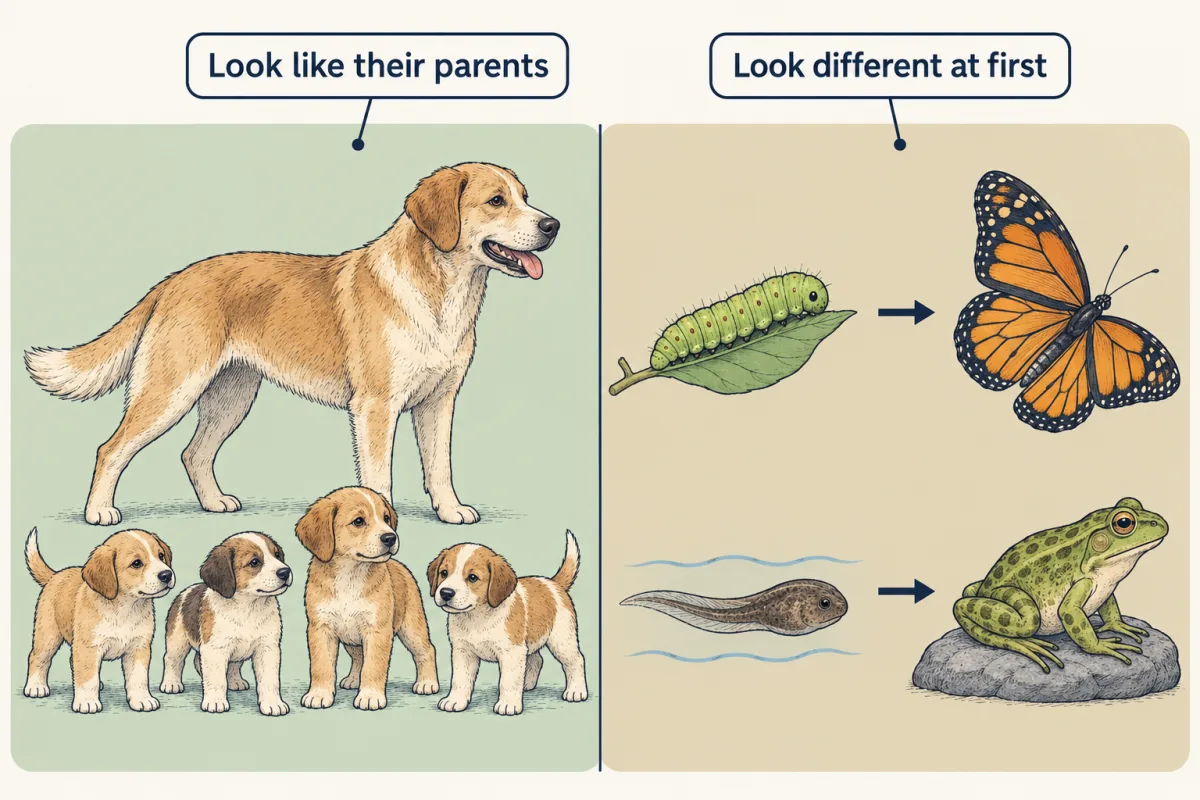
Animals work the same way. Puppies in one litter share many features, yet each one is a little different. Some babies look like small versions of their parents from the start. Others, like caterpillars and tadpoles, look very different at first and change as they grow.
Virginia’s kindergarten standard asks children to notice that offspring are similar but not identical. Grade 2 adds the idea that some animals go through stages. This activity keeps to plants and animals on purpose. It does not compare children with their own parents.
What to do
- Predict. Hold up a closed pea pod. Ask, “What will the peas inside look like? Will they all be the same?” Write down your child’s guess.
- Open the pods. Let your child split each pod with their thumbs. Line up the peas from one pod on a paper plate, in the order they sat in the pod. Count them, then count the peas in another pod. Pods from the same bag often hold different numbers.
- Measure. Measure each pea across with a ruler. Without a ruler, wrap string around each pea, mark the length and compare the marks; that length is about three times the pea’s width. Most garden peas are about 1 cm across or a little smaller. Ask your child to find the biggest, the smallest, and any that are a different shade or shape.
- Cut the apple and pepper. Lay the apple on its side on a board that does not slide, hold it steady with your fingers curled away from the blade, and cut it across its middle to show a star of seed pockets. Cut the pepper in half from top to bottom. Have your child pick out 5 seeds from each and line them up. Ask, “How are they the same? How are they different?”
- Compare leaves from one plant. Lay out 5 or 6 leaves from the same plant. Look at shape, size, color, edges and veins. Measure the longest and the shortest. They all clearly come from one kind of plant, yet no two match exactly.
- Look at animal families. Find a picture of a litter of puppies or kittens with their mother. Ask, “How do the babies look like the mother? How are they different from her and from each other?” Look for coat color, spots, ear shape and size. Keep the talk to the animals. Do not ask a child which parent they look like: many children are adopted, fostered, donor-conceived or live in blended families, and the question can hurt.
- Babies that look different. Show a caterpillar and a butterfly, or a tadpole and a frog. Ask, “Could this baby belong to that grown-up?” Then sort your animal pictures into two groups: babies that look like their parents, and babies that look different at first.
With a class, give each table of four one pod, one apple half and one set of leaves, and share the animal pictures.
Questions to ask while you do it
Ask your child to guess first, then check.
- “I wonder if all the peas in this pod are the same size. Which one do you think is biggest?”
- “What do you think we will find if we open another pod? The same number of peas?”
- “These seeds all came from one apple. Do you think they will look exactly alike?”
- “I wonder what a kitten from this mother cat will look like. What will be the same?”
- “What do you think a tadpole turns into? How could we find out?”
- “If we planted two peas from this pod, do you think the plants would be twins?”
What children often think
-
A child might say “Babies are exact copies of their mom and dad.”
You could try Look at the kitten picture together and ask, "Are all the kittens the same? Are they the same as their mother?" Count the differences you can find. Babies are like their parents but not identical, and brothers and sisters differ from each other too.
-
A child might say “All the peas in a pod are the same.”
You could try Ask your child to prove it with the ruler. Line the peas up from biggest to smallest. Many pods have at least one pea that is smaller, paler or a different shape. They are alike in many ways, but not the same.
-
A child might say “A caterpillar is a different animal from a butterfly.”
You could try That makes sense from how they look. Ask, "Where do caterpillars come from? What do they become?" A butterfly lays eggs, a caterpillar hatches, and later it turns into a butterfly. It is the same animal at a younger stage.
-
A child might say “The biggest pea came from the biggest parent.”
You could try Ask, "Where did all the peas in this pod come from?" They all came from the same plant, yet they are different sizes. So the size of a pea does not come from the size of the parent. Much of it comes from how much food reached each pea as it grew.
Why it works
A trait is a feature such as color, shape or size. Parents pass many traits on to their offspring, which is why peas make peas and cats make cats. In most animals and many plants, each offspring starts from two parents’ contributions, and each one usually gets a different mix. That is one reason brothers and sisters differ. How and where each one grows matters too.
Pea plants mostly pollinate themselves. After many generations of this, the peas in a store-bought pod share nearly the same inheritance. They still differ. Some differences likely come from how each pea grew, such as how much food and water reached it. Seeing a difference does not tell you whether it was inherited.
Apples show the opposite case. Most apple trees need pollen from a different apple variety. A seed from a Red Delicious apple does not grow into a Red Delicious tree, so growers copy favorite trees by grafting. Animals such as butterflies and frogs go through metamorphosis, a big change in body form as they grow.
Easier and harder
Ages 5 to 7
Use one pea pod and the animal pictures only. Skip the ruler: have your child line peas up from biggest to smallest and say what is the same and what is different. Ask for two “same” and two “different” ideas each time. Your child can draw instead of write. Kindergartners do not need to name the stages of a life cycle. Just notice that some babies look different from their parents.
Ages 8 to 10
Measure every pea from three pods in millimeters and record them in a table. Make a bar graph of how many peas fall in each size group. You cut two more apples of the same kind, and your child compares the seed counts. Then have your child build a simple key: write yes-or-no questions that split five leaves from the same plant into smaller groups until each leaf is on its own. Talk about which differences might be inherited and which might come from growing conditions.
If it doesn’t go as planned
If the pods are flat with tiny peas, try sugar snap peas or a different store. Snow peas hold very small peas, so look closely or use a magnifying glass. If every pea looks the same, measure more carefully or compare color under bright light. If your child steers toward their own family, bring the talk gently back to the peas and the kittens.
Observation sheet
Observation sheet
Like their parents, not the same
NameDate
Look closely. Write or draw how they are the same and how they are different.
| Pea | Size (cm) | Color | Same or different? |
|---|---|---|---|
Two ways my peas were the same:
Two ways my peas were different:
biochemistrypedia.com · Biology Together
Finish line
Test yourself
4 questions
Practice and MCAT-style, with explained answers.
Next · Lesson 4
The Mystery Feely Bag
Can you tell what something is without looking? A bag of hidden objects lets a child find out what skin can sense.
Continue →