Biology Together · Unit 2: Our senses
The Mystery Feely Bag
You hide everyday objects in a pillowcase, and your child finds them using touch alone. Along the way they describe each one (rough, smooth, hard, soft, warm, cold), compare what touch tells them with what their eyes tell them, and sort describing words to the five senses. Older children test which parts of their skin feel the finest detail.
Watch first Set Up: The Mystery Feely Bag · 1:04
Read the transcript of “Set Up: The Mystery Feely Bag”
Film transcript: Set Up: The Mystery Feely Bag
Your skin is for feeling. Even when you cannot see, your hands tell you if something is rough or smooth, hard or soft, warm or cold. Touch is one of your five senses. You need a pillowcase and eight to ten objects with different textures. Keep a metal spoon, a wooden spoon, and a spoon from the fridge aside for later. Pack the bag yourself. Your child feels one object without looking and gives three describing words, then guesses. Later, add the metal and wooden spoons. Most children find the metal spoon feels colder, though both are at room temperature. A cold spoon can feel wet, so check it with a towel. Touch cannot tell colour. Only your eyes can.
Stay with your child and check every object. Use objects too big to fit inside a toilet paper tube. Nothing sharp, hot, frozen, breakable, or alive goes in the bag.
Before you start
- Hands-on time
- About 25 minutes
- Where
- Indoors
- Ages
- 5 to 10, with an easier and a harder version below
- Grown-up
- Stay with your child the whole time. You pack the bag and check every object; you also handle the paper clip in the harder test.
What you need
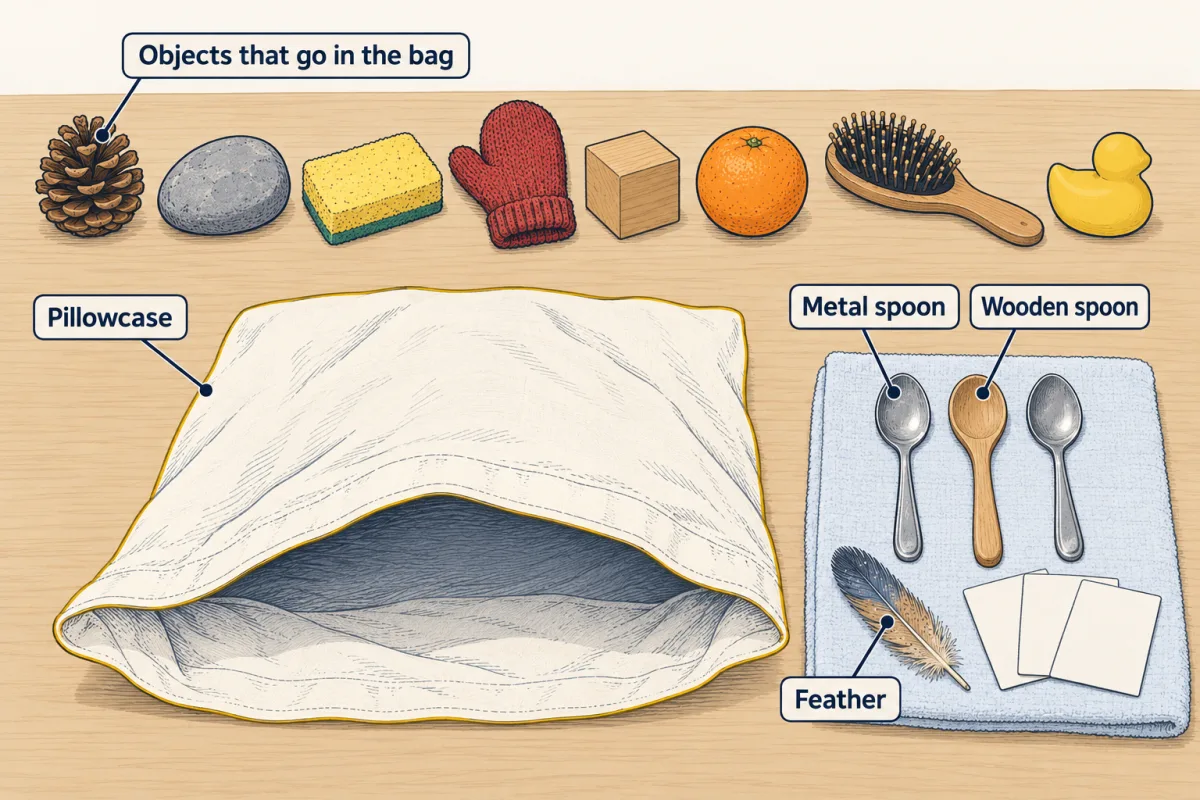
- A pillowcase, cloth bag or large clean sock
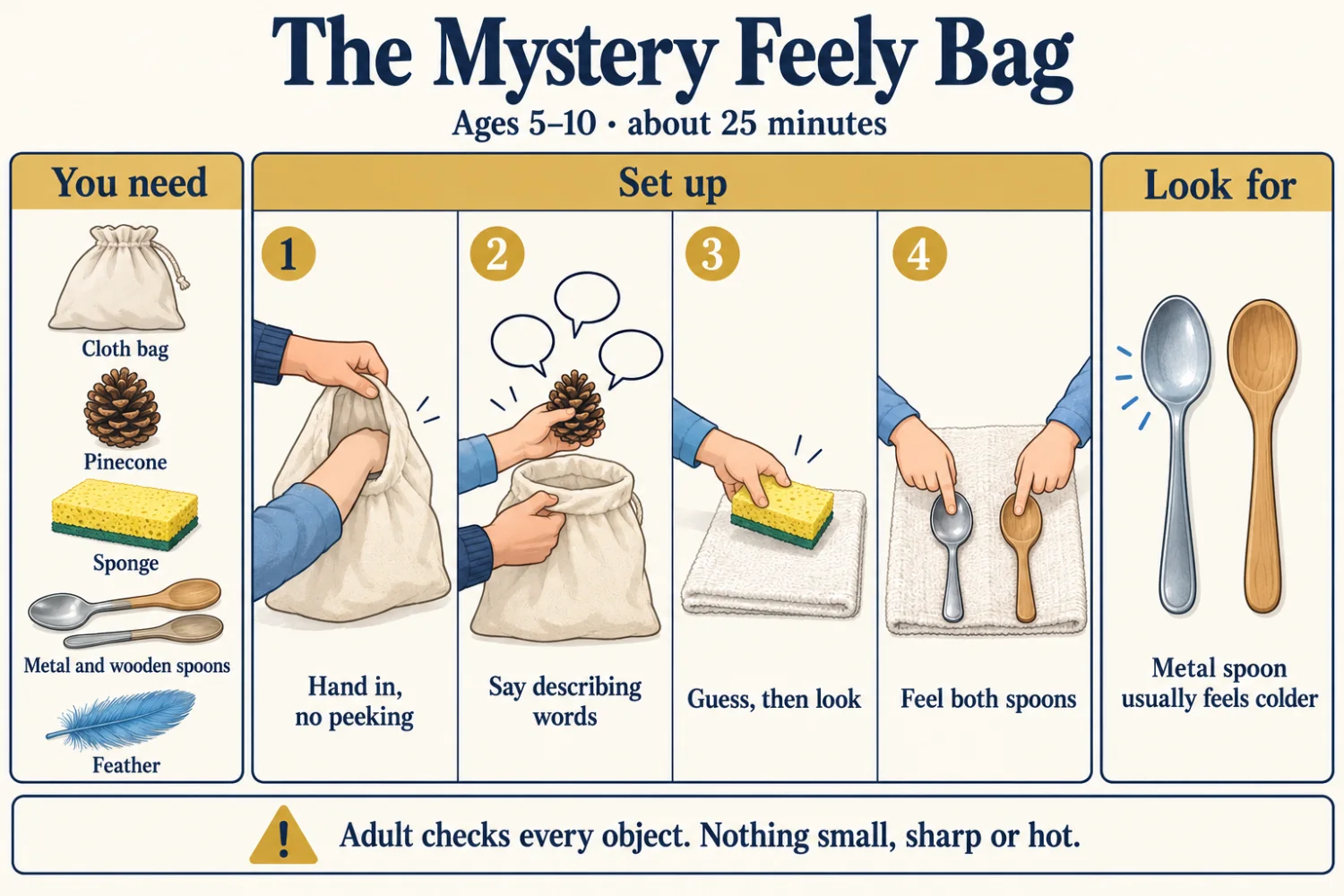
- 8 to 10 objects too big to fit inside a toilet-paper tube, with different textures: a pinecone, a large smooth stone, a new kitchen sponge, a wool mitten, a wooden block, an orange, a clean hairbrush, a clean, dry bath toy
- A metal spoon and a wooden spoon
- A second metal spoon, kept in the fridge for 30 minutes (not the freezer)
- A craft-store feather or a soft paintbrush
- Index cards or paper scraps for describing words, and a pencil
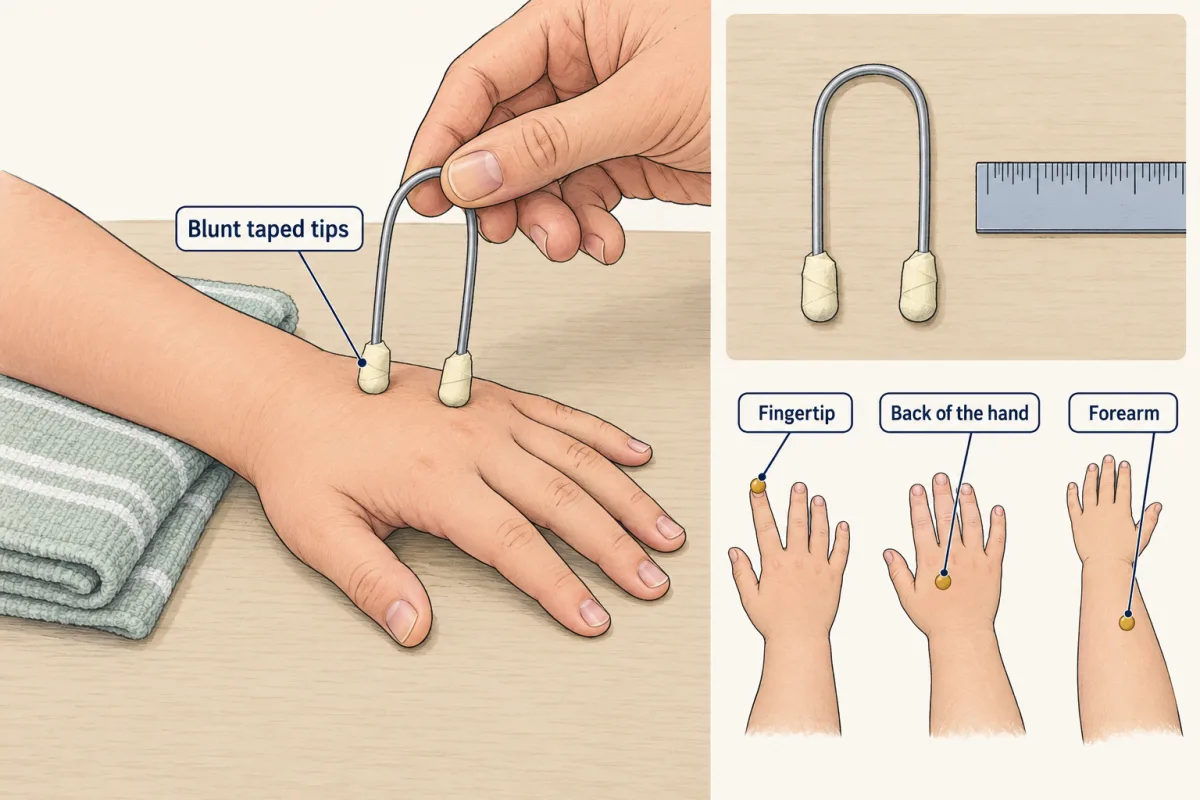
- A large paper clip, tape and a ruler (ages 8 to 10)
- The printed observation sheet below (optional)
Virginia science standards SOL K.5 aSOL K.5 b
The big idea
Children reach into pockets and toy boxes and know what they have grabbed without looking. That everyday skill is the sense of touch at work.
People have five basic senses, and each goes with a body part: eyes for sight, ears for hearing, nose for smell, tongue for taste and skin for touch. Skin can tell rough from smooth, hard from soft, and warm from cold. It covers the whole body, and fingertips feel finer detail than most of it.
The feely bag takes sight away, so touch has to do the job alone. Your child finds out what touch can tell them (shape, texture, warm or cold, heavy or light) and what it cannot (colour, words printed on a label). Then they sort describing words to the senses they belong to.
Virginia’s kindergarten standard asks children to match each sense to its body part and to use the senses to describe things. It gives word lists for each sense, and this activity uses them.
What to do
- Fill the bag. Out of sight, put 8 to 10 objects in the pillowcase. Choose a mix: rough and smooth, hard and soft, heavy and light. Keep the two room-temperature spoons and the fridge spoon aside for later.
- Feel and describe. Your child puts one hand in and holds one object without looking. Before guessing, they give you three describing words, such as “bumpy, hard, light.” Write the words down.
- Guess, then look. Now they guess and pull it out. Ask, “What did your hand know that your eyes don’t?” and “What do your eyes know that your hand didn’t?” Touch knows warm and heavy; eyes know colour.
- Two spoons. Put the metal spoon and the wooden spoon in the bag. Ask, “They have been in the same room all day. Will one feel colder?” Then your child feels both. Most children find the metal one feels colder. Both are at room temperature, but metal draws heat out of fingers faster.
- The fridge spoon. Dry the cold spoon with a towel in front of your child, then hand it to them with their eyes closed. Ask, “Is it wet or dry?” Some children say wet. Wipe it on a dry towel together and check the towel. If it stays dry, the wet feeling came from the cold. Water from the air can also form on a cold spoon, the way it does on a cold glass, especially on a humid day; if the towel gets damp, that is a real finding too.
- Feel with other skin. With your child’s eyes closed, brush the feather on a fingertip, then the back of the hand, an elbow and a foot. Ask, “Can you feel it? Where can you feel it best?” Any answer is fine. Hairy skin, like the back of the hand, is also very good at noticing a light brush. Fingertips stand out most at telling fine detail apart.
- Sort the words. Write sense words on cards: sweet, sour, bitter, salty, rough, smooth, hard, soft, cold, warm, loud, high, low, bright, dull, strong, faint. Lay out five cards labelled eyes, ears, nose, tongue and skin, and sort. “Soft” fits both skin and ears, so it can go in two places.
- Two points or one (ages 8 to 10). You unbend a large paper clip into a U with the ends 1 cm apart and tape over each cut end so the tips are blunt. With your child’s eyes closed, you touch either one end or both ends to a fingertip, then the back of the hand, then the forearm. Mix one and two at random. They say “one” or “two.” Repeat with the ends 2 cm and then 4 cm apart.
Questions to ask while you do it
Ask your child to guess first, then check.
- “I wonder what this is. What three words describe it before you guess?”
- “What do you think will happen if we swap the metal spoon for the wooden one?”
- “Is this spoon wet or just cold? How could we find out without looking?”
- “Can you feel the feather on your elbow? Where do you think you will feel it best?”
- “What do you think will happen when I touch your arm with two points close together?”
- “Which sense would tell you this orange is orange? Which would tell you it smells sweet?”
What children often think
-
A child might say “You can only feel with your hands.”
You could try Ask them to close their eyes while you brush a feather on the back of the hand, an elbow and a foot. "Could you feel that?" Skin covers the whole body and senses touch everywhere. Fingertips just notice more detail than most other skin.
-
A child might say “The metal spoon is colder.”
You could try Ask where both spoons have been all day. They are the same temperature. Metal carries heat away from warm fingers faster than wood does, and skin feels that heat loss as cold.
-
A child might say “Cold things are wet.”
You could try Wipe the fridge spoon on a dry towel together and check the towel. Skin has no sensor for wetness. The brain guesses "wet" from cold plus touch, so a cold, dry spoon can fool it.
-
A child might say “Each sense works by itself.”
You could try Hand them the orange in the bag and ask what it is. Then let them sniff the bag. Did the smell help? Senses often work together. Scientists also count more than five, such as balance and knowing where your arms are.
Why it works
Skin holds several kinds of sensors called receptors, special cells or nerve endings that each respond mainly to one kind of change. Some respond to pressure and vibration. Others respond to warmth, to cold, or to damage that we feel as pain.
Fingertips have many touch receptors packed close together. That is why they can tell two points apart when the points are only a few millimetres apart. On the forearm, the points often need to be several centimetres apart before they feel like two, and the back of the hand falls between the palm and the forearm. Exact numbers vary between people and with how the test is done.
Skin does not measure the temperature of an object directly. It senses its own temperature, which drops faster when heat leaves it quickly. Metal pulls heat away much faster than wood, so it feels colder at the same temperature. Skin also has no sensor for wetness. Research suggests the brain judges wetness from cold and touch signals together, which is why a cold, dry spoon can feel damp.
Easier and harder
Ages 5 to 7
Use five or six objects with big differences: a pinecone, a sponge, a stone, a mitten, an orange. Ask for one describing word instead of three. For the word sort, use picture cards (an eye, an ear, a nose, a tongue, a hand) and read the words aloud. Skip the two-point test. Your child can draw the object they liked best instead of writing.
Ages 8 to 10
Do the two-point test as a fair test: same paper clip, same gentle press, ten tries on each spot with one or two points mixed at random. Count correct answers and make a bar graph for fingertip, back of hand and forearm. Measure, with a ruler, the smallest gap that still feels like two on each spot. More tries, such as a gap under 1 cm and the toe, are in Going deeper.
If it doesn’t go as planned
If your child peeks, turn it into a rule they enforce: they can close their eyes and you hold the bag. If guessing gets too easy, use objects of the same shape, such as a tennis ball, an orange and a smooth stone. In the two-point test, children sometimes say “two” for a single point. That is normal. It is why you mix one and two points and count correct answers.
Going deeper
About the toilet-paper-tube check
The tube is a bit wider and longer than the official under-3 test cylinder, so it is a cautious check.
More two-point tries
On a fingertip, also try a gap smaller than 1 cm, such as 5 mm. Ask them to predict how a toe will compare first, then test only the toe, never the lips or face.
Observation sheet
Observation sheet
The mystery feely bag
NameDate
Feel each thing without looking. Write or draw what you find.
| Object number | Words my hand found | My guess | What it really was |
|---|---|---|---|
Where on my skin I felt the feather best:
The two points felt like one point on my:
biochemistrypedia.com · Biology Together
Finish line
Test yourself
4 questions
Practice and MCAT-style, with explained answers.
Next · Lesson 5
Smell Detectives
Why does food taste so dull when you have a cold? Smell cups and a pinched-nose test help a child find out.
Continue →