Life Science · Unit 7: Heredity
Reproduction and Meiosis
Why does a strawberry runner grow into a copy of its parent, while brothers and sisters come out different? You sort model chromosome pairs into sex cells and compare one-parent and two-parent reproduction, then read real chromosome numbers for nine plants and animals. Afterwards you can explain what meiosis does, why sex cells carry half the chromosomes, and why sexual reproduction makes variety.
Where this lesson sits
- Virginia SOL LS.10 b
- Virginia SOL LS.2 d
- Practices LS.1 c, LS.1 d, LS.1 e
Essential question: Why don't I look exactly like my parents, or like my brothers and sisters?
-
Life Science (grade 7) LS.10 b, LS.2 d You are here
This lesson
-
Biology
Preview it at high school level
In Biology you will learn the steps of meiosis. The cell copies its chromosomes once and then divides twice. The first division pulls apart the two chromosomes of each pair. The second pulls apart the two copies of each chromosome. Up to four cells form. You will also meet crossing over, when the two chromosomes of a pair swap matching pieces, so a chromosome can carry a new mix of alleles. Random fertilization, which egg meets which sperm, adds more variety. You will count how many mixes are possible, and see what happens when chromosomes fail to separate.
-
Biology II Biology II: Genetics, GEN.4 a-c; Advanced Topics, BIOII.4 a and b
Preview where it goes next
In Virginia’s Biology II courses, the Genetics course names the stages of meiosis and studies three sources of variety: crossing over, independent assortment of chromosome pairs, and random fertilization. It also looks at nondisjunction, when chromosomes fail to separate, and what it causes, such as an extra copy of chromosome 21. Advanced Topics returns to these same sources of variety and to nondisjunction, and adds the kinds of mutations that change chromosomes and genes.
-
College
Watch first Meiosis Makes Each Mix Different · 2:34
A strawberry plant sends a thin stem out along the ground. Where it touches the soil, it can grow roots and become a new plant that carries the same genetic information as its parent. Brothers and sisters have the same two parents, yet they usually look different. Both are reproduction. So why does one make copies and the other make differences?
What do you think? Decide before you read.
-
Scientists disagree: Traits are passed on as separate units called genes. In the 1850s and 1860s, Gregor Mendel crossed yellow-seeded and green-seeded peas. Green seeds vanished in the first offspring, then came back in the next generation. A blend could not come apart again like that.
What scientists think
Scientists disagree: Traits are passed on as separate units called genes. In the 1850s and 1860s, Gregor Mendel crossed yellow-seeded and green-seeded peas. Green seeds vanished in the first offspring, then came back in the next generation. A blend could not come apart again like that.
-
Scientists disagree: Scientists count chromosomes in stained cells under a microscope. A typical human body cell has 46. An egg or sperm normally has 23. If sex cells had 46, a fertilized egg would have 92, and the number would double every generation.
What scientists think
Scientists disagree: Scientists count chromosomes in stained cells under a microscope. A typical human body cell has 46. An egg or sperm normally has 23. If sex cells had 46, a fertilized egg would have 92, and the number would double every generation.
-
Scientists disagree: Each child grows from a different egg and a different sperm. Sex cells usually get different mixes of the parent’s chromosomes, so brothers and sisters usually get different mixes. Identical twins come from one fertilized egg, so they share nearly the same DNA.
What scientists think
Scientists disagree: Each child grows from a different egg and a different sperm. Sex cells usually get different mixes of the parent’s chromosomes, so brothers and sisters usually get different mixes. Identical twins come from one fertilized egg, so they share nearly the same DNA.
Explore: sort chromosomes into sex cells
In the sorting model, each parent cell has one, two or three pairs of chromosomes drawn as coloured bars. Each bar has a letter, such as B or b, for its version of a gene. You choose asexual or sexual reproduction, pick how many pairs, and make 8 offspring. A counter shows how many different mixes appear.
Made up for this sketch, not measured: every parent is drawn with two different alleles on each pair (B and b, D and d, G and g), as in the lesson’s count of mixes. Each bar stands for one chromosome; a copied chromosome is still one chromosome, and the copying before meiosis is not drawn. Pairs split by chance with a 50 percent chance for each bar. The steps of meiosis and the swapping of pieces are left out. Two offspring count as the same mix only when every bar matches, including which parent it came from (left bar from Parent 1, right bar from Parent 2). Rare changes in DNA are not drawn. A human body cell has 46 chromosomes in 23 pairs; this sketch shows only 1 to 3 pairs.
Rule to keep: in meiosis each pair splits by chance, so a sex cell gets one chromosome from each pair, and asexual offspring are genetically the same as the one parent. This is a sketch of the logic, not a measurement.
Try this.
- Predict whether 8 offspring from asexual reproduction will match each other. Then make them and compare.
- Switch to sexual reproduction with 1 pair. Predict what share of sex cells will carry B. Make offspring several times and watch the counter.
- Predict whether 3 pairs will give more different offspring than 1 pair. Then test it.
Explain: one parent or two
- asexual reproduction
- sexual reproduction
- offspring
- sex cells
- body cells
- meiosis
- fertilization
- chromosome pair
- allele
A species lasts only if its members reproduce. Every living thing alive today came from living things before it. Reproduction passes genetic information from parents to their offspring, the new living things made by reproduction.
Asexual reproduction is reproduction with one parent, where the offspring are genetically the same as the parent. Examples:
- a strawberry plant growing new plants from its runners
- a potato growing new plants from its eyes
- a spider plant making small plantlets
- yeast forming a bud that breaks off
- a bacterium splitting into two
The copies are not always perfect. Rare changes in DNA can still happen.
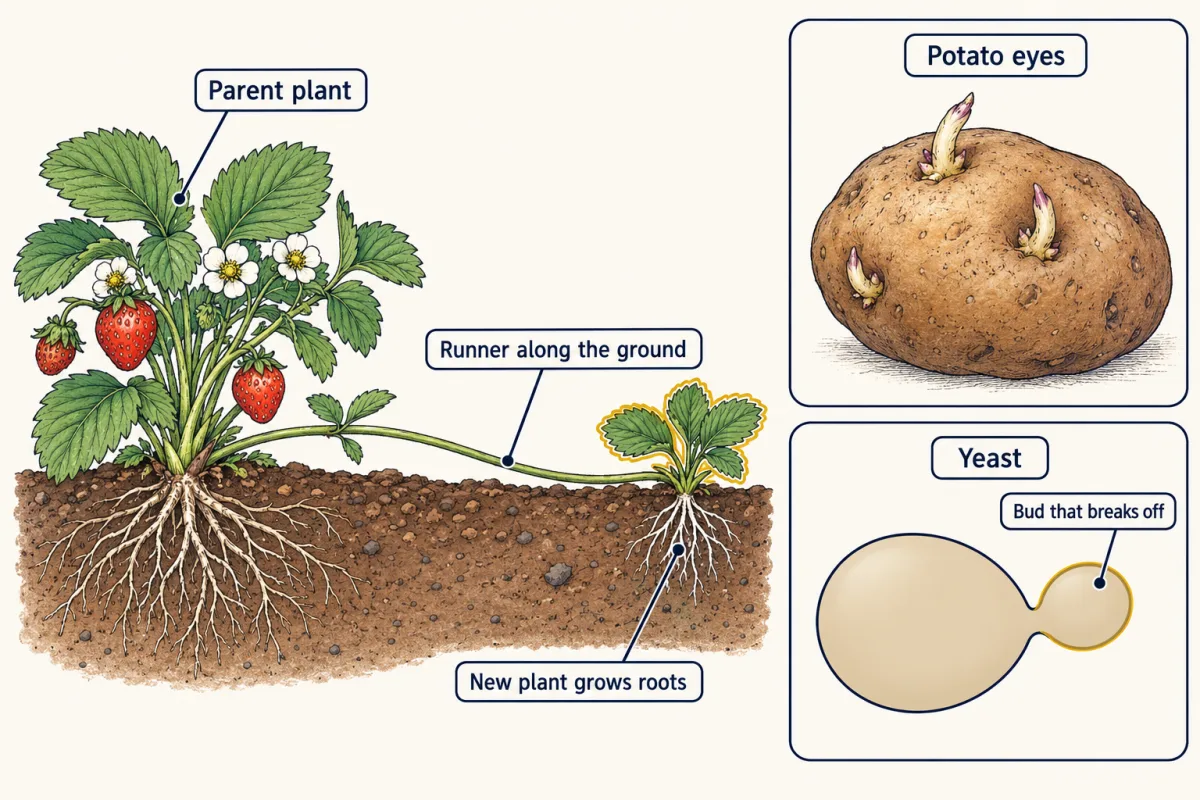
Sexual reproduction is reproduction where two sex cells join, usually one from each of two parents. Sex cells are the cells that carry genetic information to the next generation: sperm and egg cells in animals, and cells in pollen and egg cells in plants. Body cells are all the other cells, such as skin, leaf or muscle cells. Offspring from sexual reproduction resemble their parents but are not copies of them.
Explain: meiosis makes sex cells with half
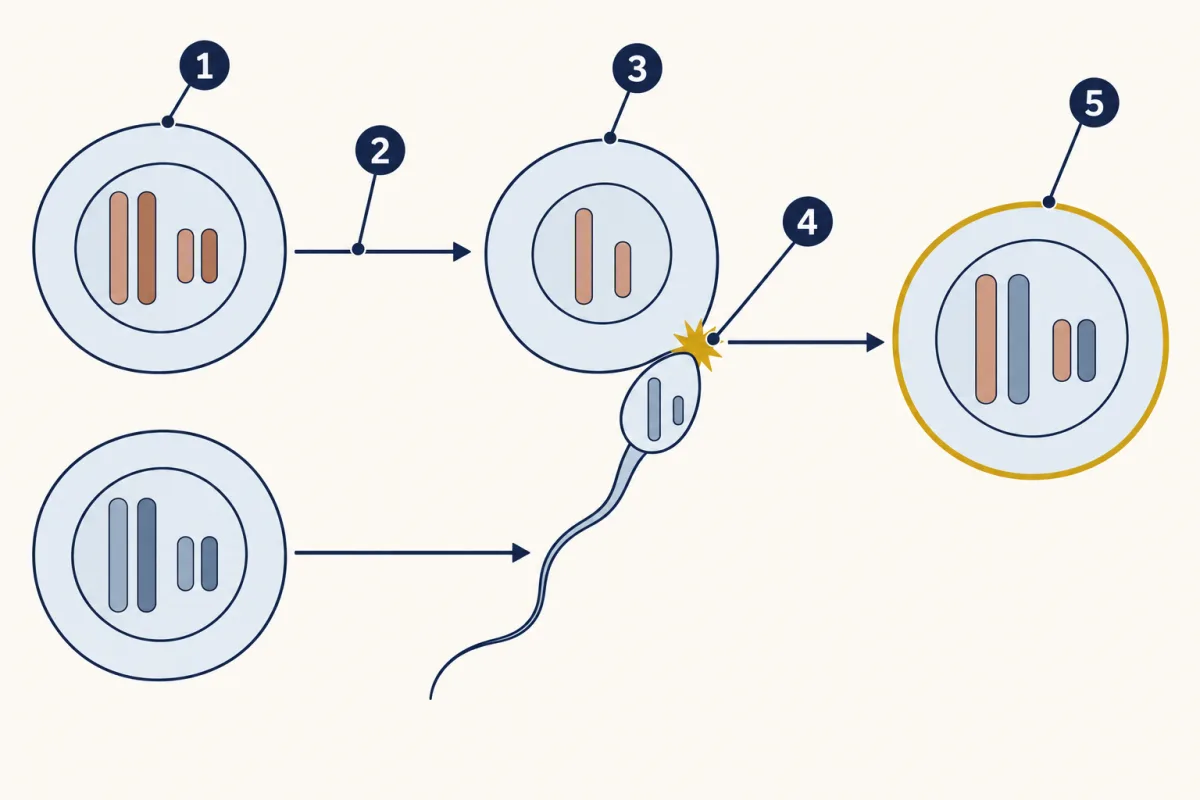
Your body cells have their chromosomes in pairs. A chromosome pair is two matching chromosomes, one from your mother and one from your father. A typical human body cell has 46 chromosomes, in 23 pairs.
Meiosis is the kind of cell division that makes sex cells with half of the parent’s chromosomes, one from each pair. Before it starts, each chromosome is copied, as in mitosis. A copied chromosome is still one chromosome, made of two joined copies. You will learn the steps in high school. Here the result is what matters: a human egg or sperm normally has 23 chromosomes.
Fertilization is when a sperm cell and an egg cell join into one new cell. In humans:
23 chromosomes (egg) + 23 chromosomes (sperm) → 46 chromosomes (fertilized egg)
The fertilized egg has full pairs again, one chromosome of each pair from each parent. In plants there is an extra stage before the sex cells form, but they still end up with half.
- body cell
- meiosis
- sex cell
- fertilization
- fertilized egg
- body cell
- blank
- blank
- blank
- fertilized egg
Word bank: fertilization, meiosis, sex cell
- blank
- blank
- blank
- blank
- blank
Check your labels
- body cell
- meiosis
- sex cell
- fertilization
- fertilized egg
Explain: sorting pairs makes variety
Each gene can come in different versions. An allele is one version of a gene. You carry two alleles of most genes, one on each chromosome of a pair.
During meiosis, each pair splits up on its own, without regard to the other pairs. So a sex cell gets one chromosome from each pair, chosen by chance. If a parent has two different alleles, B and b, each sex cell has a 50 percent chance of carrying B and a 50 percent chance of carrying b.
Count the mixes. One pair gives 2 kinds of sex cells. Two pairs give 2 × 2 = 4. With 23 pairs, one person can make 2 multiplied by itself 23 times, which is 8,388,608 different mixes of whole chromosomes (when the two chromosomes in every pair differ). That is one reason each child gets a different mix. (Linking these mixes to traits comes in Predicting Traits.)
The alleles stay separate inside the child. They do not blend like paint, so a hidden allele can show up again in a later generation.
| Mitosis | Meiosis | |
|---|---|---|
| Makes | Body cells | Sex cells |
| Used for | Growth, repair, asexual reproduction | Sexual reproduction |
| Chromosomes in new cells | Same as parent cell | Half, one from each pair |
| New cells | Match the parent cell | Each a different mix |
You met mitosis in How Cells Divide.
Elaborate: chromosome numbers across living things
| Living thing | Plant or animal | Body cell (chromosomes) | Sex cell (chromosomes, calculated) |
|---|---|---|---|
| Fruit fly | animal | 8 | 4 |
| Garden pea | plant | 14 | 7 |
| Rice | plant | 24 | 12 |
| Domestic cat | animal | 38 | 19 |
| Human | animal | 46 | 23 |
| Chimpanzee | animal | 48 | 24 |
| Garden strawberry | plant | 56 | 28 |
| Horse | animal | 64 | 32 |
| Chicken | animal | 78 | 39 |
The body-cell numbers come from published counts. Human and chimpanzee: a 2020 review (Suntsova and Buzdin). Cat: stem cells taken from the fat of female cats and grown in a lab, with one normal dividing cell counted (Algorta and others, 2024). Horse: 44 normal horses (Blue, 1981). Chicken: Fillon and others (1998). Fruit fly: female larvae (Cherezov and others, 2020). Pea: root tips of one pea line (Yurkevich and others, 2018). Rice: two rice kinds (a 2014 study). Strawberry: the garden strawberry, 56 chromosomes in 8 sets of 7 (Genome Biology, 2025; Edger and others, 2019, pieced together the DNA of 28 chromosomes, half the body-cell number, for the Camarosa kind). The sex-cell numbers were found by halving. Nobody counted them in real sex cells for this table.
- Divide each body-cell number by its sex-cell number. What do you notice?
- A chicken has 78 chromosomes and a human has 46. Does a bigger number mean a more complex living thing? Use two rows to explain.
- Find the mean body-cell number of the four plants and animals with the fewest chromosomes.
- In every row, the sex cell has blank the chromosomes of the body cell.
- This keeps the number steady because blank.
- One limit of this table is blank.
Claim, evidence, reasoning
Make a claim about what meiosis does to the chromosome number, and why fertilization brings it back, using this table.
Start with: Meiosis makes sex cells with blank the chromosomes of a body cell.
Start with: A human body cell has blank chromosomes and a sex cell has blank. A pea has blank and blank.
Start with: When two sex cells join at fertilization, blank, so the offspring has blank.
Compare with a model answer
Meiosis makes sex cells with half the chromosomes of a body cell. A human body cell has 46 and a sex cell has 23. A pea has 14 and 7, and a strawberry 56 and 28. At fertilization two sex cells join, so 23 + 23 = 46, and the offspring has the same number as its parents. One limit: the sex-cell column was calculated by halving, so the table shows the rule but does not test it. Testing it would need counts from real sex cells.
Saved in this browser only.
Design problem
Do plants grown from runners vary less than plants grown from seeds? Plan an investigation with strawberry plants.
One way to do it
- Question: Do strawberry plants grown from runners of one parent vary less in leaf length than plants grown from seeds of the same kind of strawberry?
- Independent variable: how the plant was made, from a runner (asexual) or from a seed (sexual).
- Dependent variable: the length of the largest leaf in millimetres after 8 weeks. Find the range, the longest minus the shortest, for each group.
- Constants: the same soil, pot size, water, light and temperature.
- Control: measure the parent plant too, to compare with the runner plants.
- Repeated trials: at least 10 plants in each group.
- Safety: wear gloves for soil, wash your hands, and do not eat any part of the plants.
A smaller range in the runner group would fit the idea that asexual offspring share the parent’s genetic information. Some variation will still appear in both groups, because light, water and space also affect growth. Runner plants may also start with food from the parent, which is another difference between the groups.
Evaluate: check your thinking
A strawberry runner makes a new plant by asexual reproduction, so the new plant carries its one parent’s genetic information. Brothers and sisters come from sexual reproduction. Meiosis gives eggs and sperm different mixes of chromosomes, so each child gets a different mix of alleles from the same two parents.
Science practices you used: making predictions and testing them with a model, reading a data table and finding a pattern, using numbers to support a claim, and planning a fair test with a control and repeated trials.
How we measure it
Counting chromosomes under a microscope
Cells caught while dividing are stained and spread flat on a slide, so each chromosome can be seen and counted. Scientists count normal cells from many samples to find the usual number for a kind of living thing.
Controlled pollination
A gardener removes the pollen-making parts of a flower, covers it, and then adds pollen from a chosen plant. This way the scientist knows both parents of every seed and can count which traits show up in the offspring.
Finish line
Test yourself
8 questions
Practice and MCAT-style, with explained answers.
Next · Lesson 25
Predicting Traits with Punnett Squares
How can two purple-flowered pea plants have offspring with white flowers, and can we predict how many?
Continue →