Life Science · Unit 1: Cells
Diffusion and Osmosis
How do water, oxygen and other things get into and out of a cell when nothing pushes them? You change the salt on each side of a model membrane and watch dye spread and water move, then read real masses of cucumber slices kept in salty water and in plain water. Afterwards you can explain diffusion and osmosis and use mass data to say which way water moved.
Where this lesson sits
- Virginia SOL LS.2 e
- Practices LS.1 b, LS.1 c, LS.1 d, LS.1 e
Essential question: How do things get into and out of a cell without the cell pushing them?
-
Life Science (grade 7) LS.2 e You are here
This lesson
-
Biology
Preview it at high school level
In Biology you will look closer at the cell membrane. It is a double layer of fatty molecules called phospholipids, with proteins set into it. Some of these proteins make channels, and some carry particles across. When particles use them to move from more concentrated to less concentrated, it is still passive, and it is called facilitated diffusion. You will also learn about active transport. In active transport, protein pumps spend energy from a molecule called ATP. They move substances from low concentration to high concentration, the opposite of diffusion. You will also learn words for how salty a liquid is compared with a cell.
-
Biology II Biology II: Advanced Survey of Biology Topics, BIOII.2 b
Preview where it goes next
In Biology II (BIOII.2 b), the membrane's selective permeability is explained by its parts. The phospholipids have water-loving heads and water-fearing tails, so most ions and large molecules cannot slip through the middle. Channel and carrier proteins let chosen substances across. Pumps use ATP to build up differences in concentration. Students also look at how organisms control their water and salt, and why the ratio of surface area to volume limits how big a cell can grow.
-
College
Watch first Water Moves Toward More Dissolved Salt · 2:38
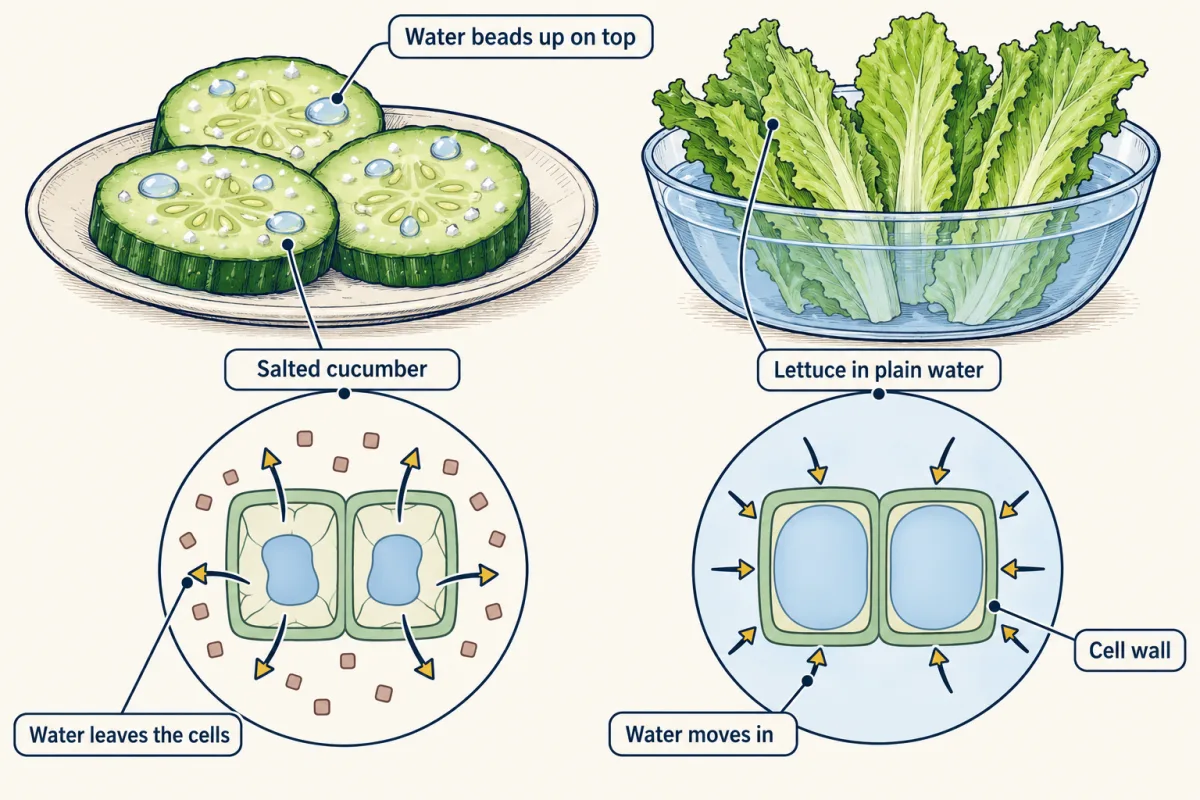
Sprinkle salt on cucumber slices, and within about 15 minutes drops of water bead up on top. Put limp lettuce leaves in a bowl of plain cold water, and in about 15 minutes they can turn crisp again.
In both cases, water moved into or out of cells. Nobody pushed it, and the cells did not pump it. So how did it move, and what decided which way it went?
What do you think? Decide before you read.
-
Scientists disagree: This is close, but it leaves out the key part. Osmosis is water crossing a membrane that lets water through and holds back many dissolved particles. In diffusion, the particles themselves spread out. Without the membrane, the dissolved particles would just mix in.
What scientists think
Scientists disagree: This is close, but it leaves out the key part. Osmosis is water crossing a membrane that lets water through and holds back many dissolved particles. In diffusion, the particles themselves spread out. Without the membrane, the dissolved particles would just mix in.
-
Scientists disagree: Osmosis and diffusion are passive. Particles move on their own, from where they are more concentrated to where they are less concentrated. Water even crosses tiny artificial bubbles of membrane, where no living cell is doing any work.
What scientists think
Scientists disagree: Osmosis and diffusion are passive. Particles move on their own, from where they are more concentrated to where they are less concentrated. Water even crosses tiny artificial bubbles of membrane, where no living cell is doing any work.
-
Scientists disagree: The membrane holds back much of the salt. Water leaves the cells and moves toward the saltier water outside, where water is less concentrated. A balance only shows the total mass change, so by itself it cannot tell water leaving from salt entering; the osmosis model is what explains the water loss.
What scientists think
Scientists disagree: The membrane holds back much of the salt. Water leaves the cells and moves toward the saltier water outside, where water is less concentrated. A balance only shows the total mass change, so by itself it cannot tell water leaving from salt entering; the osmosis model is what explains the water loss.
Explore: change the salt on each side of a membrane
In this model, a dashed line is a membrane with water on both sides. You choose how much salt goes on the left and on the right. You can also set the membrane to let only water through, or to let water and a small dye through. A cell below the tank, sitting in liquid with the left side’s salt level, shows what happens to a real cell.
Schematic, not to scale. salt, dye. Salt cannot cross the dashed line. Each dot is one particle.
- Dye dots on the left
- 0 (expected when even: 10)
- Dye dots on the right
- 0 (expected when even: 10)
- Dye crossings, last 5 s
- left to right 0, right to left 0
- Water level (relative units, start 10 each)
- left 10.0, right 10.0
- Which side has more salt per water
- about the same
- Water in the cell (relative units, start 10)
- 10.0
In this sketch the dashed membrane holds back all the salt. Real membranes let some salt through, but much more slowly than water. There is one kind of salt, drawn as squares. Each salt level adds 5 squares. Only salt sets which way water moves; the dye is just a marker. The cell is small, so the liquid around it keeps the left salt level you set. There is no pressure. Dye dots move at random, so the counts wobble around the expected value. In this sketch water keeps moving toward the side with more salt per water until the two sides match, then it moves about equally both ways. The water levels can end up different. The rates, the tank size and the cell size limits are made up. The water tank and the cell stop at the largest and smallest sizes drawn.
Rule to keep: particles spread from more concentrated to less concentrated, and water crosses toward the side with more dissolved salt; the cell spends no energy on either.
Try this.
- Add dye to one side and set the membrane to let dye through. Predict where the dots will end up. Then watch. Do the dots stop moving at the end?
- Put more salt on the left than on the right, with a water-only membrane. Predict which side’s water level will rise. Then test it.
- Make the liquid around the cell saltier than the inside. Predict whether the cell will swell or shrink. Then make the outside plain water and predict again.
Explain: particles spread from more to less
- concentration
- diffusion
- passive transport
- cell membrane
- selectively permeable
- osmosis
- homeostasis
Living things must move materials into, out of and within their cells to support life processes. Put one drop of food colouring in a glass of still water. At first the colour sits in one spot. Slowly it spreads until the whole glass is the same colour.
The dye spreads because its particles are always moving at random. Concentration is how much of a substance is in a given space. Where the drop landed, the concentration of dye is high. Far away, it is low. More particles happen to move out of the crowded spot than move into it.
Diffusion is the movement of a substance from where it is more concentrated to where it is less concentrated. In a cell, diffusion means a substance other than water crossing the cell membrane.
When the colour is even, the particles do not stop. They keep moving, but just as many move one way as the other. So the colour stops changing.
Your cells use oxygen and give off carbon dioxide (that lesson). Oxygen is more concentrated in the blood than inside a cell, so it diffuses in. Carbon dioxide is more concentrated inside, so it diffuses out.
Passive transport is movement across a cell membrane that needs no energy from the cell. Diffusion and osmosis are both passive transport.
Explain: water crosses a choosy membrane
The cell membrane is the thin layer around every cell (that lesson). It is selectively permeable: it lets some substances through and holds back others. Water, oxygen and carbon dioxide cross it easily. Many dissolved particles, such as salt and sugar, cross much less easily.
Osmosis is the movement of water across a cell membrane. Here is how to predict its direction.
- Dissolve salt or sugar in water, and the water there is less concentrated.
- Water moves toward the side with more dissolved salt or sugar.
- Many of the dissolved particles cannot cross the membrane, so the water keeps moving that way.
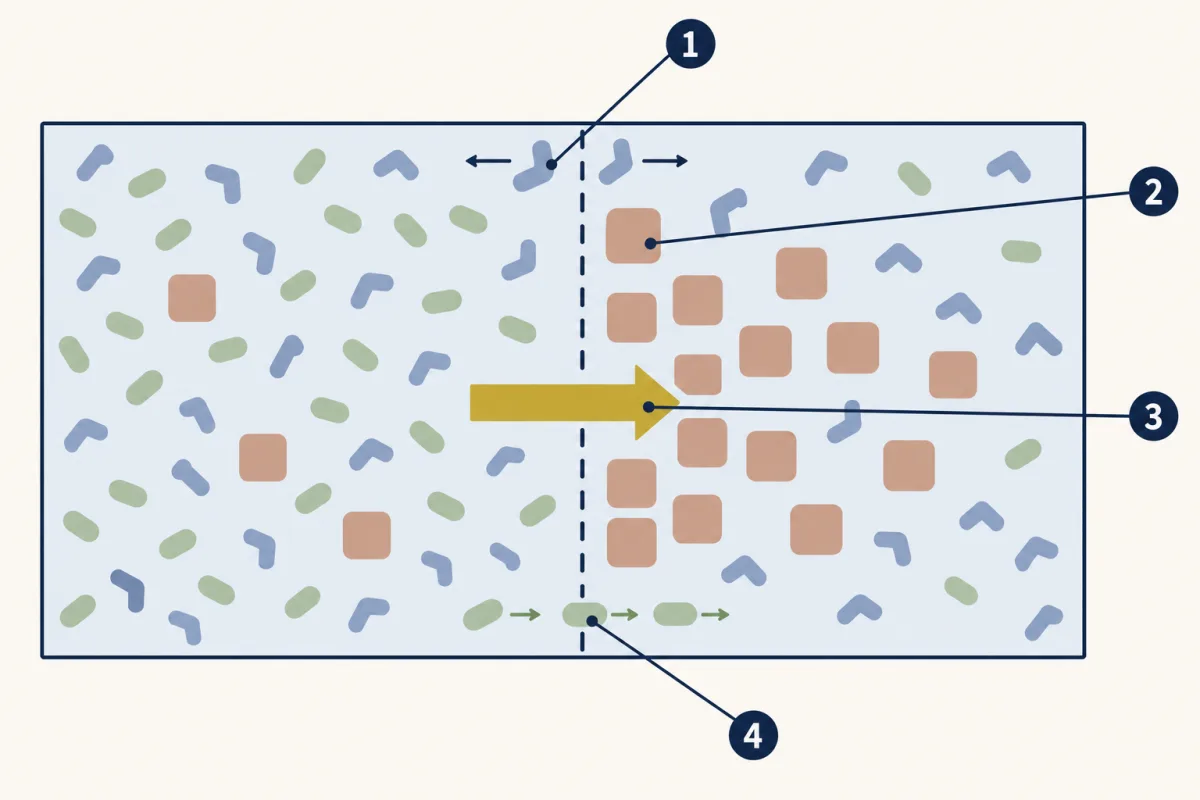
- water
- salt
- osmosis
- oxygen
- water
- salt
- blank
- blank
Word bank: osmosis, oxygen
- blank
- blank
- blank
- blank
Check your labels
- water
- salt
- osmosis
- oxygen
| What moves across the membrane | Example | |
|---|---|---|
| Diffusion | A substance other than water | Oxygen into a cell |
| Osmosis | Water | Water out of a salted cucumber |
Now the cucumber makes sense. Salt on the outside means water outside is less concentrated, so water leaves the cells. In the lettuce, the inside of each cell has more dissolved particles than plain water. Water moves in. In plants, the stiff cell wall and the large central vacuole help keep a well-watered plant firm (that lesson).
Homeostasis is keeping conditions inside a living thing steady. The membrane helps. By letting some things pass and not others, it helps keep the right amounts of water and other substances inside the cell.
A model is never the real thing. Our model membrane holds back all the salt. Real membranes let some salt through, but much more slowly than water.
Elaborate: weigh cucumber slices in salt and plain water
In a filmed Open University demonstration, one peeled cucumber slice went into salty water and one into distilled water. Each slice was patted dry and weighed several times.
percent change in mass = (final mass − starting mass) ÷ starting mass × 100
| Slice | Time in the liquid | Starting mass (g) | Mass then (g) | Change in mass (%) |
|---|---|---|---|---|
| Salty water | 1 hour | 26 | 24 | −7.7 |
| Salty water | 2 hours | 26 | 23 | −11.5 |
| Salty water | Overnight | 26 | 21 | −19.2 |
| Distilled water | 1 hour | 22 | 23 | +4.5 |
| Distilled water | 2 hours | 22 | 24 | +9.1 |
| Distilled water | Overnight | 22 | 30 | +36.4 |
Source: The Open University (OpenLearn), “Basic science: understanding experiments”, demonstration by Janet Sumner, accessed October 2026. No date or place is given. The salty water was tap water with two tablespoons of salt added; the volume of water was not stated, so the salt concentration is unknown. There was one slice in each liquid. The percent changes are calculated from the reported masses.
- Describe the trend for each slice over time.
- Overnight, how many grams did each slice gain or lose?
- Why is percent change a fairer way to compare the two slices than grams?
- The slice in blank water lost mass because water moved blank.
- The change was blank percent, which shows blank.
- The data are limited because blank.
Claim, evidence, reasoning
Make a claim that answers this: how did water move into or out of the cucumber cells without the cells pushing it? Use the table.
Start with: Water moved blank the slice in salty water and blank the slice in distilled water.
Start with: Overnight, the salty slice changed by blank percent and the distilled-water slice changed by blank percent.
Start with: This happens because water moves by osmosis toward the side where blank, and the cell spends blank energy on it.
Compare with a model answer
Water left the slice in salty water and entered the slice in distilled water. Overnight, the salty slice went from 26 g to 21 g, about −19 percent. The distilled-water slice went from 22 g to 30 g, about +36 percent. By osmosis, water moves toward the side with more dissolved particles, with no energy from the cells. There was only one slice in each liquid, the salt concentration is unknown, and a balance cannot tell water from salt.
Saved in this browser only.
Design problem
Plan an investigation: how does the amount of salt in water change the mass of potato pieces? Name your variables, constants, control and number of trials, and say how you will stay safe.
One way to do it
- Question: How does the amount of salt change the percent change in mass of potato pieces?
- Independent variable: grams of salt in each 100 mL of water, for example 0, 1, 2, 4 and 6 g.
- Dependent variable: the percent change in mass of each piece after 30 minutes.
- Constants: one potato, same-size pieces, 100 mL of liquid per cup, the same time, temperature and patting method.
- Control: the cup with 0 g of salt, which is plain water.
- Trials: three pieces in each cup. Find each piece’s percent change, then the mean.
- Measure: mass in grams on a balance, before and after, patted dry each time.
- Safety: an adult cuts the potato. Label every cup, wipe up spills, and never taste anything.
If pieces gain mass in plain water and lose more as the salt goes up, that fits osmosis.
Evaluate: check your thinking
Salt on the cucumber made the water outside the cells less concentrated, so water moved out of the cells by osmosis. The lettuce cells held more dissolved particles than plain water, so water moved in and the leaves firmed up. Neither time did the cells spend energy to move the water.
Science practices you used: making and testing predictions with a model, calculating percent change from measured masses, reading a data table and naming its limits, and planning a fair test with a control and repeated trials.
How we measure it
Blotting and weighing on a balance
A slice of plant tissue is patted dry and weighed, soaked in a liquid, then patted dry and weighed again. The percent change in mass shows whether the slice took in or lost water overall.
Testing a membrane protein in frog eggs
Scientists put the instructions for one membrane protein into frog egg cells, then compared how easily water crossed into those eggs and into eggs without the protein. A difference shows what the protein does.
Finish line
Test yourself
8 questions
Practice and MCAT-style, with explained answers.
Next · Lesson 6
From Cells to Organisms
How can a single Paramecium swim, eat, pump out water and divide, when your body shares those jobs among trillions of cells?
Continue →