Biology · Unit 2: Cells
One Cell or Many
How can one cell live on its own, when your body needs trillions of cells working together? You will share out life's jobs in a model, compare a Paramecium with the specialized cells of your body, and read real measurements of cell sizes and shapes. Afterwards you can explain how a cell's structure fits its job and why cells with the same DNA can look and work so differently.
Where this lesson sits
- Virginia SOL BIO.3e
- Practices BIO.1c, BIO.1d, BIO.1f
Essential question: How can a single cell survive on its own, when your body needs trillions of cells working together?
-
Life Science (grade 7) LS.3 a and b
Review it at grade 7 level
In Life Science you learned that some living things are made of one cell and others of many cells. In a many-celled organism, cells are organized into tissues, tissues into organs, and organs into organ systems. Each level does part of the work, which is called division of labor. You saw that muscle cells, nerve cells and blood cells have different shapes. Biology adds why those shapes matter for each job, and how cells with the same DNA can become so different by using different genes.
-
Biology BIO.3e You are here
This lesson
-
Biology II Biology II: Advanced Survey of Biology Topics, BIOII.2 c
Preview where it goes next
Biology II: Advanced Survey of Biology Topics returns to form and function with more examples and the tissues they build. Plants have dermal, vascular and ground tissues. Animals have epithelial, connective, muscle and nerve tissues. You will also study how cells send and receive signals through receptor proteins, and how those signals guide cells to grow, divide and specialize. A related idea is why most cells stay small: as a cell grows, its volume rises faster than its surface. The Genetics course adds that a specialized cell uses only some of its genes.
-
College
Watch first One Cell Does It All · 2:47
Put a drop of pond water under a microscope and you may see a Paramecium, a single cell shaped like a slipper, swimming fast. That one cell catches food, moves, pumps out extra water and splits in two to reproduce. Your body does the same kinds of jobs, but it shares them out among trillions of cells of many different kinds. How can one cell manage alone, and why are your cells so different from one another?
What do you think? Decide before you read.
-
Scientists disagree: Microscope studies show that a Paramecium has hair-like cilia for swimming, a groove that takes in food, sacs that digest it and pumps that push out extra water. All of these parts sit in one cell. One cell can be very complex, and it carries out every life process.
What scientists think
Scientists disagree: Microscope studies show that a Paramecium has hair-like cilia for swimming, a groove that takes in food, sacs that digest it and pumps that push out extra water. All of these parts sit in one cell. One cell can be very complex, and it carries out every life process.
-
Scientists disagree: Biologists have long known that nearly every body cell with a nucleus carries essentially the same DNA. What differs is which genes each kind of cell uses. A few cells, such as mature red blood cells, are exceptions.
What scientists think
Scientists disagree: Biologists have long known that nearly every body cell with a nucleus carries essentially the same DNA. What differs is which genes each kind of cell uses. A few cells, such as mature red blood cells, are exceptions.
-
Scientists disagree: Measured cells vary enormously. A human red blood cell is about 7 to 8 micrometres across, while some human nerve cells reach about a metre long. Plant root hair cells grow long tubes. Each shape matches what that cell does, as the data later in this lesson show.
What scientists think
Scientists disagree: Measured cells vary enormously. A human red blood cell is about 7 to 8 micrometres across, while some human nerve cells reach about a metre long. Plant root hair cells grow long tubes. Each shape matches what that cell does, as the data later in this lesson show.
Explore: share out life’s jobs
In the model you get five life jobs: take in food, move, sense the surroundings, reproduce and remove extra water. You can give every job to one cell, or build a group of cells and give each cell one or two jobs. Each cell has a limited energy supply, and you can make the organism bigger and see which arrangement keeps up.
In this sketch: each job is 1.5 units of work for every step of size, one cell has an energy supply of 10 units, and all five jobs must be done. In this sketch, food is the only energy supply: if no cell takes in food, no cell has energy. Units are relative, not measured.
Press a job to give it to a cell or take it away. The jobs are: take in food, move, sense the surroundings, reproduce, remove extra water.
Rule to keep in this sketch: a cell can only do as much work as its limited energy supply allows, so when the work grows, sharing the jobs among more cells lets the organism keep up. Real specialized cells still take in food and make ATP themselves; this is a sketch of the logic.
Try this.
- Give all five jobs to one small cell. Predict whether it can keep up, then run it.
- Make that single cell bigger, step by step. Predict what happens to how well it keeps up, then test.
- Build a group of cells and give each one a single job. Predict whether the group keeps up as it grows, then run it.
- Remove the cells doing one job, such as taking in food. Predict what happens to the rest of the group.
Explain: one cell that does it all
- unicellular
- multicellular
- cilia
- contractile vacuole
- binary fission
- specialized cell
- tissue
- organ
- organ system
- gene expression
A unicellular organism is a living thing made of just one cell. A multicellular organism is made of many cells. Bacteria, many algae and many protists, such as Paramecium, are unicellular.
A Paramecium has no tissues or organs, yet its one cell does every job of a living thing:
- Moves. Its surface is covered in cilia, short hair-like structures that beat together like oars.
- Feeds. Food such as bacteria is swept into a groove and enclosed in food vacuoles, where it is digested.
- Removes extra water. Pond water has fewer dissolved particles than the cell, so water keeps moving in by osmosis. A contractile vacuole is a sac that fills with this extra water and squeezes it out. You met osmosis in that lesson.
- Reproduces. It can split into two cells by binary fission, a way of reproducing without a partner in which one cell divides into two.
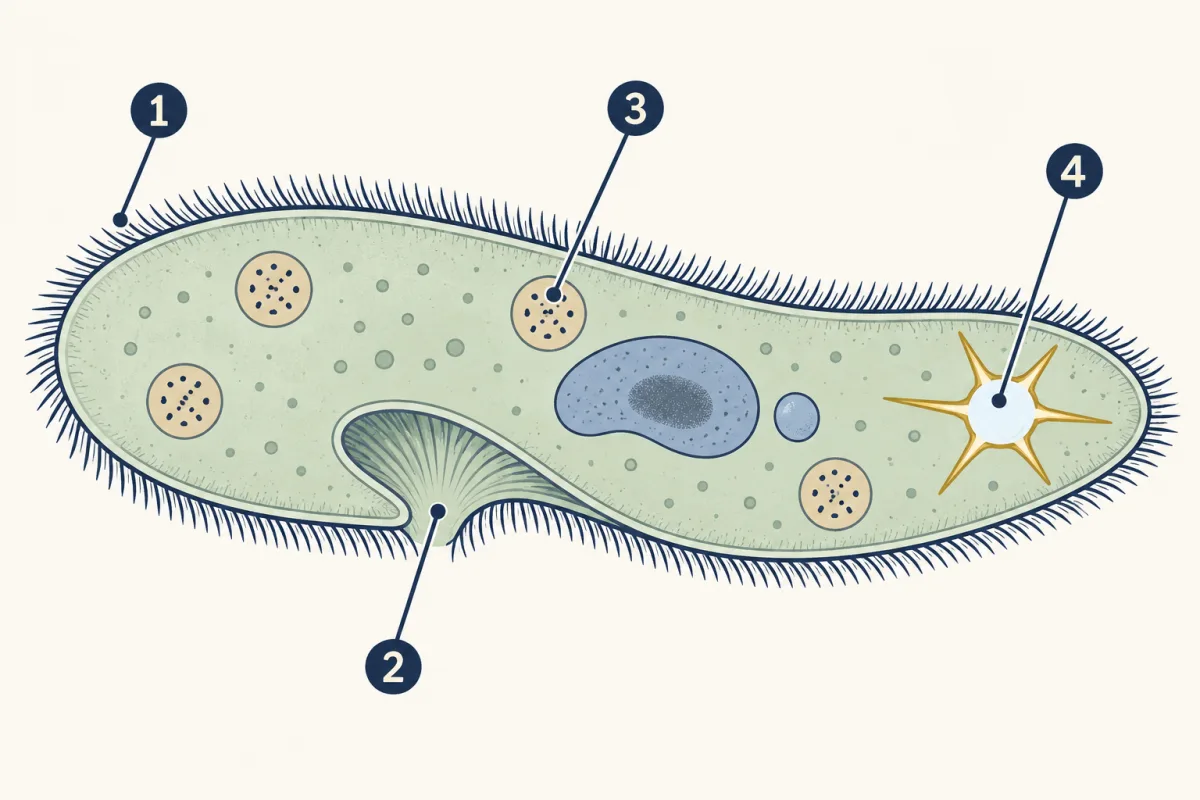
- cilia
- oral groove
- food vacuole
- contractile vacuole
- cilia
- blank
- food vacuole
- blank
Word bank: contractile vacuole, oral groove
- blank
- blank
- blank
- blank
Check your labels
- cilia
- oral groove
- food vacuole
- contractile vacuole
Some organisms sit in between. Volvox, a green alga, lives as a hollow ball of many cells. In Volvox carteri, most cells swim and make food, while a few large cells are set aside for reproduction. Colonies like this show a first step toward division of labor.
Explain: specialized cells, from tissues to systems
In a multicellular organism, cells share the work. A specialized cell is a cell with a structure that suits it to a particular job. Similar cells working together form a tissue, such as muscle tissue. Several tissues working together form an organ, such as the heart. Related organs form an organ system, such as the circulatory system.
cell → tissue → organ → organ system → organism
A 70-kilogram reference adult man holds about 30 to 36 trillion cells, according to two careful estimates (2016 and 2023); the 2023 model gave about 28 trillion for a reference woman and about 17 trillion for a 10-year-old child. Textbooks often say there are about 200 kinds of cells. A 2022 atlas that sorted cells by the genes they use counted more than 400 types in the tissues it sampled, so the true number depends on how finely you sort.
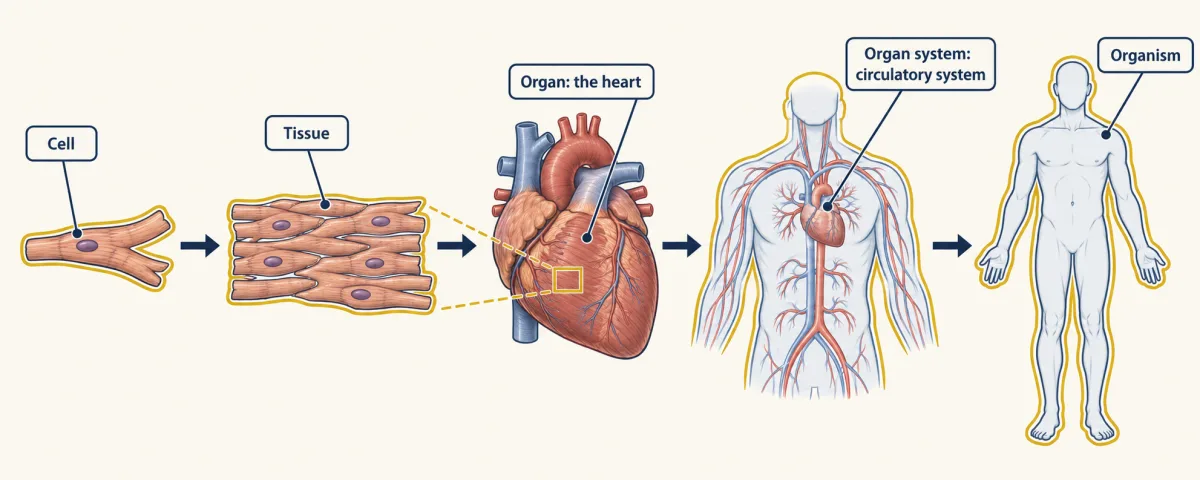
Each specialized cell’s shape fits its job:
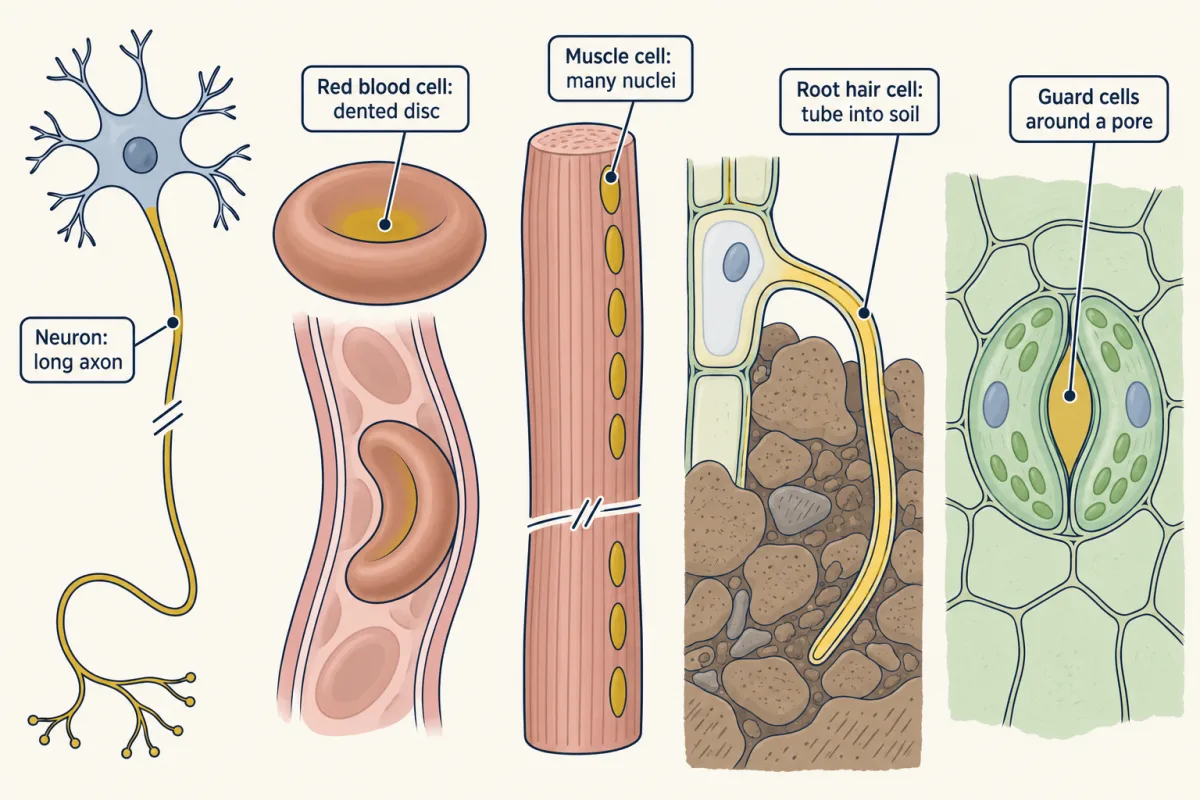
| Cell | Structure | How it fits the job |
|---|---|---|
| Neuron (nerve cell) | Long, thin extension called an axon | Carries signals long distances, such as from the spine to the foot |
| Red blood cell | Small, flexible disc dented in the middle; no nucleus when mature | Large surface for oxygen to cross; bends to squeeze through narrow vessels |
| Skeletal muscle cell | Very long cylinder with many nuclei | Packed with protein fibres that shorten together to pull on bone |
| Root hair cell | Long tube growing out from the root surface | Adds surface touching the soil, where water and minerals enter |
| Guard cell | Two cells, often curved, around a pore in a leaf | Change shape to open and close the pore, letting gases in and out |
Think of a restaurant kitchen, where one cook chops, one grills and one washes dishes. The analogy breaks in one place: a specialized cell still does its own basic work, such as taking in food molecules and making ATP for energy. A muscle cell cannot hand all of that to another cell.
Explain: same DNA, different genes
If your nerve cells and muscle cells look and work so differently, do they carry different instructions? Mostly no. Nearly every body cell with a nucleus carries essentially the same DNA, copied from the first cell you began as. You can see how that copying happens in that lesson.
The difference is gene expression, the use of a gene’s instructions to make a product such as a protein. Each kind of cell uses a different set of its genes. A muscle cell uses the genes for the proteins that shorten; a red blood cell in the making uses the genes for hemoglobin, the protein that carries oxygen. Many other genes stay unused in each cell.
There are a few exceptions. A maturing red blood cell pushes out its nucleus, so a mature one has no DNA left. Egg and sperm cells carry half a set of DNA. You will learn how genes are read in that lesson.
Elaborate: measuring specialized cells
The table collects real measurements of specialized cells from several published sources.
| Cell or part measured | Size (with unit) | Structural feature | Where the value comes from |
|---|---|---|---|
| Human red blood cell | about 7 to 8 µm across | Dented disc; no nucleus when mature | Textbook description |
| Long human axon | up to about 1 m long | Long extension of a nerve cell | Textbook description, spine-to-toe example |
| Human oocyte (developing egg cell) | 115 ± 12.1 µm across (mean ± standard deviation) | Large round cell | 1,563 oocytes from 75 patients, measured after lab maturation |
| Human sperm head | 4.96 µm long (mean) | Head measured on its own | 10 men, live cells |
| Human sperm tail | 38.22 µm long (mean) | Tail measured on its own | Same 10 men |
| Human skeletal muscle cell | up to about 30 cm long | Long cylinder, many nuclei | Textbook, a long thigh muscle |
| Arabidopsis root hair, young seedling | 0.49 ± 0.11 mm long | Tube growing from a root surface cell | Seedlings 3 to 5 days old |
| Arabidopsis root hair, older plant | 0.38 ± 0.19 mm long | Same kind of tube | Plants 10 to 14 days old |
| Arabidopsis root hair | 9.9 ± 2.2 µm wide | Width of the tube | Average of earlier studies |
| Arabidopsis root surface cell body | 146.2 ± 36.1 µm long | The cell the hair grows from | Average of earlier studies |
Sources: OpenStax Anatomy and Physiology 2e (2022) for red blood and muscle cells; Alberts and colleagues, Molecular Biology of the Cell (2002) for the axon; Pors and colleagues (2022) for egg cells; Kamieniczna and colleagues (2022) for sperm; Choi and Cho, Scientific Reports (2019), Table 1, for Arabidopsis. The rows come from different studies with different methods, not one survey. One µm (micrometre) is a thousandth of a millimetre.
- Convert the young root hair length to micrometres. How many times longer is the hair than it is wide?
- About how many times wider is the egg cell than a red blood cell?
- Can you add the sperm head and tail to get the whole cell’s length? Explain using what the table says was measured.
Claim, evidence, reasoning
Make a claim that answers the essential question: how does a specialized cell’s structure relate to its job? Use the table.
Start with: The data show that specialized cells blank.
Start with: A young root hair is blank µm long but only blank µm wide, while a red blood cell is about blank µm across.
Start with: This shape fits the job because blank.
Compare with a model answer
Specialized cells have sizes and shapes that fit their jobs. A young Arabidopsis root hair is 0.49 mm, or 490 µm, long but only 9.9 µm wide, so it is about 50 times longer than wide. That long, thin tube adds surface touching the soil, where water enters. A red blood cell is only about 7 to 8 µm across and flexible, so it fits through narrow vessels. Some axons reach about a metre, long enough to carry a signal from the spine to the foot. Limits: the rows come from different studies, and the 50-times figure comes from dividing the mean length by the mean width, not from measuring one hair.
Saved in this browser only.
Design problem
Do radish seedlings grown on drier paper towels grow longer root hairs than seedlings grown on wetter towels? Plan an investigation using a hand lens or a microscope with a scale. Name your variables, constants, control, sample size and safety steps.
One way to do it
- Independent variable: how wet the paper towel is. Add a set volume of water per towel, such as 5 mL for drier and 15 mL for wetter.
- Dependent variable: length of root hairs, measured on the same part of each root with a scale in view.
- Constants: seed batch, number of seeds per dish, temperature, light, towel type and the day you measure.
- Control: the dishes given the usual amount of water used for sprouting seeds.
- Sample size and trials: several dishes per group, ten or more seedlings per dish, and at least ten hairs per seedling. Report the mean and the spread.
- Fairness: a partner codes the dishes so the person measuring does not know the group.
- Limit: this tests one plant species at one age.
- Safety: handle slides and cover slips with care, wash hands after handling seeds, and do not eat them.
Evaluate: check your thinking
A Paramecium survives alone because its one cell holds every structure it needs: cilia to swim, food vacuoles to digest, a contractile vacuole to pump out water and the ability to divide. Your body works differently. It shares those jobs among specialized cells whose shapes fit their work, nearly all carrying the same DNA but using different genes.
Science practices you used: using a model and naming its limits, reading a data table with means and spread, converting units and comparing sizes, and planning a fair test with enough repeated measurements.
How we measure it
Measuring cells in microscope images
A scientist photographs cells through a microscope with a scale and measures a clearly defined part, such as the diameter of an egg cell taken in two directions at right angles. Measuring many cells gives a mean and a spread instead of one number.
Digital holographic microscopy
This kind of microscope records how light passes through a living cell, so cells can be measured without staining or killing them. One 2022 study used it to measure the head and tail of live human sperm cells.
Comparing plants that differ in one feature
Scientists grow plant lines (genetically different groups) that differ in root hair length, check that the main roots are the same size, and then test how well each line holds on to soil. A difference in results points to the root hairs.
Finish line
Test yourself
8 questions
Practice and MCAT-style, with explained answers.
Next · Lesson 12
Living or Not? Viruses and Bacteria
A cold virus on a light switch does nothing on its own for hours, yet inside your nose it gets cells to build new copies of it. Is it alive?
Continue →