Biology Together · Unit 4: Flowers, seeds and life cycles
Take a Flower Apart
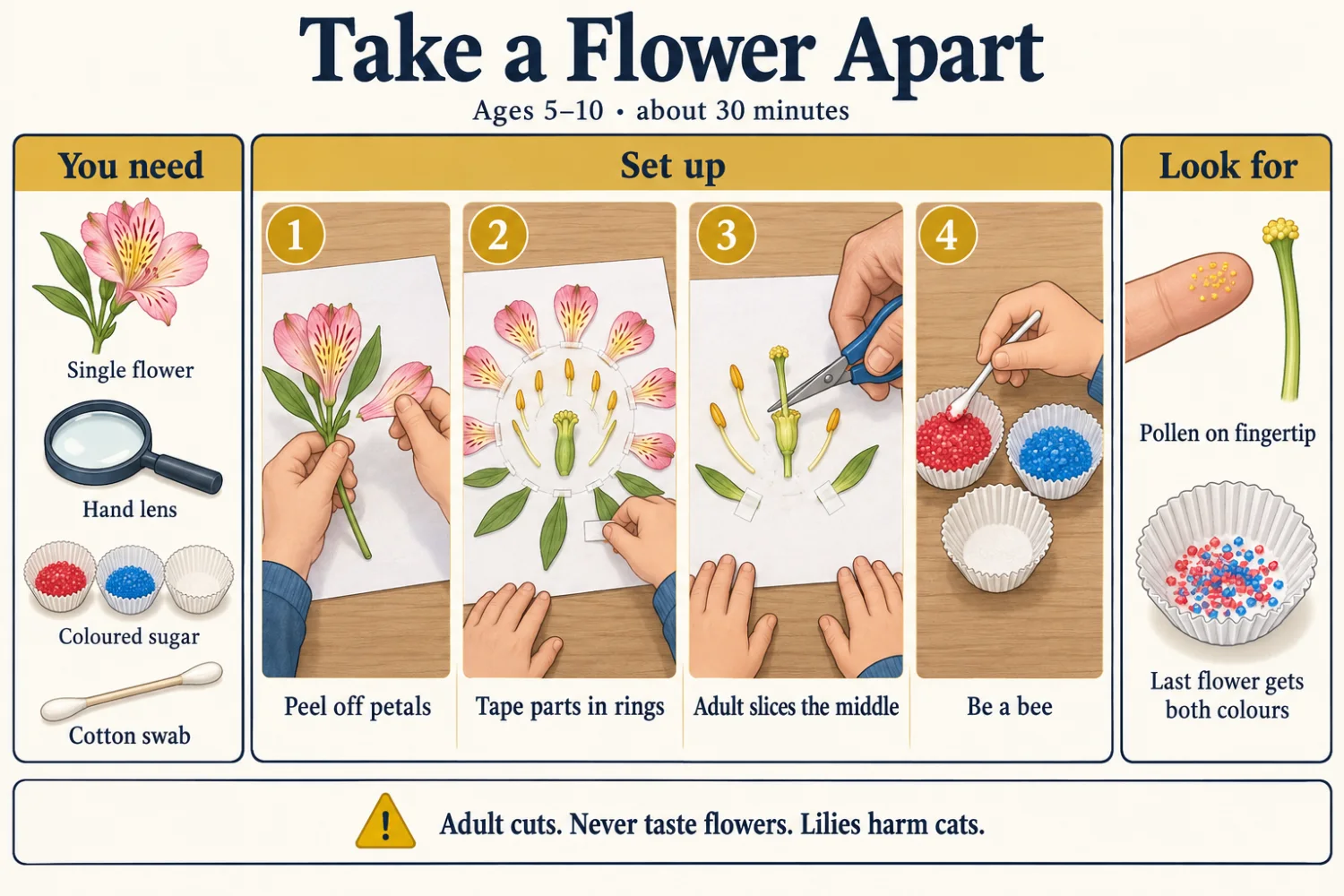
You and your child take a store-bought flower apart, one ring at a time, and tape the pieces on paper. Then a cotton swab plays bee and carries coloured "pollen" from flower to flower. Your child finds out that a flower is the part of a plant that makes seeds, and that pollen has to travel for seeds to form.
Watch first Set Up: Take a Flower Apart · 0:44
Read the transcript of “Set Up: Take a Flower Apart”
Film transcript: Set Up: Take a Flower Apart
You need two or three simple, single flowers, a hand lens, tape, and a sheet of paper. For the bee game, add coloured sugar and cotton swabs. Pull off the sepals, then the petals, and tape each ring to the paper. Find the stalks with pollen. An adult slices across the swollen base of the middle part. With the hand lens, look for tiny pale beads. Each one could become a seed if pollen reaches it. As the bee, your child carries colour from flower to flower. True lilies and daylilies can kill a cat. If a cat lives in or visits your home, do not bring them in. An adult does all the cutting.
Before you start
- Hands-on time
- About 30 minutes
- Where
- Indoors
- Ages
- 5 to 10, with an easier and a harder version below
- Grown-up
- Stay with your child the whole time. You do all the cutting and choose a flower that is safe for your home and pets.
What you need
- 2 or 3 simple, single flowers, such as alstroemeria from a grocery bouquet, a tulip, or a large garden flower like a petunia (no true lilies or daylilies if a cat lives in or visits your home, and with a cat or dog, choose alstroemeria or petunia rather than a tulip)
- A sheet of white or dark paper and clear tape
- A hand lens or magnifying glass
- Small scissors or a craft knife (adult only)
- 3 paper cupcake liners or small paper cups
- 2 colours of plain coloured sugar crystals (sanding sugar), a small spoonful of each, for the pretend pollen
- Cotton swabs, or fuzzy pipe cleaners with the ends folded back
- A tray or newspaper to work on
Virginia science standards SOL 4.2 cSOL 1.4 bSOL 2.4 b
The big idea
Most children see a flower as something pretty. Few have looked inside one. When your child pulls a flower apart, ring by ring, the pieces turn out to have different jobs.
A flower is the part of a plant that makes seeds. The outer ring protects the bud. The petals often draw in animals with colour and scent. Thin stalks in the middle make pollen, a fine powder that has to reach the central part of a flower before seeds can form. Wind, water or animals move pollen from flower to flower. This step is called pollination. Afterwards, seeds grow inside the central part, and the part around them swells into a fruit.
Virginia’s grade 4 standard asks children to describe how pollen moves and how colour and scent attract animals. It says they are not responsible for naming the male and female parts of a flower. The names stamen and pistil are an extra for older children who enjoy them.
What to do
- Look first. Give your child a whole flower and a hand lens. Ask them to draw it and count the petals. Ask, “What do you think is in the very middle?”
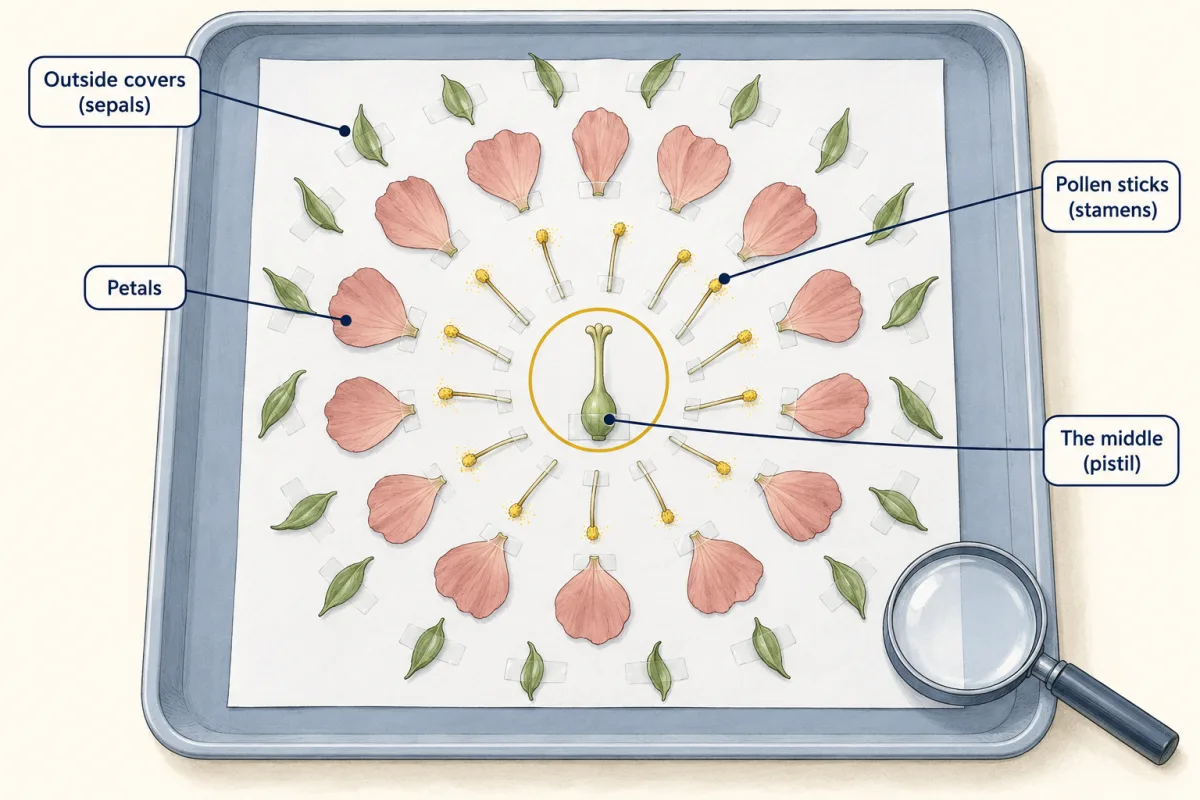
- Peel the outer ring. Gently pull off the outermost parts, the sepals, which wrapped the flower when it was a bud. In many flowers they are small and green. In alstroemeria and tulips they look like a second set of petals; botanists call both rings tepals. Pull off the outer three, which sit just outside the inner three. Tape them in a ring near the edge of the paper.
- Peel the petals. Pull off the petals and tape them in a ring inside the first one. In a petunia the petals are joined into one trumpet, so you slit it open and tape it flat. Ask, “Why might a flower be this colour? Who is it showing off for?”
- Find the pollen. Inside are thin stalks with knobs on top. Touch a knob to a fingertip or dark paper and look for powder. That is pollen. Tape the stalks in a smaller ring.
- Open the middle. One part is left in the centre. Now ask, “Where do you think seeds will grow?” You slice across the swollen base of that part, then tape the pieces in the middle of the paper. In alstroemeria, this is the green knob just under the petals. With the hand lens, look for tiny pale beads. Each one could become a seed if pollen reaches it.
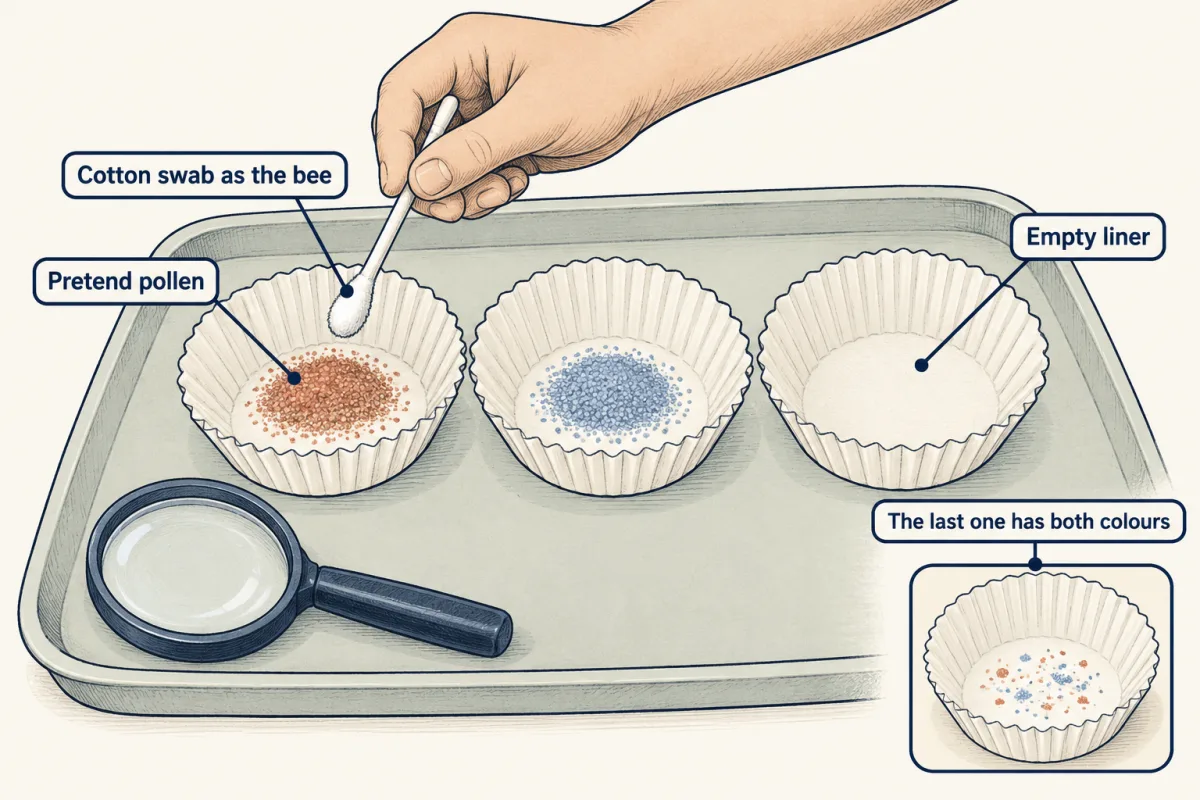
- Make the pollen. You put a small spoonful of each colour of sugar in a separate cupcake liner. Leave the third liner empty. Throw the sugar away afterwards, because it is not for eating. These are three “flowers.”
- Be a bee. Your child is the bee and the cotton swab or pipe cleaner is a hairy bee body. Before starting, ask, “What will the empty flower look like after the bee visits?” Dab the swab in the first flower, then the second, then the third. Look at each one with the hand lens. Colour moves from flower to flower, and the last one ends up with both.
With a class, give each group of four one flower and one set of liners, and let each child take a turn as the bee.
Questions to ask while you do it
Ask your child to guess first, then check.
- “I wonder how many petals this flower has. Will the next one have the same number?”
- “What do you think the green parts on the outside were for, back when this was a bud?”
- “I wonder what this dust is for. What would happen if it never moved?”
- “What do you think will happen to the empty flower when the bee visits?”
- “If a flower were plain green with no smell, how might its pollen travel?”
- “Where do you think the seeds in an apple or a bean pod came from?”
What children often think
-
A child might say “Flowers are just there to look pretty.”
You could try Ask, "Pretty for whom?" Then open the middle and look for the tiny beads that could become seeds. Colour and scent draw in animals that move pollen. The flower’s job is making seeds.
-
A child might say “Bees go to flowers to help them.”
You could try Ask what the bee gets out of it. Bees collect nectar and pollen as food. Pollen sticks to their hairy bodies and rubs off on the next flower. Helping the plant happens along the way, without the bee meaning to.
-
A child might say “Pollen is just yellow dust.”
You could try Ask what would happen to the tiny beads in the middle if pollen never reached them. Without pollen, most of them will not become seeds. Pollen is small, but a plant cannot make most of its seeds without it.
-
A child might say “All flowers make sweet nectar.”
You could try Ask, "Does grass have flowers?" It does, but they are small and green, and wind carries their pollen. Grass and corn flowers make no nectar. Flowers that use animals often offer nectar or pollen as food.
Why it works
A typical flower is a short stem with rings of changed leaves. From the outside in, they are sepals, petals, stamens (the stalks that make pollen) and the pistil (the central part). The base of the pistil, the ovary, holds the ovules, the tiny beads your child saw. When a pollen grain lands on the sticky tip of the pistil, it grows a thin tube down to an ovule and delivers two sperm cells. One joins the egg and starts the baby plant. The other helps make the seed’s food store. The fertilized ovule becomes a seed, and the ovary becomes the fruit.
Flowers that use animals often have bright colours, scent and nectar, and their pollen is sticky. Flowers that use wind tend to be small and plain, and make large amounts of light pollen. That is why grass and ragweed bother people with hay fever more than roses do. The swab demo shows the idea, not the details: real pollen sticks to fine hairs and must land on a flower of the same kind.
Easier and harder
Ages 5 to 7
Use one large flower and skip the names. Call the rings “outside covers,” “petals,” “pollen sticks” and “the middle.” Your child can count and sort pieces by colour, then play bee with just two liners. Let them draw the taped flower instead of writing, and colour each ring to match the real parts.
Ages 8 to 10
Take apart two different flowers and compare counts in a table. Many flowers have parts in threes or in fives. Add the names sepal, petal, stamen and pistil. Then compare a wind flower (grass heads or corn tassels) with an animal flower. Your child lists colour, scent, size and amount of pollen for each and writes which way each one moves its pollen.
If it doesn’t go as planned
Florists sometimes pull the pollen knobs off lilies and other flowers to keep them from staining. If you see no pollen, try a flower from a garden or a fresh bunch. If the middle part is too small to slice, use a hand lens on the base, or open a pea pod or a green bean to show where seeds sit inside a fruit (raw green beans are not for eating).
Observation sheet
Observation sheet
Take a flower apart
NameDate
Count each part. Draw or tape it in the box.
| Part | How many? | Colour | What it does |
|---|---|---|---|
| Outside covers (sepals) | |||
| Petals | |||
| Pollen sticks (stamens) | |||
| The middle (pistil) |
I think the seeds grow in:
biochemistrypedia.com · Biology Together
Finish line
Test yourself
4 questions
Practice and MCAT-style, with explained answers.
Next · Lesson 12
From Bean to Bean
Where do new beans come from? Growing one plant from seed to seed shows the whole circle.
Continue →