Biology Together · Unit 3: What plants need and how they work
Leaf Detectives
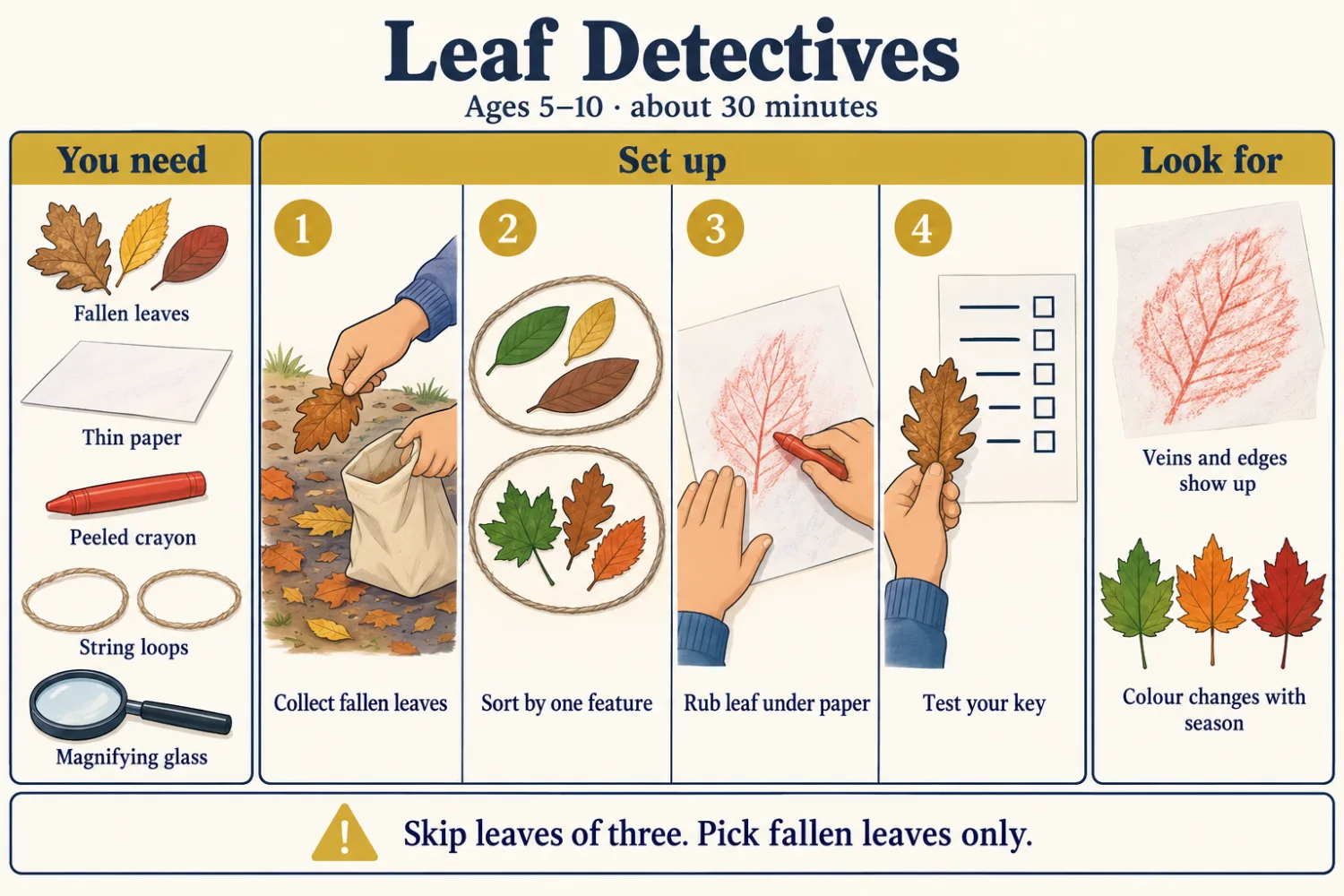
You and your child collect fallen leaves, sort them one feature at a time, and make crayon rubbings. Your child finds out which features stay the same and are useful for naming a tree, and older children build a yes-or-no key that leads to each leaf.
Watch first Set Up: Leaf Detectives · 0:41
Read the transcript of “Set Up: Leaf Detectives”
Film transcript: Set Up: Leaf Detectives
Take a bag or basket outdoors to collect eight to twelve fallen leaves that look different. Thin paper and a peeled crayon are for rubbings. On a walk of 10 to 15 minutes, pick up fallen leaves only. Lay them out and look closely at the edges. Sort them one feature at a time. Then older children write yes or no questions to make a key. Colour is a poor feature, since one leaf can be green, red, or yellow. Edges, lobes, and leaflets work better. Do not touch any leaf made of three leaflets. Leave it on the ground, because poison ivy grows across Virginia.
Before you start
- Hands-on time
- About 30 minutes
- Where
- Indoors or outdoors
- Ages
- 5 to 10, with an easier and a harder version below
- Grown-up
- Stay with your child outdoors, within sight and close by near roads. Check each leaf before it goes in the bag.
What you need
- A bag or basket for collecting
- 8 to 12 fallen leaves from different trees, or printed photos of leaves if you can't get outside
- A bundle of pine needles, if pines grow nearby (optional)
- Crayons with the paper peeled off, and thin paper for rubbings
- Two hoops or loops of string to make sorting circles
- A magnifying glass (optional)
- A tree field guide or a plant-identification app (optional)
- Paper and a pencil, or the printed observation sheet below
Virginia science standards SOL 1.4 cSOL 4.3 dSOL K.9 b
The big idea
Hand a child a pile of leaves and they start sorting: big ones, red ones, pointy ones. This activity turns that habit into one way scientists identify living things: one feature at a time, using features that do not change with the seasons.
Leaves differ in shape and in their edges, which can be smooth, toothed or prickly. Some have lobes, parts that stick out like fingers. Some are one piece, and some are made of many small leaflets on one stalk. These features help name a tree. Colour is a poor feature, because the same leaf can be green in summer and red or yellow in fall.
A dichotomous key is a list of yes-or-no questions. Each answer splits the group in two until only one kind of leaf is left. Virginia’s grade 1 standard asks children to sort plants by their features, grade 4 asks them to use a simple key, and kindergarten connects leaves to the change of seasons.
What to do
- Collect. On a 10 to 15-minute walk, pick up 8 to 12 fallen leaves that look different from each other. Choose whole, fairly flat leaves. Add a bundle of pine needles if you find one. With a class, give each group of four a bag and ask for at least six kinds.
- Look closely. Lay the leaves out. Run a finger along each edge. Look at the veins, the stalk and the tip. Use the magnifying glass if you have one.
- First sort. Ask your child to split the leaves into two groups any way they like. Then ask, “What was your rule?” Write it down in their words.
- One feature at a time. Sort again, using one feature each round: needle or flat? Smooth edge or toothed? Lobes or no lobes? One piece or many leaflets? Before each round, ask your child to guess which group will be bigger.
- Test colour. Ask, “Would colour make a good rule?” Find two leaves from the same tree in different colours if you can. A red maple leaf can be green, red, orange or yellow depending on the date.
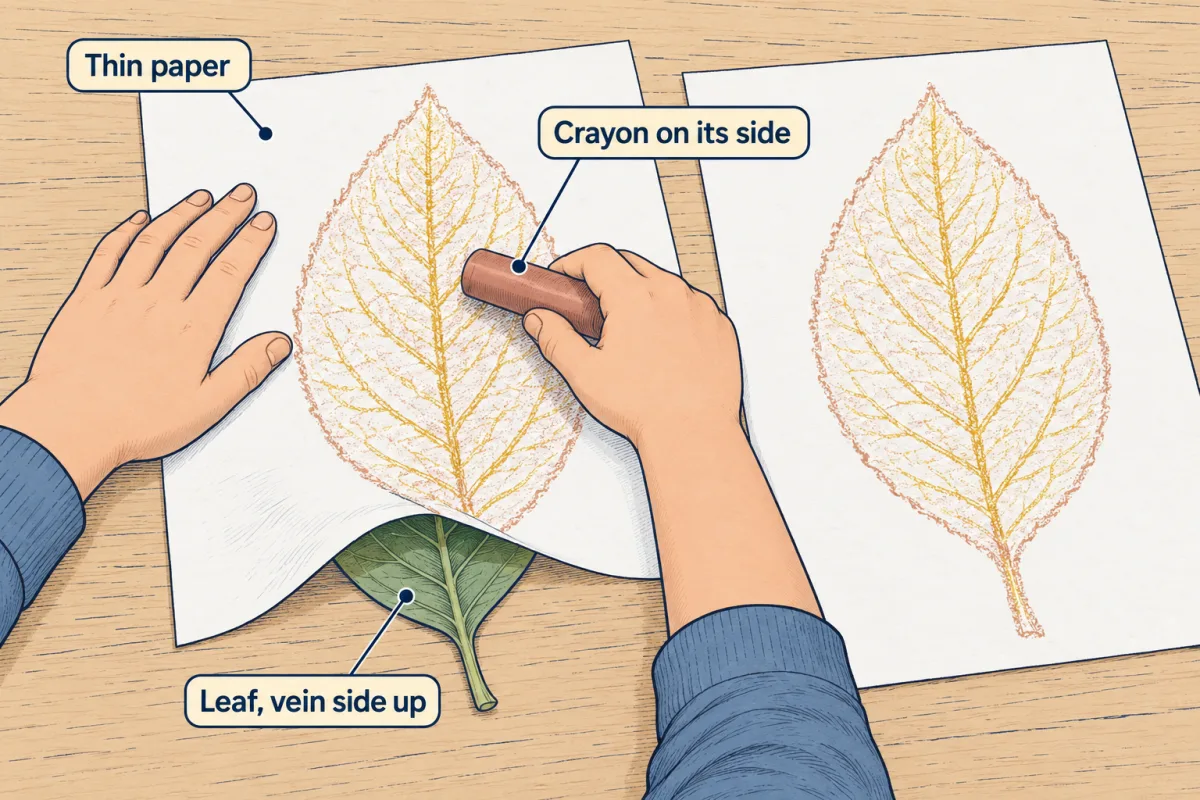
- Rubbings. Put a leaf vein side up under thin paper. Rub the side of a peeled crayon over it. The veins and edges show up. Make rubbings of three very different leaves.
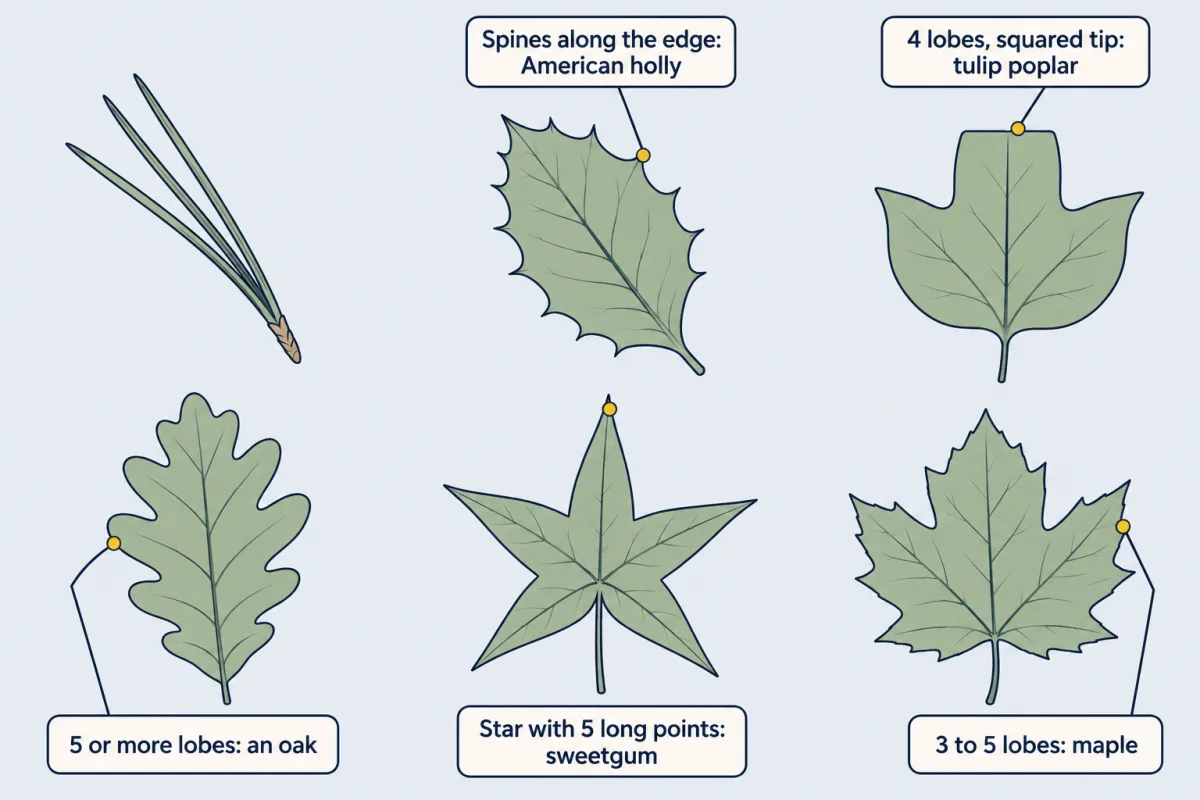
- Build a key. Together, write yes-or-no questions that lead to each of your leaves. The example key below works for only six kinds of tree: pine, American holly, tulip poplar, white or red oak, sweetgum and red maple. Other leaves will not fit, such as the smooth, unlobed leaf of a willow oak.
- Is it a needle? Yes: pine. Count the needles in a bundle: 2, 3 or 5 point to different pines. No: next question.
- Is it a stiff, shiny leaf with no lobes and sharp spines along the edge? Yes: American holly. No: next question.
- Does it have 4 lobes (sometimes 6) and a flat or notched tip? Yes: tulip poplar. No: next question.
- Does it have 5 or more lobes spaced along both sides of a long middle vein, like a feather? Yes: an oak with many lobes, such as white oak or red oak. No: next question.
- Is it a star with 5 (sometimes 7) long, even points? Yes: sweetgum. No: maple, with 3 to 5 lobes and often pale underneath.
- Test the key. Give a friend or family member one leaf and the key. Does the key lead them to the right name?
Questions to ask while you do it
Ask your child to guess first, then check.
- “I wonder if all the leaves from one tree look exactly alike. How could we check?”
- “Which feature do you think will split our pile closest to half and half?”
- “Is a pine needle a leaf? What does a leaf do?”
- “What do you think this leaf looked like in summer?”
- “If we found a new leaf, what question would you ask first?”
- “What do you think will show up in the rubbing?”
What children often think
-
A child might say “All the leaves on one tree are the same.”
You could try Collect five leaves from under one tree and line them up by size. They differ in size and sometimes in shape. A sassafras tree grows three shapes on one tree: oval, mitten-shaped and three-lobed. Each kind of tree still has its own range of features.
-
A child might say “Pine needles aren’t leaves.”
You could try Ask what leaves do for a tree. Needles are green, grow on the twigs, and make food from light just as flat leaves do. They are narrow leaves. Pines keep most of their needles through the winter.
-
A child might say “You sort leaves by colour.”
You could try Ask what colour this leaf was in July. The same leaf changes through the year, so colour is a weak clue. Shape, edges and lobes stay the same as the seasons change, which makes them better clues.
-
A child might say “This one with lots of little leaves is lots of leaves.”
You could try If you can, look at a twig on the tree. A bud sits where a whole leaf joins the twig, not at the base of each leaflet. Leaflets that share one stalk make one compound leaf, like a black walnut leaf.
Why it works
To identify a living thing, scientists use features that are steady from one plant to the next and through the year. For leaves, these include whether the leaf is a needle or flat, simple (one piece) or compound (made of leaflets), lobed or not, the kind of edge, the pattern of veins, and whether leaves sit in pairs or one at a time along a twig. Size varies, so it helps only a little.
Colour changes because of the seasons. In fall, a tree stops making chlorophyll, the green colouring, and the green fades. Yellows and oranges that were there all along show, and some trees make new reds. A key built on colour would give a different answer in July and in October.
A dichotomous key can only choose among the kinds it was built for. Field guides, such as the Virginia Department of Forestry’s guide to native trees, use longer keys of the same type to cover many more kinds; that guide covers about 80 native trees. A key is a tool for naming. Scientists group living things into families by how they are related, so two trees with look-alike leaves, such as sweetgum and maple, can belong to different families.
Easier and harder
Ages 5 to 7
Use six leaves that are very different. Sort by one feature at a time using two hoops on the floor: “pointy edges” and “smooth edges”, then “fingers” and “no fingers”. Skip the written key. Make rubbings and let your child match each rubbing to its leaf. Ask them to find two leaves that are alike in one way and different in another.
Ages 8 to 10
Let your child write the key from scratch for their own leaves, with each question answerable by yes or no. Test it on someone else and fix any question that confused them. Add tree names from a field guide or app. Measure each leaf’s length in centimetres and see whether size is a reliable feature for one kind of tree.
If it doesn’t go as planned
If you can only find leaves from one or two kinds of tree, use printed photos, or visit a park with labelled trees. Crumbly leaves tear during rubbings; choose fresher fallen leaves that still bend, and press curled ones flat inside a heavy book for a day first. If the key leads to a wrong answer, look at which question failed and rewrite it. Fixing a key is what scientists do too.
Observation sheet
Observation sheet
Leaf detectives
NameDate
Look at each leaf. Circle or write what you see.
| Leaf | Needle or flat? | Edge: smooth, toothed or spiny? | Lobes: yes or no? |
|---|---|---|---|
My first sorting rule was:
The best question in my key is:
biochemistrypedia.com · Biology Together
Finish line
Test yourself
4 questions
Practice and MCAT-style, with explained answers.
Next · Lesson 11
Take a Flower Apart
What is a flower for? Taking one apart, piece by piece, shows a child where seeds begin.
Continue →