Biology · Unit 6: Evolution
Evidence for Evolution
How do we know what lived millions of years ago, and how do we know we are related to other species? You will order fossil layers, count DNA differences between species, and read real fossil ages and DNA comparisons for whales and humans. Afterwards you can explain how fossils, rock dating and DNA each give evidence for evolution, and judge a claim using several lines of evidence.
Where this lesson sits
- Virginia SOL BIO.7a
- Virginia SOL BIO.7d
- Practices BIO.1c, BIO.1d, BIO.1e, BIO.1f
Essential question: How do we know what life was like millions of years ago, and how do we know we are related to other species?
-
Life Science (grade 7) LS.11 b
Review it at grade 7 level
In Life Science you learned that populations of living things can change over time. You used three kinds of evidence. The fossil record shows that many kinds of life existed, changed and went extinct. Comparing body parts of living and fossil animals shows similar structures. Similar DNA sequences show that organisms are related and share a common ancestor. You also learned that a scientific theory is not a guess. In Biology you add how scientists find the age of rocks and fossils, and how they compare whole genomes between species.
-
Biology BIO.7a, BIO.7d You are here
This lesson
-
Biology II Biology II: Advanced Survey of Biology Topics, BIOII.5 a and BIOII.7 b; Genetics, GEN.2 e
Preview where it goes next
In Biology II: Advanced Survey of Biology Topics, you add more lines of evidence. BIOII.5 a brings in biogeography, the pattern of where species live, and direct observation of populations changing now. BIOII.7 b compares homologous, analogous and vestigial structures across vertebrates and invertebrates; analogous structures, such as bird and butterfly wings, do a similar job without coming from one ancestral structure. In Biology II: Genetics, GEN.2 e uses the nearly universal genetic code, the same three-base codes for amino acids in almost all living things, as evidence of common ancestry. This lesson used DNA similarity; those courses ask how the code itself and its rare exceptions are evidence.
-
College
Watch first Many Kinds of Evidence, One History · 2:46
Rocks in Pakistan and Egypt hold fossil whales with leg bones. Living whales still carry small hip bones deep inside their bodies. Closer to home, Virginia State Parks reports fossil shark teeth along the Potomac shore at Westmoreland State Park, and Maryland’s Calvert Cliffs on the Chesapeake Bay expose fossils of whales and sharks. So how can rocks and bones tell us what life was like millions of years ago, and how could anyone show that whales are related to animals that walked?
What do you think? Decide before you read.
-
Scientists disagree: DNA does identify people, but scientists also line up the DNA of whole species and count the differences. Comparing genomes this way, called comparative genomics, shows which species are close relatives. For example, it grouped whales with hippos among the hoofed mammals.
What scientists think
Scientists disagree: DNA does identify people, but scientists also line up the DNA of whole species and count the differences. Comparing genomes this way, called comparative genomics, shows which species are close relatives. For example, it grouped whales with hippos among the hoofed mammals.
-
Scientists disagree: In everyday talk, a theory is a hunch. In science, a theory is a tested explanation that ties together many observations. The theory of evolution is supported by fossils, rock dating, anatomy, embryos and DNA, and each of these could have shown a different pattern but did not.
What scientists think
Scientists disagree: In everyday talk, a theory is a hunch. In science, a theory is a tested explanation that ties together many observations. The theory of evolution is supported by fossils, rock dating, anatomy, embryos and DNA, and each of these could have shown a different pattern but did not.
-
Scientists disagree: Humans did not come from today’s chimpanzees. Humans and chimpanzees descend along separate branches from a common ape ancestor that lived long ago. Both branches kept going, so both are alive today, in the same way that you and your cousins share grandparents and are all alive at once.
What scientists think
Scientists disagree: Humans did not come from today’s chimpanzees. Humans and chimpanzees descend along separate branches from a common ape ancestor that lived long ago. Both branches kept going, so both are alive today, in the same way that you and your cousins share grandparents and are all alive at once.
Explore: stack rock layers and count DNA differences
First you stack rock layers that each hold a fossil, then put them in order from oldest to youngest. Next you line up a short stretch of DNA from five species, base by base, and count the differences. Your counts build a similarity table.
In this sketch: four rock layers and a made-up DNA stretch. Layers show order only, not ages in years. Each symbol stands for one DNA base. Animals P, Q, R, S are invented. P, Q and R use the lesson’s counts (2, 9, 16 per 30 bases). S (23) is added here. 60 bases repeats the 30-base pattern, so the percent match stays the same.
Part 1. Stack the rock layers
Number in a circle: 1 means laid down first (oldest), 4 means laid down last (youngest).
Part 2. Count DNA differences
Pick a pair in the table to line up their bases and count the differences. Each cell shows bases that differ (top) and percent that match (bottom).
Keep this rule: lower layers are older in an undisturbed stack, so geologists check for folding, tilting and breaking first; and in matching stretches of DNA, fewer differences usually mean a more recent common ancestor. The DNA here is a made-up example, and a short stretch is weak evidence on its own. This is a sketch of the logic, not a measurement.
Try this.
- Before you stack the layers, predict which fossil is the oldest. Then build the stack and check your prediction.
- Tilt or flip part of the stack. Predict whether the bottom layer is still the oldest, then test it.
- Predict which species will have the fewest DNA differences from humans. Count the differences and see.
- Compare a longer DNA stretch instead of a short one. Predict whether your ranking of relatives will change.
Explain: what rocks and fossils record
- fossil
- fossil record
- relative dating
- radioactive dating
- comparative genomics
- common ancestor
- homologous structure
- vestigial structure
- embryology
- theory
A fossil is the preserved remains or traces of a living thing from the past, such as a bone, shell, tooth or footprint. The fossil record is all the fossils found so far, arranged by age. It shows that kinds of life appeared, changed and often went extinct over time.
The record is incomplete. Most dead plants and animals rot or are eaten before they can fossilize. Fossils form more often when a body is buried quickly in mud or sand under water, so sea animals are better recorded than forest animals. Life has existed for about 3.5 billion years or more, and most of it left no fossils.
Relative dating puts rocks and fossils in order from older to younger, without an age in years. Sedimentary rock builds up in layers, like a stack of mail on a table. In an undisturbed stack, the bottom layer was laid down first. So a fossil in a lower layer is older than one higher up. The analogy breaks where layers have been folded, tilted or broken by Earth movements, so geologists check for that first.
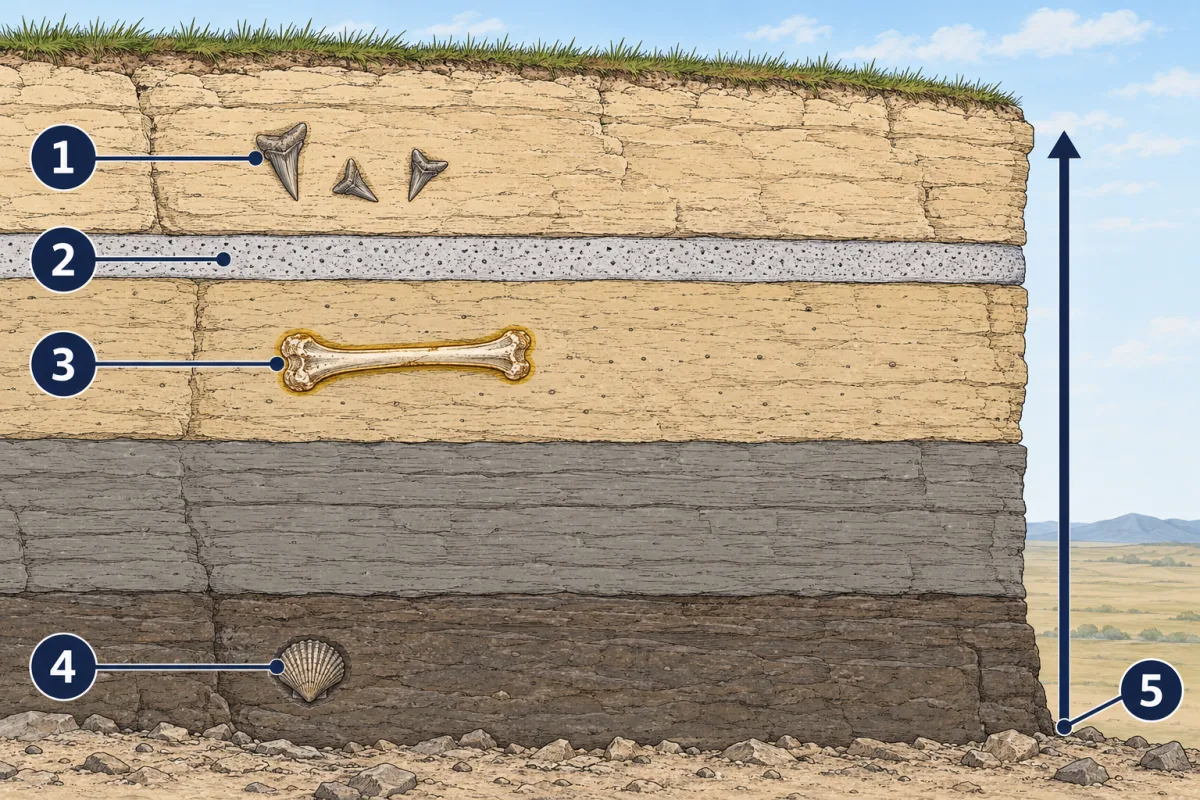
- top layer with shark teeth
- volcanic ash layer
- fossil whale bone
- oldest bottom layer
- older to younger
- top layer with shark teeth
- blank
- blank
- oldest bottom layer
- blank
Word bank: fossil whale bone, older to younger, volcanic ash layer
- blank
- blank
- blank
- blank
- blank
Check your labels
- top layer with shark teeth
- volcanic ash layer
- fossil whale bone
- oldest bottom layer
- older to younger
Radioactive dating uses radioactive atoms in certain minerals to estimate a rock’s age in years. These atoms change into other atoms at a steady rate. Measuring how much starting atom remains and how much product has built up gives the time since the mineral formed. Often dated minerals sit in volcanic layers above and below a fossil, so the fossil’s age falls between the two dates.
Different atoms suit different spans of time. Carbon-14 works only for remains up to about 50,000 years old. Fossil whales millions of years old need other atoms.
Explain: what DNA comparisons show
DNA is passed from parents to offspring. When it is copied, small changes sometimes happen, and some are passed on. Comparative genomics is the comparison of the whole DNA, or genome, of different species. A common ancestor is an ancestral population from which two or more species descended. Two species that split from a common ancestor recently have had less time to collect differences. So, for matching stretches of DNA, more similar sequences usually mean a more recent common ancestor.
In 2005, a team compared the genome of a chimpanzee named Clint with the human genome. Across about 2.4 billion lined-up bases, 1.23 of every 100 differed.
percent matching = 100% − percent different = 100% − 1.23% = 98.77%, or about 98.8%
That number counts single-base differences in matching regions only. The same study also found about five million places where short pieces of DNA had been added or lost, which the 1.23% leaves out. A 2025 study of complete ape genomes compared regions that earlier work had skipped. So a “percent similar” depends on what was compared.
DNA also tested where whales belong. In 1999, a team compared pieces of DNA that had been inserted at particular spots in the genomes of whales and hoofed mammals. Species sharing an insertion at the same spot likely inherited it from one ancestor. The pattern placed whales among the even-toed hoofed mammals, grouped with hippos. This does not mean hippos were whale ancestors. It means whales and hippos share a common ancestor.
Humans did not come from chimpanzees; both descend from a common ape ancestor.
Explain: many fields, one history
Each field below could have contradicted the others. For whales, they agree.
| Field | Whale evidence |
|---|---|
| Paleontology and geology | Legged whale fossils from Pakistan and Egypt, in layers dated tens of millions of years old |
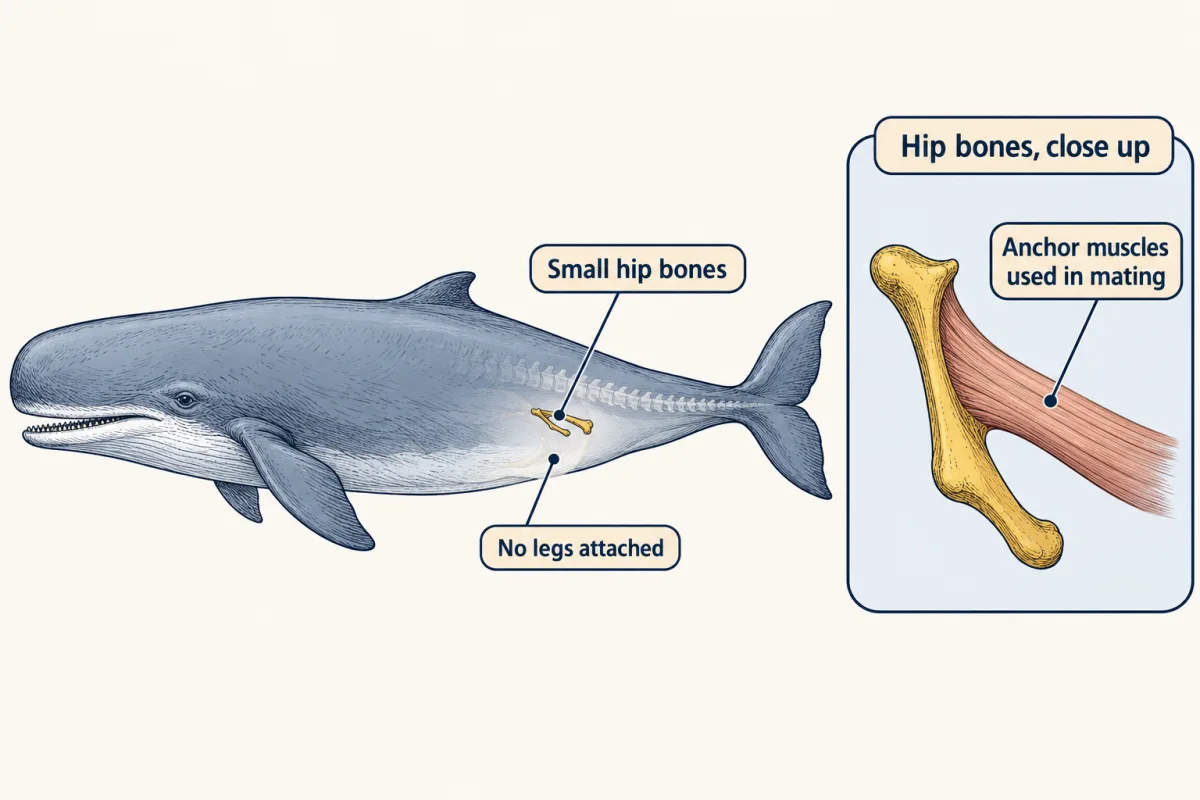
| Anatomy | Small hip bones inside living whales |
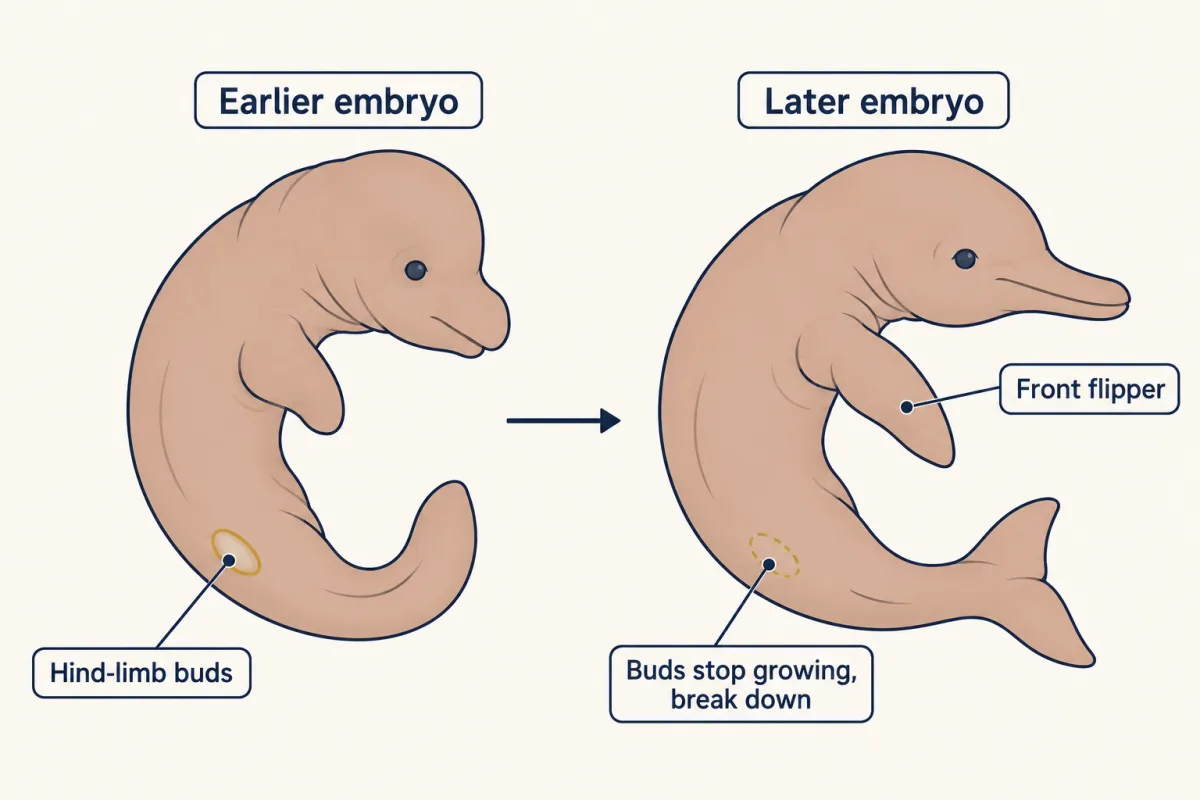
| Embryology | Pantropical spotted dolphin embryos grow hind-limb buds that disappear |
| Genetics | DNA insertions group whales with hippos |
| Biochemistry | Whales share the nearly universal genetic code (the same three-base codes for amino acids) with other life |
A homologous structure is a body part in different species that comes from the same structure in a common ancestor. A whale flipper, a human arm and a bat wing hold the same set of bones, arranged differently.
A vestigial structure is a reduced body part that no longer does the job it did in ancestors. Vestigial does not mean useless. A 2014 study measured hip bones from 130 whales, dolphins and porpoises of 29 species. In males, these bones anchor muscles used in mating.
Embryology is the study of how an organism develops before birth or hatching. Pantropical spotted dolphin embryos grow hind-limb buds that stop growing and break down around the fifth week. The embryo is not replaying its ancestors; it starts a limb and then stops.
A theory in science is a well-tested explanation supported by many lines of evidence. The theory of evolution explains fossils, anatomy, embryos and DNA with one history of common descent. For the mechanism that drives that change, see Natural Selection and New Species.
Elaborate: read DNA comparisons and fossil ages
The table mixes two kinds of evidence. Read the third column before you compare any numbers.
| Comparison or fossil | Value (% or millions of years ago) | What the number measures | Source |
|---|---|---|---|
| Human and chimpanzee | 1.23% differ (98.77% match, calculated) | Single DNA bases in about 2.4 billion lined-up bases | Chimpanzee genome team, Nature, 2005 |
| Human and mouse | about 85% identical | DNA bases in protein-coding regions, average | NHGRI summary, 2010 update |
| Chicken and human | about 60% | Chicken genes with a similar human gene | NHGRI release, 2004 |
| Fruit fly and human | about 60% | Genes shared; no single comparison method given | NHGRI fact sheet, 2020 update |
| Pakicetus | about 50 | Rounded teaching age for the group | Burke Museum activity |
| Ambulocetus | about 49 | Rounded teaching age for the group | Burke Museum activity |
| Rodhocetus | about 47 | Rounded teaching age for the group | Burke Museum activity |
| Maiacetus inuus, Pakistan | 47.5 | Age given for one skeleton | Gingerich and colleagues, PLoS ONE, 2009 |
| Basilosaurus isis WH 10001, Egypt | about 37.5 | Age of one skeleton, Wadi Al Hitan | Voss and colleagues, PLoS ONE, 2019 |
Sources: the chimpanzee row compares one chimpanzee, Clint, with the human reference genome. The mouse, chicken and fly values are published summaries from the National Human Genome Research Institute (NHGRI), not one study. The first three fossil ages are rounded teaching ages from a Burke Museum classroom activity, so they are rounded values for a group, not measurements of one skeleton.
- Put the five fossils in order from oldest to youngest. How many million years separate Pakicetus and WH 10001?
- The mouse value counts matching bases, and the chicken value counts genes. Can you use them to rank mouse and chicken as human relatives? Why or why not?
- Does the fossil order prove that each whale was the parent species of the next one?
Claim, evidence, reasoning
Make a claim that answers the essential question: are whales related to land mammals? Use the fossil ages and at least one other line of evidence from this lesson.
Start with: The evidence shows that whales blank.
Start with: The oldest whale fossil in the table, blank, is about blank million years old and blank. Living whales have blank. DNA shows blank.
Start with: These lines of evidence count because blank. Together they blank, even though blank.
Compare with a model answer
Whales descend from land mammals. In the table, Pakicetus has a teaching age of about 50 million years, and Maiacetus, at 47.5 million years, kept all four limbs with hands and feet. Basilosaurus fossils from Egypt, about 37.5 million years old, include small hind-limb and foot bones. Living whales carry small hip bones, and DNA insertions group whales with hippos among the hoofed mammals. These are independent kinds of evidence that point the same way. One limit: the ages are rounded or come from single skeletons, and the order of fossils does not show that any one was a direct ancestor.
Saved in this browser only.
Design problem
Some people say a whale’s small hip bones are leftovers with no job. Plan a study, using museum skeletons, to test whether the hip bones are linked to mating in male whales.
One way to do it
- Question: In male whales, do species with relatively larger testes also have relatively larger hip bones?
- Independent variable: relative testes size of each species, from published records.
- Dependent variable: hip bone size and shape, measured the same way on every skeleton.
- Constants: adult males only, the same measuring tool and method, and every size divided by body length, so large and small species can be compared.
- Control: measure a rib from each skeleton too. If ribs also track testes size, the link is about overall body size, not mating.
- Sample size and repeated trials: many species and several skeletons per species; measure each bone more than once. The 2014 study used 130 whales, dolphins and porpoises from 29 species.
- Ethics: museum skeletons harm no living animal.
If hip bones track testes size and ribs do not, the bones likely still serve mating. This is a pattern, not proof of cause.
Evaluate: check your thinking
Fossil whales with legs sit in rock layers dated tens of millions of years old, and living whales still carry small hip bones. Dolphin embryos start hind limbs and then lose them, and DNA groups whales with hippos. Several independent fields point to one answer: whales descend from ancestors that walked on land.
Science practices you used: ordering rock layers and naming a model’s limits, calculating a percent and a difference from a data table, checking whether two numbers measure the same thing, and making and judging a claim from several lines of evidence.
How we measure it
Reading rock layers (stratigraphy)
Geologists map the order of sedimentary rock layers and check that they have not been folded or flipped. In an undisturbed stack, lower layers and their fossils are older than the layers above them.
Radioactive (radiometric) dating
A lab measures how much of a radioactive starting atom, and of the atom it changes into, are in a mineral. The amounts give an estimate of when the mineral formed, which dates the rock near a fossil.
DNA sequence alignment
A computer lines up the matching stretches of DNA from two species, base by base. Counting the positions that differ, out of all positions compared, gives a percent difference.
Finish line
Test yourself
8 questions
Practice and MCAT-style, with explained answers.
Next · Lesson 27
Variation and Survival
After years of ivory poaching in Mozambique, about half of the female elephants that survived had no tusks. How could a whole population change like that?
Continue →