Biology · Unit 6: Evolution
Natural Selection and New Species
How does a trait become more common in a population, and how can one species become two? You sort finches through a drought in a model, then read real beak measurements from birds that lived and birds that died. Afterwards you can explain natural selection step by step, tell fast change from slow change, and use beak data to support a claim.
Where this lesson sits
- Virginia SOL BIO.7c
- Virginia SOL BIO.7d
- Practices BIO.1c, BIO.1d, BIO.1e, BIO.1f
Essential question: How do traits become more common in a population, and how can one species become two?
-
Life Science (grade 7) LS.11 a
Review it at grade 7 level
In Life Science you learned that populations can change over time. Mutations make new variations, and a variation may help, harm or do nothing. Natural selection means that organisms with helpful variations are more likely to survive and reproduce, so those traits become more common over many generations. Adaptations are traits that help an organism live in its environment. If a species has no traits that suit a changed environment, it may become extinct. Biology adds real measurements of selection in the wild, fast and slow patterns of change, and how one species can split into two.
-
Biology BIO.7c, BIO.7d You are here
This lesson
-
Biology II Biology II: Advanced Survey of Biology Topics, BIOII.5 c-f; Genetics, GEN.6; Ecology, EC.6 a and c
Preview where it goes next
Virginia's Biology II courses add the other forces that change a population's genes. Genetic drift is change by chance, strongest in small populations, as after a bottleneck or when a few founders start a new group. Gene flow moves alleles between populations when individuals migrate. Mutation and non-random mating can also change a population's genetic makeup. The Hardy-Weinberg model describes a population with none of these forces, so it works as a baseline to test against. The courses also sort the barriers that keep species apart, compare speciation by adaptive forces such as selection with speciation by chance, and ask how to tell selection from drift.
-
College
Watch first Selection Sorts Differences That Already Exist · 2:54
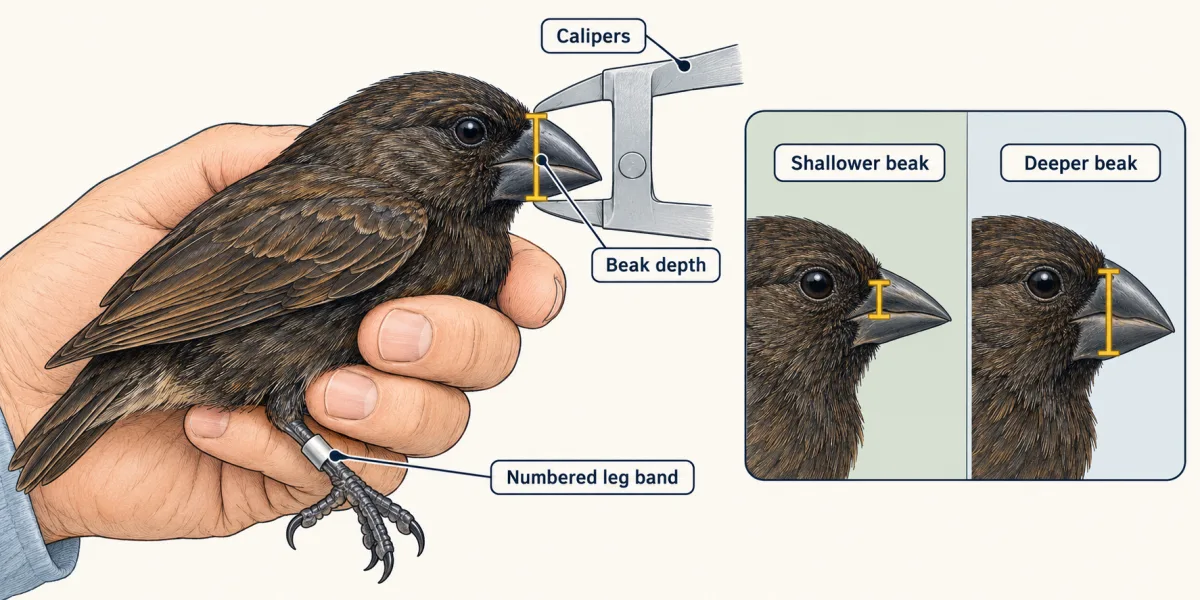
In 1977 a severe drought struck Daphne Major, a small island in the Galápagos, and most of its medium ground finches died. The birds that were left had, on average, deeper beaks than the birds that had lived there before.
Researchers had measured hundreds of these birds before the drought, and they knew which lived. So you can ask a real question: did the drought change the birds, or change which birds were left?
What do you think? Decide before you read.
-
Scientists disagree: To a biologist, fitness means how many offspring an individual leaves that survive to reproduce. Strength counts only when it leads to more young. On Daphne Major large birds, especially males with large beaks, survived best, and a deep beak helped crack the hard seeds left. A strong animal that leaves no young has a fitness of zero.
What scientists think
Scientists disagree: To a biologist, fitness means how many offspring an individual leaves that survive to reproduce. Strength counts only when it leads to more young. On Daphne Major large birds, especially males with large beaks, survived best, and a deep beak helped crack the hard seeds left. A strong animal that leaves no young has a fitness of zero.
-
Scientists disagree: No finch grew a deeper beak because it needed one. Researchers measured the beaks before the drought, and the birds that survived already had deeper beaks on average. Need does not change an animal’s genes. The population changed because some birds died and others lived and bred.
What scientists think
Scientists disagree: No finch grew a deeper beak because it needed one. Researchers measured the beaks before the drought, and the birds that survived already had deeper beaks on average. Need does not change an animal’s genes. The population changed because some birds died and others lived and bred.
-
Scientists disagree: New inherited variation comes from mutation, and sexual reproduction shuffles it into new combinations. Selection only sorts the variation that is already there. If no finch had carried a deeper beak, the drought could not have favoured one. Scientists see this when they track the same measured birds over time.
What scientists think
Scientists disagree: New inherited variation comes from mutation, and sexual reproduction shuffles it into new combinations. Selection only sorts the variation that is already there. If no finch had carried a deeper beak, the drought could not have favoured one. Scientists see this when they track the same measured birds over time.
Explore: send a finch population through a drought
In the model below, finches have a spread of beak depths. You set the seed supply: mostly small soft seeds or mostly large hard ones. Survival depends on beak depth, survivors breed, and their young inherit beak depth with some variation, shown as a histogram each generation. A second tab splits one population with a river and lets the two sides change on their own.
- this generation (number of birds)
- generation 0, the start
- mean now
- mean at the start
- chance of surviving (sketch rule, right axis)
- generation sorted by small soft seeds
- generation sorted by large hard seeds
| Last generation | Expected | Observed |
|---|---|---|
| Birds that survive (of 200) | – | – |
| Mean beak depth of survivors (mm) | – | – |
| Mean beak depth of their young (mm) | – | – |
- Generation
- 0
- Mean beak depth at the start (mm)
- about 9.2
- Mean beak depth now (mm)
- about 9.2
Assumptions in this sketch: 200 finches. The starting mean beak depth, about 9.2 mm, is the lesson’s mean for adults before the drought (from a separate Open University summary); the spread of 0.8 mm is a sketch value. With large hard seeds, the chance of surviving rises with beak depth along an S-shaped curve that is not fitted to the lesson’s sample (survivors 9.67 mm, nonsurvivors 9.11 mm) (centred at 9.4 mm, a sketch value). With small soft seeds, every bird has the same chance, 50%. Survivors pair at random. Each young bird gets the average of its two parents plus a random amount, and the group is refilled to 200. The random amounts are sketch values. Expected values come from the rule; observed values come from the random draws.
- left group’s trait
- right group’s trait
- gap between the groups
| Now | Expected | Observed |
|---|---|---|
| Gap between the groups (relative units) | 0 | 0 |
| In this sketch, a cross between the sides gives fertile young | – | 100% |
- Generation
- 0
- River
- between the groups
Assumptions in this sketch: all numbers are relative units, and time is counted in generations of the sketch, not years. Both groups start with the same trait. Each generation, each group’s trait changes by a random amount (different mutations and chance). With different conditions, each side also gets a steady push in its own direction, 0.6 relative units per generation, so the expected gap grows by 1.2 per generation. The chance that a cross between the sides gives fertile young falls in a straight line as the gap grows, and reaches zero at a gap of 24. Once the river is gone, this sketch follows only the mixing of the groups. The size of the steps is a sketch value, not a measurement of any real animal. Real speciation is usually slow; the number of generations here is a sketch value, not a prediction.
Selection sorts inherited differences that are already there, so a trait that helps birds leave more young becomes more common; separated groups that change in different ways may stop being able to interbreed, but separation alone is not speciation.
Try this.
- Predict where the mean beak depth will move if the island has only large hard seeds. Run five generations and check.
- Switch back to small soft seeds. Predict first: will the mean move back, stay, or keep rising?
- Set the starting population so every bird has the same beak depth. Predict what drought does now, then test it.
- On the river tab, run both sides for many generations. Watch when the two groups can no longer interbreed.
Explain: how natural selection works
- natural selection
- variation
- inherited trait
- fitness
- adaptation
- mutation
- extinction
- gradualism
- punctuated equilibrium
- species
- speciation
- geographic isolation
Natural selection is the process in which individuals with some inherited traits survive and reproduce more than others, so those traits become more common in a population. It works only when three things are true at once.
- Variation: individuals differ in a trait. Variation means the differences among individuals in a population.
- Inheritance: the differences are passed to offspring. An inherited trait is a trait carried in genes from parent to young.
- Unequal success: the differences change how many offspring an individual leaves.
Where does variation come from? A mutation is a change in DNA, and it is the source of new versions of genes. Sexual reproduction then shuffles those versions into new combinations, as you saw in that lesson. Selection does not make variation. It sorts what is already there.
Fitness is how many offspring an individual leaves that survive to reproduce. An adaptation is an inherited trait that helps an organism survive and reproduce in its present environment. On Daphne Major in 1977, a deep beak was an adaptation. The study that measured the birds found that large birds, especially males with large beaks, survived best, because they could crack the large, hard seeds left after the drought.
No bird’s beak grew because of the drought. The birds that died were, on average, different from the birds that lived. Studies of parents and young showed that beak size is strongly inherited, so the next generation’s beaks were deeper on average too. Over many generations, unequal survival like this leaves a population made up mostly of well-suited individuals, and the inherited change tends to last unless the environment later favours something else.
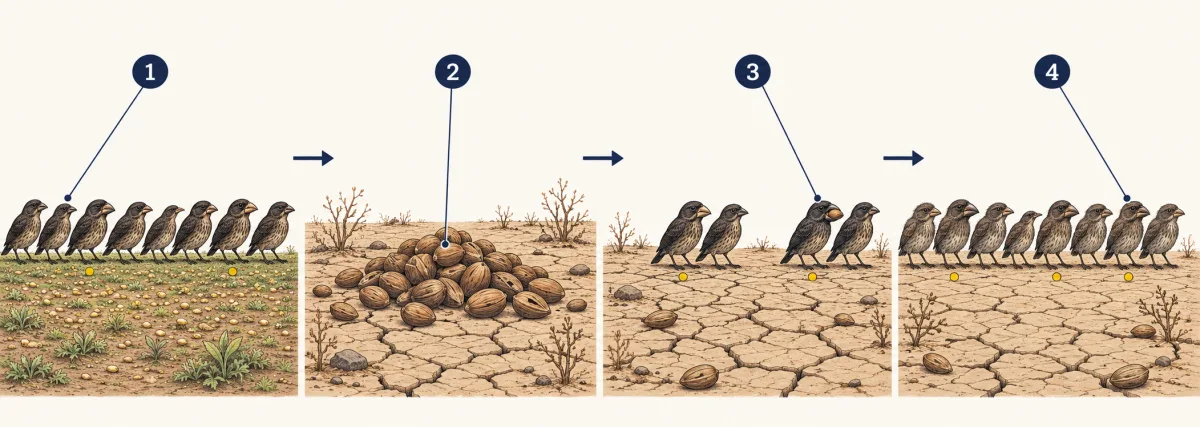
- a spread of beak depths
- large, hard seeds
- deep-beaked birds survive and breed
- the next generation
- blank
- large, hard seeds
- blank
- blank
Word bank: a spread of beak depths, deep-beaked birds survive and breed, the next generation
- blank
- blank
- blank
- blank
Check your labels
- a spread of beak depths
- large, hard seeds
- deep-beaked birds survive and breed
- the next generation
Explain: fast change, slow change and new species
Selection can be fast. Bacteria divide often, so an antibiotic can sort a population within days. In one laboratory study, E. coli grew resistant to a very high dose of an antibiotic in about 10 days. You can read more in that lesson. Large animals can change in decades: poaching for ivory in Mozambique favoured female elephants with no tusks. Other changes build up over thousands or millions of years.
Biologists describe two patterns in the history of life.
| Pattern | What the change looks like | Picture |
|---|---|---|
| Gradualism | Small changes add up steadily over long periods | A ramp |
| Punctuated equilibrium | Long periods of little change, broken by bursts of change that are fast in geologic time | A staircase |
Gradualism is the idea that change builds up in small steps over long periods. Punctuated equilibrium is the idea that species stay much the same for long periods, then change in short bursts, which can still last thousands of years. The two can occur together in one lineage at different times.
A species that cannot adapt to a change may suffer extinction, the death of every member of a species. Adapting does not guarantee rescue, though. A population can become better suited and still shrink to nothing if the environment worsens faster than it changes.
A species is a group of organisms that can interbreed and produce fertile offspring. This definition works for organisms that reproduce sexually. Speciation is the process in which one species splits into two or more groups that can no longer interbreed and produce fertile offspring. Speciation often starts with geographic isolation, the separation of groups of one species by a barrier such as a river, a mountain range or a canyon. On each side, different mutations arise and different traits are favoured, so the groups change in different ways.
Separation alone is not speciation. The Kaibab squirrel on the north side of the Grand Canyon looks different from the Abert’s squirrels on the south side, yet biologists usually treat it as a subspecies of Abert’s squirrel, so as one species. They show a split that may or may not be finished. Speciation can also happen without a barrier. It can also begin fast: on Daphne Major, a new finch lineage that started with one immigrant male stopped breeding with the other finches within three generations.
Elaborate: read the drought data
The table uses a real classroom sample of 100 medium ground finches. Each beak was measured before the drought, and each bird is labelled by whether it survived. The sample was chosen to hold 50 survivors and 50 nonsurvivors.
| Beak depth before the drought (mm) | Nonsurvivors (number of birds) | Survivors (number of birds) |
|---|---|---|
| 7.5 to under 8.0 | 5 | 0 |
| 8.0 to under 8.5 | 8 | 4 |
| 8.5 to under 9.0 | 9 | 9 |
| 9.0 to under 9.5 | 11 | 8 |
| 9.5 to under 10.0 | 8 | 9 |
| 10.0 to under 10.5 | 4 | 10 |
| 10.5 to under 11.0 | 4 | 7 |
| 11.0 to under 11.5 | 1 | 3 |
| Mean beak depth (mm) | 9.11 | 9.67 |
Counts are calculated from HHMI BioInteractive’s “Finches in the Galápagos” dataset, data from Peter and Rosemary Grant, birds of Daphne Major measured about 1976, sorted by survival of the 1977 drought.
A separate summary of the Grants’ figures, from the Open University, gives a mean beak depth of about 9.2 mm for adults before the drought, about 9.9 mm for the survivors that bred, and about 9.7 mm for their young hatched in 1978. Those are different groups of birds from the table, so do not mix the two sets.
- Find the beak depth range where survivors first outnumber nonsurvivors. What happens in the ranges above it?
- Subtract the two means. How much deeper, on average, were the survivors’ beaks?
- The sample is half survivors on purpose. Why can it not tell you what share of the island’s finches survived?
Claim, evidence, reasoning
Make a claim that answers the essential question for the Daphne Major finches, using these data.
Start with: The data show that during the drought, birds with blank beaks were more likely to survive, so the trait became blank in the population.
Start with: Survivors had a mean beak depth of blank mm, compared with blank mm for nonsurvivors, and the 1978 young averaged about blank mm.
Start with: Beak depth varied among birds and is blank, so when deep beaks helped birds crack blank, the next generation had blank beaks on average.
Compare with a model answer
During the 1977 drought, finches with deeper beaks were more likely to survive, and deeper beaks became more common in the next generation. The survivors in the sample had a mean beak depth of 9.67 mm, compared with 9.11 mm for nonsurvivors, and, in a separate Open University summary of other groups, the young hatched in 1978 averaged about 9.7 mm, deeper than the pre-drought adults at about 9.2 mm. Beak depth varied and is strongly inherited, and deep beaks could crack the large, hard seeds that were left. One limit: these are birds from one island in one drought, and body size varied with beak size, so beak depth may not be the only trait that mattered.
Saved in this browser only.
Design problem
A different island has a population of seed-eating finches that has never been studied. Plan a study that could show whether the next drought selects on beak depth.
One way to do it
Before any drought, band as many birds as you can (a few hundred if possible) and measure each beak depth three times with the same tool, then take the mean. Record body mass too, since big birds tend to have big beaks. Keep the method, measurer and season constant. Handle each bird briefly, release it unharmed, and work under the permits wildlife studies require.
After a drought, record which banded birds are still alive. Beak depth is the independent variable and survival the dependent variable. Compare the mean beak depth of survivors and nonsurvivors. A wet year is your comparison: if beak depth predicts survival only in the drought year, selection by the drought is the likely cause. Then measure the survivors’ young; a higher mean in them, with young resembling their own parents, is evidence the change was inherited. Equal means in survivors and nonsurvivors would suggest that selection did not favour either deeper or shallower beaks.
Evaluate: check your thinking
The drought did not reshape any finch’s beak. Birds with deeper beaks were already in the population, they cracked the hard seeds that were left, and more of them lived to breed. Because beak depth is inherited, their young had deeper beaks too, so the population changed between generations.
Science practices you used: planning a fair study with variables and a comparison, reading a data table with counts and means, using a model and naming its limits, and making a claim from evidence.
How we measure it
Banding and measuring wild birds
Each bird gets a numbered leg band, and its beak depth is measured in millimeters with a small measuring tool such as calipers. Because each measurement belongs to one known bird, researchers can later check whether that bird survived.
Comparing parents and offspring
Researchers measure parents and their young and check whether parents with deeper beaks tend to have young with deeper beaks. A match like this is evidence that the trait is inherited.
Comparing group means and spreads
Measurements are sorted into groups, such as survivors and nonsurvivors, and each group's mean and spread are compared. A difference in means shows an association, not by itself the cause.
Finish line
Test yourself
8 questions
Practice and MCAT-style, with explained answers.
Next · Lesson 29
Populations and Carrying Capacity
Why can the number of blue crabs in the Chesapeake Bay change by more than 100 million from one winter to the next?
Continue →