Life Science · Unit 6: Changing ecosystems
Helping Ecosystems Recover
Can people help a damaged ecosystem come back? You test a pesticide ban and protected nesting forest in a model of Virginia's bald eagles, then read real eagle survey counts from 1977 to 2016. Afterwards you can explain how people change ecosystems near and far, and how conservation and restoration can help them recover.
Where this lesson sits
- Virginia SOL LS.9 c
- Practices LS.1 c, LS.1 d, LS.1 e, LS.1 f
Essential question: Can people help a damaged ecosystem come back?
-
Life Science (grade 7) LS.9 c You are here
This lesson
-
Biology
Preview it at high school level
In Biology you use real Chesapeake Bay restoration numbers. You compare the nitrogen reaching the Bay with the goal for cutting it. You read how much underwater grass grew back, using only areas that were mapped in both years, and you see how restored oyster reefs did. You also treat restoration as an engineering design problem. You choose and test fixes, such as forest buffers and better wastewater plants. Each fix must meet its goals within limits of money, land and time. You learn that results can take years to show up, so you measure, compare and improve.
-
Biology II Biology II: Ecology, EC.2 d and f, EC.7 c; Advanced Topics, BIOII.6 f
Preview where it goes next
Virginia's Biology II: Ecology course pairs each threat from people with ways to fix it. It adds the laws and agreements behind conservation, such as the Endangered Species Act and the United Nations Convention on Biological Diversity. You run a biosurvey of a local area and study invasive species in a local ecosystem. The Advanced Topics course asks how biodiversity helps an ecosystem resist a disturbance or bounce back from it, which ecologists call resilience, and when a push becomes too large for a return.
-
College
Watch first People Can Help Nature Recover · 2:43
In 1977, a survey found only 33 pairs of bald eagles nesting in Virginia. In 2016, a larger search, which also used ground checks and volunteer reports, counted 1,070 pairs.
Something had gone wrong for eagles, and then people changed what they did. Can people help a damaged ecosystem come back?
What do you think? Decide before you read.
-
Scientists disagree: Carbon dioxide from burning coal, oil and gas is warming Earth. People can also help. After the United States banned most uses of the pesticide DDT and protected eagles, Virginia’s yearly surveys counted far more eagle pairs.
What scientists think
Scientists disagree: Carbon dioxide from burning coal, oil and gas is warming Earth. People can also help. After the United States banned most uses of the pesticide DDT and protected eagles, Virginia’s yearly surveys counted far more eagle pairs.
-
Scientists disagree: By 1933, a disease and a hurricane had wiped out eelgrass in Virginia’s coastal bays. Scientists later spread eelgrass seeds there, and a 2020 study reported 3,612 hectares of meadow. A review of 400 studies found that damaged places often improve, but full recovery is less common.
What scientists think
Scientists disagree: By 1933, a disease and a hurricane had wiped out eelgrass in Virginia’s coastal bays. Scientists later spread eelgrass seeds there, and a 2020 study reported 3,612 hectares of meadow. A review of 400 studies found that damaged places often improve, but full recovery is less common.
-
Scientists disagree: Scientists sampled small animals in the restored eelgrass meadows. Some kinds turned up that were missing from nearby natural meadows. A place can recover and still be different, because ecosystems keep changing.
What scientists think
Scientists disagree: Scientists sampled small animals in the restored eelgrass meadows. Some kinds turned up that were missing from nearby natural meadows. A place can recover and still be different, because ecosystems keep changing.
Explore: bring the eagles back
The simulation shows a Bay shoreline, with a bar of eagle nests for each decade from the 1950s to the 2020s. You choose the year a harmful pesticide is banned, or never ban it. You set how much shoreline forest is protected for nests, and you can switch on a new pollution problem.
Start here: under “Pesticide banned in”, choose 1972 and watch the bars.
- Top strip: pesticide in use
- Top strip: pesticide banned
- Lower strip: pollution problem on
In this sketch, the pesticide is never banned. Choose a ban year to compare.
Assumptions made up for this sketch: The pesticide is in use from 1950 (invented). Bar heights are relative units, not nest counts, and the starting height in the 1950s is invented. There is one cause of egg failure: while the pesticide is used, far fewer young are raised. Young eagles reach nesting age after a delay of 5 years. Food is the same every year, and no eagles arrive from other states. Forest only sets how many young find a safe nest place (the lesson does not say how much it helps). The pollution starts in 2000 and halves the young raised. All rates are invented. Each bar is a decade average.
Rule to keep: removing the harmful pesticide and protecting nesting places let eagles recover over decades, because young eagles take several years to grow old enough to breed.
Try this.
- Predict how fast the nests come back if the pesticide is banned in 1972. Test it. Do the nests return right away?
- Keep the same ban year. Predict what more protected forest will do. Compare low and high.
- With a 1972 ban, after the nests recover, predict what a new pollution problem will do. Switch it on.
Explain: living and nonliving changes
- biotic factor
- abiotic factor
- fossil fuel
- deforestation
- ocean acidification
- pesticide
- conservation
- restoration
- sustainable practice
A biotic factor is a living part of an ecosystem, such as eelgrass, oysters or eagles. An abiotic factor is a nonliving part, such as water, air, sunlight or temperature. A change in either one can change the whole ecosystem.
Natural changes count too. By 1933, a disease and a hurricane had wiped out the eelgrass in Virginia’s coastal bays. The disease was a biotic change. The storm was an abiotic one.
You met habitat loss and invasive species in People Change Habitats. Here are six more ways people change ecosystems.
| Area | What people do | One effect |
|---|---|---|
| Climate | Burn coal, oil and gas | Carbon dioxide builds up in the air and warms Earth |
| Water supply | Pump water from streams and wells | Streams can carry less water |
| Air quality | Release exhaust from cars and factories | The gas ozone near the ground can slow photosynthesis in sensitive trees, such as black cherry and tulip poplar |
| Energy production | Run power plants | Some release carbon dioxide and gases that pollute the air; some return warmer water to rivers |
| Ocean acidification | Add carbon dioxide to the air | The ocean absorbs it and becomes more acidic |
| Waste management | Throw away, reuse or treat waste | Wastewater with extra nutrients can feed algae; reusing things saves energy |
A fossil fuel is a fuel formed from the remains of ancient living things, such as coal, oil or natural gas. Deforestation is clearing forests for farms, roads or towns. Burning fossil fuels and clearing forests both add carbon dioxide to the air.
Air moves around the whole planet, so a smokestack in one place adds to climate change everywhere. Factories can also pollute air and water far away.
Ocean acidification is ocean water becoming more acidic as it absorbs carbon dioxide from the air. Seawater is still not an acid like vinegar. But the change leaves less of the material oysters and corals use to build their shells.
These changes touch the cycles of matter. Burning fossil fuels moves carbon from underground into the air (The Carbon and Water Cycles). Extra fertilizer adds nitrogen to rivers. Changes can help too: new meadows and forests take in carbon dioxide for photosynthesis.
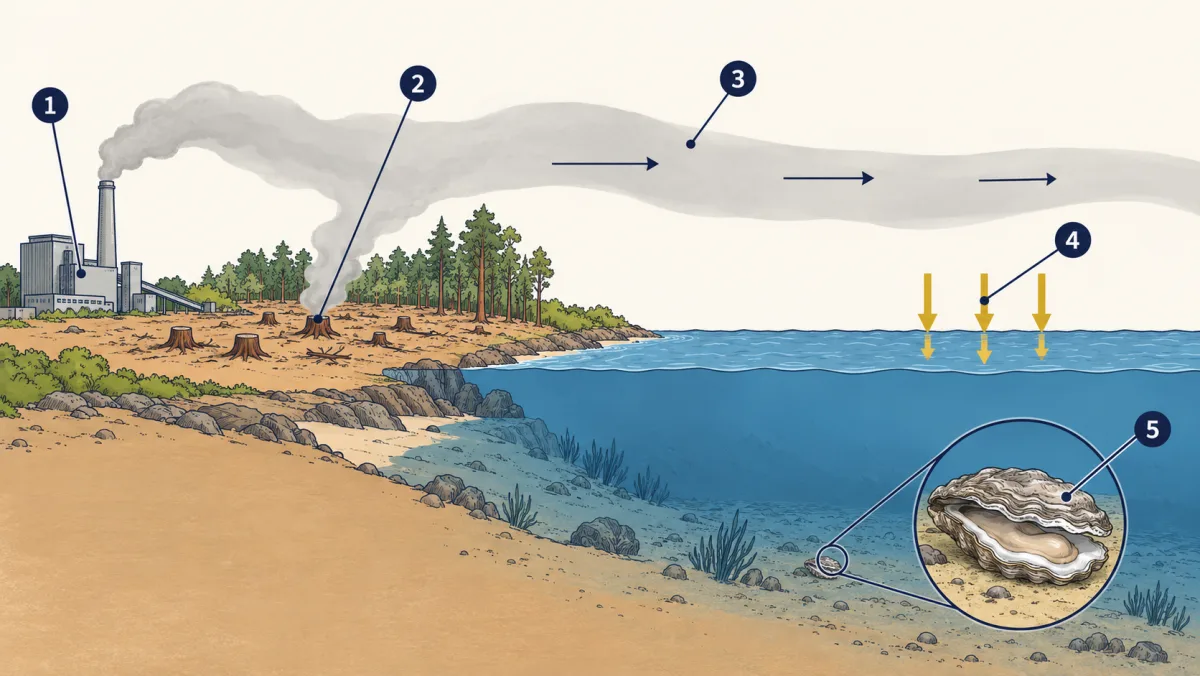
- power plant
- deforestation
- carbon dioxide
- ocean acidification
- oyster
- power plant
- blank
- blank
- blank
- oyster
Word bank: carbon dioxide, deforestation, ocean acidification
- blank
- blank
- blank
- blank
- blank
Check your labels
- power plant
- deforestation
- carbon dioxide
- ocean acidification
- oyster
Explain: why Virginia’s eagles came back
A pesticide is a chemical used to kill pests, such as insects. DDT was once a common one in the United States.
DDT breaks down into a related chemical called DDE. DDE can make bird eggshells thin. Very thin bald eagle eggshells often broke while the parents sat on them. Other eggs failed to hatch. So few young eagles were raised.
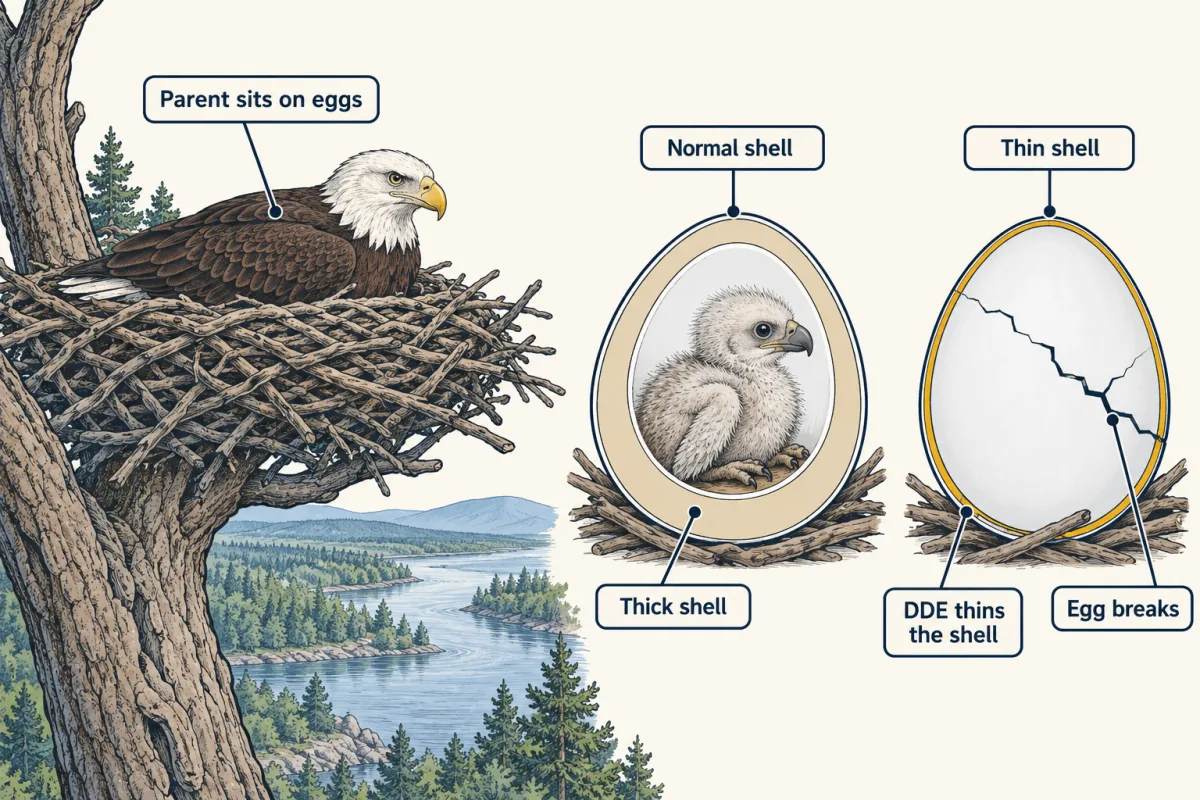
DDT was not the only problem. People also destroyed eagle habitat, and some shot eagles illegally.
Then people acted:
- In 1972, the United States banned most uses of DDT.
- Laws protected eagles and their nests.
- People protected the places where eagles nest.
Conservation is protecting living things and their habitats so they last into the future. Saving eagles was conservation.
Recovery took decades, because young eagles take several years to grow old enough to breed. The count also did not rise every single year.
Recovery is a bit like savings that earn interest: new pairs raise young that become pairs too. The comparison breaks because eagles also die and face new dangers.
Explain: helping damaged places heal
Restoration is helping a damaged ecosystem recover. Virginia scientists spread eelgrass seeds by hand in the coastal bays. The new plants made seeds that spread past the planted areas. A 2020 study reported 3,612 hectares of eelgrass.
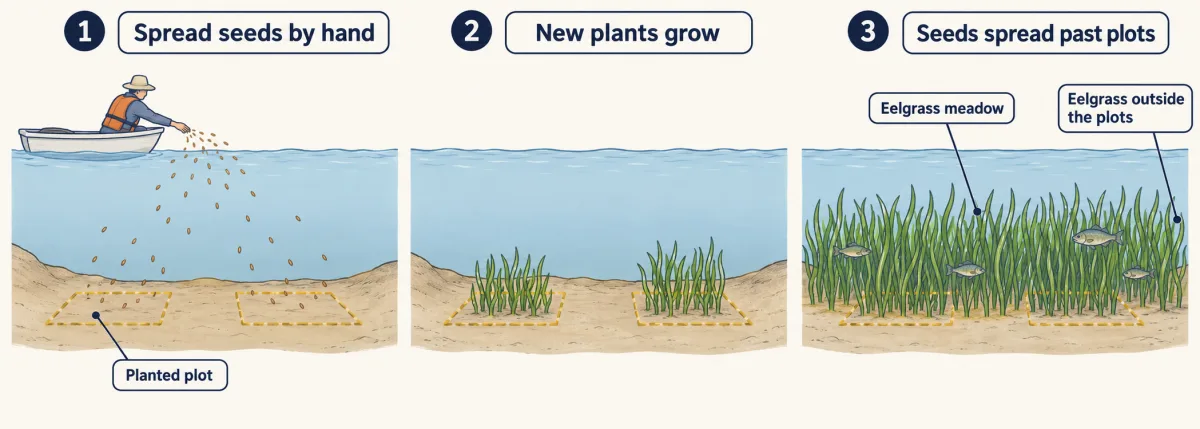
Other Virginia projects build oyster reefs in rivers such as the Lafayette, keep strips of trees along streams and upgrade wastewater plants (Big Changes).
A sustainable practice is a way of using resources that meets people’s needs now and leaves enough for the future. Examples are using only the fertilizer crops need and reusing things.
Recovery has limits:
- It is often partial. A review of 400 studies found that damaged places often improve. Full recovery was less common while scientists watched.
- It can look different. The restored eelgrass held some small animals missing from nearby natural meadows.
- Protecting comes first. A 2017 study found that restoring cannot always replace protecting a healthy ecosystem.
- It depends on the damage. Recovery usually goes better when the cause is removed and the damage was not too severe or too long.
- After blank was banned, the number of eagle pairs blank.
- A recovered ecosystem can still differ from before because blank.
Elaborate: read 40 years of eagle counts
| Breeding year | Eagle pairs (occupied nesting territories) | Chicks counted in spring |
|---|---|---|
| 1977 | 33 | not listed |
| 2003 | 435 | 454 |
| 2004 | 428 | 612 |
| 2005 | 453 | 657 |
| 2007 | 560 | 737 |
| 2008 | 584 | 864 |
| 2010 | 684 | 883 |
| 2011 | 726 | 938 |
| 2016 | 1,070 | not listed |
Counts are from the Virginia bald eagle survey, flown each year from late winter into spring over the Bay’s tidal rivers and the lower Eastern Shore. Sources: a 2002 survey history by Watts and Byrd (1977), yearly reports of the Center for Conservation Biology at William and Mary and Virginia Commonwealth University (2003 to 2011), and the Center’s 2016 survey release. Each pair is two adults using and keeping up a nest. The survey does not count every eagle. The area searched grew over the years, and by 2016 the count also used ground checks and volunteer reports from inland counties.
- How many more pairs were counted in 2011 than in 1977?
- Find a year when the number of pairs went down. What happened the next year?
- From 2003 to 2004, pairs fell. Did chicks rise or fall?
Claim, evidence, reasoning
Make a claim that answers the question: can people help a damaged ecosystem come back? Use the eagle table.
Start with: The data show that Virginia’s eagle population blank after people blank.
Start with: The survey counted blank pairs in 1977 and blank pairs in blank, with a dip in blank.
Start with: DDE from DDT made eggshells blank, so after the ban and nest protection, more eggs could blank.
Compare with a model answer
People can help a damaged population come back. Virginia’s survey counted 33 eagle pairs in 1977, 726 in 2011 and 1,070 in 2016, with a small dip from 435 to 428 in 2004. DDE from DDT thinned eggshells, so many eggs broke. After the United States banned most DDT uses in 1972 and protected eagles and nests, more eggs could hatch. One limit: the table cannot show how much each action helped, and the area searched changed over the years.
Saved in this browser only.
Design problem
Does a strip of plants along a stream keep soil from washing into the water? Plan a fair test with trays of soil.
One way to do it
- Question: Does a strip of grass at the low end of a soil tray reduce the soil that washes off?
- Independent variable: a strip of grass sod at the low end, or bare soil.
- Dependent variable: the mass of soil in the runoff, in grams. Weigh a dry coffee filter first. Pour the runoff through it, let the filter dry, weigh it again and subtract the filter’s mass.
- Control: trays of bare soil with no grass strip.
- Constants: the same soil, tray size, slope, amount of water (500 mL) and pouring speed.
- Repeated trials: three trays of each kind. Find the mean for each.
- Safety: wear goggles and gloves, wipe up spills so no one slips, and wash your hands.
- Meaning: less soil from grass trays supports the idea that the strip holds soil back. Trays are a model, not a stream.
Evaluate: check your thinking
Virginia’s eagles became rare because DDE from DDT thinned their eggshells and people harmed their habitat. After the DDT ban and laws protecting eagles and nests, pairs rose over decades. People can help damaged ecosystems come back, but recovery is often slow, may be partial, and can leave a place different from before.
Science practices you used: testing a model and naming its limits, reading a data table and finding a difference, planning a fair test, and making a claim from evidence.
How we measure it
Aerial nest survey
Observers fly over rivers and shorelines in late winter to find nests that eagle pairs are using, then fly again in spring to count the chicks. Repeating the same survey each year shows whether the number of breeding pairs is rising or falling.
Aerial mapping of underwater grass
Pictures taken from aircraft show where eelgrass meadows grow, and the area of each meadow is measured from the images. Comparing maps from year to year shows whether a planted meadow is spreading.
Finish line
Test yourself
8 questions
Practice and MCAT-style, with explained answers.
Next · Lesson 27
DNA: The Code of Life
If strawberries, mushrooms, bacteria and people all have DNA, why are they so different?
Continue →