Biology · Unit 5: Classifying life
Domains and Kingdoms
How can you classify a living thing you have never seen before? You will walk mystery organisms through a key of yes-or-no questions, compare the three domains and six kingdoms, and sort seven real organisms using their database records and traits. Afterwards you can place an unknown organism in a domain and kingdom, say what evidence that takes, and write a scientific name correctly.
Where this lesson sits
- Virginia SOL BIO.6d
- Virginia SOL BIO.6e
- Practices BIO.1c, BIO.1d, BIO.1f
Essential question: How can we classify an organism we have never seen before?
-
Life Science (grade 7) LS.3 c
Review it at grade 7 level
In Life Science you learned that living things are sorted into three domains, Archaea, Bacteria and Eukarya, and then into kingdoms. You grouped organisms by whether their cells have a nucleus, which cell structures they have, how many cells they have, and how they get energy. You used dichotomous keys to identify animals and plants, learned the levels from domain down to species, and wrote two-part scientific names. You also learned that DNA sequences show how similar organisms are. Biology adds the words prokaryote and eukaryote, the membrane and cell wall chemistry that separates Archaea from Bacteria, and a full description of all six kingdoms.
-
Biology BIO.6d, BIO.6e You are here
This lesson
-
Biology II Biology II: Advanced Survey of Biology Topics, BIOII.5 e; Genetics, GEN.6 e
Preview where it goes next
In Biology II: Advanced Survey of Biology Topics, you build cladograms from DNA, protein and body-structure data and use them to show how groups are related. The Genetics course adds that modern classification groups organisms by shared derived traits and by their genetic makeup, and it introduces a species idea based on ancestry. This lesson left out why that changes the kingdoms: when relationships are tested with DNA, the protists split into many separate branches instead of one group. You will also see energy strategies in more detail, including mixotrophs that can make food and take it in.
-
College
Watch first Sort Life by Asking the Right Questions · 2:45
Put a drop of water from a Virginia pond under a microscope and you may see a crowd: green algae, a creeping amoeba, tiny animals, and specks too small to make out. Some of those specks may be bacteria, and the mud at the bottom of a pond can hold archaea. How would you sort living things you have never seen before? It takes asking the right questions in the right order.
What do you think? Decide before you read.
-
Scientists disagree: A domain is the largest group in classification, not a score. Scientists placed organisms into domains by comparing the sequence of ribosomal RNA, a molecule every cell has. Those comparisons show how closely groups are related. They give no ranking of better or worse, and the bacteria alive today have been evolving just as long as we have.
What scientists think
Scientists disagree: A domain is the largest group in classification, not a score. Scientists placed organisms into domains by comparing the sequence of ribosomal RNA, a molecule every cell has. Those comparisons show how closely groups are related. They give no ranking of better or worse, and the bacteria alive today have been evolving just as long as we have.
-
Scientists disagree: Archaea were first studied in harsh places, but surveys that search seawater for archaeal genes found them in ordinary coastal water. In one year-long survey near Hawaii, one group of archaea in deep water below the sunlit layer reached 39% of the tiny DNA-containing cells detected. That number is for one place, but it shows they can be common.
What scientists think
Scientists disagree: Archaea were first studied in harsh places, but surveys that search seawater for archaeal genes found them in ordinary coastal water. In one year-long survey near Hawaii, one group of archaea in deep water below the sunlit layer reached 39% of the tiny DNA-containing cells detected. That number is for one place, but it shows they can be common.
-
Scientists disagree: A mushroom does not make food from light. It releases digestive enzymes into wood or soil and absorbs the small molecules. Its cell walls contain chitin, not the cellulose of plant walls. DNA comparisons show that fungi are more closely related to animals than to plants.
What scientists think
Scientists disagree: A mushroom does not make food from light. It releases digestive enzymes into wood or soil and absorbs the small molecules. Its cell walls contain chitin, not the cellulose of plant walls. DNA comparisons show that fungi are more closely related to animals than to plants.
Explore: classify the unknown
In the model you meet mystery organisms described by observations, such as “green, many cells, cell walls.” You answer yes-or-no questions: Does it have a nucleus? Is it made of many cells? Does it have a cell wall? Does it make its own food? Does it absorb its food? The model places each organism in a domain and kingdom and explains every step.
In this sketch the key is the five-step key from the lesson. Each mystery organism is a made-up, textbook-style description, not a measurement. The key here asks only whether there is a wall, not what it is made of.
Rule to keep: ask the nucleus question first. A cell with no nucleus can be placed in Archaea or Bacteria only with sequence or chemistry evidence. A key works only for the organisms and traits built into it.
Try this.
- Predict which question the key will ask first, and why. Then run the first mystery organism.
- Choose an organism with a nucleus, many cells and cell walls that does not make its own food. Predict its kingdom, then test.
- Run a single cell with no nucleus. Predict whether the key can name its domain from looks alone.
- Change one answer for an organism, such as cell wall from yes to no. Predict where it lands, then test.
Explain: three domains of life
- domain
- prokaryote
- eukaryote
- kingdom
- multicellular
- autotroph
- heterotroph
- decomposer
- ingester
- dichotomous key
- binomial nomenclature
- genus
The largest group in classification is the domain, a rank above kingdom. There are three: Bacteria, Archaea and Eukarya.
The first question is about the nucleus. A prokaryote is a one-celled organism with no nucleus; its DNA sits in the cytoplasm. A eukaryote is an organism whose cells have a nucleus, a compartment wrapped in membrane that holds the DNA. You met it in that lesson. Bacteria and Archaea are prokaryotes. Eukarya are the eukaryotes.
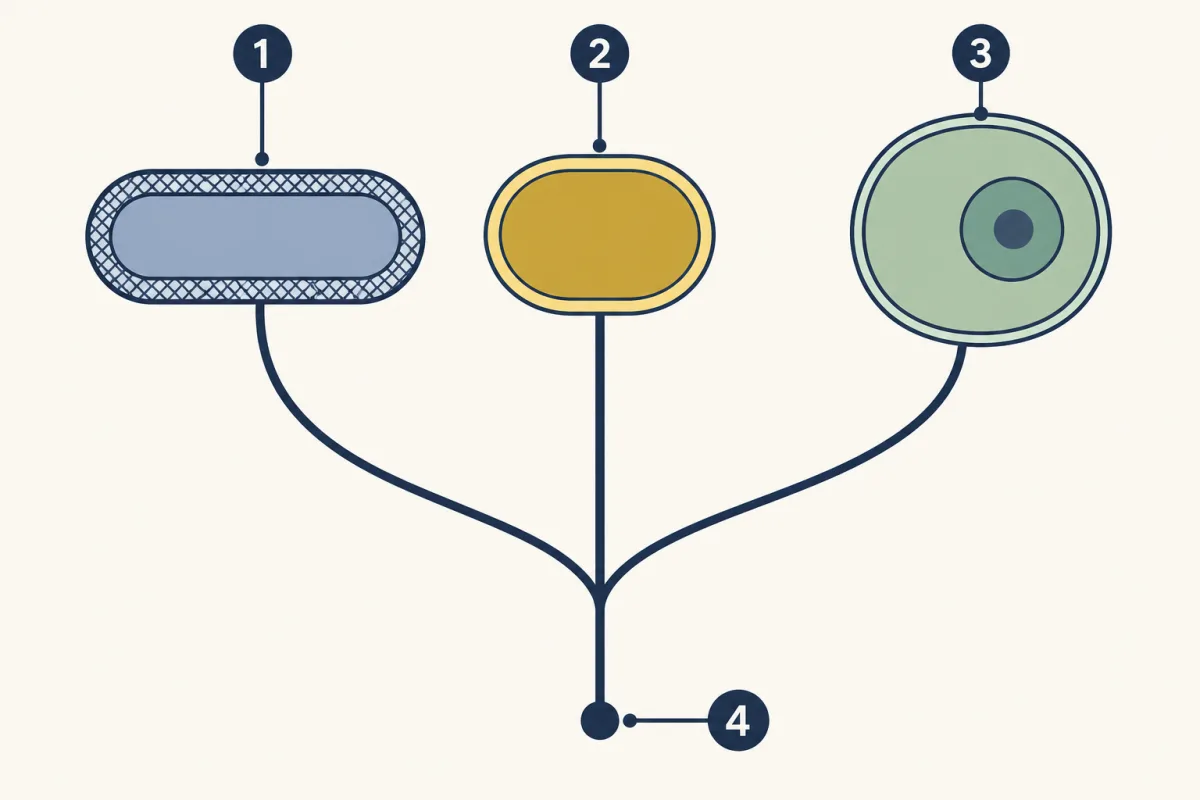
Bacteria and archaea look alike under a light microscope, but they differ in three ways:
- Nucleic acid sequences. Their ribosomal RNA, a molecule every cell uses to build proteins, has a different sequence. In the 1970s, comparing it showed that methane-making microbes stood apart from typical bacteria. You compared sequences to build trees in that lesson.
- Cell membrane. In typical archaea, the fat-like molecules of the membrane are held together by a different kind of chemical link, called an ether link, than the ester link in bacteria and eukaryotes.
- Cell wall. Most bacteria have a wall containing peptidoglycan, a mesh of sugars and short protein-like chains. Archaea walls have no peptidoglycan.
| Trait | Bacteria | Archaea | Eukarya |
|---|---|---|---|
| Nucleus | No | No | Yes |
| Ribosomal RNA sequence | Bacterial pattern | Archaeal pattern | Eukaryotic pattern |
| Membrane lipid links (typical) | Ester links | Ether links | Ester links |
| Cell wall | Most have one, with peptidoglycan | Many have one, never peptidoglycan | Plants and fungi have walls; animals do not |
- Bacteria
- Archaea
- Eukarya
- shared root
- blank
- blank
- Eukarya
- shared root
Word bank: Archaea, Bacteria
- blank
- blank
- blank
- blank
Check your labels
- Bacteria
- Archaea
- Eukarya
- shared root
Think of the domains as three branches of one tree, not three steps on a staircase. The analogy breaks because, unlike a real tree, this one cannot be seen directly; it is worked out from sequence comparisons and still tested.
Explain: six kingdoms
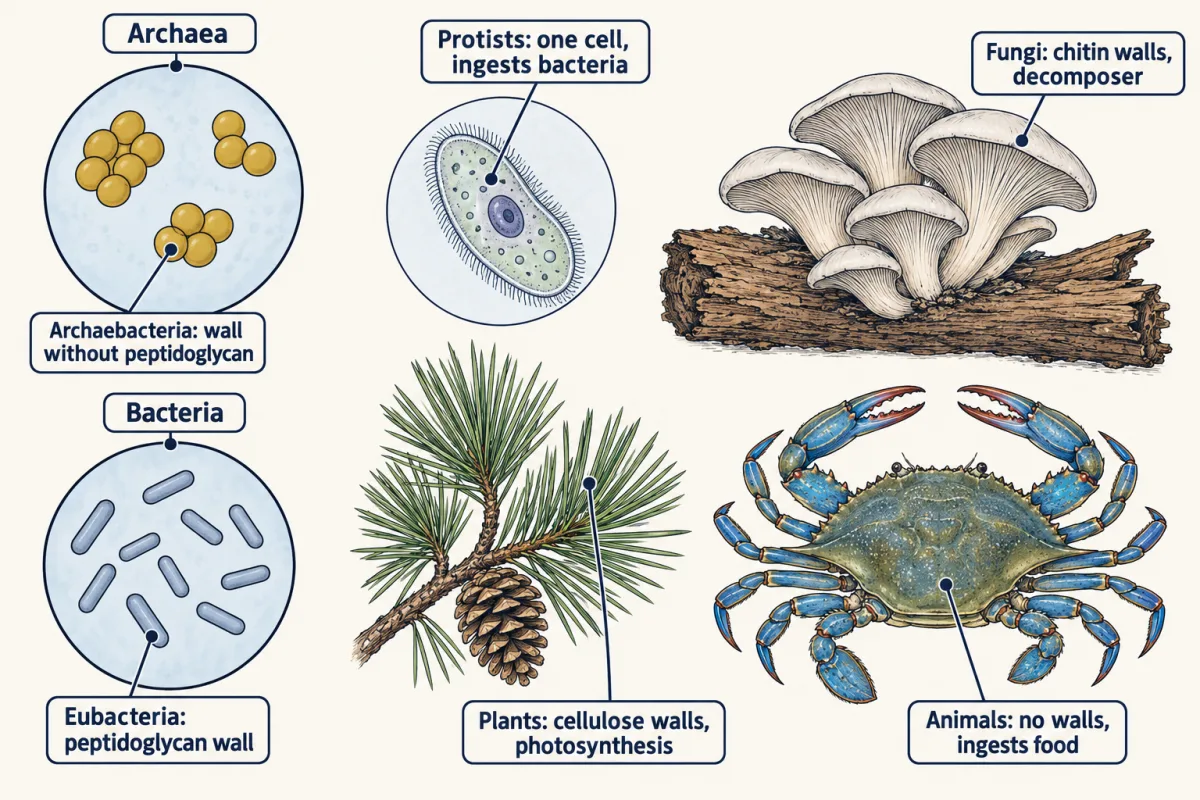
A kingdom is the rank just below domain. The Virginia Biology standards use six. A multicellular organism is made of many cells. An autotroph makes its own food from carbon dioxide, usually using light. A heterotroph gets food from other living things or their remains. A decomposer is a heterotroph that breaks down dead material and absorbs the nutrients. An ingester is a heterotroph that takes food inside its body to digest it.
| Kingdom | Domain | Nucleus | Cells | Cell wall | Tissues | Food |
|---|---|---|---|---|---|---|
| Archaebacteria | Archaea | No | One | Usually; no peptidoglycan | No | Autotroph or heterotroph |
| Eubacteria | Bacteria | No | One | Usually; peptidoglycan | No | Autotroph or heterotroph |
| Protists | Eukarya | Yes | Mostly one | Some do, some do not | No | Autotroph, heterotroph, or both |
| Fungi | Eukarya | Yes | Most many; yeasts one | Yes; chitin | No | Heterotroph; decomposer |
| Plants | Eukarya | Yes | Many | Yes; cellulose | Yes | Autotroph (most plants) |
| Animals | Eukarya | Yes | Many | None | Yes (sponges are a special case) | Heterotroph; ingester |
The protist kingdom holds every eukaryote that is not a plant, animal or fungus. Many biologists no longer treat protists as one natural group, which you will see in that lesson.
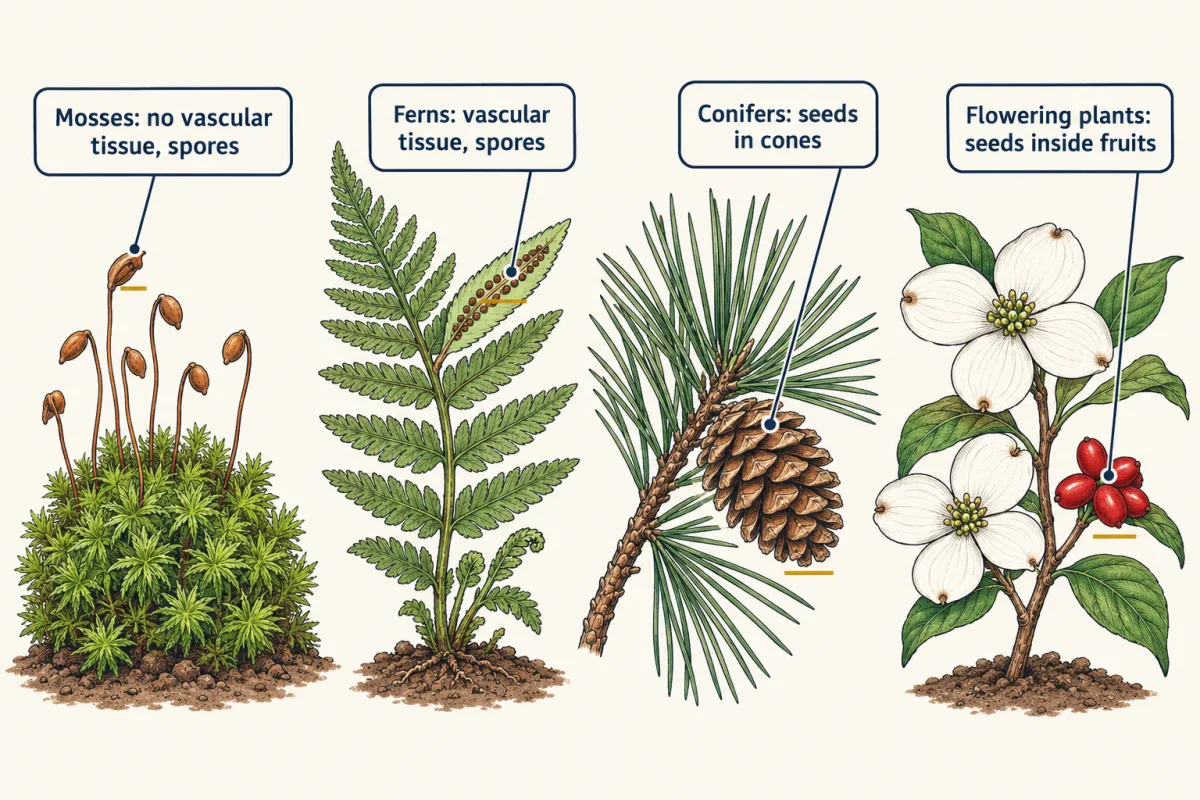
This course uses four plant divisions, a simplified list. Botanists often say phylum instead of division.
- Mosses have no vascular tissue (tubes that carry water) and no seeds. They spread by spores.
- Ferns have vascular tissue but no seeds. They also spread by spores.
- Conifers have seeds in cones, as the loblolly pine does.
- Flowering plants have flowers and seeds inside fruits, as Virginia’s state tree, the flowering dogwood, does.
Explain: keys and names
Below kingdom come smaller ranks. The full list is domain, kingdom, phylum, class, order, family, genus and species. The blue crab of the Chesapeake Bay belongs to domain Eukarya, kingdom Animalia, phylum Arthropoda, class Malacostraca, order Decapoda, family Portunidae and genus Callinectes.
Binomial nomenclature is the system of giving each species a two-part scientific name. The first part is the genus, a group of closely related species, written with a capital letter. The second part names the species and is written in lower case. Both words are printed in italics: Callinectes sapidus.
A dichotomous key is a set of paired choices that leads you, step by step, to a name or a group. Here is a short one for this lesson:
- Nucleus present: go to 3. Nucleus absent: go to 2.
- Sequence or wall chemistry like Archaea: archaebacteria. Like Bacteria: eubacteria. No such evidence: stop; looks cannot decide.
- Many cells, cellulose walls, makes food by photosynthesis: plants. Otherwise: go to 4.
- Chitin walls, digests food outside its cells and absorbs it: fungi. Otherwise: go to 5.
- Many cells, no walls, ingests food: animals. A single eukaryotic cell that fits none of these: protists.
A key works only for the organisms and traits built into it.
Elaborate: sorting seven real organisms
| Organism | Common name | Database record (ID number) | Higher group in the record | Nucleus | Cells | Cell wall | How it gets food |
|---|---|---|---|---|---|---|---|
| Methanosarcina barkeri | a methane-making archaeon | NCBI 2208 | Archaea | No | One, or clumps of cells | Yes, no peptidoglycan | Can build food from carbon dioxide |
| Escherichia coli | E. coli | NCBI 562 | Bacteria | No | One | Yes, peptidoglycan | Absorbs small food molecules |
| Paramecium caudatum | paramecium | NCBI 5885 | Eukaryota; Alveolata | Yes | One | None | Ingests bacteria |
| Pleurotus ostreatus | oyster mushroom | NCBI 5322 | Eukaryota; Fungi | Yes | Many | Yes, chitin | Decomposes dead wood |
| Pinus taeda | loblolly pine | NCBI 3352 | Eukaryota; Viridiplantae | Yes | Many | Yes, cellulose | Photosynthesis |
| Cornus florida | flowering dogwood | ITIS 27806 | Plantae | Yes | Many | Yes, cellulose | Photosynthesis |
| Callinectes sapidus | blue crab | NCBI 6763 | Eukaryota; Metazoa (animals) | Yes | Many | None | Ingests food |
Names and higher groups come from the NCBI Taxonomy and ITIS databases, accessed 20 October 2026. The trait columns are textbook descriptions of each kind of organism, not measurements from one sample, and the records do not show where any specimen was collected.
- Which two organisms match in every trait column? What would you need to know to place them in different plant divisions?
- Which columns separate Methanosarcina barkeri from Escherichia coli? Which of those traits could you see with a classroom microscope?
- How many of the seven organisms have cell walls? Does “has a cell wall” alone tell you the kingdom?
Claim, evidence, reasoning
Make a claim that answers the essential question: how can we classify an organism we have never seen before? Use the table.
Start with: We can classify an unknown organism by blank.
Start with: In the table, blank and blank both have walls, but one wall contains blank and the other contains blank.
Start with: This matters because blank, so a key needs blank to place an organism in a domain and kingdom.
Compare with a model answer
We can classify an unknown organism by asking a set of trait questions in order and checking chemical or DNA evidence where looks are not enough. In the table, the nucleus question splits Methanosarcina and E. coli from the other five. Those two both have no nucleus and a wall, so looks cannot separate them, but the wall of E. coli contains peptidoglycan and the archaeon’s does not. Among eukaryotes, chitin walls and decomposing mark the mushroom as a fungus, while no walls and ingesting mark the crab as an animal. Limit: the traits are textbook descriptions, not observations of these specimens.
Saved in this browser only.
Design problem
Yeast is a one-celled fungus. A classmate says yeast is a tiny plant. Plan a fair test of whether yeast needs light or needs sugar to stay active. Name your variables, constants, control, trials and safety steps.
One way to do it
- Independent variables: sugar (sugar water or plain water) and light (a bright window or a dark cupboard), giving four groups.
- Dependent variable: the height of foam, or the size of a balloon over each bottle, after 30 minutes. Foam and gas show that yeast is breaking down food.
- Constants: amount of yeast, water volume and temperature, amount of sugar in the sugar-water groups, bottle type and timing.
- Control: plain water in the dark, where neither light nor food is supplied.
- Trials: three or more bottles per group; report the mean.
- What results mean: activity only with sugar points to a heterotroph. Activity only with light would point to an autotroph.
- Limit: one kind of yeast, one temperature.
- Safety: use baker’s yeast, do not taste anything, do not seal bottles tightly, and wash your hands afterward.
Evaluate: check your thinking
To sort the pond drop, ask first whether each cell has a nucleus. Algae, amoebas and tiny animals do, so they are Eukarya; cell number, walls and food then separate protists from animals. The specks with no nucleus are prokaryotes, but only their RNA sequences or wall and membrane chemistry can tell you whether they are Bacteria or Archaea.
Science practices you used: using a classification key and naming its limits, organizing and reading a table of characteristics, comparing evidence from a microscope with evidence from DNA, and planning a fair test with a control and repeated trials.
How we measure it
Dichotomous key
A key gives two choices at each step, such as "nucleus present" or "nucleus absent", and each answer leads to the next step. It can only sort the organisms and traits that were built into it.
Ribosomal RNA sequence comparison
Scientists read the order of bases in ribosomal RNA, or in the gene that codes for it, from different organisms and compare them. Organisms with more similar sequences are judged more closely related, which is how Archaea were told apart from Bacteria.
Taxonomy database lookup
Databases such as NCBI Taxonomy and ITIS store each organism's accepted scientific name and the larger groups it belongs to. A record gives the classification, but it does not show where any one specimen was collected.
Finish line
Test yourself
8 questions
Practice and MCAT-style, with explained answers.
Next · Lesson 25
Classification Changes
If some microbes look just like bacteria under a microscope, how could a molecule inside them show they belong to a different domain of life?
Continue →