Life Science · Unit 3: Energy for life
Releasing Energy from Food
How do living things get energy out of food, and do plants do it too? You change the temperature, oxygen and sugar in a flask of living cells, then read real data from peas and yeast. Afterwards you can explain cellular respiration and what makes it go faster or slower.
Where this lesson sits
- Virginia SOL LS.4 b
- Practices LS.1 b, LS.1 c, LS.1 d, LS.1 e
Essential question: How does the food I eat turn into energy my body can use, and do plants do this too?
-
Life Science (grade 7) LS.4 b You are here
This lesson
-
Biology
Preview it at high school level
In Biology you will learn the name of the molecule that carries the released energy: ATP. A cell uses energy from sugar to build ATP, then spends ATP on its work. You will write the balanced equation, C6H12O6 + 6O2 → 6CO2 + 6H2O + energy, and check that the atoms on each side match. You will also compare respiration with oxygen to fermentation, which works without it. With oxygen, a cell gets about 30 to 32 ATP from each glucose; by fermentation it gets only 2. Then you will read Chesapeake Bay data to see how bacteria breaking down dead algae can use up the oxygen in deep water.
-
Biology II Biology II: Advanced Survey of Biology Topics, BIOII.3 c
Preview where it goes next
In Biology II: Advanced Survey of Biology Topics (BIOII.3 c), respiration and photosynthesis are studied together: matter cycles between them, while energy flows through. You split respiration into its stages: glycolysis in the cytoplasm, then the Krebs cycle and the electron transport chain in the mitochondria. You follow carbon atoms from sugar to carbon dioxide and back into sugar by photosynthesis, and see how energy carriers such as ATP are used in both processes.
-
College
Watch first Cells Release Energy Stored in Sugar · 2:26
Pack sprouting peas into one thermos and boiled peas into another. Over a day or two, the thermometer in the sprouting peas can climb above room temperature, while the boiled peas stay close to it.
Now stir some yeast into warm sugar water. It foams, and a balloon on top of the bottle slowly fills with gas. In ice-cold water, you would expect the same mix to fill the balloon more slowly. Peas have no muscles, and yeast has no lungs. So where do the warmth and the gas come from?
What do you think? Decide before you read.
-
Scientists disagree: Plants and fungi respire too. Sprouting seeds give off carbon dioxide and can warm up. Yeast, a fungus, gives off carbon dioxide from sugar. Plant cells have mitochondria, the same energy-releasing parts that animal cells have.
What scientists think
Scientists disagree: Plants and fungi respire too. Sprouting seeds give off carbon dioxide and can warm up. Yeast, a fungus, gives off carbon dioxide from sugar. Plant cells have mitochondria, the same energy-releasing parts that animal cells have.
-
Scientists disagree: Breathing moves air in and out of your lungs. Cellular respiration happens inside most cells, where sugar and oxygen are used. The two are linked: breathing brings in the oxygen your cells use. Seeds and yeast have no lungs, yet their cells respire.
What scientists think
Scientists disagree: Breathing moves air in and out of your lungs. Cellular respiration happens inside most cells, where sugar and oxygen are used. The two are linked: breathing brings in the oxygen your cells use. Seeds and yeast have no lungs, yet their cells respire.
-
Scientists disagree: Careful measurements show that energy is never made from nothing. It only changes form. The energy was already stored in the food. Cells release it, and some of it always leaves as warmth, which is why living seeds can heat up a thermos.
What scientists think
Scientists disagree: Careful measurements show that energy is never made from nothing. It only changes form. The energy was already stored in the food. Cells release it, and some of it always leaves as warmth, which is why living seeds can heat up a thermos.
Explore: warm up a flask of living cells
In the simulation you set up a flask of sprouting seeds, or yeast in sugar water. A balloon on top collects the carbon dioxide, and a thermometer shows the temperature. You can change the temperature of the water bath, open or seal the flask to change the oxygen, and change the amount of sugar or the number of seeds.
Schematic, not to scale. Circles are yeast cells, ovals are seeds, small squares are sugar (glucose).
made up (above 25 °C) pea table range (only at 5 seeds, open flask)
- Carbon dioxide in balloon
- 0 of 100 (relative units)
- Oxygen in the flask gas (made-up run-down)
- 20.9 %
- Time so far
- 0 time units
Press Start. The balloon collects carbon dioxide from the cells.
Rule to keep: warmer cells usually respire faster, but too much heat damages them; less oxygen or less sugar slows respiration.
Try this.
- Predict what will happen to the balloon when you warm the water bath from 10 °C to 25 °C. Write down your guess, then test it.
- Seal the flask so no fresh air can get in. Predict how fast the balloon fills after a while, then watch.
- Keep raising the temperature in small steps. Predict whether the rate keeps rising forever, then check the graph.
Explain: how cells release energy from sugar
- glucose
- cellular respiration
- oxygen
- carbon dioxide
- mitochondria
- breathing
- thermal energy
- rate of respiration
A peanut, a slice of bread and a pea seed all store energy in their molecules. Your cells must break the food down to use it.
The main fuel is glucose, a sugar that stores energy in its molecules. Plants make sugar (glucose) by photosynthesis, as you saw in that lesson.
Cellular respiration is the process in which cells break down sugar (glucose) with oxygen and release energy. Oxygen is a gas in the air that cells use in this process. Carbon dioxide is a gas that cells give off when they respire.
sugar (glucose) + oxygen → carbon dioxide + water + energy
If you like chemistry, the same idea in symbols is C6H12O6 + 6O2 → 6CO2 + 6H2O + energy. You do not have to learn it.
Inside a cell this happens in many small steps, not one big burst. The energy comes out in a form the cell can easily use.
Most of this work happens in the mitochondria (one is a mitochondrion). These are small organelles where cells release energy from food. Plant cells and animal cells both have them. Chloroplasts let a plant make food. Mitochondria let a cell use food for energy. Almost all plant, animal and fungus cells have mitochondria. A few do not, such as mature red blood cells in mammals.
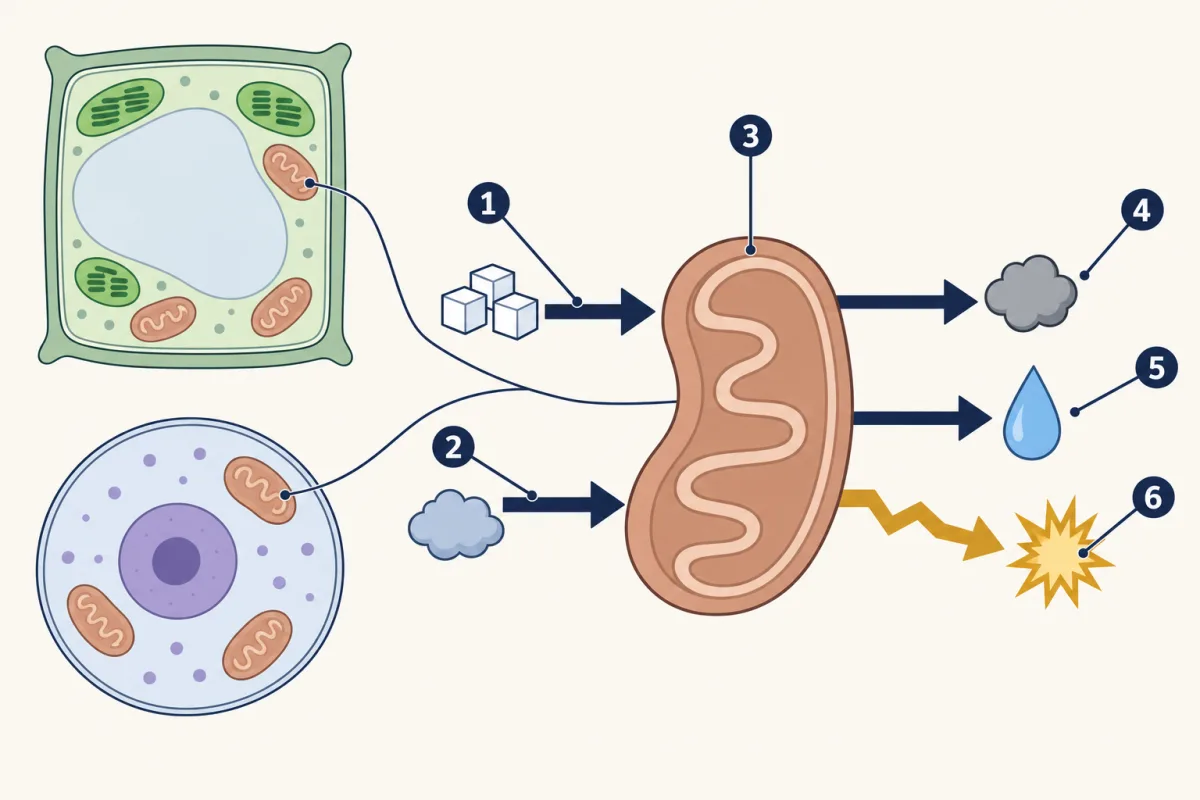
- sugar (glucose)
- oxygen
- mitochondrion
- carbon dioxide
- water
- energy
- blank
- blank
- mitochondrion
- blank
- water
- blank
Word bank: carbon dioxide, energy, oxygen, sugar (glucose)
- blank
- blank
- blank
- blank
- blank
- blank
Check your labels
- sugar (glucose)
- oxygen
- mitochondrion
- carbon dioxide
- water
- energy
Breathing is moving air into and out of your lungs. It is not the same thing as cellular respiration.
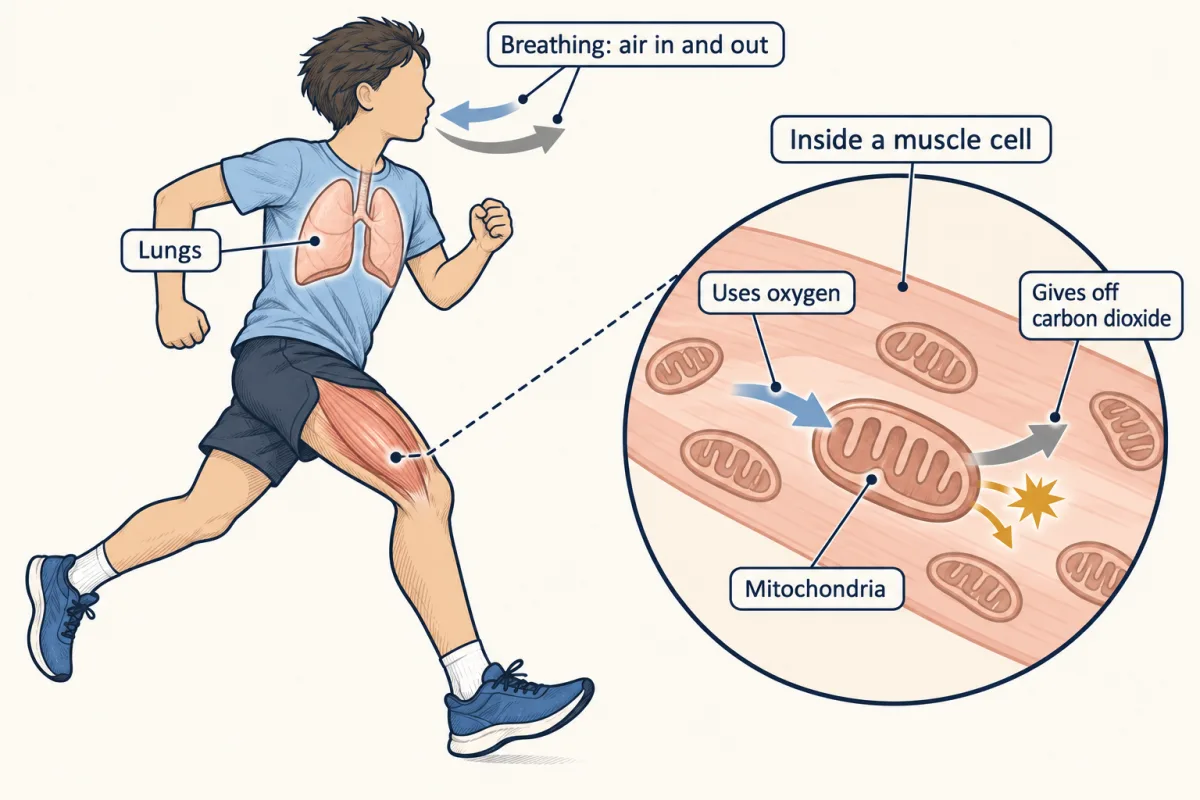
| Breathing | Cellular respiration | |
|---|---|---|
| Where it happens | Lungs (in you and many animals) | Inside cells of plants, animals and fungi |
| What it does | Moves air in and out | Breaks down sugar and releases energy |
| How they connect | Brings in oxygen, carries out carbon dioxide | Uses the oxygen, gives off the carbon dioxide |
Yeast is a fungus. It breaks down sugar and gives off carbon dioxide, the gas in the balloon. Yeast can also release energy from sugar without oxygen, which you will study in Biology. In a closed bottle with little air, some of the gas in the balloon may come from that process. Photosynthesis and respiration work as partners, as you will see in that lesson.
Explain: where the energy goes and what changes the speed
Cells spend the released energy on work, such as contracting muscle cells or building new cell parts.
Some energy always leaves as thermal energy, the energy of moving particles that you feel as warmth. That is why the sprouting peas warmed their thermos. The thermos kept the thermal energy from escaping quickly.
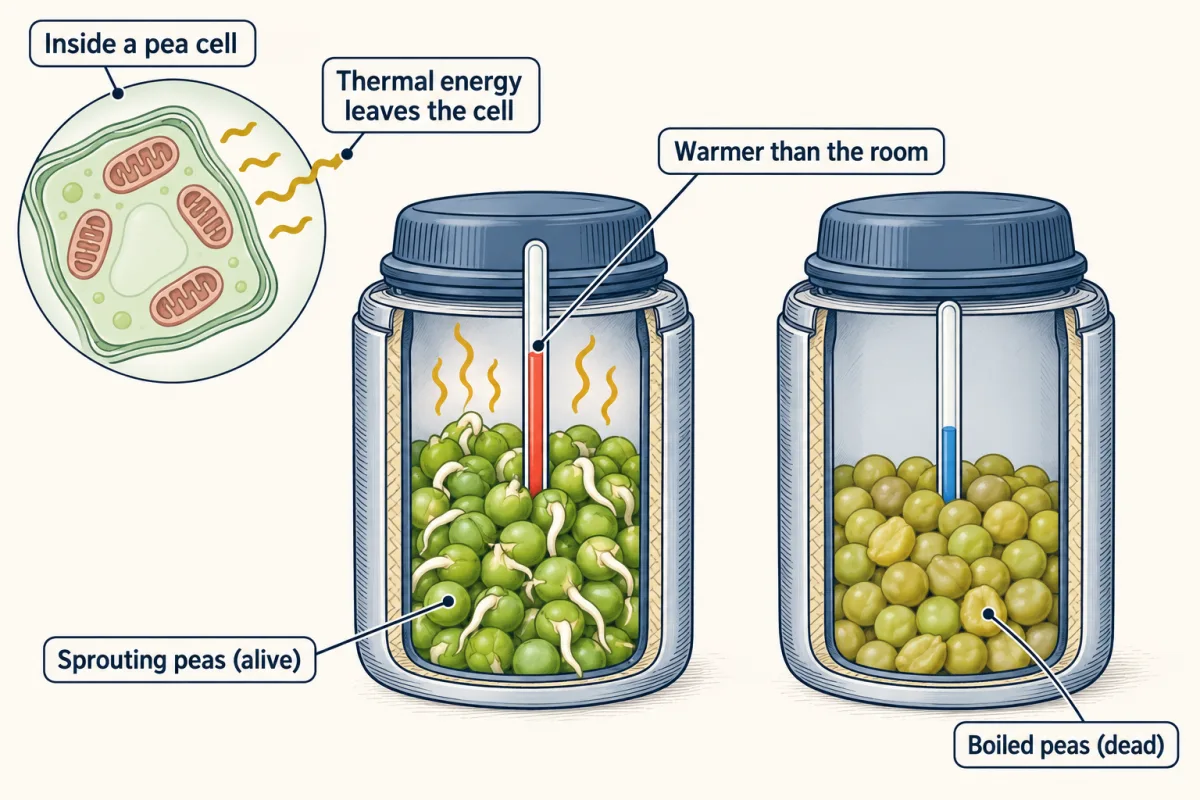
Your body loses thermal energy to the air all the time. Respiration in your cells keeps releasing more. This is a big reason your body stays near 37 °C, even on a cold day.
Food does not turn into energy, and energy is never used up. It changes form. In respiration, energy stored in sugar becomes energy for cell work, plus thermal energy.
The rate of respiration is how fast cells carry out respiration. You can measure it as how much carbon dioxide is given off, or how much oxygen is used, in one hour. Three things change the rate:
- Temperature. Within a suitable range, warmer cells usually respire faster. Too much heat damages cells, and respiration slows or stops. Boiled peas are the extreme case: their cells are dead.
- Oxygen. With less oxygen, respiration that uses oxygen slows down.
- Sugar (glucose). With too little sugar, respiration slows. Adding more sugar helps only up to a point.
- When the temperature goes up a little, the rate of respiration blank because blank.
- With less oxygen, the cells blank.
- The thermos of sprouting peas gets warm because blank.
Elaborate: read real respiration data
We could not find a full data set for sprouting seeds at many temperatures. The closest real set is for fresh garden peas, picked and stored as food. Their cells are still alive, so they still respire.
| Temperature (°C) | Carbon dioxide given off (mg per kg of peas per hour) |
|---|---|
| 0 | 30 to 46 |
| 5 | 55 to 72 |
| 10 | 63 to 108 |
| 15 | 165 to 185 |
| 20 | 220 to 322 |
| 25 | 298 to 327 |
Source: USDA Agriculture Handbook 66 (2016 edition), pea chapter by Morris and Jobling. It gathers earlier measurements (ASHRAE 1985; Suslow and Cantwell 1998). Each row is a range. The handbook does not say where or in which year the peas were measured.
A second study tested oxygen. Scientists grew baker’s yeast at 30 °C. They changed only how much oxygen was in the gas bubbled into the yeast.
| Oxygen in the gas (%) | Oxygen used (mmol per gram of dry yeast per hour) |
|---|---|
| 20.9 | 2.7 |
| 1.0 | 1.7 |
| 0.5 | 1.2 |
| 0.0 | 0.0 |
Source: Jouhten and others, BMC Systems Biology, 2008. Each value is a mean from repeated lab cultures of one yeast strain.
- Describe how carbon dioxide given off by the peas changes from 0 °C to 25 °C.
- Compare 0 °C and 20 °C. Is the lowest value at 20 °C bigger than the highest value at 0 °C?
- How many times as much oxygen did the yeast use with 20.9% oxygen as with 0.5%?
Claim, evidence, reasoning
Make a claim that answers the essential question for plants and fungi: what controls how fast their cells release energy from sugar? Use both tables.
Start with: The data show that the rate of respiration in peas and yeast depends on blank and blank.
Start with: Peas gave off blank mg of carbon dioxide per kg per hour at 0 °C but blank at 25 °C. Yeast used blank units of oxygen with 20.9% oxygen but blank with 0%.
Start with: Respiration uses blank and gives off blank, so these amounts show how fast blank.
Compare with a model answer
Peas and yeast both respire. The pea data show temperature changing how fast, and the yeast data show oxygen changing how fast. Peas gave off 30 to 46 mg of carbon dioxide per kg per hour at 0 °C, but 298 to 327 at 25 °C. Yeast used 2.7 units of oxygen with 20.9% oxygen, but 0.0 with none. Respiration uses oxygen and gives off carbon dioxide, so these numbers track its rate. One limit: the pea table stops at 25 °C, so it cannot show what happens when cells get too hot.
Saved in this browser only.
Design problem
Plan an investigation to test whether sprouting peas release thermal energy. You have dried peas, water, four or more thermoses, thermometers that read in °C, and a teacher who can boil water.
One way to do it
- Question: Do living, sprouting peas warm their surroundings?
- Independent variable: the peas in each thermos: living peas soaked for a day, or soaked peas that your teacher boils and then cools to room temperature (the control).
- Dependent variable: the temperature inside each thermos in °C, read once a day for three days.
- Constants: the same mass of peas (for example 200 g), the same kind of thermos, the same room, the same thermometer depth and the same reading times.
- Repeated trials: at least two thermoses of each kind. Find the mean temperature for each kind on each day.
- What results would mean: if only the living peas get warmer than the room, the warmth comes from their respiration. Bacteria growing on the peas can also release thermal energy, so a warm control would mean the test needs fresh, clean peas.
- Safety: only the teacher boils water or handles hot peas. Do not screw the thermos lids on tightly, so carbon dioxide can escape. Do not eat the peas. Wash your hands afterwards and throw away mouldy peas.
Evaluate: check your thinking
The sprouting peas are alive. Their cells break down stored sugar with oxygen, and some of the released energy leaves as thermal energy, which the thermos holds in. The boiled peas are dead, so they do not respire. Yeast cells break down sugar and give off carbon dioxide, which fills the balloon, and in ice-cold water they should work more slowly.
Science practices you used: predicting and testing with a model, reading data tables and comparing values, making a claim from evidence and naming its limits, and planning a fair test with a control and repeated trials.
How we measure it
Thermometer in an insulated flask
A thermos slows the loss of thermal energy, so a thermometer inside can show a small warming from living seeds. Comparing living seeds with boiled, cooled seeds helps show whether the warmth comes from living cells.
Gas analysis
An instrument measures the gas going into and coming out of a container of living cells. The difference shows how fast the cells use oxygen or give off carbon dioxide in respiration.
Finish line
Test yourself
8 questions
Practice and MCAT-style, with explained answers.
Next · Lesson 11
Partners in Energy
Why does the oxygen in a quiet Virginia creek go up and down over a single summer day?
Continue →