Biology Together · Unit 5: Animal bodies, homes and adaptations
Make a Fossil Print
Your child presses shells, leaves and toy animal feet into modelling clay to make prints, and an adult can fill them with plaster to make copies. Then you trade prints and guess what made each one and where it lived. Your child finds out how fossils tell us about living things and places from long ago.
Watch first Set Up: Make a Fossil Print · 0:42
Read the transcript of “Set Up: Make a Fossil Print”
Film transcript: Set Up: Make a Fossil Print
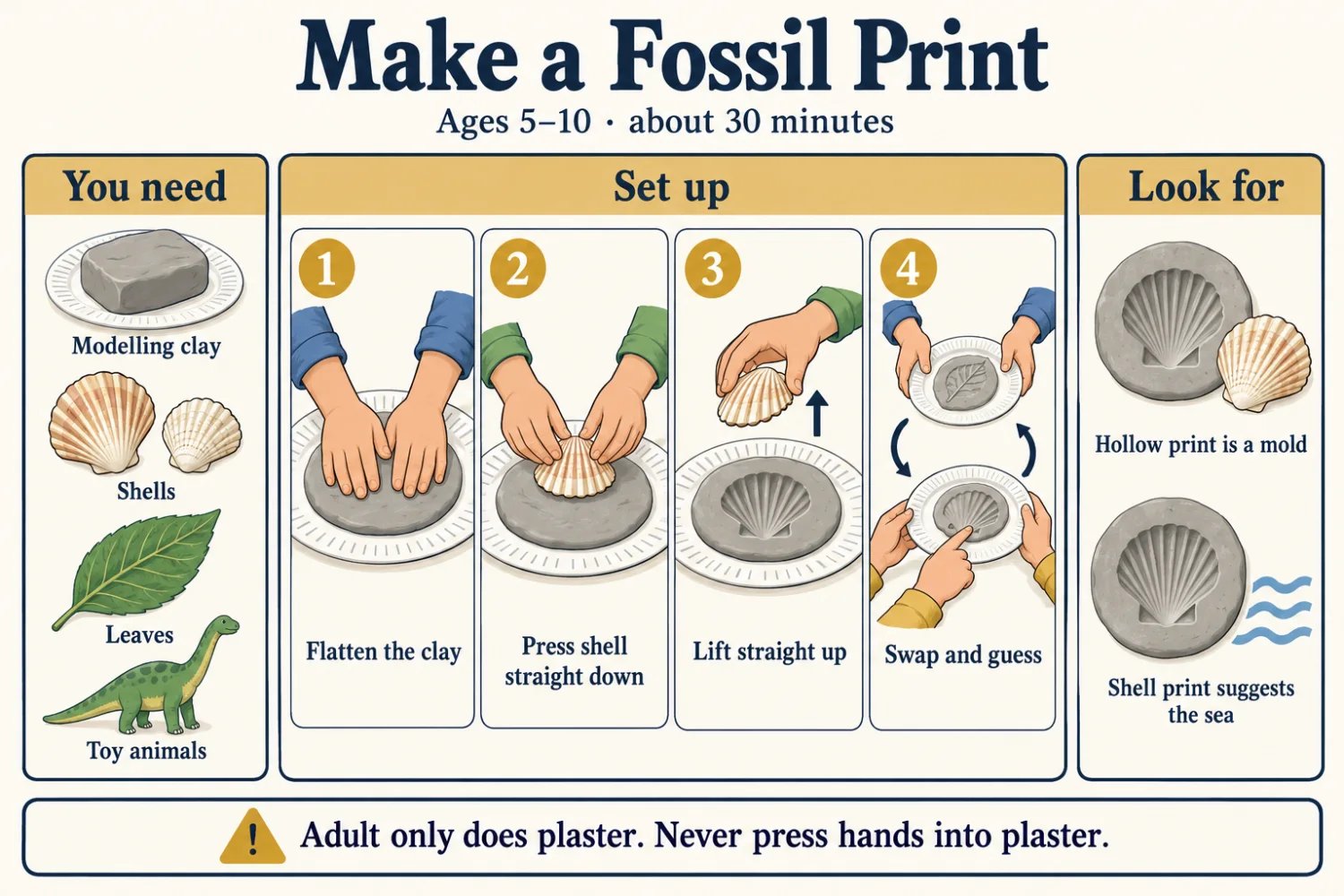
You need modeling clay that does not harden, bought from a store. Gather things to press, such as shells, leaves, and a pinecone. Knead the clay until it is soft. Flatten it about two centimeters thick on a paper plate. Press each object straight down, then lift it straight up. Shells with ridges, leaves with thick veins, and toy feet with clear toes make the sharpest prints. Trade prints and guess what made each one. Stay with your child the whole time. If you make plaster casts, only an adult does the plaster. It can get hot as it hardens, so never press a hand into it.
Before you start
- Hands-on time
- About 30 minutes, if you make plaster casts, leave them about an hour to harden and overnight to dry before you peel them out
- Where
- Indoors
- Ages
- 5 to 10, with an easier and a harder version below
- Grown-up
- Stay with your child the whole time. An adult does all the plaster mixing and pouring, and keeps clay away from pets.
What you need
- Store-bought modelling clay that does not harden (not homemade flour dough; see the safety notes)
- Things to press: 4 to 6 shells, leaves with strong veins, a pinecone, small toy animals with clear feet
- A rolling pin or a smooth jar
- Paper plates or plastic lids to work on
- Plaster of Paris, about 2 cups, and a disposable cup and spoon for mixing (optional, adult only)
- Old newspaper to cover the table
- A tub of clean play sand and a paintbrush (optional, for the harder version)
Virginia science standards SOL 3.4 cSOL 3.4 a
The big idea
When your child presses a shell into soft clay and lifts it out, the shell is gone but its shape stays. Many fossils are shapes like this. In nature, mud or sand buries the shell, and long after, water can dissolve the shell and leave its shape in the rock. A fossil is the remains or the print of a living thing from long ago, saved in rock.
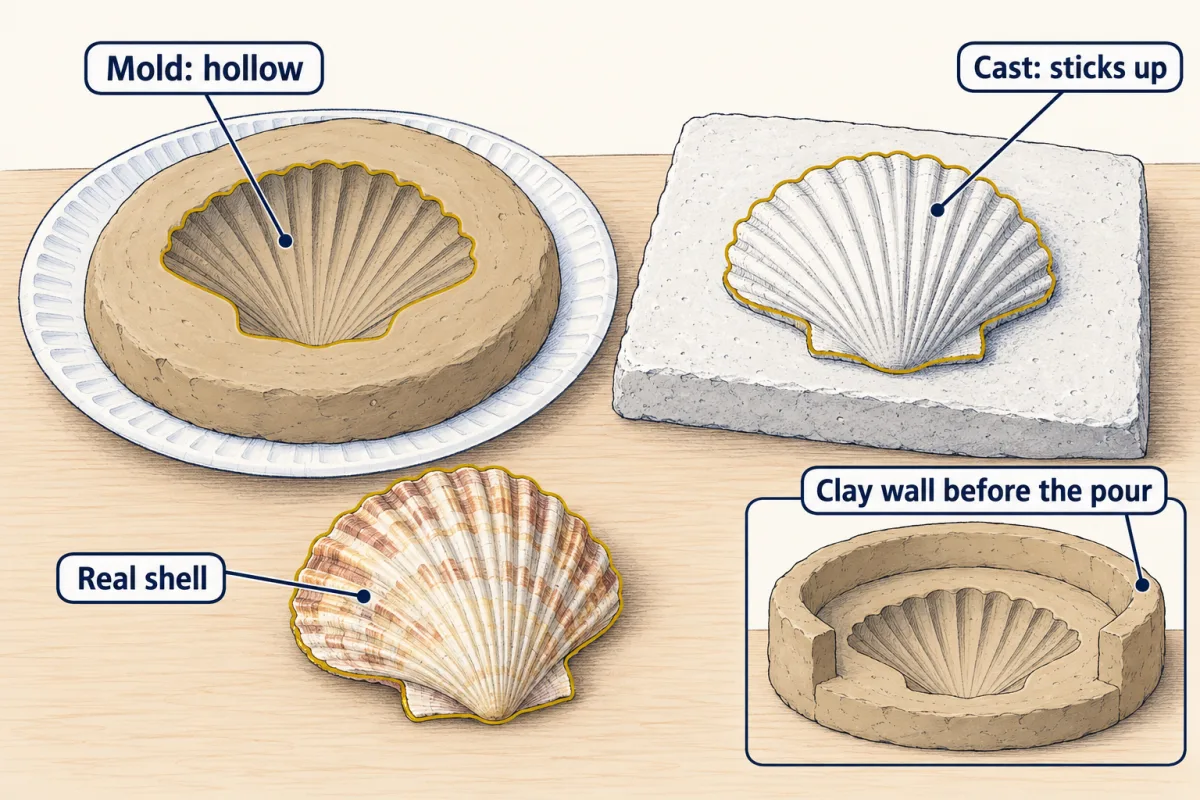
There are two kinds of print to make. A mold is the hollow shape left behind. A cast is a copy made when something fills the mold, like plaster in this activity or mud and minerals in nature.
Fossils are clues. A shell fossil says what animal lived there and also what the place was like. Virginia’s state fossil is a scallop shell called Chesapecten jeffersonius. It is found in cliffs along rivers in eastern Virginia, such as the James River. Scallops live in the sea, so these fossils show that a shallow sea once covered that land, millions of years ago. Virginia’s grade 3 standard asks children to use fossils this way, as evidence of what lived long ago and what the place was like.
What to do
- Soften the clay. Your child squeezes and kneads the modelling clay in their hands until it is soft enough to shape.
- Flatten. Your child rolls a ball of clay about the size of an orange, then presses it flat to about 2 cm thick on a paper plate. Make one for each object.
- Press. Press each object firmly and straight down, then lift it straight up. Shells with ridges, leaves with thick veins and toy feet with clear toes make the sharpest prints. Each print is a mold.
- Trade and guess. Make some prints while your child looks away. Then swap. Ask, “What made this print? Where did it live: in the sea, on land, or in a tree?” A ridged scallop shell suggests the sea. A leaf suggests land with plants.
- Make a cast (optional, adult only). Use extra clay to build a wall about 2 cm high around the print. In a disposable cup, the adult stirs plaster into water as the package directs, until it is like thick pancake batter. Pour it gently into the mold until full.
- Wait. The plaster usually hardens in about 30 to 60 minutes, depending on the mix and the room. It can get hot as it sets, so keep hands off it and children back until it has cooled. Leave it overnight to dry before you peel off the clay.
- Compare. Put the mold and the cast side by side. Ask, “Which one is hollow? Which one sticks up, like the real shell?”
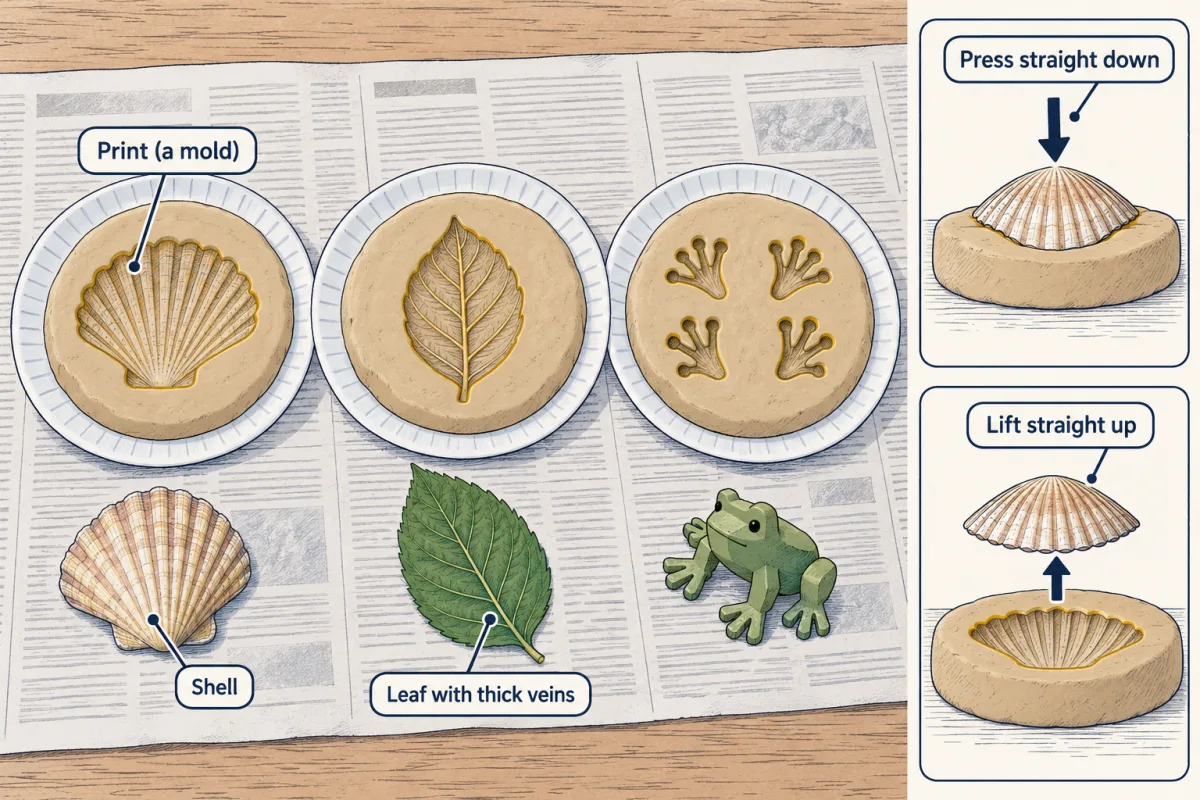
With a class, give each table its own set of objects and let groups trade prints and guess.
Questions to ask while you do it
Ask your child to guess first, then check.
- “What do you think made this print? How can you tell?”
- “I wonder where this animal lived. What clues does the print give?”
- “What do you think the cast will look like when we peel off the clay?”
- “If you found a shell print on top of a mountain, what would you think?”
- “What parts of an animal would make a good fossil? What parts would rot away?”
What children often think
-
A child might say “Fossils are just old bones.”
You could try Hold up a leaf print and a shell print. Ask, "Are these bones?" Fossils can be shells, leaves, teeth, footprints, burrows or bones. Any print or remains saved in rock counts.
-
A child might say “All fossils are dinosaurs.”
You could try Ask which prints on the table came from dinosaurs. Most fossils are small sea animals with shells. Virginia’s state fossil is a scallop, not a dinosaur.
-
A child might say “A fossil is the real shell, just old.”
You could try Sometimes much of the shell is still there, as with many of Virginia’s fossil scallops. Often minerals have slowly replaced it, or only the print is left, like your clay mold. Ask, "Is our mold the real shell?"
-
A child might say “Fossils only take a few years to make.”
You could try Ask, "Has any mud in our yard turned to rock?" Turning mud into rock takes a very long time. Virginia’s fossil scallops are about 4 million years old.
Why it works
Most living things never become fossils. They rot, get eaten or break apart. A fossil is more likely when hard parts, like shells, bones or teeth, are buried quickly in mud or sand. Over a very long time, the layers above press the mud into rock. Water moving through the rock can dissolve the shell and leave a hollow mold. If minerals or sediment later fill that hollow, they form a natural cast.
Fossils show what lived in a place and what the place was like. Virginia’s state fossil scallop lived about 4.5 to 4.3 million years ago in a shallow sea over what is now the Coastal Plain. A drawing of a Virginia fossil scallop, printed in England in 1687, is thought to be the first published picture of a fossil from North America. The scallop is now extinct, which means none are alive anywhere. Fossils of extinct animals are part of the evidence that living things have changed over long spans of time.
Easier and harder
Ages 5 to 7
Skip the plaster. Make three or four prints and play “guess what made it.” Use objects your child knows well: a shell, a leaf, a pinecone, their own fingertip. Then sort the prints into “lived in water” and “lived on land.”
Ages 8 to 10
Make a fossil dig. Bury your hardened casts and some shells and leaf prints in layers in a tub of play sand: sea things at the bottom, land things on top. Your child digs with a paintbrush and spoon and keeps a tally of what was in each layer. Ask what the layers say about how the place changed. Brush gently, keep the sand lightly damp, and keep it below face height.
If it doesn’t go as planned
If prints are blurry, the clay may be too soft or the object slid. Let warm clay cool for a few minutes, and press straight down. If the plaster cracks or stays soft, it may have had too much water, or the powder may be old or damp, so follow the package amounts and use fresh powder next time. If the cast sticks, peel the clay away slowly and pick out the last bits with a wooden stick.
Observation sheet
Observation sheet
Fossil detective
NameDate
Look at each print. Guess what made it and where it lived.
| Print number | What made it? | Water or land? | Clue I used |
|---|---|---|---|
A shell print on dry land tells me:
biochemistrypedia.com · Biology Together
Finish line
Test yourself
4 questions
Practice and MCAT-style, with explained answers.
Next · Lesson 21
Who Eats Whom?
Why does a hawk need grass? Picture cards and a ball of yarn show how the food in a meadow and in the Bay connects.
Continue →