Biology Together · Unit 1: Alive and growing
Alive or Not?
A sorting game with things from around the house and yard, then a short walk outside. Your child makes a first guess about what is alive, builds a checklist of what living things do, and tests every object against it, including tricky ones like a seed, a car and a dead leaf.
Watch first Set Up: Alive or Not? · 1:06
Read the transcript of “Set Up: Alive or Not?”
Film transcript: Set Up: Alive or Not?
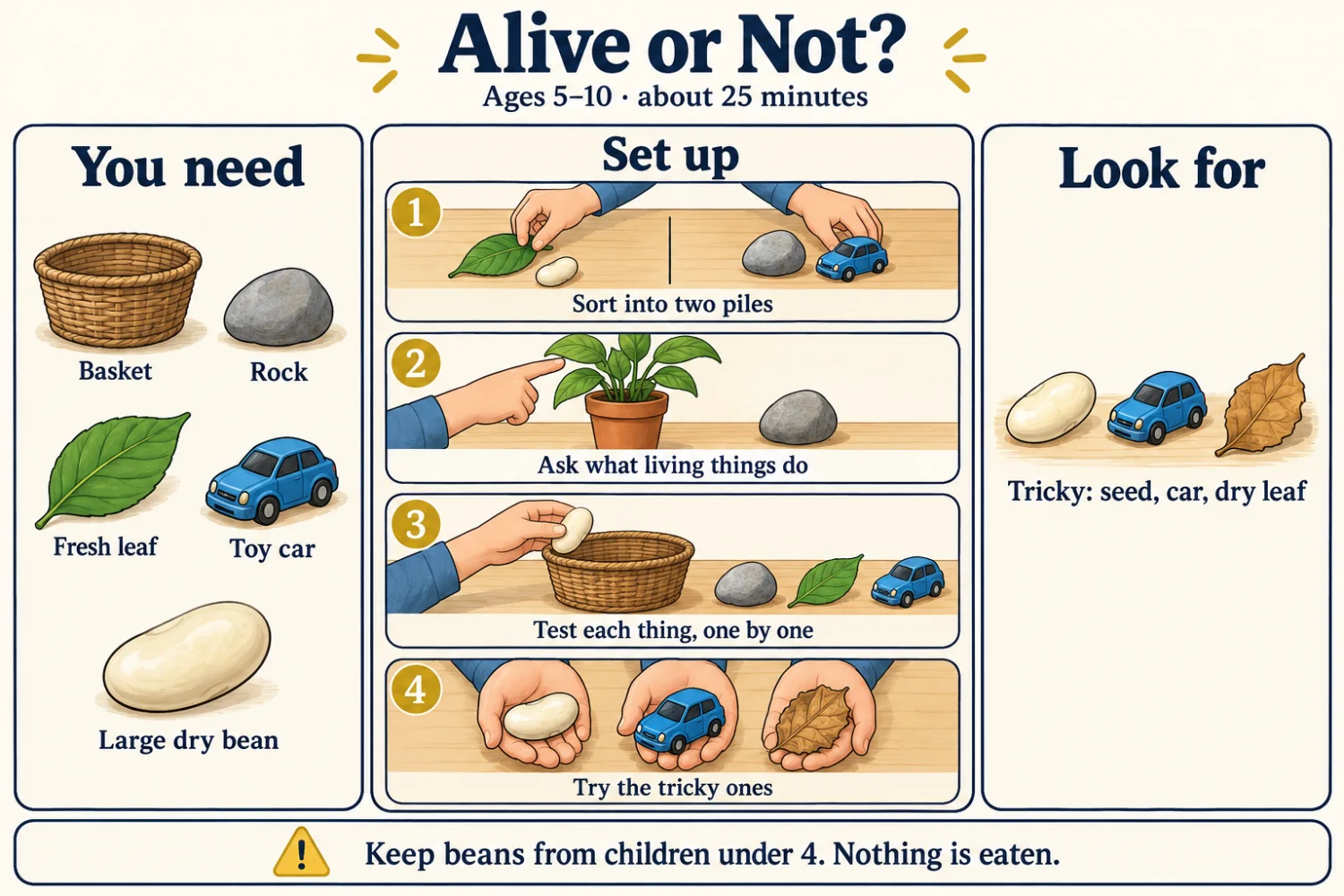
Is it alive? One clue is never enough. Living things grow, need water, air and food, react to changes, and make more of their kind. A toy car moves, but it is not alive. Fill a basket with ten to twelve things from around the house. Mix a rock, a toy car, a dry leaf, an apple, and a houseplant. Add one or two large dry beans. Ask your child to sort everything into two piles, alive and not alive. Ask how they decided, and write down their rule. Do not correct it yet. Next, build a checklist from a pet or plant, and test each object. Spend the most time on the seed, the toy car, and the dry leaf. A resting seed is alive, though it shows few clues today, and a toy car is not.
It is fine to leave a question open. Stay with your child. Keep beans and other small objects away from children under four. Nothing from the basket is for eating.
Before you start
- Hands-on time
- About 25 minutes, plus an optional 10-minute walk outside
- Where
- Indoors or outdoors
- Ages
- 5 to 10, with an easier and a harder version below
- Grown-up
- Stay close the whole time, and closer outdoors. Keep small objects away from younger brothers and sisters.
What you need
- A basket, box or bag for collecting
- 10 to 12 things from around the house: a rock, a fresh leaf from a plant you know (not poison ivy), a dry leaf, a stick or pinecone, an apple, a smooth shell, a toy car, a metal spoon, a wind-up toy or a battery toy whose battery cover is closed with a screw, a houseplant in its pot
- 1 or 2 large dry beans from the kitchen, such as a lima bean (not packet seeds from a garden shop, which may be treated with chemicals)
- A pet, a houseplant or a person to look at (the child counts)
- Paper and a pencil, or the printed observation sheet below
Virginia science standards SOL K.6 aSOL K.6 bSOL K.7 aSOL 2.5 a
The big idea
Here is a sorting game for a hard question: what makes something alive?
Living things share a set of features. They grow. They need water, air and food. Animals eat food, and plants use light to make their own. They respond to what happens around them, like a plant bending toward a window or a cat running from a loud noise. They make more of their own kind, though not every single one does. A kitten or a child is alive long before it can have young. No single feature settles it. A toy car moves, and a fire grows, but neither does all of these things.
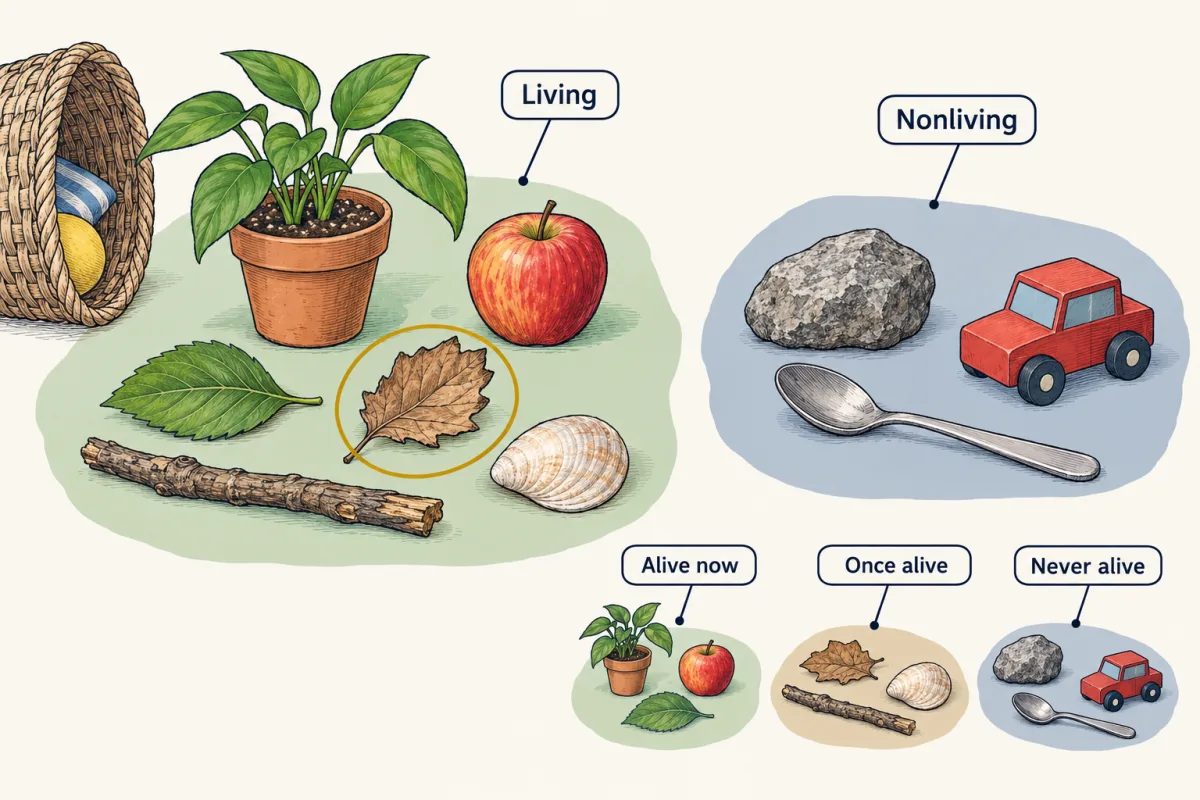
Virginia’s kindergarten standard uses two groups. Living means anything that is alive now or was ever alive, so a dry leaf or a log counts. Nonliving means anything that never was, like a rock or a metal spoon. Older children can split “living” into “alive now” and “once alive.”
What to do
- Gather. Put 10 to 12 things in a basket, plus the dry beans. Mix things that are alive now (a houseplant, an apple, a fresh leaf), things that were once alive or were part of something alive (a dry leaf, a stick, a shell), and things that never were (a rock, a metal spoon, a toy car).
- First guess. Ask your child to sort everything into two piles, “alive” and “not alive,” with no help from you. Then ask, “How did you decide?” Write down their rule in their words. Don’t correct it yet.
- Build a checklist. Look at something everyone agrees is alive, such as your child, a pet or a houseplant. Ask, “What does it do that the rock doesn’t?” Help them land on four questions: Does it grow? Does it need water, air and food? (A plant makes its own food from light.) Do things like it make more of their own kind? (Your child is alive even though they cannot have babies yet. This question is about the kind of living thing, not each one.) Does it react when things change around it?
- Test each object. Go through the basket one thing at a time and check it against the list. Use the questions as clues: some living things, like a resting seed, will not show every clue today. Let your child move things between piles as they go.
- Try the tricky ones. Spend the most time on the seed, the toy car and the dry leaf. A seed doesn’t seem to do anything. Ask, “What would happen if we planted it?” The car moves. Ask, “Does it grow? Can it make a baby car?” The dry leaf isn’t growing now. Ask, “Was it ever part of something alive?” The apple and the fresh leaf are tricky too. Each is a part of a plant, not a whole plant. Its cells stay alive for a while after it is picked, then slowly die. Either way, it goes in Virginia’s living group.
- Final sort. Use Virginia’s two groups: living (alive now or ever alive) and nonliving (never alive). For ages 8 to 10, use three piles instead: alive now, once alive, never alive.
- Walk outside (optional). With an adult, spend 10 minutes in your own yard or on a park path finding three living things and three nonliving things. Stay on the path or short grass, away from tall grass, roads and water. Look, don’t pick. If you want to bring home a fallen leaf or stick, let the adult pick it up, and only where no poison ivy grows nearby. Poison ivy can still cause a rash when its leaves are dry or dead, and in winter its bare vines look like hairy ropes on trees.
Questions to ask while you do it
Ask your child to guess first, then check.
- “I wonder if this seed is alive. What could we do to find out?”
- “The car moves. Does it grow? Does it eat?”
- “Does this rock need anything to keep going? What happens to a plant with no water?”
- “Was this stick ever alive? How can you tell?”
- “What do you need to stay alive? Does a dog need the same things? Does a tree?”
- “Can you find something that breaks our rule?”
What children often think
-
A child might say “It moves, so it’s alive.”
You could try Hold up the toy car and ask, "Does it grow? Does it need food? Can it have babies?" Moving is a clue, but living things do more than move.
-
A child might say “Plants aren’t alive. They don’t do anything.”
You could try Ask how the plant got so big, and what happens if nobody waters it. Plants grow, need water and light, and many make seeds. They react too, just slowly, like bending toward a window over a few days.
-
A child might say “A seed is just a little rock.”
You could try Don’t settle it with words. Put a seed in a damp paper towel and see what happens over a few days. That test is the next activity, Wake Up a Seed.
-
A child might say “Fire is alive. It eats wood and grows.”
You could try That is a good argument, so take it seriously. Ask, "Does fire have babies that look like it? Is it made of the same stuff as a leaf or a dog?" Fire meets some of the checklist, but not all of it.
-
A child might say “The dry leaf is not alive, so it goes with the rocks.”
You could try Ask where the leaf came from. In Virginia’s kindergarten groups, something that was once alive counts as living. Older children can give it its own pile, "once alive."
Why it works
Scientists have no one-line test for life either. They look at features together: being made of cells, taking in energy from food or light, growing, responding to surroundings, and reproducing. Your child’s checklist is a simple version of that list.
The seed is the best puzzle. A dry seed is alive but resting. It uses very little of its stored food, and many seeds can wait months or years until water and warmth let them sprout. The toy car and the fire each seem alive in one or two ways, such as moving or growing, which is why the full list matters more than any single clue.
Easier and harder
Ages 5 to 7
Use only two piles and six to eight objects, with clear examples (a plant, an apple, a rock, a metal spoon) and one puzzle (a seed). Ask just three questions: Does it grow? Does it eat or drink? Can things like it have babies? Your child can draw instead of write.
Ages 8 to 10
Use three piles (alive now, once alive, never alive) and add harder items: a cotton sock, a sheet of paper, a wooden spoon, an unlit beeswax candle (never light anything for this activity). Each was made from something, so ask what. Paper and cotton come from plant parts that were once alive. Beeswax, like a shell, was made by a living animal but was never made of living cells, so your child may decide it needs its own pile, “made by a living thing.” Have your child write a rule, then hunt for an object that breaks it and change the rule to fit.
If it doesn’t go as planned
If your child gets stuck, go back to themselves: “Do you grow? Do you eat? Did you start as a baby?” Then compare an object to that. If they want a yes-or-no answer for fire or the car, it’s fine to leave it open and say, “Scientists use the whole list. Let’s check it again.” Leaving a question open is part of science.
Observation sheet
Observation sheet
Alive or not?
NameDate
Check each thing. Write your answer in each box.
| Thing | Does it grow? | Does it need water and food (or light)? | Do things like it make more of their kind? | Alive now, once alive, or never alive? |
|---|---|---|---|---|
My rule for living things is:
biochemistrypedia.com · Biology Together
Finish line
Test yourself
4 questions
Practice and MCAT-style, with explained answers.
Next · Lesson 2
Wake Up a Seed
Is a dry bean alive, or is it just a little stone? Two bags and a damp paper towel let a child find out.
Continue →