Biology Together · Unit 6: Food chains, soil and decomposers
Soil Shake
You and your child shake garden soil in a jar of water, then watch it settle over a day. Your child sees that soil is not one thing: it is bits of rock of different sizes, dark bits of old plants, air and water, and the bits sort themselves into layers by size.
Watch first Set Up: Soil Shake · 0:45
Read the transcript of “Set Up: Soil Shake”
Film transcript: Set Up: Soil Shake
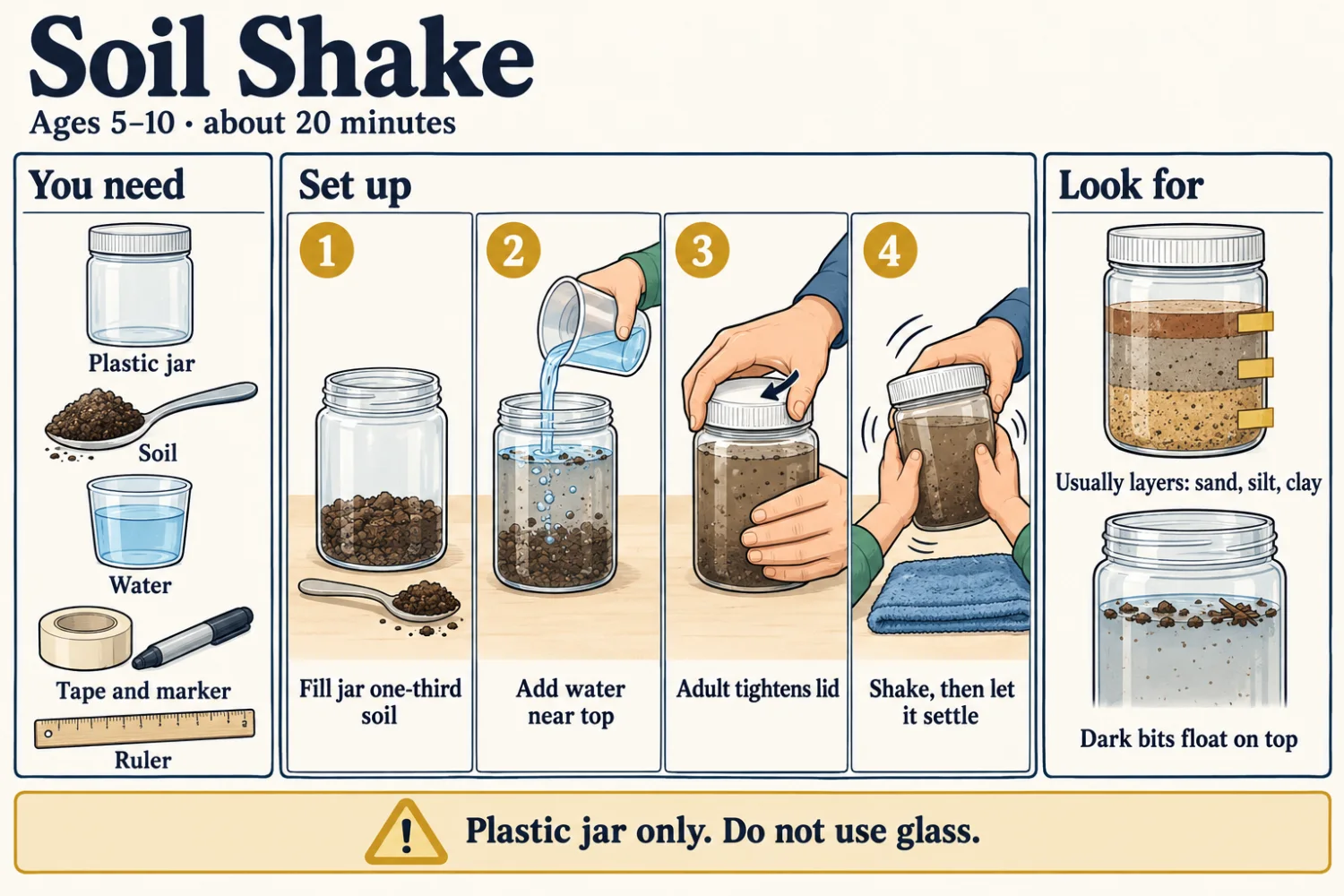
You need a clear plastic jar with a tight lid, about one to one and a half cups of bagged topsoil or garden soil, water, and masking tape. Fill the jar about one third full of soil. Add water to about one inch from the top. You screw the lid on tight. Shake hard for two to three minutes, then set it down. Check at one minute, one hour, and one to two days. Sand usually settles first, then silt, then clay, and the water slowly clears. Stay with your child while the soil and water are out. Use a plastic jar, never glass, and you tighten the lid before anyone shakes.
Before you start
- Hands-on time
- About 20 minutes, plus quick looks after 1 hour and after 1 to 2 days
- Where
- Indoors or outdoors
- Ages
- 5 to 10, with an easier and a harder version below
- Grown-up
- Stay with your child while the soil and water are out. You tighten the lid and check it before any shaking.
What you need
- A clear plastic jar with a tight screw lid, about 1 quart or 1 liter (a clean plastic food jar works)
- About 1 to 1½ cups of bagged topsoil, or soil from a garden bed (see the safety notes)
- Water
- Masking tape and a marker
- A ruler
- A spoon, a sheet of white paper and an old towel or tray
- A magnifying glass (optional)
- Paper and a pencil, or the printed observation sheet below
Virginia science standards SOL 3.6 aSOL 3.6 bSOL 3.8 d
The big idea
To a child, soil is brown stuff that gets on shoes. Rub a pinch between two fingers, though, and it feels gritty, smooth or sticky. That is a clue that soil is a mix.
Soil is made of bits of rock in three sizes. Sand is the biggest and feels gritty. Silt is smaller and feels smooth, like flour. Clay is the smallest and feels sticky when wet. Soil also holds humus, the dark, broken-down remains of plants and animals, plus air and water.
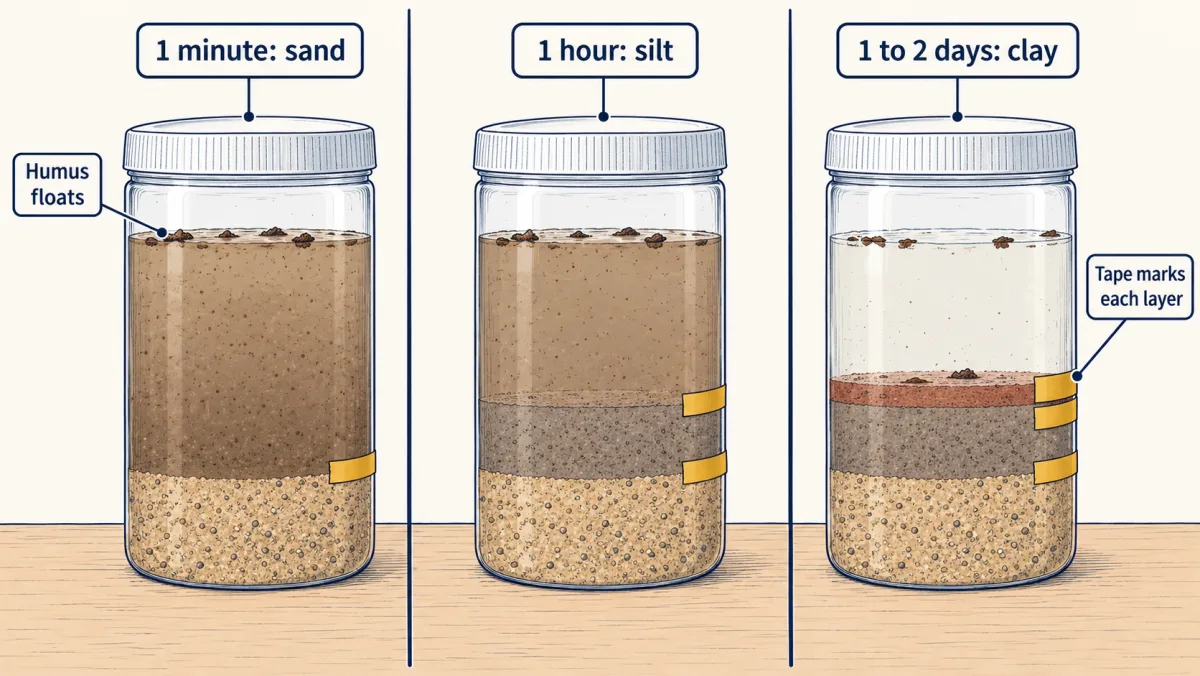
When you shake soil in water and let it sit, the bits settle by size. Big sand grains sink in about a minute. Silt takes an hour or more. Clay can take a day or longer. The jar shows the parts of soil as layers your child can see and measure.
Virginia’s grade 3 standard asks children to name these parts and explain why soil matters to living things. It also asks them to see soil as a resource worth protecting, since new soil takes a very long time to form.
What to do
- Look and feel. Spread a spoonful of soil on white paper. Let your child poke through it with a spoon or a magnifying glass. Ask them to find bits of rock, roots and old leaves. Have them rub a pinch between their fingers. Is it gritty, smooth or sticky?
- Predict. Ask, “If we shake soil in water and wait, what will it look like?” Have your child draw their guess.
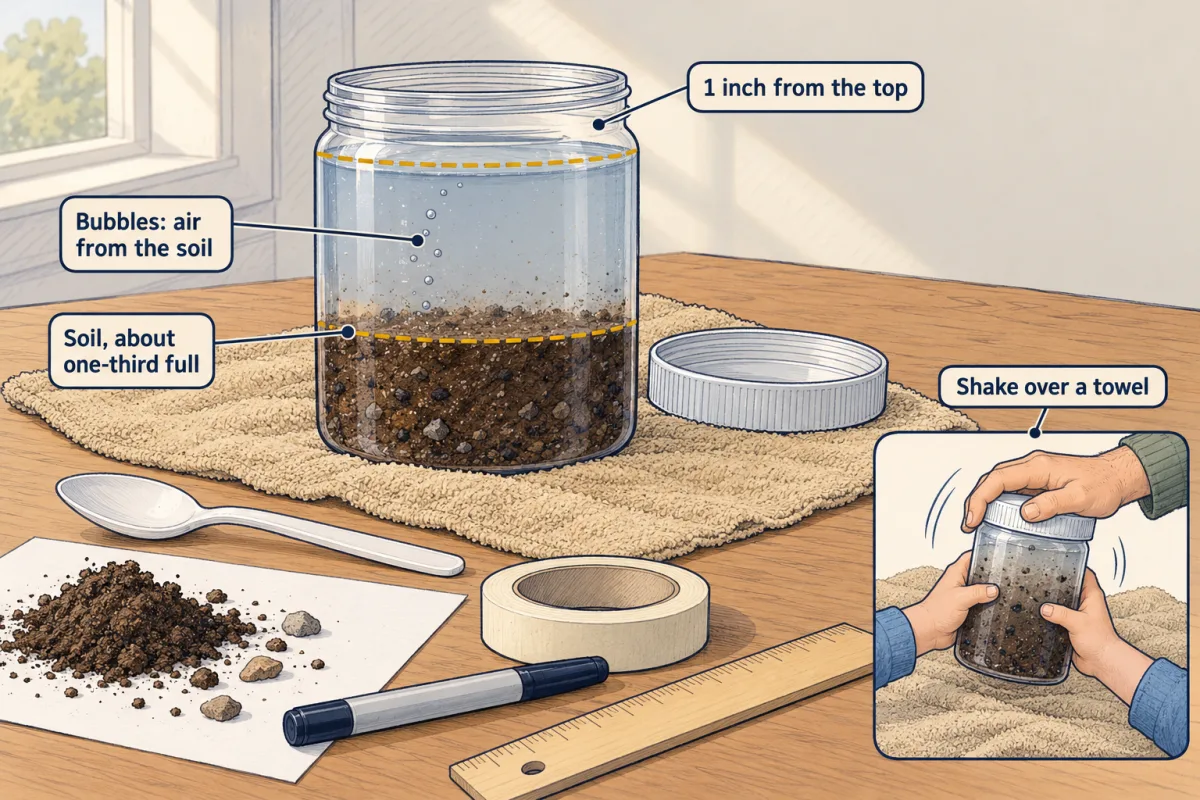
- Fill the jar. Pick out sticks and stones larger than a pea. Fill the jar about one-third full of soil. Slowly add water until it is about 1 inch (2 to 3 cm) from the top. Watch for bubbles rising as the water goes in. That is air that was in the spaces in the soil.
- Shake. You screw the lid on tight. Shake the jar hard for 2 to 3 minutes over a towel, taking turns. Then set it on a flat spot where nobody will bump it.
- Check at 1 minute. The bottom layer is sand. Your child puts a strip of tape on the side to mark its top and draws it. Bits floating on the water are usually bits of old plants on their way to becoming humus.
- Check after 1 hour. A layer of silt has usually formed on top of the sand. The water is still cloudy. Mark the new layer with tape. In a sandy soil the water may already be fairly clear.
- Check after 1 to 2 days. A clay layer usually forms on top of the silt as the water slowly clears. Clay-rich soils can stay cloudy for several days. Measure each layer in centimeters and compare. Do not move the jar while you wait.
Questions to ask while you do it
Ask your child to guess first, then check.
- “I wonder what soil is made of. What did you find on the paper?”
- “What do you think the bubbles are?”
- “Which bits do you think will sink first, the big ones or the tiny ones?”
- “What is floating on top? Where do you think it came from?”
- “Do you think soil from another spot would make the same layers?”
- “What do you think a plant gets from soil?”
What children often think
-
A child might say “Soil is just dirt. It’s all the same.”
You could try Ask your child to rub soil from two places between their fingers. Does one feel grittier? Then compare two jars. Soils differ in how much sand, silt, clay and humus they hold.
-
A child might say “The dark stuff on top is dirt.”
You could try Ask, "Does it look like rock, or like bits of leaves and roots?" Look with a magnifying glass. The dark floating bits are old plant parts that decomposers are breaking down into humus.
-
A child might say “Plants eat soil.”
You could try Ask, "If plants ate soil, would the pot get emptier as the plant grows?" It barely does. Plants make their own food from sunlight, air and water. Soil holds them up and gives water and nutrients.
-
A child might say “The soil melted in the water.”
You could try Wait and look again tomorrow. Ask, "Where did the brown go?" The bits did not melt. They were floating in the water and slowly sank to the bottom.
Why it works
Sand grains are big enough to see one by one. Silt bits are much smaller, about as fine as flour. Clay bits are too small to see even with a magnifying glass. Small particles sink much more slowly, because for their tiny weight, the water holds them back a lot. Clay bits also carry tiny electric charges that push them apart, so they can stay floating for days.
Bits of old plants float because they are light and hold air. Some sink later and lie on top of the clay.
The layers are a rough guide, not a lab test. Some clay clumps and settles with the silt, so the clay layer can look thinner than its real share. Lab soil tests use special methods to measure the amounts more closely. Your jar still shows what soil is made of, and why sandy, silty and clay soils feel and behave differently.
Easier and harder
Ages 5 to 7
Skip the measuring. Your child marks each layer with a strip of tape and draws the jar at 1 minute, 1 hour and 1 day. Ask one question each time: “What sank? Is the water still cloudy?” Talk about “big bits” and “tiny bits” instead of sand, silt and clay. Have your child crouch to look at the jar from the side, at eye level, without touching it.
Ages 8 to 10
Fill two jars the same way with soil from two different places, such as a garden bed and a spot under a tree. Measure each layer in centimeters and make a bar graph. Then plant three dry beans from the kitchen in cups of sand, garden soil and clay soil. Give each cup the same water and light, and measure growth for two weeks.
If it doesn’t go as planned
If you see only one thick layer, your soil may be mostly sand or mostly clay. Try soil from another spot. If the water is still muddy after three days, the soil may be high in clay, though very fine silt can do this too. Do not add detergent, salt or any other powder or cleaner to the jar. Powdered dishwasher detergent can burn eyes, skin and mouths, and salt makes clay clump and sink with the silt. Clay settles slowly on its own, so just wait longer.
Observation sheet
Observation sheet
Soil shake
NameDate
Draw the jar each time you look. Mark the layers.
| When I looked | What I see | Is the water cloudy? | Layer height (cm) |
|---|---|---|---|
| 1 minute | |||
| 1 hour | |||
| 1 day | |||
| 2 days |
Soil is made of:
biochemistrypedia.com · Biology Together
Finish line
Test yourself
4 questions
Practice and MCAT-style, with explained answers.
Next · Lesson 24
What Do Earthworms Like?
Do earthworms care where they crawl? A tray with two sides lets a child ask the worms.
Continue →