Biology Together · Unit 6: Food chains, soil and decomposers
Rot Detectives
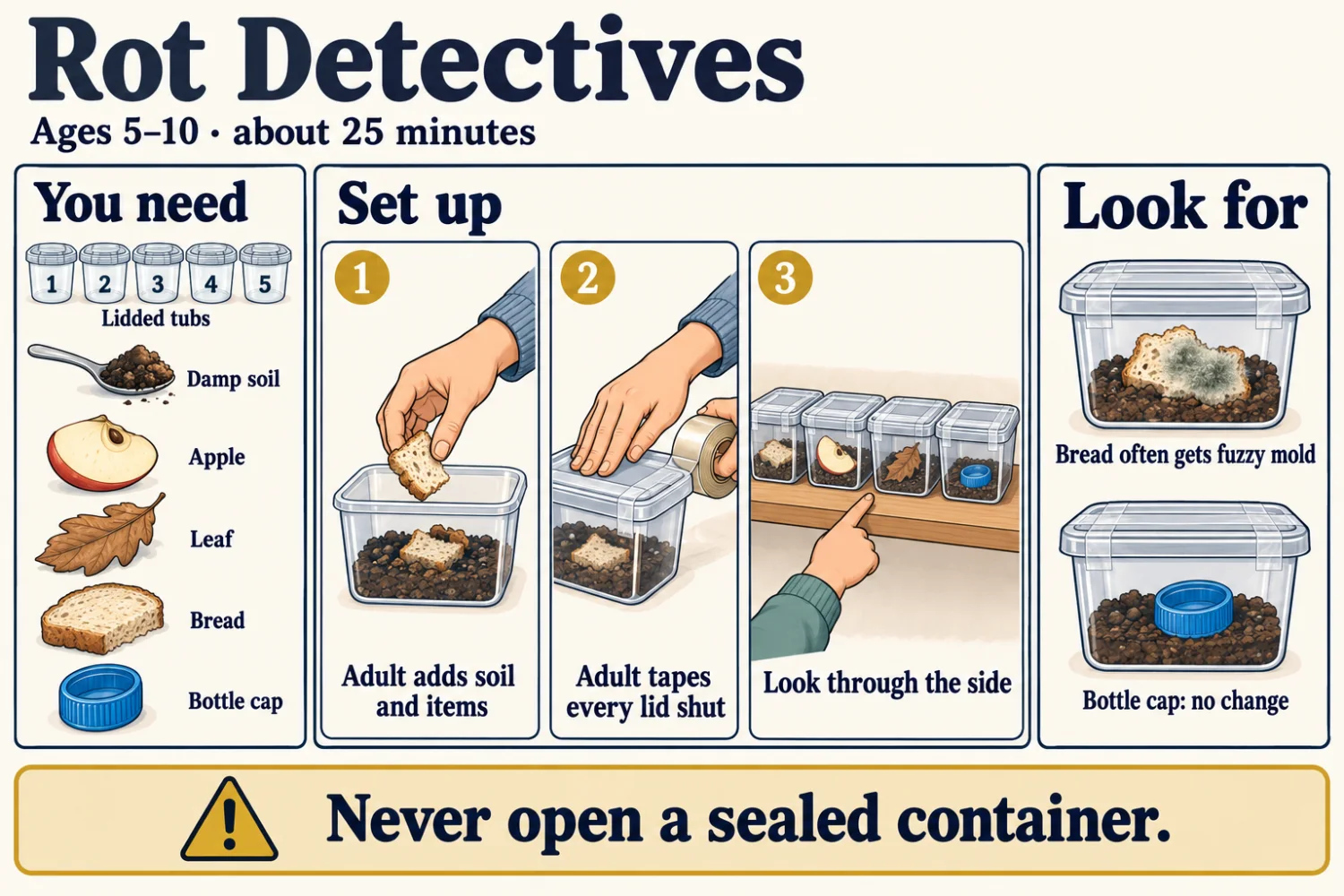
You seal an apple slice, a leaf, a piece of bread and a bottle cap in clear containers with a little damp soil, then your child checks them twice a week for three to four weeks. Your child sees that some things rot fast, some slowly, and some not at all, and finds out that tiny living things do the rotting.
Watch first Set Up: Rot Detectives · 0:45
Read the transcript of “Set Up: Rot Detectives”
Film transcript: Set Up: Rot Detectives
You need five clear containers with tight lids, packing tape, and damp soil. Add an apple slice, a dry leaf, bread, and a bottle cap. An adult does the setup. Put damp soil and one item in the first four. The fifth gets apple and no soil. Then close and tape each lid all the way around. Look twice a week for three to four weeks. Bread often grows fuzzy mold within one to two weeks. Both apples usually rot. An adult seals every container, and nobody opens one. Mold spores can set off allergies and asthma, so anyone with asthma, a mold allergy, or a weakened immune system should not handle them.
Before you start
- Hands-on time
- About 25 minutes, plus a 5-minute look twice a week for 3 to 4 weeks
- Where
- Indoors
- Ages
- 5 to 10, with an easier and a harder version below
- Grown-up
- You set up and seal every container, and you throw them away at the end. Children look and draw but never open the containers.
What you need
- 5 clear plastic containers with tight lids, such as clean deli or takeout tubs, or 5 zip-top sandwich bags
- Wide clear packing tape
- About 1 cup of damp soil from a garden bed or a bag of potting soil
- 1 apple slice, cut in half
- 1 dry fallen leaf
- 1 small piece of bread
- 1 plastic bottle cap or a small ball of foil
- A spoon and a permanent marker
- A magnifying glass (optional) and a ruler (for ages 8 to 10)
- Paper and a pencil, or the printed observation sheet below
Virginia science standards SOL 3.5 bSOL 4.3 bSOL K.10 cSOL K.10 d
The big idea
Every autumn, trees drop huge piles of leaves. A year later, many of them seem to be gone. Where did they go?
Living things called decomposers break down dead plants and animals. Most are far too small to see, like bacteria. Some, like mold, a kind of fungus, grow fuzzy patches you can see. Small animals such as earthworms and pill bugs help too, by eating dead leaves. As decomposers break things down, they return nutrients to the soil, and plants use them again.
In this activity, your child watches decomposers at work through the side of a sealed container. Some changes are fast, like fuzz on bread within a week. Some are slow, like a dry fallen leaf, which may barely change in a month. A bottle cap does not change at all, because plastic is not food for most decomposers.
Virginia’s kindergarten standard asks children to see that changes can be fast or slow and can be measured. Grades 3 and 4 add decomposers and their place in the food web.
What to do
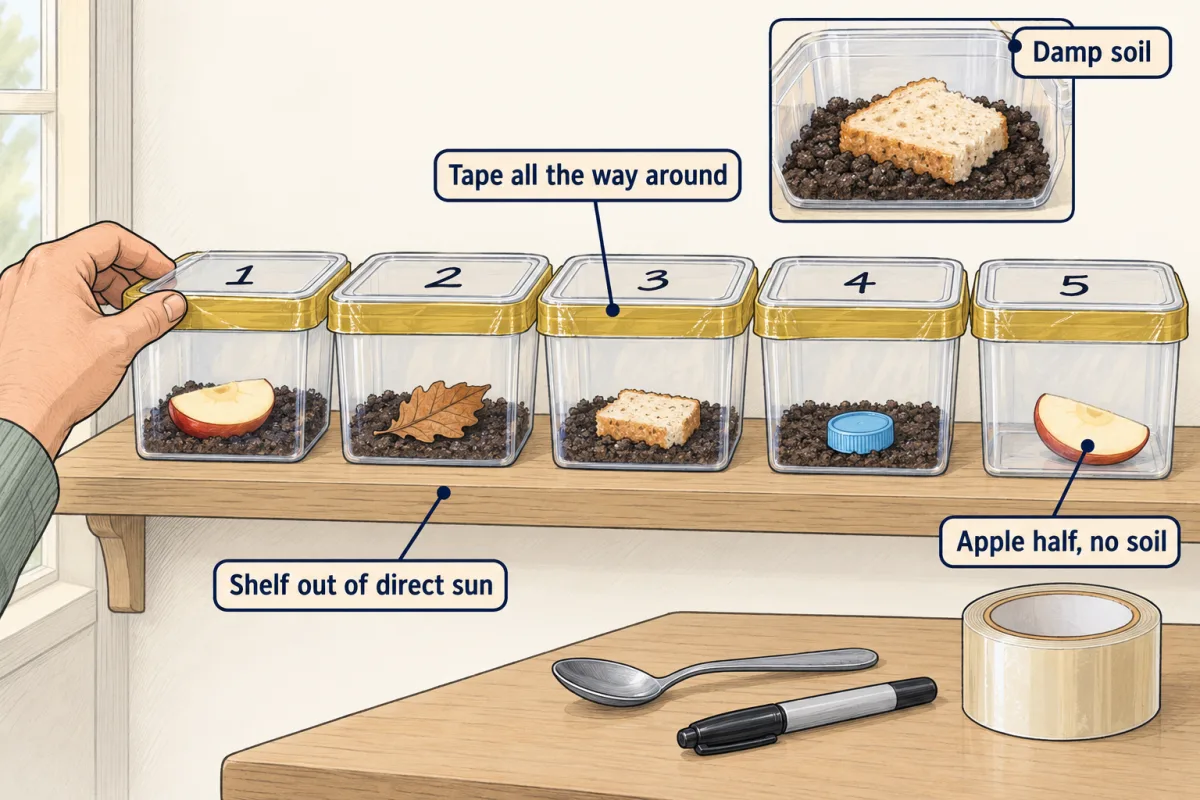
- Set up. Number five containers with the marker. Put 2 or 3 spoonfuls of damp soil in containers 1 to 4. The soil should feel like a wrung-out sponge. If it is dry, add a teaspoon of water. Pick out any worms or bugs and put them back outside.
- Add the things. You put half of the apple slice in container 1, the leaf in container 2, the bread in container 3, and the bottle cap or foil in container 4. Container 5 gets the other half of the apple slice and no soil. Close each lid and tape it all the way around, or seal each bag and tape the top.
- Predict before you look. Ask your child, “Which one will change first? Which one will never change?” Write their guesses on the sheet.
- Draw day one. Your child draws each container as it looks now. Older children can note color, size and shape.
- Check twice a week. Put the containers on a shelf out of direct sun. Look at them twice a week for 3 to 4 weeks. Look for fuzz, spots, color changes, liquid and shrinking. Bread often grows fuzzy mold within one to two weeks, sooner for plain bread without preservatives. Store bread with preservatives can take longer.
- Compare the apples. Ask, “Is the apple with soil changing in a different way than the apple without soil?” Both usually rot, since mold spores are in the air and on the fruit. The two may look different.
- Wrap up. After 3 or 4 weeks, line up the drawings from first to last. Ask, “What changed fast? What changed slowly? What did not change?” Then you bag the containers and throw them out, unopened.
Questions to ask while you do it
Ask your child to guess first, then check.
- “I wonder which one will get fuzzy first. Why do you think so?”
- “What do you think the fuzz is? Is it alive?”
- “What will happen to the bottle cap? Will it look different in a month?”
- “I wonder if the apple without soil will rot. What could make it rot with no soil?”
- “Where do you think the apple goes when it gets smaller?”
- “What would happen in the woods if nothing ever rotted?”
What children often think
-
A child might say “Things just disappear when they rot.”
You could try Ask, "Where could the apple have gone? The lid never opened." The apple is being eaten by tiny living things and turned into gases, water and bits that go back into the soil.
-
A child might say “Mold is dirt.”
You could try Ask, "Does dirt grow bigger each time we look?" Track one spot over a week. Mold is a living fungus. It grows from tiny spores that float in the air and land on food.
-
A child might say “Rotting is bad. We should stop it.”
You could try Ask what the woods would look like if no leaf or log ever rotted. Rotting in food is a problem for us, but outdoors it clears away dead things and feeds the soil.
-
A child might say “Everything rots, even plastic.”
You could try Let the bottle cap answer. After a month, ask, "Did it change?" Most decomposers cannot use plastic as food. It can last a very long time, which is why litter matters.
Why it works
Bacteria and molds feed by releasing chemicals that break food down outside their bodies, then taking in the small pieces. Mold spores are everywhere in air and soil, so a slice of apple soon carries some. In a warm, damp, sealed space they grow fast.
Soft, wet foods like bread and apple are easy to break down. A leaf is tougher. It has stiff fibers and waxy layers, so on a forest floor it can take months to years to break down fully. Outdoors, bacteria, fungi, earthworms and pill bugs all work on it together. A sealed jar holds mostly the tiny ones.
Plastic is made of very long chains too, but they are built in a way that most decomposers cannot break apart or use as food. It breaks into smaller pieces over many years, but it does not rot like food. Foil is a metal and does not rot either.
Easier and harder
Ages 5 to 7
Use three containers: bread, apple and bottle cap. Your child draws each one on day one and again at the end. Ask one question each visit: “Fast, slow or no change?” Let your child sort the final drawings into those three groups. Use the words “rot” and “tiny living things” before you introduce mold and decomposers.
Ages 8 to 10
Use all five containers. On each check, measure the widest patch of mold in centimeters through the side with a ruler and record it in a table. Plot the bread mold size on a line graph. Then plan a fair test with one thing changed, such as damp versus dry bread, keeping everything else the same.
If it doesn’t go as planned
If nothing grows after two weeks, the soil may be too dry or the room too cold. Set up new containers with damper soil in a warmer room. Keep them at normal room temperature, away from heaters, radiators and sunny windows. Store bread may take three weeks to show mold. If one container leaks or the tape comes loose, bag it and throw it away. Do not reseal it.
Observation sheet
Observation sheet
Rot detectives
NameDate
Look through the side. Never open the containers. Draw or write what you see.
| Date | Apple with soil | Apple, no soil | Leaf | Bread | Bottle cap |
|---|---|---|---|---|---|
What changed fast?
What changed slowly or not at all?
biochemistrypedia.com · Biology Together
Finish line
Test yourself
4 questions
Practice and MCAT-style, with explained answers.
Next · Lesson 23
Soil Shake
Is dirt just dirt? Shake some soil in a jar of water and watch it sort itself into layers.
Continue →