Biology Together · Unit 7: Seasons and living things
Sleep, Travel or Stay?
A sorting game with picture cards of Virginia animals, then a 15-minute window watch. Your child sorts animals into three winter plans (travel, rest deeply, or stay and change) and finds out that winter is hard mostly because food runs short. Repeat the window watch in another season and compare who is around.
Watch first Set Up: Sleep, Travel or Stay? · 0:47
Read the transcript of “Set Up: Sleep, Travel or Stay?”
Film transcript: Set Up: Sleep, Travel or Stay?
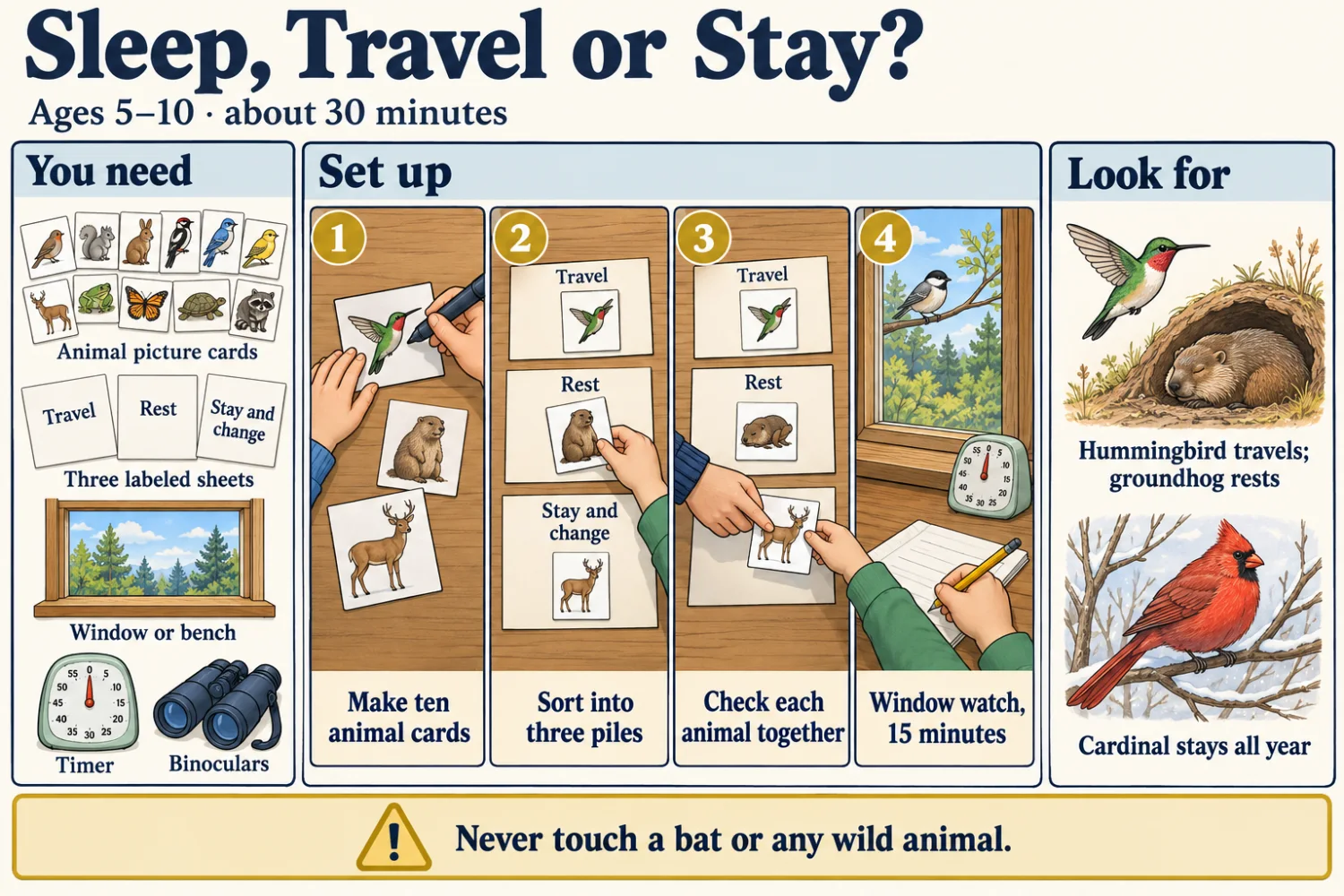
Draw or print 10 animal cards, like a hummingbird, groundhog and deer. Lay out three sheets: Travel, Rest, and Stay and change. Find a window with a view of trees or the sky. Ask your child to sort the cards with no help, and to say how they decided. Then check each animal together, and move cards as they learn. Then sit at the window for 15 minutes and count the birds you see. The count depends on the season. An empty yard is a result too. Stay with your child for the whole activity. Nobody touches a wild animal, alive or dead. Never touch a bat, even one that seems asleep or hurt.
Before you start
- Hands-on time
- About 30 minutes, plus a 15-minute window watch, repeated in another season
- Where
- Indoors or outdoors
- Ages
- 5 to 10, with an easier and a harder version below
- Grown-up
- Stay with your child for the whole activity, and stay beside them for any outdoor watch. Nobody touches wild animals, and a bird feeder, if you use one, is an adult job.
What you need
- 10 picture cards of animals, drawn by hand, printed, or cut from old magazines (list in step 1)
- Three sheets of paper labeled Travel, Rest and Stay and change
- A window with a view of trees, a yard or the sky, or a bench outside
- A clock or timer
- Binoculars (optional)
- A bird feeder (optional; only in winter, see the safety notes)
- Paper and a pencil, or the printed observation sheet below
Virginia science standards SOL 2.7 aSOL 1.7 cSOL 2.5 c
The big idea
Your child has probably noticed that some birds disappear in winter and others stay at the feeder. Winter is hard for animals mainly because food runs short, and staying warm uses energy. Each kind of animal has its own way of getting through.
Some animals travel to places with more food and come back later. This is migration. Some rest deeply in a sheltered spot and live on stored fat. In hibernation, an animal’s body cools and its heartbeat slows far below normal sleep. Turtles and frogs go dormant: their bodies cool with the weather and they barely move until spring. Other animals stay active and change: thicker coats, food stored in fall, or a new diet.
Grade 1 children only need the plain words “travel,” “rest” and “stay and change.” Grade 2 adds the terms migrate, hibernate and dormancy, and asks how food supply changes behavior through the year.
What to do
- Make the cards. Draw, print or cut out 10 animals: ruby-throated hummingbird, monarch butterfly, tundra swan, groundhog, bat, eastern box turtle, wood frog, white-tailed deer, gray squirrel and northern cardinal. Write the name on each card.
- First guess. Lay out the three sheets: Travel, Rest and Stay and change. Ask your child to sort the cards with no help. Ask, “How did you decide?” Write down their reasons. Don’t correct anything yet.
- Check each animal. Go through the cards together, using the list below. Let your child move cards as they learn. Ask before each one, “Where do you think this one goes?”
- Travel. Hummingbirds leave Virginia in late summer and fall and spend winter from Mexico to Central America. Monarchs fly to mountain forests in central Mexico. Tundra swans come the other way: they nest in the Arctic and fly thousands of miles south to spend winter on Virginia’s rivers and bays.
- Rest. Groundhogs hibernate in burrows. Many Virginia bats hibernate in caves, mines or buildings, though some kinds fly south instead. Box turtles dig into soil. Wood frogs, found mostly in northern and western Virginia, lie under dead leaves and can partly freeze.
- Stay and change. Deer stay and grow a grayish-brown winter coat. Gray squirrels bury nuts in fall and dig them up in winter. Cardinals stay all year and fluff their feathers in the cold.
- Window watch. Sit at a window or outside for 15 minutes. Before you start, ask, “How many kinds of birds do you think we’ll see?” Count how many birds of each kind you see and note what they are doing. The count depends on the season, the time of day and what grows nearby. An empty yard is a result too.
- Watch again later. Repeat the watch in another season, at the same time of day. Compare the two sheets. Which birds were there both times? Which ones came or went?
Questions to ask while you do it
Ask your child to guess first, then check.
- “I wonder what a hummingbird would eat here in January. What do you think?”
- “Why do you think the cardinal can stay when the hummingbird leaves?”
- “What do you think a groundhog eats all winter?”
- “If Virginia is ‘south’ for tundra swans, where do you think their summer home is?”
- “Which birds do you think we’ll see this time that we didn’t see last time?”
- “What do you think would happen to a squirrel that forgot where it buried its nuts?”
What children often think
-
A child might say “Birds fly south because they’re cold.”
You could try Ask, "What do hummingbirds eat? Are there flowers in January?" Cold matters, but food is a big reason. Many birds that leave could handle the cold. Their nectar and insects run out, so they go where food is.
-
A child might say “All birds fly south for winter.”
You could try Check the window watch in winter. Cardinals, crows and many other birds stay all year. Tundra swans even fly south to Virginia, so for them Virginia is the warm winter home.
-
A child might say “All animals hibernate in winter.”
You could try Ask, "Have you seen a squirrel in winter? A deer?" Many animals stay active. Bears are a tricky case. Virginia’s black bears spend much of winter in dens without eating, but they wake easily and may walk out on warm days.
-
A child might say “Hibernating animals are just asleep.”
You could try Ask, "When you sleep, do you get cold? Does your heart nearly stop?" A hibernating groundhog can cool to a few degrees above freezing, and its heart slows to just a few beats a minute. It is much deeper than sleep.
Why it works
Winter cuts the food supply for many animals. Insects, nectar and fresh leaves disappear. At the same time, staying warm burns more energy. Each strategy solves that problem a different way.
Migrating animals move to where food is. Changing day length and an inner yearly clock tell many birds when to fatten up and leave, so they go before food runs out. Weather and food can shift the exact day. Monarchs that fly south in fall are a special late-summer generation that lives for months; in spring they start back north and lay eggs, and their descendants finish the trip over several generations.
True hibernators, like groundhogs and many bats, lower their body temperature and heart rate and live on stored fat. Groundhogs still warm up and wake briefly from time to time during the winter. Cold-blooded animals, such as box turtles and wood frogs, cool to the temperature around them and become dormant. Wood frogs survive partial freezing because their liver releases sugar into the blood, which protects their cells from ice.
Animals that stay rely on thick coats, fat, stored food and switching to foods like seeds and bark.
Easier and harder
Ages 5 to 7
Use six cards: hummingbird, monarch, groundhog, box turtle, squirrel and deer. Use the plain words “travel,” “rest” and “stay.” Let your child act each one out: flap away, curl up, or scurry and dig. For the window watch, draw the birds you see and make a tally mark each time one lands.
Ages 8 to 10
Use all 10 cards and add the words migrate, hibernate and dormant. Add a fourth pile, “comes here for winter,” for tundra swans. Make a bar graph of how many birds of each kind you saw. Repeat the watch in winter and in spring at the same time of day, then compare the graphs and explain one difference using food.
If it doesn’t go as planned
If no birds come, try early morning or the hour before sunset, when many birds feed. Sit still and quiet for the first five minutes. If your child can’t name a bird, have them describe it: size compared with a sparrow or a crow, main color, and what it was doing. A drawing is enough. If cards end up in “wrong” piles, ask what evidence would settle it rather than giving the answer.
Observation sheet
Observation sheet
Window watch
NameDate
Watch for 15 minutes. Write or draw each animal you see.
| Animal I saw | How many? | What was it doing? |
|---|---|---|
Date, time and weather:
What changed since my last watch?
biochemistrypedia.com · Biology Together
Finish line
Test yourself
4 questions
Practice and MCAT-style, with explained answers.
Next · Lesson 27
Hidden Leaf Colors
Where does the yellow in a fall leaf come from? A coffee filter shows that it was there all along.
Continue →